
The Thematic Space of Knowledge Engagement
A Weave-the-Strategy Perspective
by Oliver Ding
The recent Revisiting-and-Rebuilding of the Knowledge Strategy trilogy pulled my focus back toward several years of work on Knowledge Engagement — work I had deliberately stepped away from earlier this year, when I redirected my creative attention toward Cultural Innovation.
That creative journey unfolded through three projects: ACS (Anticipatory Cultural Sociology), SDP (Strategic Developmental Psychology), and GO Theory. In the first half of 2026, I produced several new book drafts and created a series of knowledge frameworks. Among them, the Gejunction framework led me back to the Knowledge Engagement work, especially the Knowledge Strategy series of book drafts I created in 2025.
The previous articles reflected on Knowledge Engagement from three aspects of Gejunction: RelationFields, Living Coordinates, and Weave-points. This article focuses on the fourth aspect: Thematic Spaces.
Thematic Space is not a single-level concept. It has different positions and functions in different theoretical levels. In Thematic Space Theory (TST), it is an abstract theoretical concept. In the HLS (History[Life[Self(Body)]]) framework, it is a theoretical concept within a collaborative whole. In Gejunction, it is an operational-level concept directly facing individual actors. The task of this article is to clarify these three levels and show how they constitute a nested toolkit.
To further understand the concept of Thematic Space from the Knowledge Strategy perspective, the Weave-the-Strategy model was adopted as an entry point, to review its achievements in 2025 and naturally extend to the Gejunction framework in 2026.
Part 1: The Three Levels of the Thematic Space Concept
TST Level: Thematic Space as an Independent Knowledge Enterprise (Abstract Theoretical Concept)
Thematic Space Theory (TST) is an independent knowledge enterprise. At this level, Thematic Space is a purely abstract theoretical concept.
HLS Level: Thematic Space as a Theoretical Concept within a Collaborative Whole (Singular)
1.3 Gejunction Level: Thematic Spaces as Operational Concepts (Plural)
Gejunction is a unit of synthesis within the GO Theory platform. It is GO Theory's most recent unit of synthesis. Its most direct contribution is to close a gap that neither ACS nor SDP v1.2 had addressed.
1.1 Thematic Space Theory (TST)
Thematic Space Theory is based on the Theme (Concept) ontology and the concept of Thematic Space. It was formed with three levels:
- The "Theme (Concept)" Ontology
- The "Map(Move)" Realism / The "THEORY(PRACTICE)" Realism
- The "Model (Map)" Hermeneutics
The concept of "Thematic Space" was born as an application of the Container (Containee) ontology: Theme (Concept). I distinguish between "Theme" and "Concept." While "Theme" emphasizes subjective experience and understanding, "Concept" pertains more to objective meaning and definition.
A Thematic Space refers to a cognitive space where a person's ideas, activities, and practices revolve around one particular theme. A theme can be an established theory, such as "Activity Theory," a general concept, such as "Platform" or "Life," or an idea somewhere in between, such as "Design Thinking" or "UX."
Thematic Space Theory not only considers the semantic relationship between themes but also the genetic relationship between them. While the semantic relationship is associated with the "themes" part, the genetic relationship relates to the "practice" part, meaning the real historical development of projects.
The "Map(Move)" Realism is a general form: any Move, any activity, admits a Map representing its own structure. "THEORY(PRACTICE)" — the "Theory, Practice, End, Means" model — is the specific shape this Realism took when I first built it to view Concept Development as a social practice. This specific shape is, precisely, the Knowledge Discovery Canvas (KDC), which I designed in early 2022. The "THEORY(PRACTICE)" Realism also emphasizes the dual trajectories behind Concept Development:
- The Developmental Trajectory of "PRACTICE"
- The Developmental Trajectory of "THEORY"
At the Developmental Trajectory of "PRACTICE," I see all acquired knowledge as heuristic tools for real-life activity in managing all kinds of projects. At the Developmental Trajectory of "THEORY," I see all real actions of running projects as data to test different theoretical approaches and knowledge frameworks.
The "Theme (Concept)" Ontology and the "THEORY(PRACTICE)" Realism lay the foundation for Hermeneutics. The "Theme (Concept)" Ontology defines four types of actors and four types of terms, forming a matrix of meaning. The "THEORY(PRACTICE)" Realism defines four thematic areas. If we combine these two, we see "Model (Map)" Hermeneutics — the interpretation of Realism itself:
- Map: Each thematic area provides a map for Concept Development.
- Model: Each actor can adopt various perspectives and knowledge frameworks for their Concept Development activities.
The "Theme — Map — Model" schema highlights the uniqueness of Thematic Space Theory.
This is why the architecture reaches further than the purpose it was first built for. "THEORY(PRACTICE)" was shaped specifically for Concept Development, but the underlying Realism it instances — any Move admits a Map of its own structure — is not. Any knowledge framework can be understood as a set of Thematic Spaces: a Map. Once a social reality is read against such a map, Social Moves become something that can be modeled directly on it, with the Mental Moves they correspond to observed in turn — and the relationship runs the other way as well, from Mental Moves back to the Social Moves they imply. This is the bridge TST actually provides, between Mental Moves and Social Moves, through whatever Map a given knowledge framework happens to supply. KDC is one such map, built specifically for Concept Development; Part 2 uses it that way. But the bridge itself, not any one map, is what this article puts to work.
Read this way, TST's own three levels already anticipate Part 1's Map, Moves, and Models: the Map (Move) Realism supplies the Map, representing whatever Moves it is built to describe; the Model (Map) Hermeneutics supplies the Model, interpreting the Moves. Map, Moves, and Models are not a framework borrowed from outside TST to organize this article — they are TST's own architecture, read at a different grain.
1.2 The History{Life[Self(Body)]} framework (HLS)
In the History{Life[Self(Body)]} framework (HLS), Thematic Space is a specific application of TST. It remains a theoretical concept, but it is no longer isolated. It now forms a collaborative whole with three other concepts. This is an attribute it does not have at the TST level.
The HLS Framework organizes social life into four regions, generated by crossing two pairs of systems: Cultural System and Historical System on one axis, Mental System and Behavioral System on the other. At the exact center of this 2×2 grid sits the Biological System — Self(Body) itself, the living organism from which everything else in the framework radiates outward.
Putting Rosen's Natural/Formal axis and Lui's inside/outside distinction together with HLS's own Cultural-Historical / Mental-Behavioral grid produces four regions, each defined as a specific intersection:
- Symbolic Universe = Cultural System ∩ Historical System (outside subjective experience). Adopted directly from Lui, who in turn drew the term from Berger and Luckmann's The Social Construction of Reality.
- Social Territory = Mental System ∩ Behavioral System (inside subjective experience). Also adopted from Lui.
- Thematic Space = Cultural System ∩ Mental System. Developed independently within this project beginning in January 2022.
- Social Landscape = Historical System ∩ Behavioral System. Also developed independently, emerging from the House of Project Engagement project in 2024, and refined into a full framework the same year.
Two of these four regions come from Lui's sociology; two are this project's own contribution, filling in the two intersections Lui's original framework left unnamed. The four together give HLS a complete account of the social world's structure — but a structure of four regions, not yet a single unit.
HLS's four regions are not static territories. They are continually generated and transformed by four mechanisms radiating outward from the center — Self(Body) — toward each region:
- Mental Moves toward Thematic Space
- Generative Narrative toward Symbolic Universe
- Social Moves toward Social Landscape
- Strategic Curation toward Social Territory
In HLS, Thematic Space uses the singular form. It is an abstract theoretical concept — a structural region of the social world. It corresponds to the mechanism of Mental Moves. On the horizontal axis, Thematic Space (left, Mental Moves) forms a symmetry with Social Landscape (right, Social Moves).
1.3 The Gejunction Framework (Gejunction)
Gejunction is a unit of synthesis within the GO Theory platform. It is GO Theory's most recent unit of synthesis. Its most direct contribution is to close a gap that neither ACS nor SDP v1.2 had addressed.
Gejunction is best understood as the latest link in a chain of theoretical enterprises, not as an invention manufactured for a single occasion. Its ontological foundation, the History[Life[Self(Body)]] Framework (HLS), was itself the product of an earlier theoretical enterprise — the Advanced Life Strategy project, begun in 2022.
In Gejunction, Thematic Spaces uses the plural form. It is a more specific operational-level concept, directly facing individual actors. Gejunction is the interface between HLS and the individual.
Gejunction presents a different face depending on which of HLS's four regions one approaches it from:
- As a Weave-point, it represents the symbolic aspect. Specifically, a Weave-point is an intersection point in the Weave diagram family — diagrams built by crossing a diachronic line against a synchronic line — used to develop the series of Weave diagrams and the GO Square model. Each weave-point marks a theme or concept, functioning as a concrete tool for expressing the Symbolic Universe; each theme or concept, in turn, links onward to a Thematic Space (corresponding mechanism: Generative Narrative).
- As a Living Coordinate, it represents the territorial aspect, within Social Territory (corresponding mechanism: Strategic Curation). A person's visible centers — a Knowledge Center, for instance — are only the surface of this aspect; what an outsider sees is typically some further surface product of that center, such as an email list. The center itself needs to be anchored in a Living Coordinate before it can be strategically curated at all — without that anchor, Strategic Curation has no site to work on.
- As a RelationField, it represents the relational aspect, within Social Landscape (corresponding mechanism: Social Moves). RelationField is a distinct model for environmental analysis in its own right, with a basic unit of Subject-Subject (Subject-Object) — the Object here can be a concrete thing or an abstract one.
- As a Thematic Space, it represents the thematic aspect (corresponding mechanism: Mental Moves). A Thematic Space is a cognitive container named by a single theme, but what it actually holds is a shifting collection of related thematic clues, concepts, and information — cognitive elements that change over time, combined into structures that vary from space to space rather than following one fixed pattern. Mental Moves itself carries two senses: the movement of mental elements between different thematic spaces, and the movement of a person's attention or focus between thematic spaces, and between mind and its elements. Once visualized, a Thematic Space becomes a map, which can in turn be used to represent an individual's activity progress — and it is through this visualized, activity-tracking use that Thematic Space also connects to Social Moves.
These four aspects are not four separate entities requiring their own decomposition. They are four analytical perspectives on one and the same social unit — the same underlying configuration, viewed from four different angles, none reducible to the others. Each aspect, in turn, draws on a distinct knowledge system with its own developmental history.
At a deeper level, these four aspects are the interface at which Self(Body) is situated within the social world — the surface where the psychological Self(Body) meets HLS's four regions. Self(Body), moving through the social world along two axes — the diachronic (time) and the synchronic (space) — is thereby constituted as what sociology calls an actor. Each axis brings a pair of critical elements into view.
Along the time axis, Flow becomes Focus, and this transition requires thematic focus — the capacity to hold a theme steady enough for a flow of experience to condense into something pursuable. Along the space axis, Center and Circle emerge. Every center has a boundary, and a boundary is what brings identity into being.
Flow, Focus, Center, Circle together constitute the FFCC model — the four basic ecological forms of World of Activity. These ecological forms are closely bound to Self(Body): they are what Self(Body)'s movement through time and space actually produces, and it is this production that the four aspects of Gejunction are built to capture.
In Gejunction, Thematic Spaces (plural) corresponds to Mental Moves. It is the thematic aspect of the four analytical perspectives. It is the operational-level concept that knowledge workers actually traverse and construct in their knowledge activities.
1.4 Attachance, Thematic Space, and Moves
The concept of Thematic Space was also developed with the concept of Attachance. From 2023 to 2025, I worked on a series of projects that aims to develop the the concept of Attachance into Attachance Theory, including three projects focused on "Moves":
- The Mental Moves project
- The Social Moves project
- The Strategic Moves project
From the Strategic Moves project, the concept of "Paths" emerged, leading to the identification of three types of Paths, each corresponding to a type of Move:
- Mental Paths
- Social Paths
- Strategic Paths
Mental Paths refer to the use of thematic maps to navigate cognitive moves. They represent how individuals explore, connect, and transition between ideas within a structured thematic space. Mental Paths help in organizing thoughts, identifying conceptual relationships, and facilitating deep cognitive engagement with knowledge frameworks.
In February 2025, I applied Thematic Space Theory to the field of strategy, resulting in a three-level hierarchical knowledge system. The Thematic Space Theory Toolkit (v1.0) functions as a specific theory to support the Ecological Strategic Cognition Framework (v2.3).
In the late 2025, the concept of Thematic Space was applied to the Creative Life Theory (v3.0) project, serving as a core concept of the "Mind" level of the project was framed by the Self-Life-Mind meta-framework. Together, it was assisted with other concepts such as Mental Moves, Mental Curation, Mapping the Curativity of Mind, Mental Models, etc.
In 2026, the concept of Thematic Space, Mental Moves, and the Map-Model-Moves schema were applied to a series of case studies, across several knowledge projects.
Part 2: The Weave-the-Strategy Toolkit
The concept of Thematic Space does not remain at the abstract level. It appears in a series of toolkits in the form of models and knowledge frameworks. These tools are the concrete ways in which the concept lands in practice.
In October 2025, I introduced the Weave-the-Strategy model, in which the concept of Thematic Space works with other concepts. Based on the mode, this part presents a three-level toolkit:
- level 1: the Weave-the-Strategy Model
- level 2: the Creative Workfield Model
- level 3: the Thematic Map Method
This thematic map method has been applied to various thematic maps I made in the past several years. These maps also led to a series of case studies of mental moves, social moves, and strategic moves.
2.1 Weave-the-Strategy: Understanding Strategic Moves
Weave-the-Strategy belongs to the Weave-the-Mind toolkit, and the Weave-the-Mind toolkit belongs to the Mental Platform sequence. But Weave-the-Strategy is a comprehensive model specifically for understanding Strategic Moves.
The core definition of Weave-the-Strategy: Strategy as a process of Slow Cognition, encompassing both mental moves across thematic spaces and social moves across social landscapes.
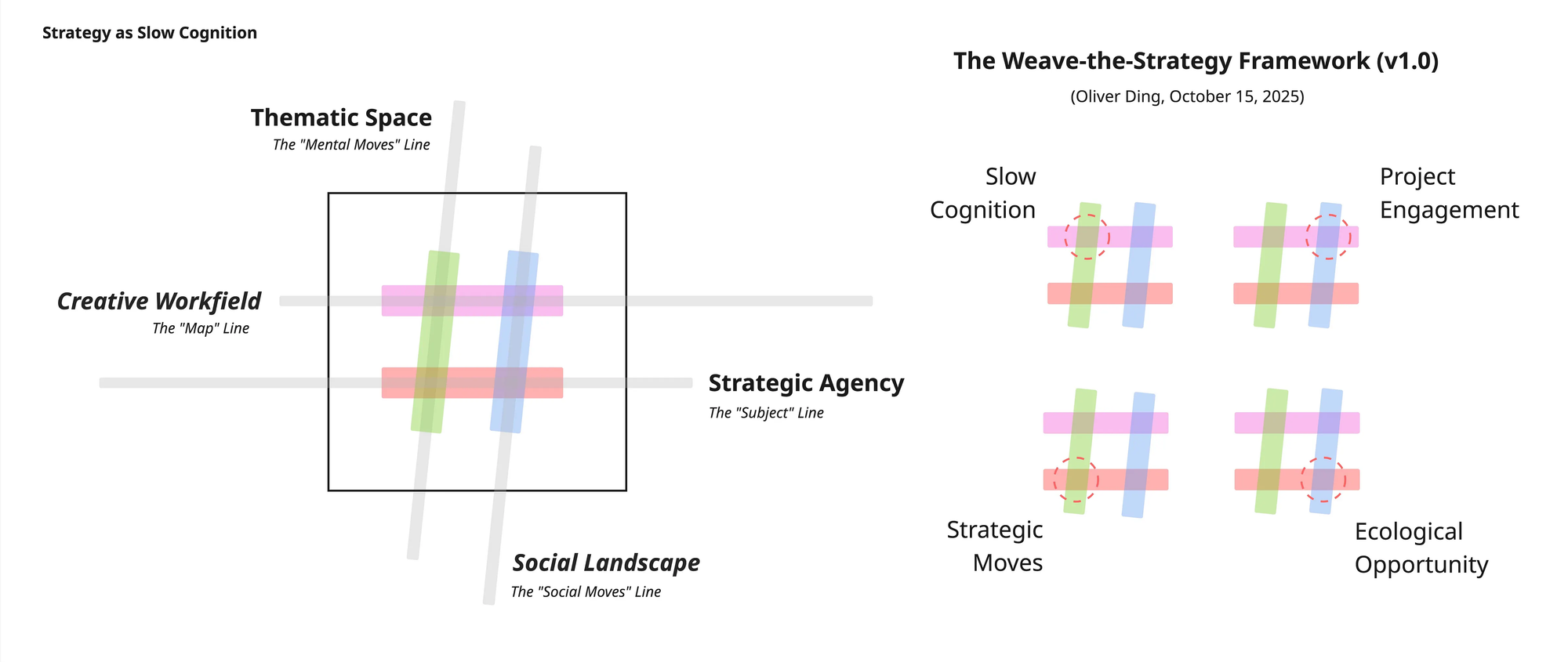
The model has four dimensions:
- Thematic Space → "Mental Moves" Line
- Social Landscape → "Social Moves" Line
- Strategic Agency → "Subject" Line
- Creative Workfield → "Map" Line
The model consists of four Weave-points, each representing a structural nexus where one synchrony dimension intersects with one diachrony dimension:
- Thematic Space (Mental Moves) × Creative Workfield → Slow Cognition
- Thematic Space (Mental Moves) × Strategic Agency → Strategic Moves
- Social Landscape (Social Moves) × Creative Workfield → Project Engagement
- Social Landscape (Social Moves) × Strategic Agency → Ecological Opportunity
Weave-the-Strategy places Thematic Space and Mental Moves at the core of the strategy model. Strategy is not a static plan. It is a process of Slow Cognition, formed gradually through Mental Moves across different Thematic Spaces.
The concept of "Strategic Agency" refers to nine aspects of strategic action, featured in my 2025 book draft, Strategy as Curation:
- Anticipating
- Performing
- Discovering
- Producing
- Modeling
- Unfolding
- Storytelling
- Curating
- Perceiving
These nine aspects are assigned to four groups, corresponding to the four entities of the Curativity of Mind:
- Action: Discovering, Producing, Unfolding
- Perception: Perceiving, Performing
- Conception: Modeling, Storytelling
- Curation: Anticipating, Curating
2.2 Creative Workfield: The House of Slow Cognition
The concept of "Creative Workfield" refers to a thematic map: The House of Slow Cognition.
Creative Workfield is the extension of the Map-Move-Model triad. In Weave-the-Strategy, Creative Workfield corresponds to the "Map" Line. It is a specific tool for Slow Cognition.
The Map-Move-Model triad is the core structure of Thematic Space Theory. Maps represent natural and social environments. Moves refer to actions. Paths are sequences of moves. Creative Workfield extends this triad into a dynamic work field where knowledge workers can systematically understand their strategic development.
Creative Workfield provides the cognitive terrain and model tools for Mental Moves and Strategic Moves. It transforms the abstract structure of Thematic Space Theory into an operable work field. Through Creative Workfield, the knowledge worker can see the landscape of their cognitive activities, track their moves, and use models to interpret what they see.
The House of Slow Cognition is a thematic map that organizes the Creative Workfield. It includes thematic rooms for Approaches, Models, Methods, Attachances, Meanings, Maps, Aspects, and other elements. These rooms represent the different dimensions of the knowledge worker's cognitive work field.
2.3 Thematic Map: Visualizing Knowledge Models as Maps
Once visualized, a Thematic Space becomes a map, which can in turn be used to represent an individual's activity progress — and it is through this visualized, activity-tracking use that Thematic Space also connects to Social Moves.
The core structure of Thematic Map is: Maps represent natural and social environments. Moves refer to actions. Paths are sequences of moves.
Thematic Space Theory employs thematic and knowledge maps to explore creative cognition, social cognition, and strategic cognition. In October 2025, I introduced the term "Creative Cartography" to describe this kind of practice. I also classified it into four purposes:
- Mapping Situational Themes
- Mapping Strategic Moves
- Mapping Social Landscapes
- Mapping Strategic Aspects
Four Houses serve as mapping tools:
- The House of Knowledge Discovery: For mapping the journey from themes to concepts—how we develop understanding of specific topics (Knowledge dimension).
- The House of Creative Life Curation: For mapping the curation of life experiences into meaningful narratives—how we organize our creative biography (Context dimension).
- The House of Project Engagement: For mapping engagement with developmental projects—how we navigate social landscapes through activities (Activity dimension).
- The House of Creative Life Strategy: For mapping strategic agency across nine aspects—how mental platforms guide enterprise development (Function dimension).
Together, these four Houses provide a comprehensive toolkit for mapping the Curativity of Mind across its four dimensions. Each House corresponds to one dimension, yet they all interconnect—just as the four dimensions themselves form an integrated whole.
The Thematic Map makes it possible for knowledge workers to "see" their cognitive terrain. It provides a visual reference for Mental Moves and strategic development.
Part 3: Case Analysis
This part uses three case sets, each corresponding to one of the three tools introduced in Part 2. The first case set demonstrates the Thematic Map. The second case set demonstrates Creative Workfield. The third case set demonstrates Weave-the-Strategy.
3.1 Case Set One: Mapping Cases (Demonstrating Thematic Map)
Case A: The House of Knowledge Discovery
The House of Knowledge Discovery is a thematic map inspired by the Knowledge Discovery Canvas and the Grasping the Concept Model. It was designed to trace a journey of transforming a theme into a concept.
This metaphor aligns with my notion of the contemporary knowledge ecosystem: the forest signifies public knowledge and the broader scientific community, while kingdoms and castles represent individual schools of thought and personal knowledge.
In the House of Knowledge Discovery, the area outside the large circle symbolizes objective public knowledge, while the inner space reflects subjective personal knowledge. This idea stems from the Knowledge Discovery Canvas.
The House of Knowledge Discovery functions as a thematic map, structured with thematic rooms that represent different aspects of knowledge discovery. It shows how a theme transforms into a concept within various social contexts. The map tracks the Mental Moves of the knowledge worker as they navigate from Enter to Exit, passing through different thematic zones.
Case B: The House of Ecological Practice
On October 2, 2024, I created a thematic map, Container and Containee: The House of Ecological Practice, to introduce a set of primary theoretical concepts and four models.
The House of Ecological Practice was created to showcase the core concepts and models of the Ecological Practice approach. Its spatial visual layout draws inspiration from the Unit of Analysis of Ecological Interaction, a method I developed in July 2020.
In this map, four major models are shown on the right side, while six key concepts are listed on the left. These six concepts include Genidentity and a set of ideas about potential action opportunities:
- Affordance
- Attachance
- Supportance
- Projectivity
- Curativity
The four models are: 1) the Basic model, 2) the Field model, 3) the Landscape model, and 4) the World of Activity model.
The House of Ecological Practice demonstrates how six core concepts and four models can be organized into a single thematic map. It shows the Mental Moves of the knowledge worker as they navigate between different concepts and models, building a coherent understanding of the Ecological Practice approach.
Case C: Mapping Strategic Moves #13: The Journey of Building Thematic Space Theory
The diagram represents the journey of constructing Thematic Space Theory, a prime example of a Strategic Path.
From 2022 to the present, inspired by Thematic Space Theory, I have developed a series of canvases, thematic maps and diagrams for mapping moves. I have also conducted a series of case studies.
These case studies provide concrete examples for understanding the relationship between "Maps," "Moves," and "Paths" when applying Thematic Space Theory in practice.
Maps represent natural and social environments. Moves refer to actions. Paths are sequences of moves.
The journey of building Thematic Space Theory itself has been mapped as a Strategic Path. The map shows a series of moves, each labeled with a number, tracing the development from the initial concept to the full theory. This case demonstrates how Thematic Space Theory can be used to map its own development — a self-referential application of the theory.
Each of these three cases demonstrates a different aspect of the Thematic Map tool:
- The House of Knowledge Discovery shows how a theme transforms into a concept.
- The House of Ecological Practice shows how core concepts and models are organized into a single map.
- Mapping Strategic Moves #13 shows how the construction of a theory itself can be mapped as a Strategic Path.
Together, they show the Thematic Map as a versatile tool for visualizing cognitive terrain, tracking Mental Moves, and forming Paths.
3.2 Case Set Two: Container Thinking Journey (Demonstrating Creative Workfield)
The "Container Thinking" Journey (2019–2025) is a case study of the historical development of the Ecological Practice Approach. I often refer to this framework as "Container Thinking" in informal contexts. This case demonstrates the Creative Workfield — the cognitive terrain within which the knowledge worker operates over an extended period.
The Creative Workfield dimension of the Container Thinking Journey is represented by the development of a series of core concepts, the construction of A Tree of Thoughts, the House of Ecological Practice, and the Knowledge Discovery Canvas.
The Ecological Practice Approach was born in 2019, initially called the Gibson-Lakoff-Schön Approach, drawing from the theoretical contributions of James J. Gibson, George Lakoff, and Donald Schön. From September 2018 to March 2019, I wrote Curativity: The Ecological Approach to Curatorial Practice, exploring one of my key life themes: Curation. The Ecological Practice Approach emerged from the process of writing this book.
In 2020, I drafted After Affordance: The Ecological Approach to Human Action, introducing the "germ-cell" version of the approach, which centers on three key concepts: Affordance, Attachance, and Containance.
The development of these concepts represents the construction of the Creative Workfield:
- From Curation to Knowledge Curation
- From Knowledge Curation to Knowledge Engagement
- From Knowledge Engagement to Knowledge Enterprise
- From Knowledge Enterprise to Creative Enterprise
Each step adds a new layer to the cognitive terrain, expanding the work field within which the knowledge worker operates.
The concept of Supportance was born on October 27, 2020, after I wrote the Ecological Practice Approach Toolkit on October 19, 2020. The concept of Supportance meant the Ecological Practice Approach had transformed from a curated toolkit to an original theoretical framework. This was a major milestone of the approach.
Thematic Space was developed in 2022. In July 2022, the new insight that "Life as a journey of moving between thematic spaces" inspired the creation of a new method: Mapping Thematic Spaces.
At the end of 2024, I detached the concept of Thematic Space from Attachance Theory and developed it as an independent theory. Later, I assigned it to TALE (Thematic Analysis Learning Engagement), a knowledge center focused on thematic engagement.
In January 2024, I employed the "Container (Containee)" structure to organize these books into a tree formation. The most recent version of this tree is A Tree of Thoughts, which represents 42 possible books and 12 creative themes.
The Tree of Thoughts uses the "Container (Containee)" as the germ cell to build the tree. This logic operates through nested relationships:
- Whole (Pieces)
- Theme (Concept)
- Social (Cognition)
- Life (Self)
I also repeat this structure at each level. For example:
- Social (Cognition) → Activity (Knowledge) → Diagram (Framework)
- Life (Self) → Career (Project)
This echoes Kant's fractal tree. In his 2001 book Chaos of Disciplines, the American sociologist Andrew Abbott introduced the idea of self-similar social structure—the insight that many social patterns repeat themselves across different scales.
The Knowledge Discovery Canvas is a tool for mapping the landscape of knowledge engagement. It defines four thematic areas and a set of thematic zones, offering a map for understanding how a theme transforms into a concept within various social contexts.
These maps and frameworks constitute the Creative Workfield — the cognitive terrain within which the knowledge worker operates. The Creative Workfield is not a static container. It is a dynamic, self-organizing system that evolves as the knowledge worker develops new concepts, builds new frameworks, and engages in new projects.
3.3 Case Set Three: Weave-the-Strategy Analysis (Demonstrating Weave-the-Strategy)
The Container Thinking Journey can also be analyzed using the four dimensions of Weave-the-Strategy. This case set demonstrates how the model operates in a real knowledge activity.
Thematic Space (Mental Moves)
The Thematic Space dimension of the Container Thinking Journey is represented by the development of a series of core concepts: Curativity, Attachance, Supportance, Thematic Space, and finally GO Theory.
The development of these concepts represents a series of Mental Moves across different Thematic Spaces:
- From Curation to Knowledge Curation
- From Knowledge Curation to Knowledge Engagement
- From Knowledge Engagement to Knowledge Enterprise
- From Knowledge Enterprise to Creative Enterprise
Each move represents a shift in the knowledge worker's attention and focus, as they navigate between different thematic spaces and build new connections.
These developments show how Mental Moves operate across different Thematic Spaces. Each new concept represents a move, a shift in attention and focus, a new connection between ideas.
Social Landscape (Social Moves)
The Social Landscape dimension of the Container Thinking Journey is represented by the establishment of Knowledge Centers and the practice of Creative Dialogue.
On June 2, 2022, I launched the Curativity Center as an independent knowledge center to host a series of Curativity-related knowledge projects. From 2022 to 2024, the Curativity Center also functioned as a meta-center, supporting a network of several knowledge centers. It became a strategic hub for my creative journey over the past few years.
Later, the Knowledge Curation project led to a new knowledge enterprise around the theme of "Knowledge Engagement" and "Knowledge Enterprise," which continues to build the Self-referential Strategy.
The Activity U project led to a new knowledge center called the Activity Analysis Center, focusing on creation and curation around activity-centered thoughts.
In January 2023, I launched TALE (Thematic Analysis Learning Engagement) as an independent knowledge center.
These Knowledge Centers represent Social Moves — changes in the knowledge worker's position within the Social Landscape. Each center is a new position, a new set of relationships, a new network of collaborators and audiences.
Creative Dialogue is another form of Social Move. On September 15, 2022, I launched the Thematic Engagement Toolkit (v1.0), which was designed for understanding knowledge engagement, thematic conversation, controversy, thematic reflection, etc. The toolkit referred to a dialogue between the following two knowledge frameworks:
- The Themes of Practice Approach (2019, 2021)
- The Project Engagement Approach (2021, 2022)
In fact, this was a milestone in my journey of "Activity—Opportunity" Thematic Dialogue.
The Thematic Engagement Framework represents a dialogue between Activity Theory and Ecological Psychology. Through this dialogue, I found a new way to develop a thematic dialogue between two different theories.
The strategy behind this process:
- Move from "Theory" to "Thematic Space"
- Move from "User" to "Maker"
- Switch between Host and Guest
- Second-wave Development
- Close A Thematic Dialogue
TALE later led to a series of knowledge projects that inspired the second-wave development of the Ecological Practice Approach, such as the second-wave development of Attachance Theory, and the birth of the "Social (Cognition)" version (2023).
These Social Moves show how the knowledge worker navigates the Social Landscape, building relationships, establishing centers, and engaging in creative dialogues.
Strategic Agency (Subject)
The Strategic Agency dimension of the Container Thinking Journey is represented by the three-level General Strategy and the five Strategic Moves.
In 2020, I made a framework called HERO U for knowledge creators. Based on this framework, I also developed a canvas.
After reflecting on the "Container Thinking" journey, I identified several strategic themes that constitute a general strategy. These themes are categorized using the Enter-Event-Exit Schema:
- Starting with a Genidentity (Enter)
- Ontological Invention (Event)
- Framework-first Development (Event)
- Grounding through Case Studies (Event)
- Objectification-Driven Subjectification (Exit)
- Dialogical Expansion (Exit)
These three sets of ideas now form a meaningful whole: a three-level general strategy for knowledge engagement.
- Meta-framework: The "Enter—Event—Exit" Schema
- Predictive Model: The "HERO U" Framework
- Situational Model: The "Container Thinking" Strategic Themes
In addition to the three-level General Strategy, I also identified five Strategic Moves made from 2019 to 2021:
- Move #1: Turning a By-Product into a Strategic Object — shifting from Curativity Theory to the Ecological Practice Approach in the summer of 2019.
- Move #2: Self-referential Strategy for Platform Orientation — shifting from Curativity Theory to the Knowledge Curation Project in June 2020.
- Move #3: Activity Theory as Role Model — selecting Activity Theory as the primary object of the first knowledge curation project in August 2020.
- Move #4: Meta-knowledge as Strategic Object — running the D as Diagramming project from August to December 2021.
- Move #5: The Theory—Practice Gap as Opportunity — developing knowledge frameworks and selecting particular domains to test them.
These five moves illustrate how concepts, frameworks, and practices emerged in response to shifting creative contexts. They represent the Strategic Agency of the knowledge worker — the capacity to make decisions, take action, and navigate the knowledge landscape.
Creative Workfield (Map)
The Creative Workfield dimension of the Container Thinking Journey is represented by A Tree of Thoughts, the House of Ecological Practice, and the Knowledge Discovery Canvas.
These maps and frameworks constitute the Creative Workfield — the cognitive terrain within which the knowledge worker operates. They provide the Map dimension of the Weave-the-Strategy model.
Return to the Four Weave-points
The Container Thinking Journey demonstrates how the four Weave-points of Weave-the-Strategy operate in a real knowledge activity:
- Thematic Space (Mental Moves) × Creative Workfield → Slow Cognition: The development of concepts (Curativity, Attachance, Supportance, Thematic Space) through Mental Moves, supported by the Creative Workfield (Tree of Thoughts, House of Ecological Practice, Knowledge Discovery Canvas), represents Slow Cognition — the gradual, long-term development of understanding.
- Thematic Space (Mental Moves) × Strategic Agency → Strategic Moves: The Mental Moves across thematic spaces, combined with Strategic Agency (three-level General Strategy, five Strategic Moves), produce Strategic Moves — the purposeful actions that advance the knowledge enterprise.
- Social Landscape (Social Moves) × Creative Workfield → Project Engagement: The Social Moves (establishing Knowledge Centers, engaging in Creative Dialogue), combined with the Creative Workfield, produce Project Engagement — the active involvement in projects that shape the knowledge landscape.
- Social Landscape (Social Moves) × Strategic Agency → Ecological Opportunity: The Social Moves, combined with Strategic Agency, produce Ecological Opportunity — the potential action opportunities that emerge from the knowledge worker's position in the Social Landscape.
3.4 Theory as Enterprise Analysis
The Container Thinking Journey reveals a deeper pattern: Theory as Enterprise. This is the moment when theory reveals itself.
The "Theory as Enterprise" theme refers to 1) Theory as Thematic Enterprise, which offers a new perspective on Theory, treating it as a dynamic, collaborative, and developmental process; 2) Using the metaphor of Business Enterprise to understand the structural complexity of an evolving knowledge enterprise.
1) It Is the Development Outcome of the Knowledge Worker's Own Mental Platform
Theory as Enterprise is the outcome of the knowledge worker's own Mental Platform development. The Container Thinking Journey, from Curativity to Attachance, Supportance, Thematic Space, and finally GO Theory, represents a series of Mental Moves that gradually built a Mental Platform.
The Mental Platform is a concept system that supports the development of a Creative Enterprise. It is the structural product of curatorial activity — the dynamic, self-organizing concept systems that the mind continuously builds.
When these concept systems are connected to a concrete context — such as the Creative Enterprise emphasized in Creative Life Theory — they reveal their functional role in supporting purposeful activity. It is this contextualized, functionalized concept system that constitutes the Mental Platform.
The Container Thinking Journey shows how a knowledge worker builds a Mental Platform over years of work. Each new concept, each new framework, each new book draft is a Mental Move that adds to the platform. The platform is not static; it is dynamic and self-organizing, constantly evolving as the knowledge worker engages in new projects and develops new ideas.
2) It Is Designed According to Map-Model
Theory as Enterprise is designed according to the Map-Model structure. The four-layer architecture of Theory as Enterprise can be understood through the Map-Model distinction:
- Meaning Control System is the Map — the ontological level that manages semantic coherence and value orientation.
- Operating System and Application Programs are the Model — the operational level that provides the technical architecture and methodological tools.
- Interactive Interface is the interface between Map and Model — the dynamic tools and maps that navigate the creative and cognitive landscape.
The Map-Model design allows Theory as Enterprise to be both a theoretical presentation and a practical toolkit. It is not just a theory about theory; it is a theory that can be used to develop other theories.
3) Its Four-Layer Construction
Theory as Enterprise has a four-layer construction:
Meaning Control System
The Meaning Control System corresponds to the Ontology layer. It manages the semantic coherence and value orientation of the theoretical enterprise.
The term Meaning Control System is inspired by what theoretical sociologist Thomas J. Fararo and his student John Skvoretz called "a hierarchical meaning control system." According to Fararo and Skvoretz, "Calling this a meaning control hierarchy is intended to emphasize that higher levels constitute commitments that 'inform'—enable and constrain—the lower level activities or discoveries."
For curating a thematic enterprise, I used the following meta-frameworks for the Ecological Practice Approach:
- The "THEORY-END-MEANS-PRACTICE" schema
- The "Enter-Event-Exit" Schema
- The "Mental-Social-Material" Schema
- The Life Coordinate Framework (v2, 2023)
Operating System
The Operating System corresponds to the Realism layer. It provides the technical architecture and methodological tools for theoretical practice.
The core concepts of the Ecological Practice Approach function as an operating system for action-centered social ecology:
- Affordance refers to the potential action opportunities that environments and material objects offer to individuals. In the operating system, this serves as the environmental interface layer, providing the material foundation and environmental conditions for action.
- Supportance describes potential supportive action opportunities offered by social environments and interpersonal relationships. This functions as the social networking layer, providing relational energy and social support infrastructure for collaborative action.
- Attachance focuses on potential action opportunities provided by actual connecting and disconnecting operations. This operates as the execution layer, transforming environmental possibilities and social support into concrete attach/detach actions — the basic binary operations of life and historical events.
- Projectivity pertains to opportunities for forming or participating in projects, allowing individuals to realize their development alongside others. This serves as the application layer, where individual life themes and social-cultural themes converge through concrete project containers.
- Curativity refers to the potential action opportunities of turning pieces into a meaningful whole through curatorial processes. This functions as the strategic construction layer, organizing micro-operations into coherent patterns and structures through meaning control systems.
- Genidentity refers to recognizing a thing's uniqueness and maintaining its identity across time and change. This operates as the system kernel, ensuring the continuity and consistency of the entire system throughout its historical development.
How do they work together as an operating system?
Affordances and Supportance serve as the power supply, energizing the system with potential and resources. Attachance acts as the processor, executing operations and making connections. Curativity functions as the organizer, structuring these operations into meaningful patterns. Genidentity operates as the memory keeper, preserving continuity across all changes.
Like any operating system: power → processing → organization → persistence. Each feeds into the next in a continuous cycle, creating a self-sustaining computational environment.
Application Programs
The Application Programs correspond to the Realism layer. Just as a computer operating system can run different types of applications, this theoretical operating system can "run" various types of programs: scholarly research, business ventures, social practices, and creative projects.
Over the past years, the core concepts of the Ecological Practice Approach have functioned as abstract theoretical concepts and have been used to develop knowledge frameworks for specific domains such as strategy, design, curation, support, and narrative — covering key functions of Center Development:
- Strategy: Advanced Life Strategy (2022), Strategy as Curation (2024), Knowledge Strategy (2025)
- Narrative: Strategic Life Narrative (book, v1, 2025)
- Curation: Curativity (2019), Knowledge Curation (2022), Creative Life Curation (2022), Pieces, Whole, and Curativity (2025)
- Support: Platform for Development (2021)
- Design: Ecological Practice Design (2022)
Each possible book offers specific frameworks, diagrams, and methods. The core concepts of the approach are incorporated into these frameworks and related tools.
Interactive Interface
The Interactive Interface corresponds to the Hermeneutics layer. Within the landscape of the Ecological Practice Approach, this interactive interface corresponds to Thematic Space Theory.
In GO Theory, Thematic Space Theory functions as a methodological theory, offering the "Map" section with key concepts about Moves and Mapping.
In the Theorizing Creative Life Model, Thematic Space Theory serves as a psychological theory, offering the "Hermeneutics" aspect of the "Mind" section with concepts such as "Thematic Space," "Knowledge Framework," "Mental Models," and "Mental Moves."
Thematic Space Theory functions as an interactive interface of Theory as Enterprise, providing dynamic tools and maps to navigate creative and cognitive landscapes.
The four-layer construction of Theory as Enterprise — Meaning Control System, Operating System, Application Programs, Interactive Interface — positions the Ecological Practice Approach as a systematic approach to concept-centered activity. It is a comprehensive and evolving thematic enterprise of developing a theory.
Part 4: Return to Theory — Connection and Conclusion
4.1 Connecting the Cases with the Three Levels
The three case sets demonstrate how Thematic Space operates in real knowledge activities. Now we return to the theoretical level to connect the cases with the three levels of Part 1.
TST Level
The cases show how Thematic Space, as an abstract theoretical concept, is operationalized in knowledge activities through the Thematic Map and Weave-the-Strategy.
The Thematic Map tool, demonstrated in the Mapping cases, shows how the abstract concept of Thematic Space becomes a visual map that knowledge workers can use to track their Mental Moves and form Paths. The Weave-the-Strategy model, demonstrated in the Container Thinking Journey, shows how the abstract concept of Thematic Space becomes a dimension of a comprehensive strategy model.
In both cases, the abstract theoretical concept of Thematic Space is transformed into an operable tool. The concept does not remain abstract; it becomes a practical instrument for knowledge work.
HLS Level
The cases show how Thematic Space (singular), as a theoretical concept within a collaborative whole, interacts with Social Landscape and other regions.
In the Container Thinking Journey, we see the interaction between Mental Moves (across Thematic Spaces) and Social Moves (across Social Landscapes). The establishment of Knowledge Centers, the practice of Creative Dialogue, and the development of concepts are all interconnected. Mental Moves and Social Moves are two dimensions of the same process.
The HLS framework provides the ontological address for Thematic Space. It shows how Thematic Space is not an isolated concept but a region within a larger structure. It interacts with Social Landscape, Social Territory, and Symbolic Universe.
Gejunction Level
The cases show how Thematic Spaces (plural), as an operational-level concept, actually operates in the knowledge activities of individual actors.
In the Container Thinking Journey, we see the knowledge worker navigating between multiple Thematic Spaces, making Mental Moves, building a Mental Platform, and developing a Creative Enterprise. The Thematic Spaces are not abstract; they are the actual cognitive spaces where the knowledge worker operates.
The Gejunction framework shows how Thematic Spaces (plural) is one of four analytical perspectives on the same social unit. It corresponds to Mental Moves and is connected to the other three aspects: Weave-point, Living Coordinate, and RelationField.
4.2 Conclusion
This article has traced the natural extension of Thematic Space from TST to HLS to Gejunction.
In TST, Thematic Space is an abstract theoretical concept — a cognitive space where a person's ideas, activities, and practices revolve around one particular theme. It is part of an independent knowledge enterprise.
In HLS, Thematic Space (singular) is a theoretical concept within a collaborative whole. It is one of four regions of the social world, corresponding to the mechanism of Mental Moves. It forms a symmetry with Social Landscape on the horizontal axis.
In Gejunction, Thematic Spaces (plural) is an operational-level concept, directly facing individual actors. It corresponds to Mental Moves and is one of four analytical perspectives on the same social unit. It forms the Mental System together with Living Coordinate, with the Mental Platform sequence at its core.
The Weave-the-Strategy model serves as the bridge between Knowledge Engagement and HLS. It shows how strategy is a process of Slow Cognition, encompassing both mental moves across thematic spaces and social moves across social landscapes. It provides the tools for knowledge workers to develop their strategies in knowledge activities.
The nested toolkit — from TST to HLS to Gejunction, from Creative Workfield to Weave-the-Strategy to Thematic Map — provides a comprehensive framework for understanding Thematic Space in Knowledge Engagement. It shows how an abstract theoretical concept becomes an operable tool, and how that tool is used in real knowledge activities.
Just as RelationField uses the Subject-Subject model to open the social relation field, this article uses the Weave-the-Strategy model and Creative Workfield to open the cognitive thematic space. The two articles form a complementary pair, each illuminating one aspect of the Gejunction framework.
The knowledge worker, moving through the social world along the diachronic and synchronic axes, is constituted as an actor. The Thematic Spaces (plural) are the cognitive spaces where the actor operates, where Mental Moves occur, where strategy develops. They are the thematic aspect of the four analytical perspectives on the same social unit.
This is the Thematic Space of Knowledge Engagement: a concept that has evolved from an abstract theoretical concept to a collaborative theoretical concept to an operational concept, from an independent knowledge enterprise to a region of the social world to a perspective on the same social unit. Through this evolution, it provides the knowledge worker with a powerful tool for developing strategy and achieving optimal results in knowledge activities.
Related Links
- The Curativity of Mind: Function, Context, Knowledge, and Activity
- Mental Moves: Mapping the Curativity of Mind
- The Weave-the-Mind Framework
- Thematic Space Theory: A Toolkit as a Specific Theory
- The House of Knowledge Discovery
- The House of Ecological Practice
- The "Container Thinking" Journey (2019–2025, Part A–D)
- Gejunction: A Unit of Synthesis within GO Theory