
Thematic Space Theory: A Toolkit as a Specific Theory
The Thematic Space Theory Toolkit (v1.0)
by Oliver Ding
February 26, 2025
This article was originally published on TALE’s website on Medium.com. On September 29, 2026, I republished it on the Activity Analysis Center’s website to provide background on Thematic Space Theory for the Gejunction project, where Thematic Space is considered one aspect of Gejunction.
This article is also part of my project to revisit and rebuild last year’s Knowledge Strategy series.
Over the past several days, I used the Ecological Strategic Cognition Framework (v2.3) as a meta-framework to develop the following two knowledge frameworks:
- The Knowledge Strategy Toolkit (v2.0)
- The General Life Strategy Toolkit (v1.0)
This article continues that journey but shifts direction — moving from a top-down approach to a bottom-up one.
As noted in Ecological Strategic Cognition: A Theory of Strategy (v2, 2025), this project applies the Thematic Space Theory approach to Strategic Cognition.
In this article, we will return to Thematic Space Theory, develop a toolkit, and create a three-level hierarchical knowledge system.
Contents
1. A Three-Level Hierarchical Knowledge System
2. Making a New Toolkit
3. Maps → Thematic Spaces
4. Moves → Attachance
5. Paths → Thematic Mapping
6. Strategic Themes → Themes of Practice
7. Objects / Operations → Concept Development
8. Subjects → Ecological Relevance
9. Mind → Slow Cognition
10. Meets → Creative Dialogue
11. Meaning → Meaning Discovery
12. A Methodological Theory
13. A New Possible Book: Thematic Space Theory
1. A Three-Level Hierarchical Knowledge System
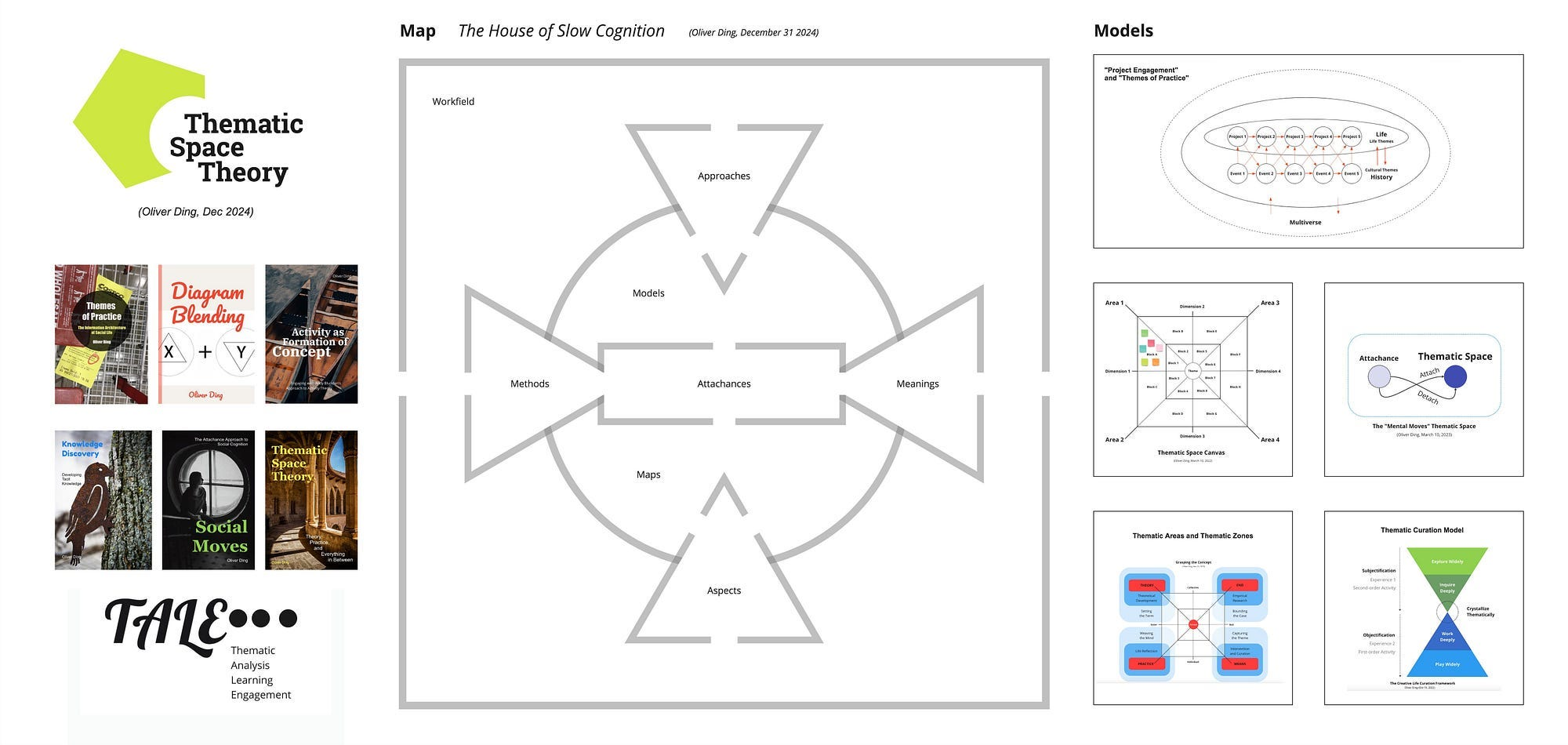
Today, I developed the Thematic Space Theory Toolkit (v1.0) as a special theory to support the Ecological Strategic Cognition Framework (v2.3). The outcome is a three-level hierarchical knowledge system (See the diagram below).
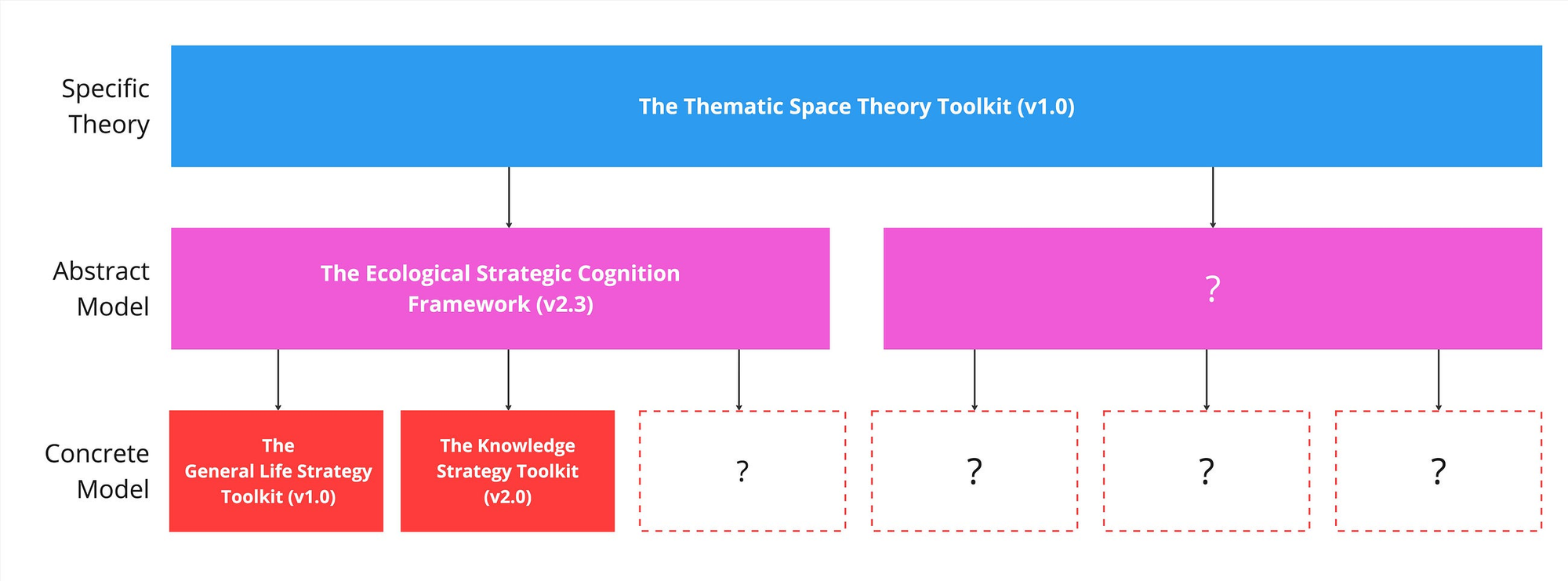
The three-level hierarchical structure comes from the HERO U diagram, a tool for single-theory curation.
An academic or scientific theory is a high-level abstract knowledge system comprising interconnected theoretical concepts and their complex relationships. An established theory or theoretical tradition may have multiple applications at different levels of abstraction. To establish its identity, a theory must define its uniqueness — distinguishing itself from other theories.
Thus, there are at least three approaches to conducting a Single-Theory Curation project.
- Depth: The concept dynamics of a theory
- Width: The applicational practices of a theory
- Height: The uniqueness of a theory
The Depth approach focuses on analyzing the internal structure and complexity of a theory’s conceptual network. This includes tracing the historical development of theoretical concepts and their interconnections. For example, Clay Spinuzzi’s 2019 paper “Trying to predict the future”: third-generation activity theory’s codesign orientation is a good example of the Depth way.
The Height approach involves comparing a theory with similar ones to highlight its unique features. This can be done by analyzing theories within a shared theme or through a multi-aspect comparison of two theories.
Reijo Miettinen, for instance, frequently writes about comparing Activity Theory with other frameworks. His 2016 paper Four theories of networks: from interconnectedness to object-oriented collaboration, explores the theme of networks. He has also examined the relationship between Deweyan pragmatism and Cultural-historical activity theory in response to Jim Garrison, a philosopher and Dewey scholar.
The Width approach reviews how a theory or a specific theoretical concept is applied across different contexts, offering a landscape view of a knowledge enterprise. For instance, in their analysis of Activity Theory in HCI research, Bonnie Nardi (2016) and her colleagues examined 109 papers and identified five strategies used by scholars: 1) an object of analysis, 2) a conceptual tool for design, 3) a meta-tool for developing new analytical tools, 4) a tool for conceptual analysis, and 5) a tool for empirical analysis.
These three dimensions — Depth, Width, and Height — can be used individually or in combination within a single project. Together, they form a 3D approach for analyzing the development of a thematic space within a particular theory.
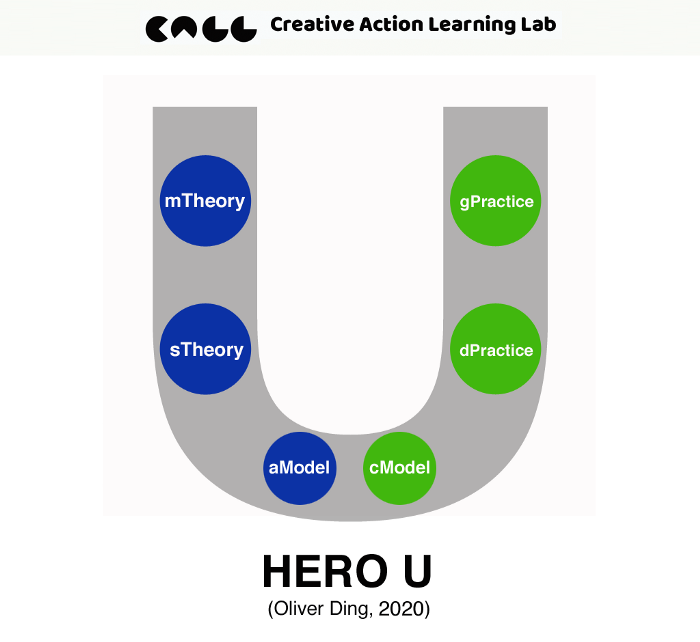
The HERO U diagram follows the Width approach and defines six types of objects of knowing:
- mTheory: Meta-theory
- sTheory: Specific Theory
- aModel: Abstract Model
- cModel: Concrete Model
- dPractice: Domain Practice
- gPractice: General Practice
More details can be found in The Knowledge Curation Toolkit #1: Theme U for Single-theory Curation.
The diagram below applies the HERO U to the current project.
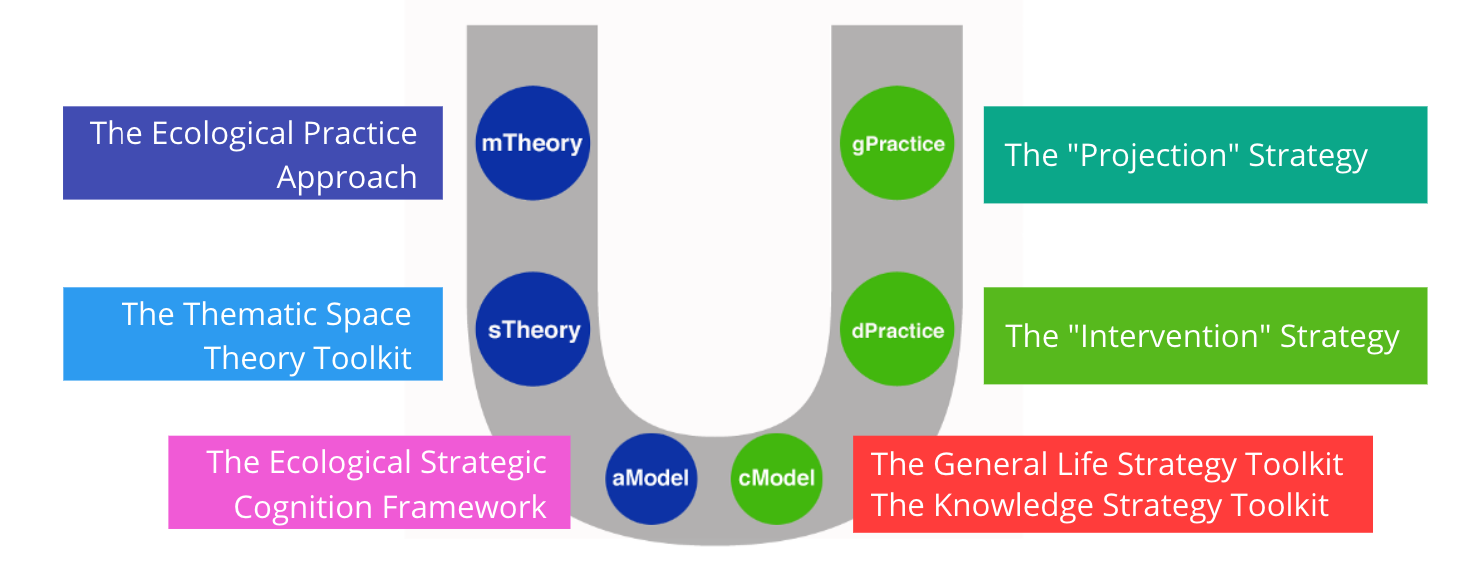
- Meta-theory → The Ecological Practice Approach
- Specific Theory → The Thematic Space Theory Toolkit
- Abstract Model → The Ecological Strategic Cognition Framework
- Concrete Model → The General Life Strategy Toolkit / The Knowledge Strategy Toolkit
- Domain Practice → The “Intervention” Strategy
- General Practice → The “Projection” Strategy
Thematic Space Theory is part of the Ecological Practice Approach. This article focuses on the Specific Theory and Abstract Model. For details on Domain Practice and General Practice, see Knowledge Strategy: Ten Strategic Themes and a Toolkit.
2. Making a New Toolkit
The process is straightforward: I select a thematic space from the Ecological Strategic Cognition Framework (v2.3) and then choose a concept from Thematic Space Theory.
Here’s how the elements align:
- Maps → Thematic Spaces
- Moves → Attachance
- Paths → Thematic Mapping
- Strategic Themes → Themes of Practice
- Objects / Operations → Concept Development
- Subjects → Ecological Relevance
- Mind → Slow Cognition
- Meets → Creative Dialogue
- Meaning → Meaning Discovery
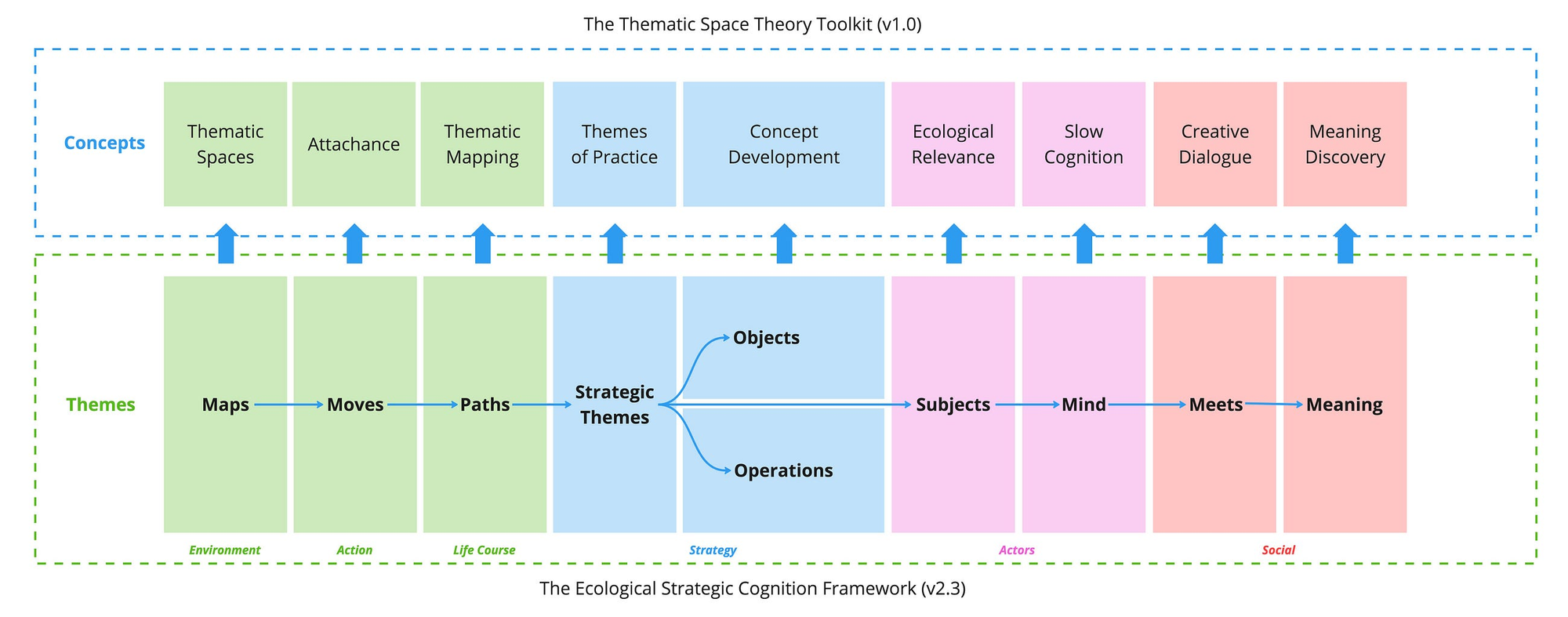
This approach introduces a new way to curate the knowledge system of Thematic Space Theory.
A key strategy behind this approach is the distinction between Concepts and Themes at two levels. At the “Specific Theory” level, the knowledge elements are Theoretical Concepts. However, at the “Abstract Model” level, the knowledge elements can be Theoretical Concepts, Operational Concepts, or Creative Themes. In this context, the abstract model — the Ecological Strategic Cognition framework — is represented by a thematic map, where the knowledge elements are Themes.
In this context, the bottom-up approach refers not only to moving from a lower to a higher level of abstraction but also to shifting from Creative Themes to Theoretical Concepts.
By using the Ecological Strategic Cognition Framework (v2.3) as a creative heuristic tool, I curated a set of predeveloped concepts into the toolkit. However, I lacked a concept to describe my recent exploration of creating thematic maps, knowledge maps, and developing methods based on these maps. To address this, I coined the term “Thematic Mapping” to encompass these practices.
In the following sections, I will provide more details on the series of concepts included in the toolkit.
3. Maps → Thematic Spaces
The concept of “Thematic Spaces” is the core foundation of Thematic Space Theory.
A Thematic Space refers to a cognitive space where a person’s ideas, activities, and practices revolve around one particular theme. A theme can be an established theory such as “Activity Theory,” a general concept such as “Platform” or “Life,” or an idea somewhere in between, such as “Design Thinking” or “UX.”
In January 2022, I created the “Thematic Space Canvas” to study the development of tacit knowledge. In 2023, the theme of “Thematic Space” transformed from a theme into a theoretical concept. By 2024, it grew into an independent theory, separate from Curativity Theory.
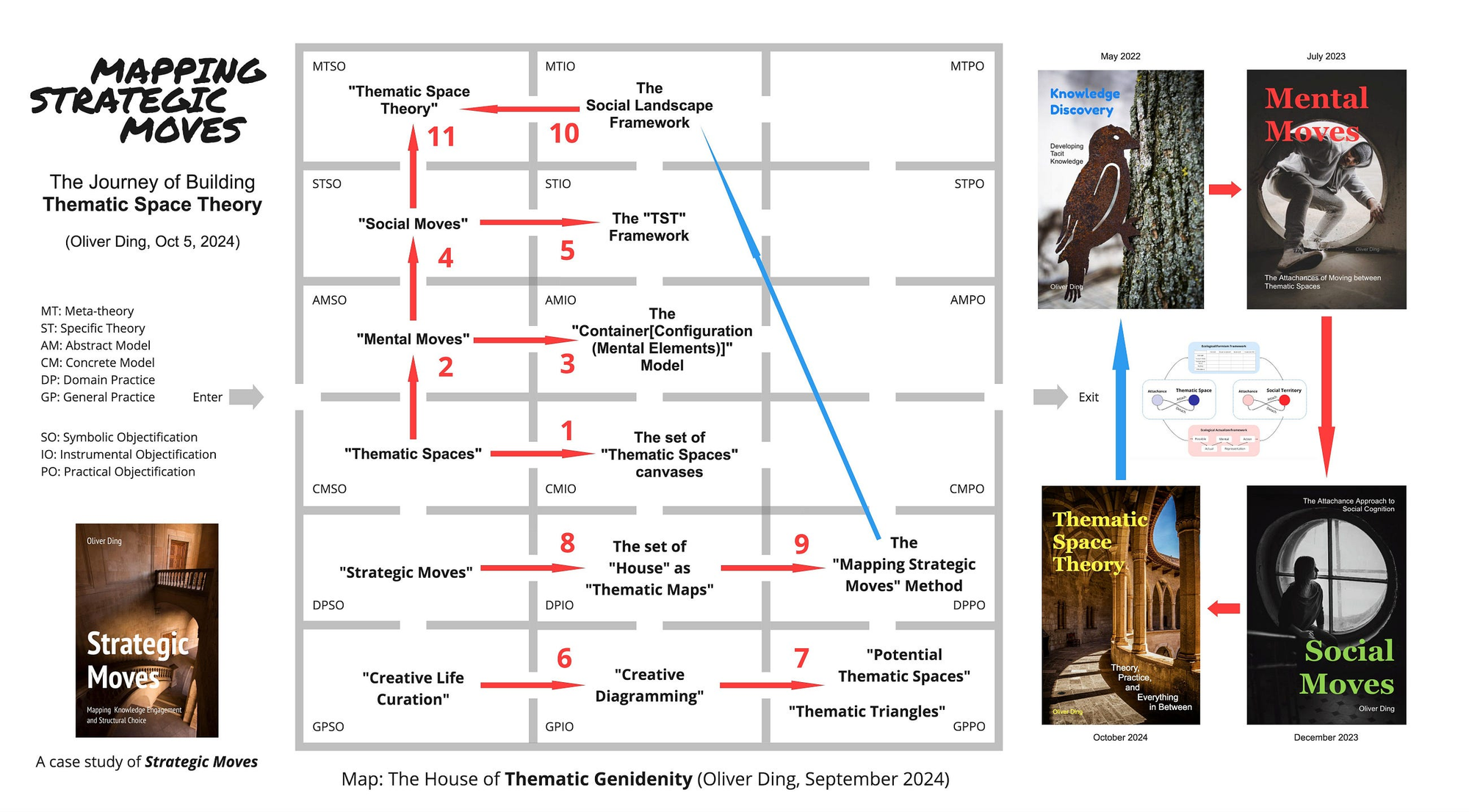
The diagram below uses the House of Thematic Genidentity to map several strategic moves in the journey of building Thematic Space Theory.
4. Moves → Attachance
Attachance Theory is a sub-theory within the Ecological Practice approach, primarily inspired by James J. Gibson’s Affordance Theory in ecological psychology. My 2020 book draft After Affordance: The Ecological Approach to Human Action officially introduced it.
Between 2019 and 2022, I applied the term “Attachance” in various ways:
- The Attachance Perspective refers to its philosophical implications, explored further in D as Diagramming: The Attachance Perspective.
- Attachance as a theoretical concept within the Ecological Practice Approach, elaborated in After Affordance, where I discuss it alongside Affordance in the context of creative actions. More details can be found in Creative Actions: Second-order Affordance and Attachance.
- Attachance as a conversational term, used in informal discussions about stories or topics from this perspective. An example can be found in Possible Practices: Attach, Detach, and Opportunities.
By 2022, the development of Attachance had become interconnected with the concept of Thematic Space, specifically as a form of cognitive container.
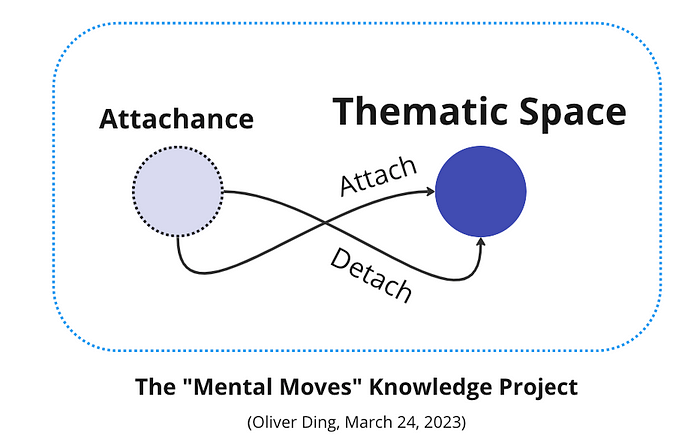
In 2023, I applied the Attachance Perspective to the study of creative and social cognition through two book drafts, Mental Moves and Social Moves. These works solidified the concept, leading me to formally establish Attachance Theory as a new knowledge framework. In 2024, the journey continues with the Strategic Moves project!
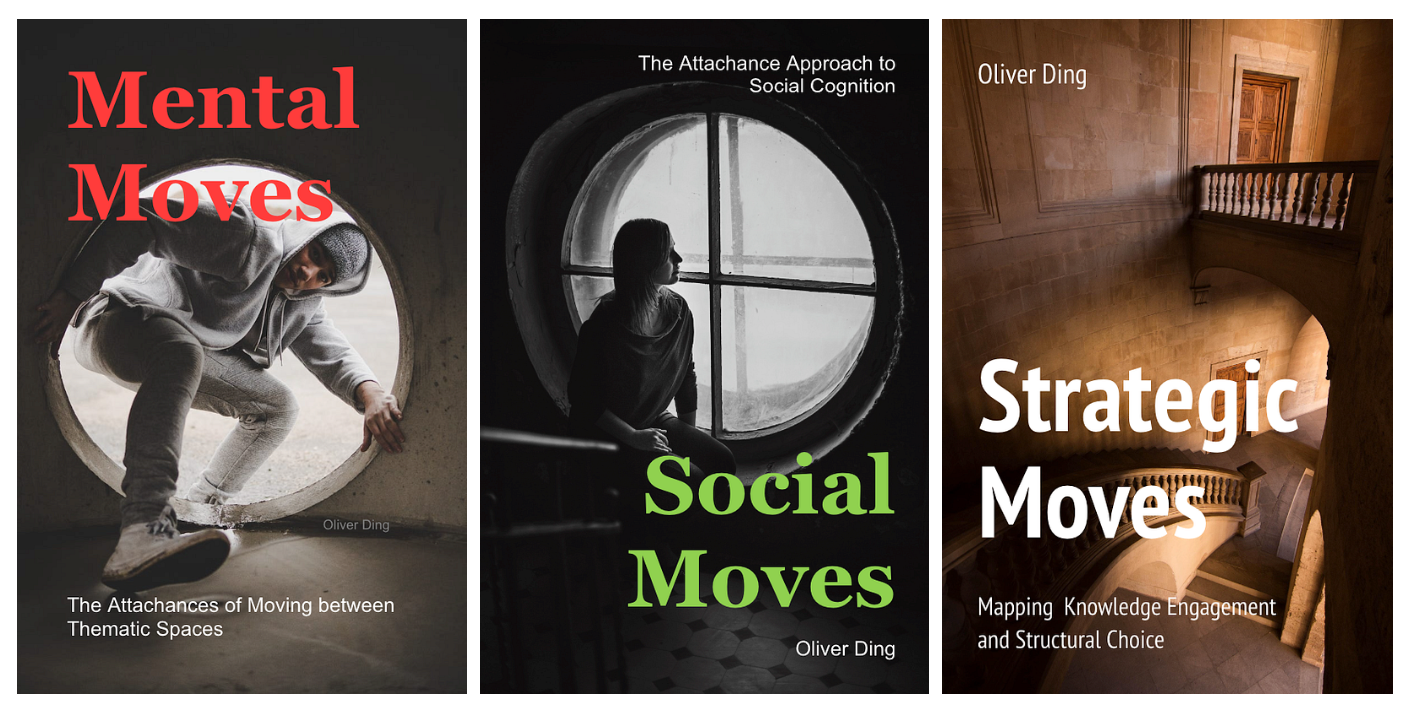
More details can be found in the links below:
- Mental Moves (book, v1) — Introduction
- Social Moves (book, v1, 2023)
- Strategic Moves: Mapping Knowledge Engagement and Structural Choice (book, v1, 2024)
- Mapping Strategic Moves #3: Building Attachance Theory
5. Paths → Thematic Mapping
In Thematic Space Theory, the concept of “Paths” refers to sequences of moves on thematic maps. Rather than following a single, fixed structure, a thematic map enables multiple Paths, each representing different modes of engagement.
The concept of “Thematic Mapping” refers to the practice of mapping these moves on thematic maps. For example, the diagram below illustrates four paths using the same thematic map: the Knowledge Discovery Canvas.
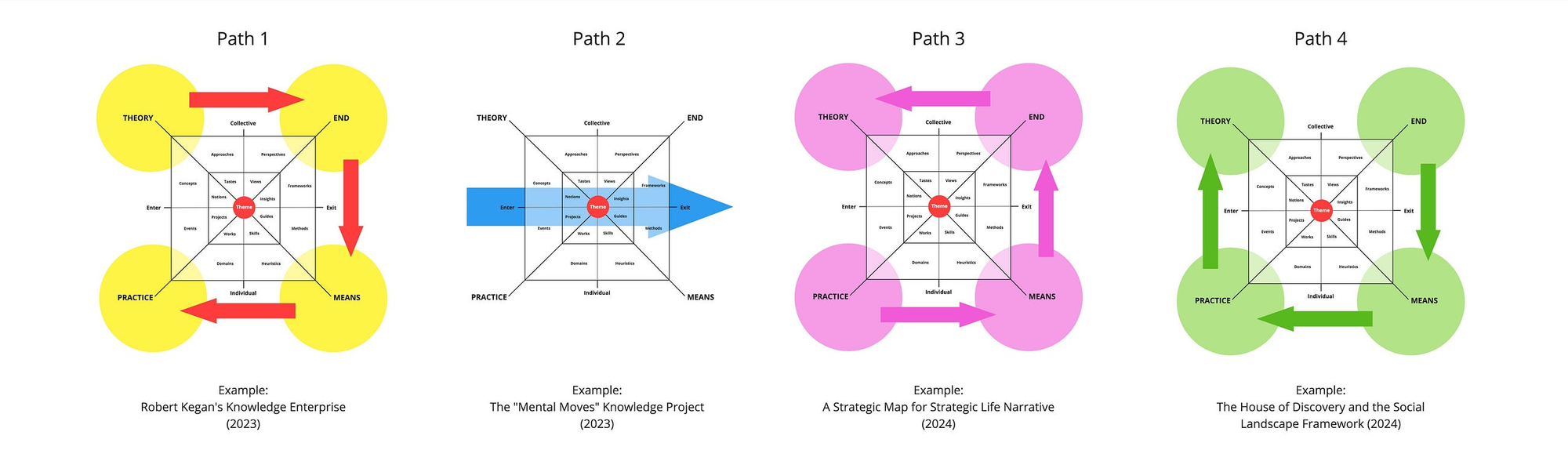
The diagram above represents four distinct paths, each accompanied by corresponding examples:
- Path 1: Robert Kegan’s Knowledge Enterprise (2023)
- Path 2: The Mental Moves Knowledge Project (2023)
- Path 3: A Strategic Map for Strategic Life Narrative (2024)
- Path 4: The House of Discovery and the Social Landscape Framework (2024)
More details can be found in Thematic Space Theory: One Map and Four Paths.
6. Strategic Themes → Themes of Practice
On August 27, 2023, I wrote a long reflection on my journey of engaging with the theme of “themes” from 2017 to 2023.
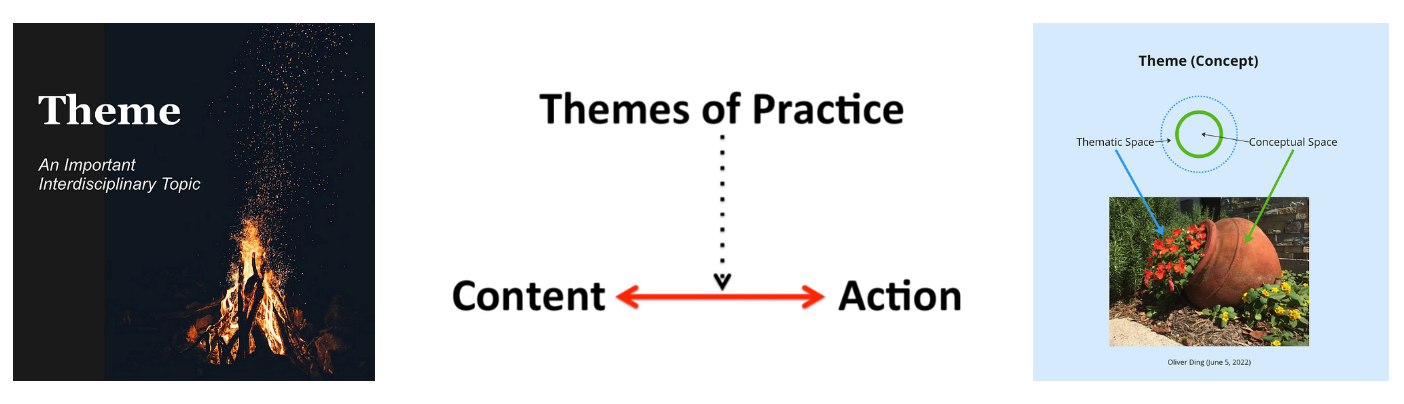
In Thematic Space Theory, I distinguish between “Theme” and “Concept.” While “Theme” emphasizes subjective experience and understanding, “Concept” focuses on objective meaning and definition.
I began developing the concept of Themes of Practice in 2019 in my book Curativity Theory. The purpose of the concept was to connect “life themes” and “cultural themes.”
Anthropologist Morris Opler (1945) introduced a theoretical concept called “themes” to study culture. Meanwhile, career counseling therapists and psychologists developed “life themes” to explore personal narratives. Meanwhile, career counseling therapists and psychologists developed “life themes” to explore personal narratives. When we place cultural themes and life themes together, we encounter a fundamental debate in social science: the tension between the individual and the collective.
In Thematic Space Theory, the concept of “Theme of Practice” describes the dynamic development of themes throughout a person’s life course.
More details can be found in Themes of Practice (2019–2021) and Themes of Practice: Concept, Activity, and Cognition.
7. Objects / Operations → Concept Development
Traditional theories of concepts focus on common objects. However, my primary interest in concepts is in Creating New Concepts. Over the years, I have used terms such as Concept Building, Creating New Concepts, and Concept Development to describe this line of exploration. In January 2025, I used “Concept Development” as the official name for this pursuit.
The idea of “Concept Development” proposes a new approach to Creative Concepts:
Activity as Formation of Concept (Concept as Ontological Invention)
This approach applies the Theme (Concept) ontology to explore how concepts are constructed and engaged with from both knowledge and cultural perspectives.
The notion of “Concept as Ontological Invention” refers to defining the boundaries of Conceptual Space, while the notion of “Activity as Formation of Concept” refers to filling and shaping the Thematic Space.
This perspective addresses the tension between Knowledge Concepts and Cultural Concepts:
For those focused on Knowledge Concepts, the journey of concept development begins with Ontological Invention. They may choose not to engage further in the Thematic Space, where Activity plays a central role in conceptual formation. In contrast, for those working with Cultural Concepts, the emphasis is on Activity as Formation of Concept, engaging more directly with themes, practices, and social movements.
This dual approach supports both types of concept engagement, allowing individuals to focus on the aspects most relevant to their goals.
Three relevant books are recommended:
- Activity as Formation of Concept: Engaging with Andy Blunden’s Approach to Activity Theory
- Center, Circle, and Genidentity: The Dynamics of Networked Knowledge Centers
- Grasping the Concept: The Territory of Concepts and Concept Dynamics
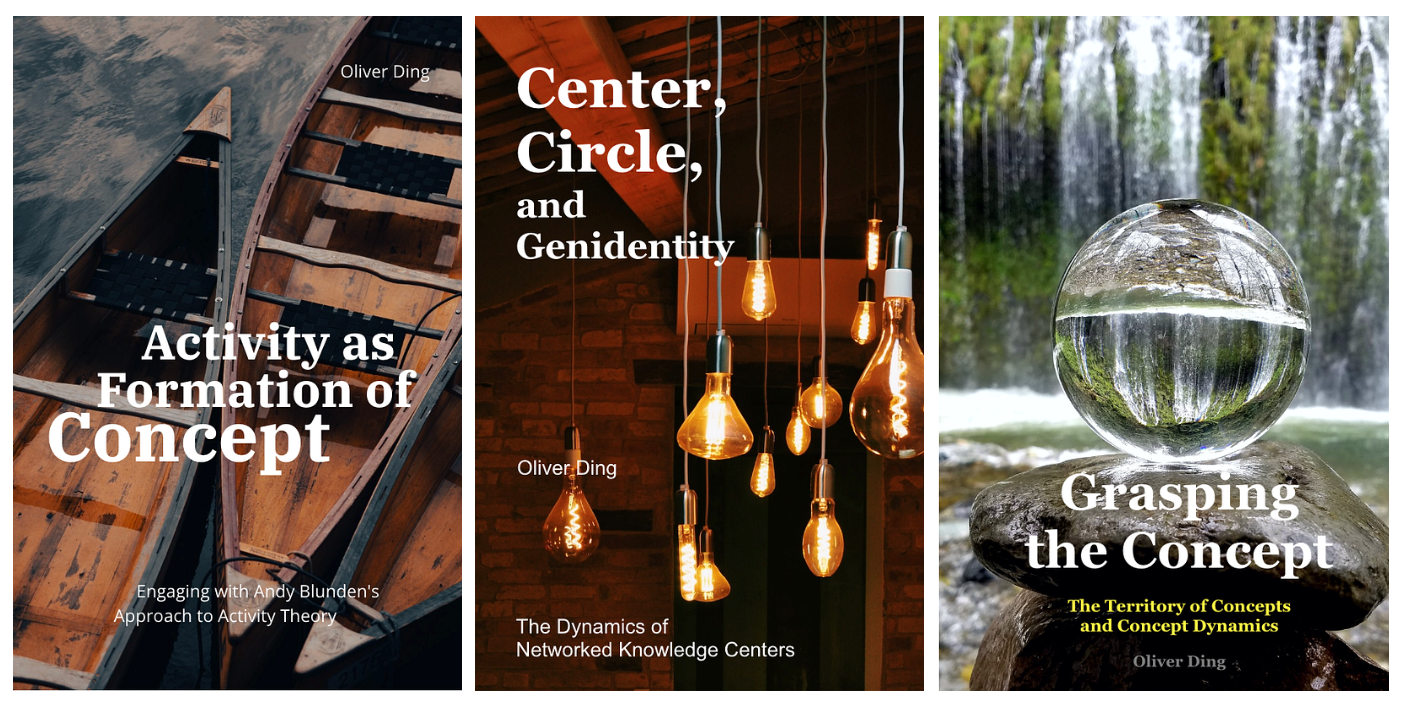
In 2021, I introduced Andy Blunden’s notion of Activity as Formation of Concept in my book draft titled Project-oriented Activity Theory.
Later, I applied this notion to develop several knowledge frameworks and used it as a method to guide my projects in creating new concepts, such as:
- The concept of “Activity Analysis”
- The concept of “Knowledge Center”
- The concept of “Value Circle”
- The concept of “Platform Genidentity”
Eventually, I connected the notion of “Formation of Concept” with my other ideas such as “Themes of Practice,” “Thematic Exploration,” and “Evolving Concept System.”
The book draft Activity as Formation of Concept (book, v1, 2024) focuses on Andy Blunden’s notion of “Activity as Formation of Concept” and my relevant practice. However, it doesn’t mention the idea of “Concept as Ontological Invention.”
Blunden’s account, rooted in social movements, engages deeply with Cultural Concepts. In contrast, my notion of Concept as Ontological Invention centers on creating innovative Knowledge Concepts. Together, these two perspectives form a comprehensive theoretical framework for concept development.
By combining Activity as Formation of Concept and Concept as Ontological Invention, we gain a holistic framework that bridges the realm of cultural practices with the creation of new knowledge. This dual approach not only enhances the adaptability of concept development across contexts but also allows for a dynamic interplay between the evolving cultural and intellectual dimensions of concepts.
In this way, concept development is approached as both a boundary-defining invention and an activity-driven formation, supporting both theoretical innovation and practical engagement.
8. Subjects → Ecological Relevance
Thematic Space Theory does not provide a theory for understanding Subjects or Subjectivity. However, it introduces the theoretical concept of Ecological Relevance to describe the Self–Other relationship. See the diagram below.
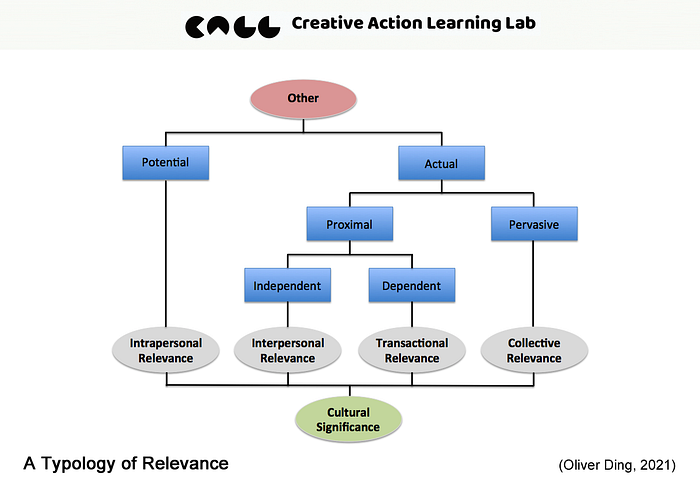
The framework is based on four units of analysis:
- Intrapersonal Relevance: the Other is potential, not actual.
- Interpersonal Relevance: the Other is actual, but the “Self—Other” is not considered as a whole.
- Transactional Relevance: the Other is actual, and the “Self—Other” is considered as a whole.
- Collective Relevance: the Other is pervasive, not proximal. The “Self — Other” relationship is understood as “Self — Group”.
At its core, the framework examines three aspects of the Other:
- Potential vs. Actual
- Independent vs. Dependent
- Proximal vs. Pervasive
If a person does not have direct interaction with actual others, they consider whether their work or actions are relevant to predecessors or potential audiences. This is what defines Intrapersonal Relevance.
For example, as I write this article, I compare my typology with Schutz’s typology. Since Schutz is a predecessor, I cannot interact with him directly or receive his response. However, the Potential aspect of relevance also includes contemporaries — researchers who study Schutz’s theoretical ideas today. While I may not currently engage with them, there remains the possibility of direct communication in the future.
Interpersonal Relevance refers to direct interactions aimed at receiving feedback from others. In this situation, the Other is actual, yet the “Self–Other” relationship is not considered as a whole because there is no reciprocity of motives — each party may have different interests or priorities.
How can a person receive meaningful feedback? It depends on Relevance from the Other’s perspective. We can apply Schutz’s typology of Relevance to understand how others perceive and engage with a given topic. For example, if I seek feedback on my work for the Thematic Space Theory project, I must consider how my writing style resonates with my audience. Similarly, if I share an article on LinkedIn and mention specific contacts, I should assess whether those contacts find the topic relevant. Their engagement will depend on the degree to which the content aligns with their interests and priorities.
Transactional Relevance is about dependent relationships and interactions where the Other is actual, and the “Self—Other” is considered as a whole. In this context, both parties share reciprocity of motives, meaning their goals, challenges, and background knowledge are mutually aligned. If we adopt Schutz’s typology of Relevance, Transactional Relevance exhibits high relevance across all three dimensions: Motivational relevance, Thematic relevance, and Interpretational relevance. This form of relevance fosters deep collaboration, as the Self — Other relationship is built on interdependence and mutual engagement.
Collective Relevance considers Others as a pervasive group, rather than as specific individuals. In this context, the “Self–Other” relationship transforms into a “Self–Group” relationship, where relevance is shaped by broader social, cultural, or professional communities. This perspective aligns with Schutz’s social domains of relevance.
Together, these four types of relevance — Intrapersonal, Interpersonal, Transactional, and Collective — form a framework for understanding Ecological Relevance, offering a nuanced approach to analyzing how individuals engage with Others across different levels of interaction.
For further details, see Mapping Thematic Space #5: The “Relevance” Thematic Space.
9. Mind → Slow Cognition
In Thematic Space Theory, the concept of Mind refers to the development of tacit knowledge and cognitive methods, with a particular emphasis on the long-term development of ideas and thoughts. This perspective is known as “Slow Cognition.”
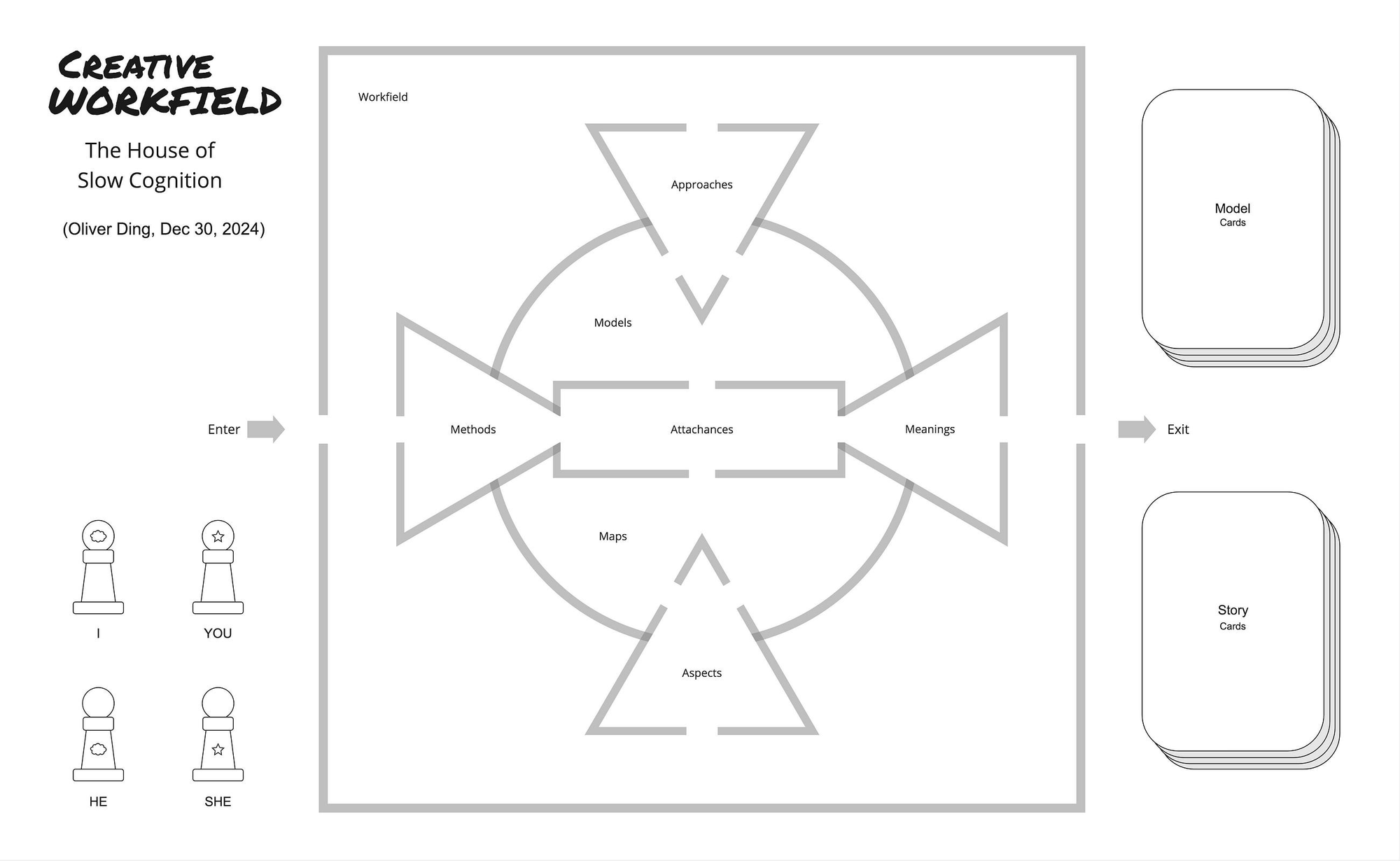
To illustrate this, I recently designed a thematic map titled Creative Workfield: The House of Slow Cognition. This map highlights key themes that structure and support the slow cognitive process, providing insights into how ideas mature over time:
- Aspects
- Attachances
- Approaches
- Maps
- Models
- Methods
- Meanings
In my recent projects, I mentioned a method called “5M5A.”
5M refers to the following things:
- Meaning
- Moves
- Map
- Models
- Methods
We can see an example in Mapping Strategic Moves #14: The House of Creative Life Curation.
- Meaning: Achieving a creative life
- Moves: The real-life actions of creative life
- Maps: The House of Creative Life Curation, representing 12 key themes of the approach
- Models: The Lifescope Model, the Thematic Curation Framework, and the Creative Identity Engagement Framework
- Methods: The Creative Life Curation method, which uses Maps and Models to reflect on Moves
5A refers to the Slow Cognition model.
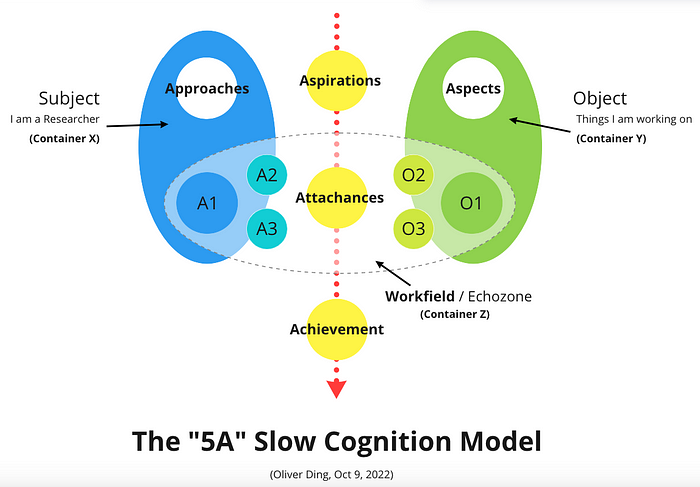
I use the following five keywords to summarize my creative pattern behind the journey of Slow Cognition:
- Aspirations
- Aspects
- Approaches
- Attachances
- Achievement
More details can be found in The “5A” Slow Cognition Model.
This new thematic map integrates the 5A model and the 5M method into a cohesive new framework.
10. Meets → Creative Dialogue
Over the past several years, I have developed a set of concepts, diagrams, knowledge frameworks, and metaphors to explore a family of topics such as boundary innovation, opposite themes, thematic conversation, creative dialogue, etc.
In March 2024, I used the concept of “Creative Dialogue” to describe these ideas and wrote a book draft titled Mapping Creative Dialogue (book, v1, 2024).
In the book draft, I developed a basic form of Creative Dialogue from the perspective of Thematic Space Theory. See the diagram below.
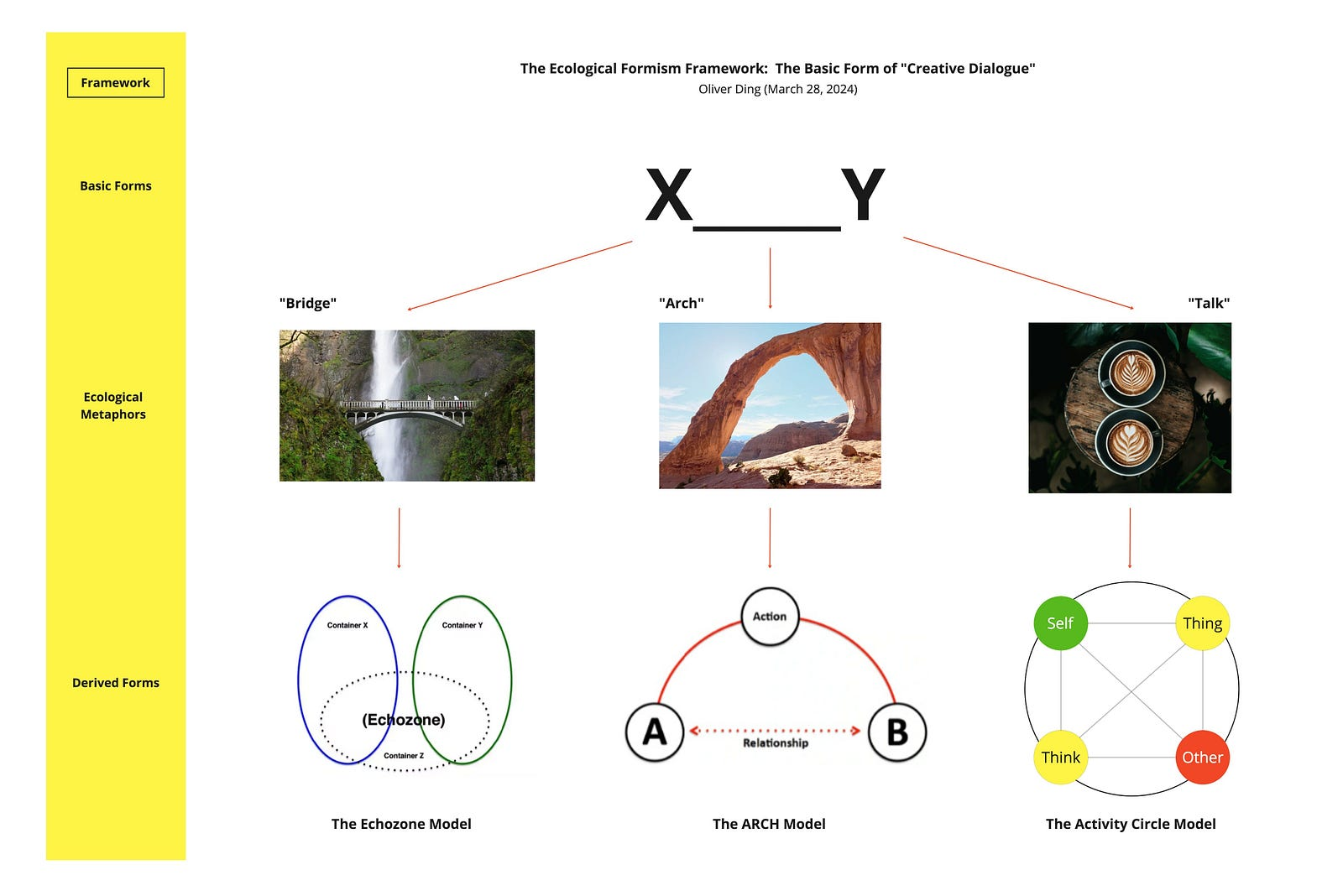
After sorting my tools and articles about the “Creative Dialogue” unit of analysis, I identified three categories behind these works:
- Subjects are Objects (such as knowledge themes, career themes, etc.)
- Subjects are People
- Subjects are Social Entities (or People within a Social Entity)
I also found that the three models I have developed align with these three categories:
- The Echozone model: Subjects as Objects
- The ARCH Model: Subjects as People
- The Activity Circle Model: Subjects as Social Entities
It’s also easy to find three metaphors that represent these models.
- “Bridge”
- “Arch”
- “Talk”
While this classification is helpful, it’s not perfect. Some tools and articles explore knowledge themes, but the ECHO Way model doesn’t quite capture them.
To further enhance this classification, we can use a meta-diagram to transform a Basic Form into a Derived Form. The diagram below illustrates this process.
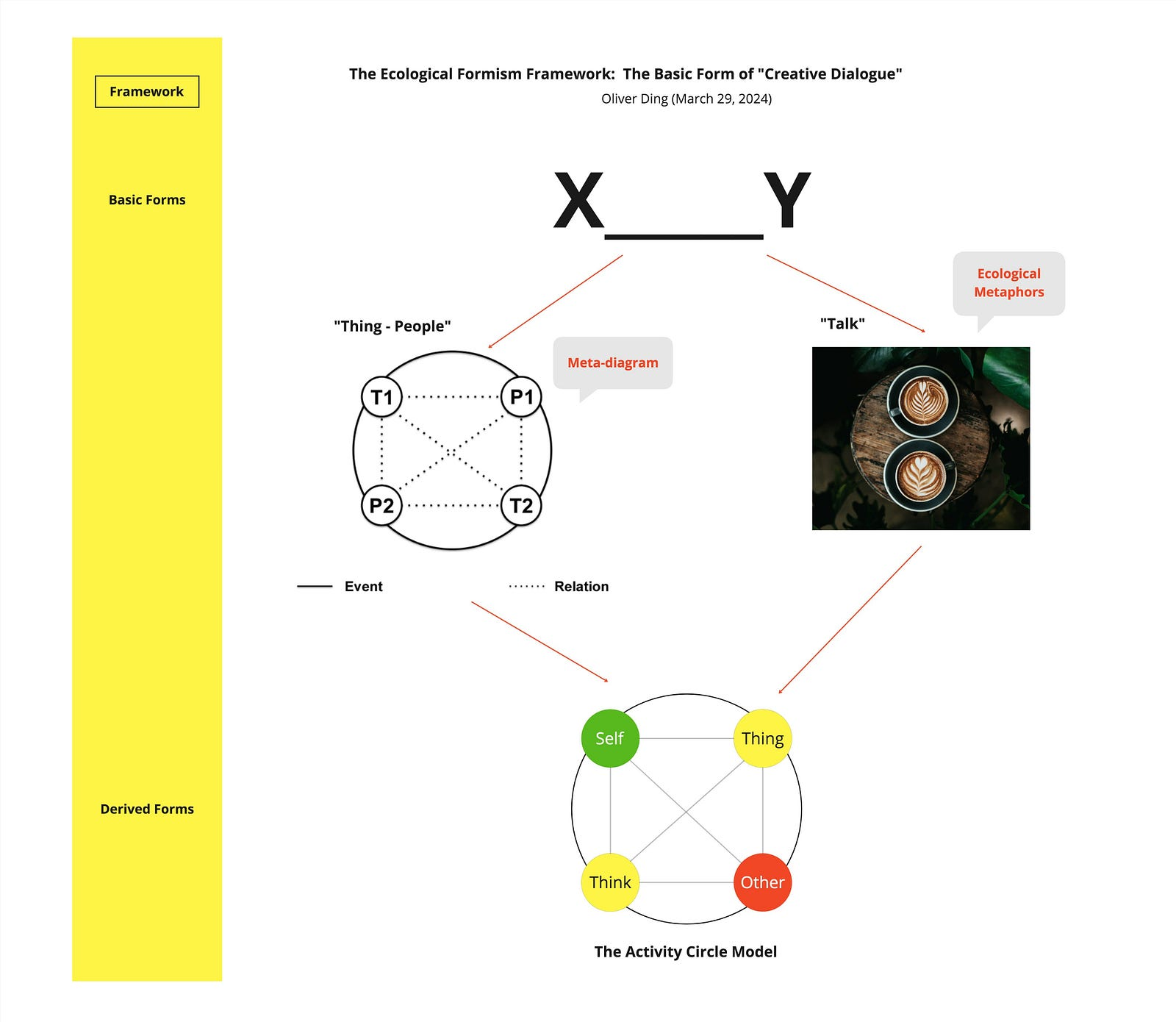
You can find more details in TALK: Two Cups of Coffee and Activity Circle.
11. Meaning → Meaning Discovery
Meaning Discovery Canvas was introduced in my 2024 book draft Meaning Discovery.
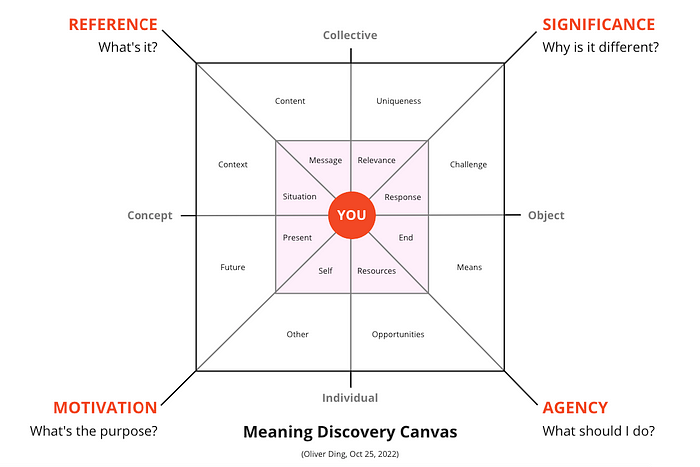
The canvas was designed with four major Thematic Areas:
- Motivation: What’s the purpose?
- Agency: What should I do?
- Significance: Why is it different?
- Reference: What’s it?
It also highlights four Significant Aspects of “Meaning”:
- Concept
- Object
- Truth
- Value
More details can be found in Meaning Discovery (book, v1, 2024).
12. A Methodological Theory
From the above description, we can see the multifaceted nature of Thematic Space Theory. There is also a strong connection between Thematic Space Theory, Attachance Theory, and Concept Dynamics Theory.
What is the purpose of highlighting Thematic Space Theory as an independent knowledge enterprise?
Attachance Theory aims to develop an ecological approach to social cognition, creative cognition, and strategic cognition.
Concept Dynamics Theory aims to establish an ecological approach to Concept Science.
While Thematic Space Theory shares certain ideas with both Attachance Theory and Concept Dynamics Theory, its primary purpose is to serve as a methodological theory for researchers and thinkers in general.
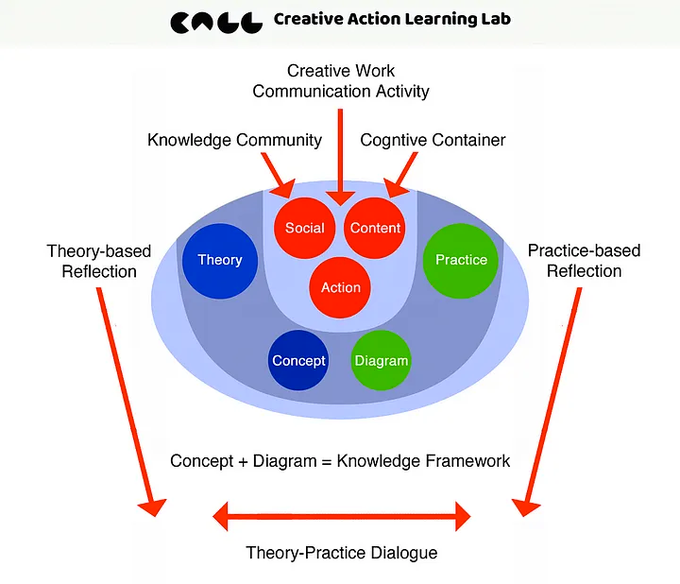
The seed of this innovative methodological theory was inspired by the double creative dialogues I conducted in 2021. These dialogues are represented as follows:
- The THEORY — PRACTICE dialogue
- The Concept — Diagram dialogue
More details can be found in The Strategic Life Narrative Practice #6: Creative Dialogue.
In 2022, I worked on the Slow Cognition project and conducted a case study of my journey in developing the Anticipatory Activity System (AAS) framework between August 21, 2021, and August 26, 2022. See the diagram below.
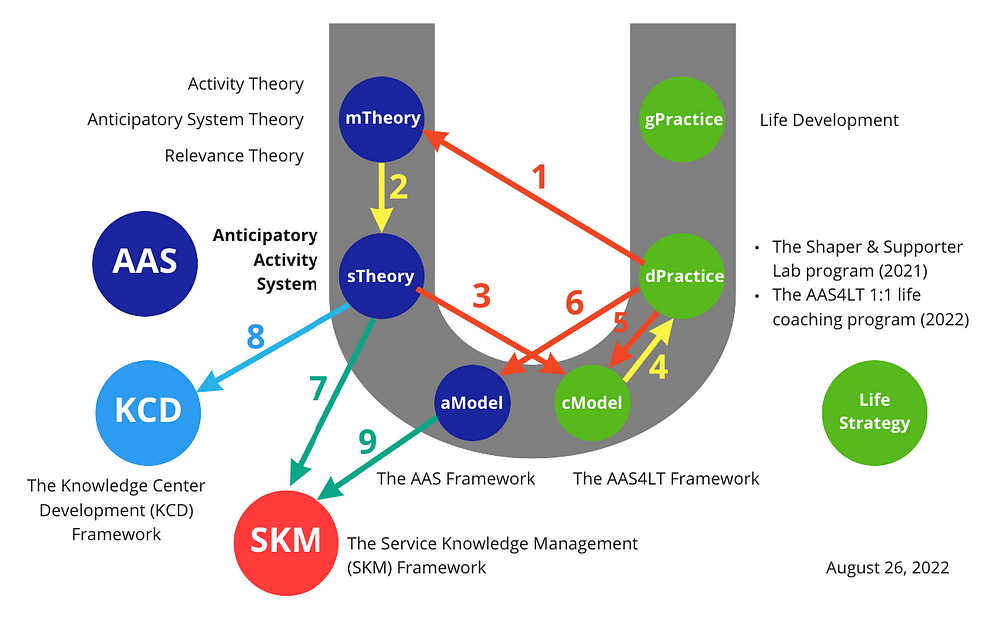
The diagram above represents nine moves in this creative journey.
This significant insight laid the foundation for Thematic Space Theory as a methodological theory.
13. A New Possible Book: Thematic Space Theory
On October 9, 2024, in Mapping Strategic Moves #13: The Journey of Building Thematic Space Theory, I outlined a Predictive Model for a new project: curating a new book titled Thematic Space Theory: Theory, Practice, and Everything in Between.
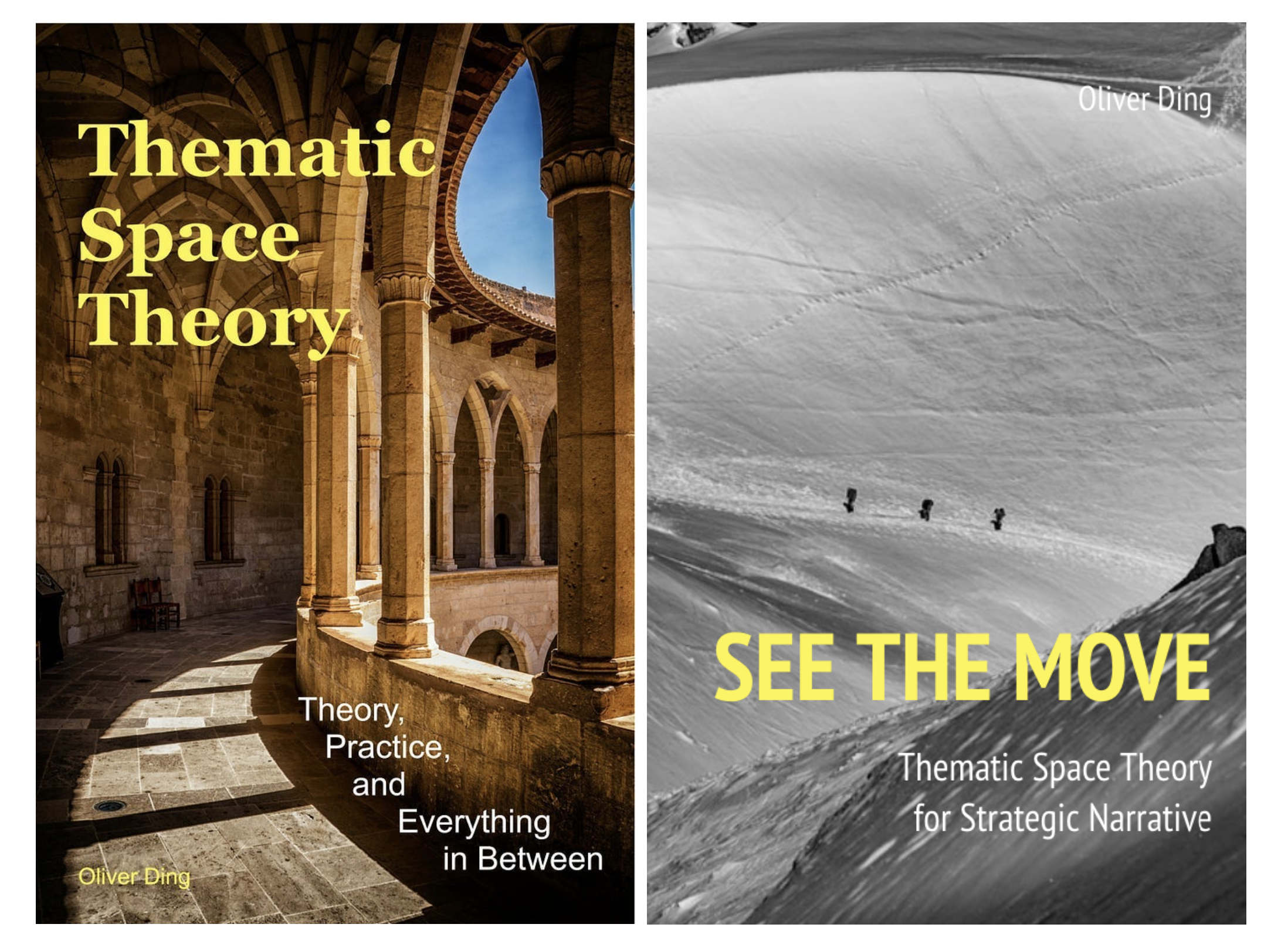
This upcoming book envisions Thematic Space Theory as an ecological approach to social cognition, with a specific focus on knowledge engagement. While Social Moves established an ecological perspective on social cognition in general, Thematic Space Theory will concentrate on how we engage with knowledge.
Social Moves: The Attachance Approach to Social Cognition was edited on December 19, 2023. Since then, I’ve written several articles applying the Ecological Formism framework introduced in that book.
In recent months, I have focused on designing a series of thematic maps and further developing the concept of Thematic Mapping. A key example of this exploration is the Thematic Space Theory Toolkit (v1.0).
Given the significant developments and expansions in Thematic Space Theory over this period, it’s now time to compile and edit a new possible book that represents both the landscape and evolution of the theory.
Related Links
v1.0 - February 15, 2025 - 3,796 words