
The Knowledge Strategy Series
Revisit and rebuild the Knowledge Strategy Trilogy and Beyond
by Oliver Ding
September 29, 2026
The recent Revisiting-and-Rebuilding of the Knowledge Strategy trilogy pulled my focus back toward several years of work on Knowledge Engagement, work I had deliberately stepped away from earlier this year, when I redirected my creative attention toward Cultural Innovation.
That creative journey unfolded through three projects: ACS (Anticipatory Cultural Sociology), SDP (Strategic Developmental Psychology), and GO Theory. In the first half of 2026, I produced several new book drafts and a series of knowledge frameworks. Among them, the Gejunction framework led me back to the Knowledge Engagement work, especially to the Knowledge Strategy book drafts I wrote in 2025.
The trilogy closed in June 2025. What I now call the Knowledge Strategy series extends that timeline: later manuscripts carry it through the second half of 2025 and up to SDP.
This article lists the possible boos, thematic connections and key knowledge frameworks for further reference.
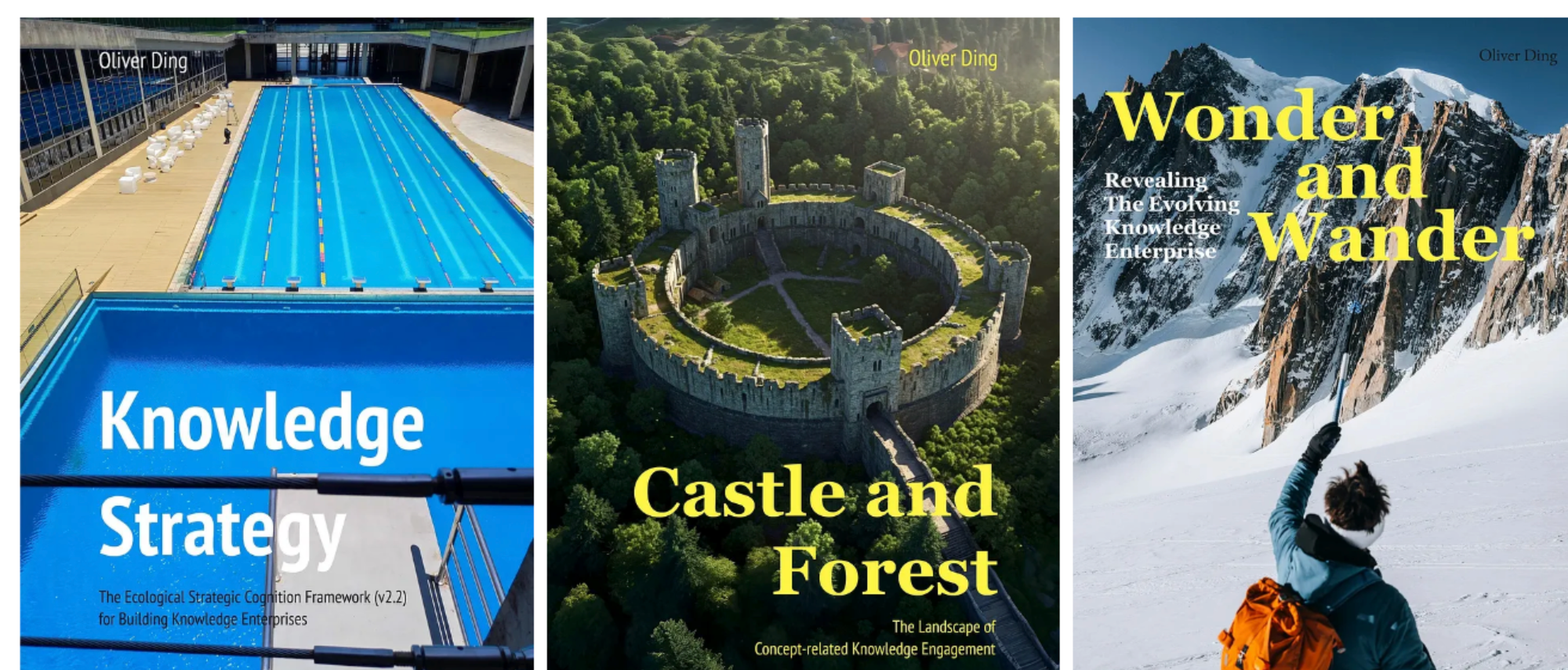
Knowledge Strategy
The Ecological Strategic Cognition Framework (v2.2) for Building Knowledge Enterprises
Introduces v1.0 of the Knowledge Strategy Toolkit, integrating various knowledge frameworks and models.
- January 31, 2025
The possible book has 11 chapters:
- Chapter 0: Introduction
- Chapter 1: Maps
- Chapter 2: Moves
- Chapter 3: Paths
- Chapter 4: Strategic Themes
- Chapter 5: Objects
- Chapter 6: Operations
- Chapter 7: Subjects
- Chapter 8: Mind
- Chapter 9: Meets
- Chapter 10: Meaning
Some numbers about the possible book:
- 11 chapters
- 50 articles
- Total read time: 800 min
- Total word count: 212,000 (about 424 single-spaced pages)
- Introduction and Table of Contents
Castle and Forest
The Landscape of Concept-related Knowledge Engagement
Serves as a follow-up to my 2022 book draft, Knowledge Discovery. While it still focuses on the Knowledge Discovery Canvas and related tools, the primary theme shifts from tacit knowledge to the broader knowledge ecosystem.
- February 27, 2025
The possible book is divided into five parts:
- Part 1: The Gap
- Part 2: The Map
- Part 3: The Landscape
- Part 4: The Model
- Part 5: The People
- Part 6: The World
Some numbers about the v2.0 of the possible book:
- 6 parts
- 32 chapters
- 73 articles
- 1025 minutes of reading time
- 271,625 words (about 543 single-spaced pages)
- Introduction
Wonder and Wander
Revealing The Evolving Knowledge Enterprise
The Wonder and Wander project is an ongoing reflection on my creative journey from March 2019 to March 2025.
The “Wonder and Wander” theme was born in January 2025 while I was working on an annual review of my 2024 creative journey. From March 1, 2025, to June 8, 2025, I selected eight themes and conducted eight case studies of Creative Journeys. For each journey, I reviewed the series of projects within it, explored relevant themes, and discovered deep patterns and models.
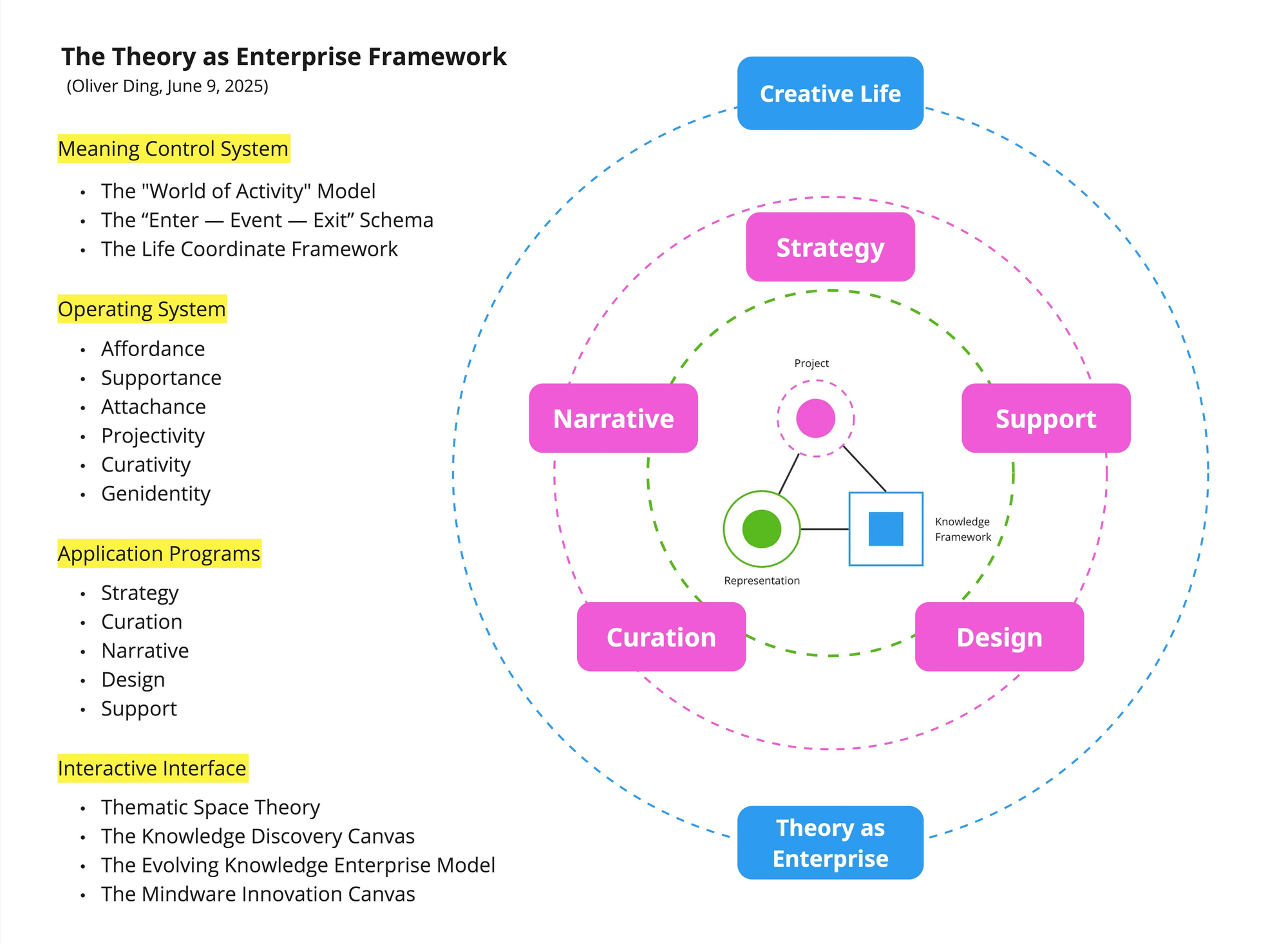
Based on several case studies on Evolving Knowledge Enterprises and Center Development, the book introduces the "Theory as Enterprise" framework.
- June 13, 2025
The possible book is divided into four parts:
- Part 1: Wondering Into the Enterprise
- Part 2: Case Studies on Evolving Knowledge Enterprise
- Part 3: Case Studies on Center Development
- Part 4: Annual Review
Some numbers about v1.0 of the possible book:
- 4 parts
- 12 chapters
- 10 case studies
- 584 minutes of reading time
- 154,760 words (about 310 single-spaced pages)
- Introduction
- Table of Contents
The Knowledge Strategy Toolkit (v2.1)
- June 13, 2025
This toolkit was introduced in Wonder and Wander.
In Knowledge Strategy: The Ecological Strategic Cognition Framework (v2.2) for Building Knowledge Enterprises, I introduced version 1.0 of the Knowledge Strategy Toolkit on January 31, 2025.
Later, I continued working on improving both the Ecological Strategic Cognition framework and the Knowledge Strategy Toolkit.
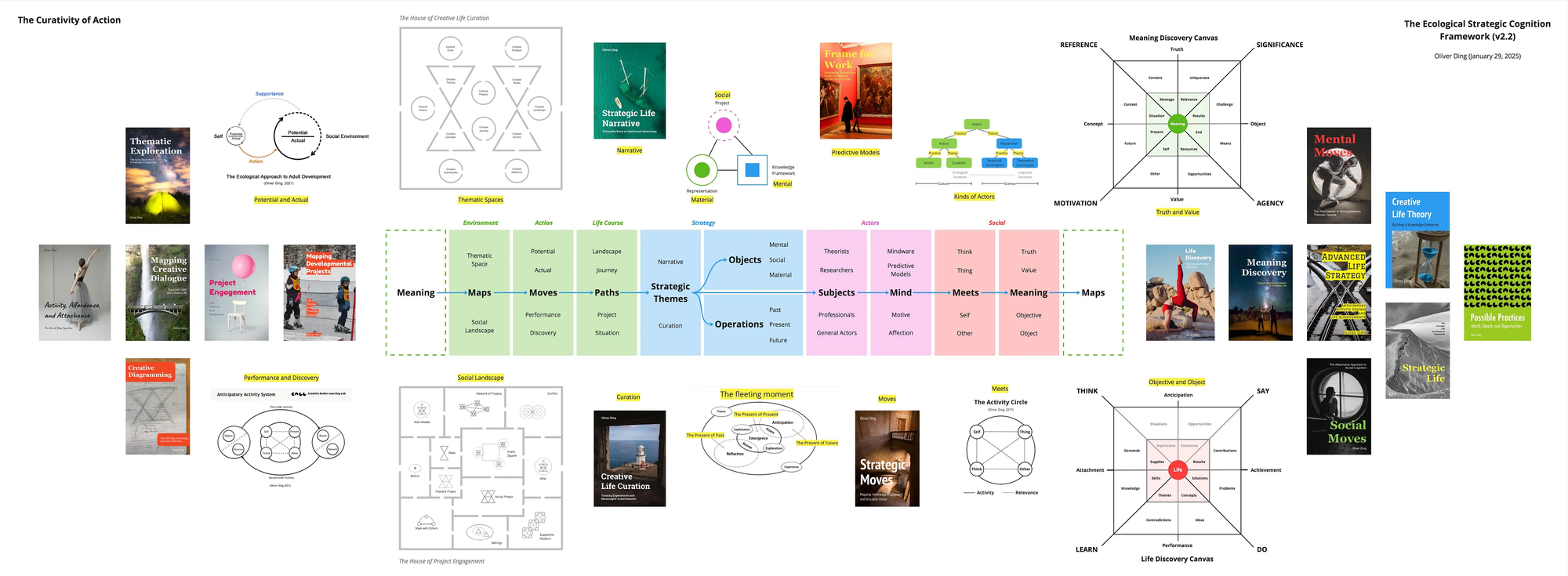
On March 6, 2025, I developed version 2.1 of the Knowledge Strategy Toolkit. See the diagram below. More details can be found in [Frame for Work] The Knowledge Strategy Toolkit (v2.1).
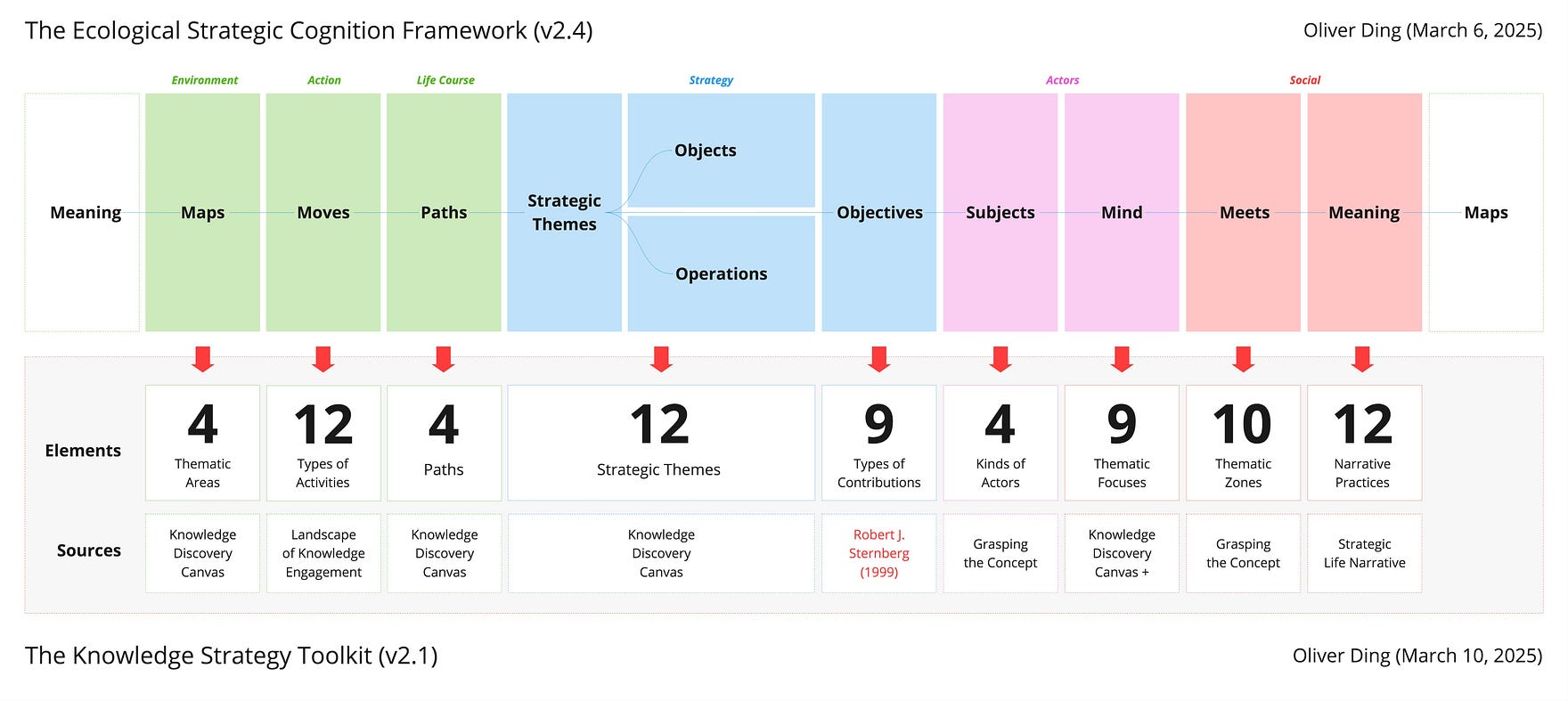
In the diagram above, the top section represents the Ecological Strategic Cognition framework (v2.4), while the bottom section represents the Knowledge Strategy Toolkit (v2.1).
It is worth noting that version 2.1 focuses on the Knowledge Discovery Canvas and related ideas.
However, the Wonder and Wander project was designed to center around the Evolving Knowledge Enterprise Model.
What is the difference between these two? And what is their connection?
The Knowledge Discovery Canvas and related ideas address the social landscape of a thematic enterprise, while the Landscape of Evolving Knowledge Enterprise model focuses on its internal structure and developmental journey.
Taken together, these distinctions reveal a deeper structure underlying the Knowledge Strategy trilogy:
- The first book introduces the Ecological Strategic Cognition approach and sets the strategic foundation.
- The second book focuses on the external dynamics of the social ecology surrounding a thematic enterprise.
- The third book explores the internal complexity of managing a creative center as the core activity of a thematic enterprise.
A Three-Level General Strategy for “Theory as Enterprise”
While the Knowledge Strategy trilogy offers systematic insights for knowledge workers, the Wonder and Wander project focuses on a specific form of knowledge engagement: Theory as Enterprise.
All case studies included in the Wonder and Wander project revolve around the development of a theoretical approach as a thematic enterprise. This makes the project not only a narrative of conceptual evolution but also a living laboratory for testing and refining strategies for theoretical innovation.
In the case study The “Container Thinking” Journey (2019–2025, Part B), I developed a three-level general strategy for “Theory as Enterprise” as a specific framework.
- Meta-framework: The “Enter — Event — Exit” Schema
- Predictive Model: The “HERO U” Framework
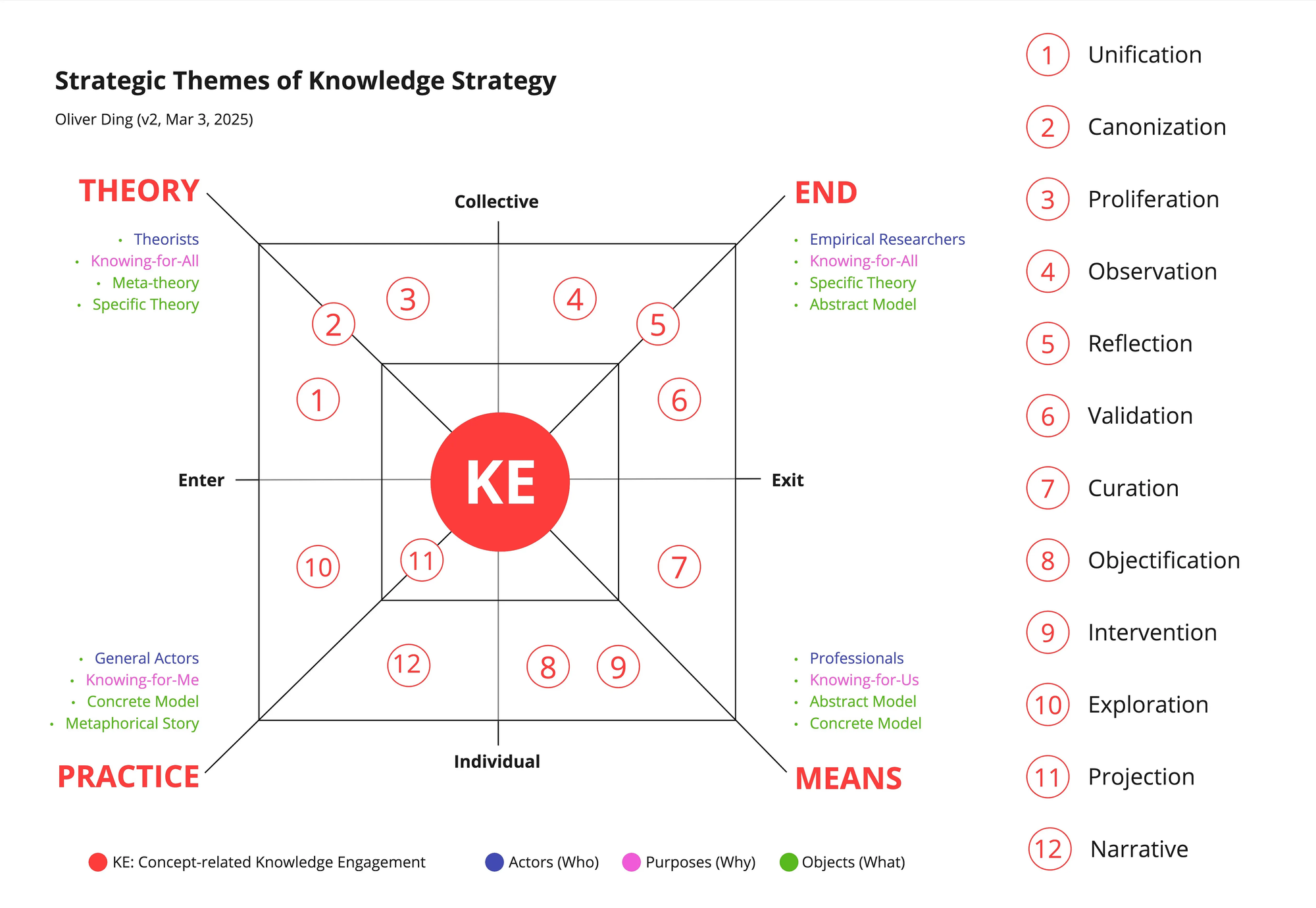
- Situational Model: The “Container Thinking” Strategic Themes
In 2020, I made a framework called HERO U for knowledge creators.In a recent article, I connected the HERO U framework with the Life Curation Framework. See the diagram below. More details can be found in [Frame for Work] The “Enter — Event — Exit” Schema.

After reflecting on the “Container Thinking” journey, I identified several strategic themes that constitute a general strategy. These themes are categorized using the Enter — Event — Exit Schema:
- Starting with a Genidentity (Enter)
- Ontological Invention (Event)
- Framework-first Development (Event)
- Grounding through Case Studies (Event)
- Objectification-Driven Subjectification (Exit)
- Dialogical Expansion (Exit)
More details can be found in The “Container Thinking” Journey (2019–2025, Part B).
Follow the general strategy, I also highlight several specific strategic actions, particularly those taken during the early stage. The diagram below represents five strategic moves I made from 2019 to 2021.

- Move #1: Turning a By-Product into a Strategic Object
- Move #2: Self-referential Strategy for Platform Orientation
- Move #3: Activity Theory as Role Model
- Move #4: Meta-knowledge as Strategic Object
- Move #5: The Theory—Practice Gap as Opportunity
More details can be found in The “Container Thinking” Journey (2019–2025, Part C).
Self-referential Strategy
During the case studies, I identified a significant strategic theme: the Self-Referential Strategy.
In the early development of the Ecological Practice Approach, Move #2 — titled Self-referential Strategy for Platform Orientation — highlighted the power of the Self-referential Strategy in my decision-making process.
Move #2 refers to the Strategic Move #2: shifting from Curativity Theory to the Knowledge Curation Project in June 2020.
Curativity Theory was born in 2019. Later, I faced a challenge of applying it to a particular field. If we see a theory as a Platform, then this challenge refers to Platform Orientation.
Chapter 7 of the book draft is titled Curativity Analysis. I chose four fields to test my theoretical concepts and frameworks: Toy Design, Clothing Customization, Family Curation, and Knowledge Curation. These four cases can be considered as the prototype of Curativity Analysis.
In 2020, I needed to decide on a new strategy for CALL (Creative Action Learning Lab). I chose Knowledge Curation as the primary application of Curativity Theory and started the Knowledge Curation Project.
An interesting thing was that one of the applications of Curativity theory was Knowledge Curation, which can be used to guide the development of Curativity theory. Thus, I roughly made a theoretical self-reference.
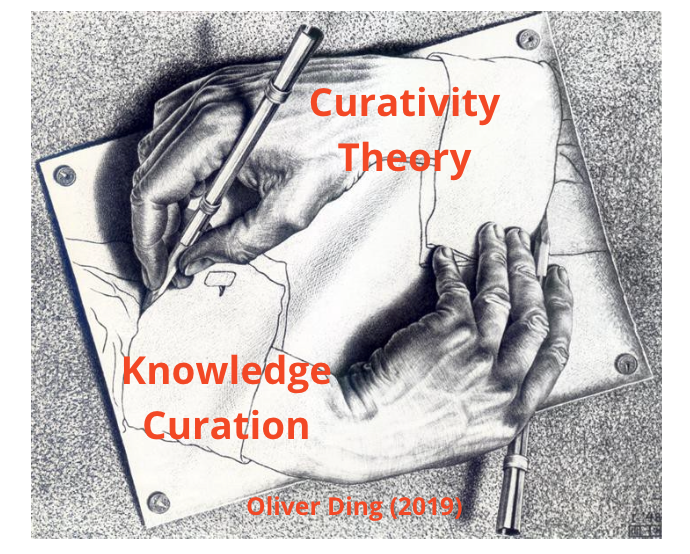
However, it depends on how we define the boundary of the “self” within Self-referential Activity. From the perspective of Curativity theory, it is too naive to claim that the pieces and parts are determined by the whole. In fact, Curativity theory embraces the dialectical hierarchy of the pieces-whole relationship. For example, as an application of Curativity theory, Knowledge Curation is a piece while the whole is the Curativity theory. The outcome of Knowledge Curation can be returned to guide the development of Curativity theory.
In the case study The “Container Thinking” Journey (2019–2025, Part D), I found that the Self-referential Strategy was applied throughout the whole journey. As discussed earlier, the core concepts of the Ecological Practice Approach were used to guide the development of the approach itself.
This case illustrates how the approach functions not only as a theoretical model but also as a systematic framework for developing both a theory and a thematic enterprise. It demonstrates the potential of self-referential strategies to drive recursive learning, adaptive refinement, and creative evolution in long-term theoretical work.
The Self-referential Activity of “Theory as Enterprise”
In November 2024, I created the thematic map below for the Strategic Life Narrative project.
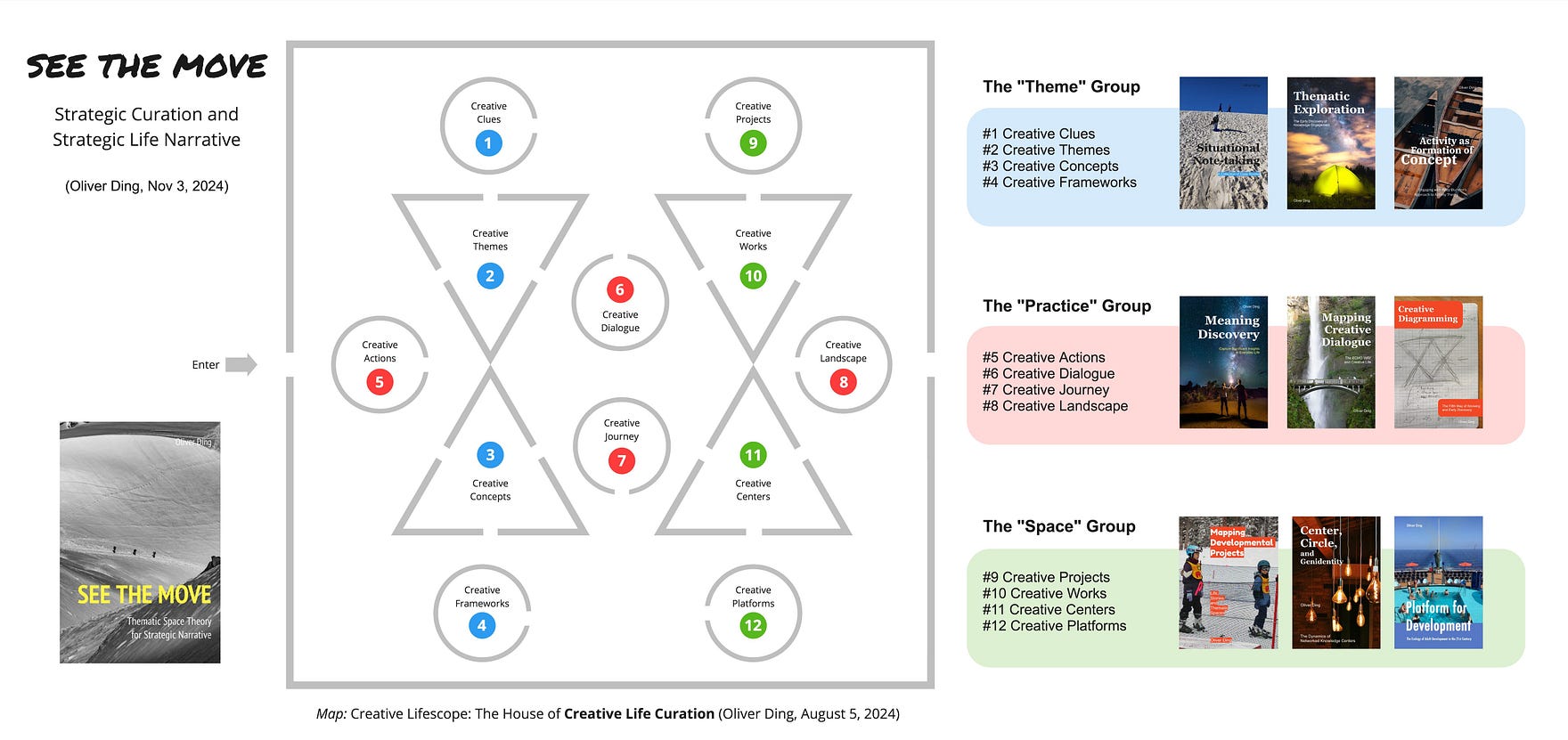
The map represents 12 types of strategic life practices. To support these practices, I employ the Self-referential Activity model. Inspired by Activity Theory and Self-referential systems theory, this model describes a specific type of activity that fosters self-referential development.
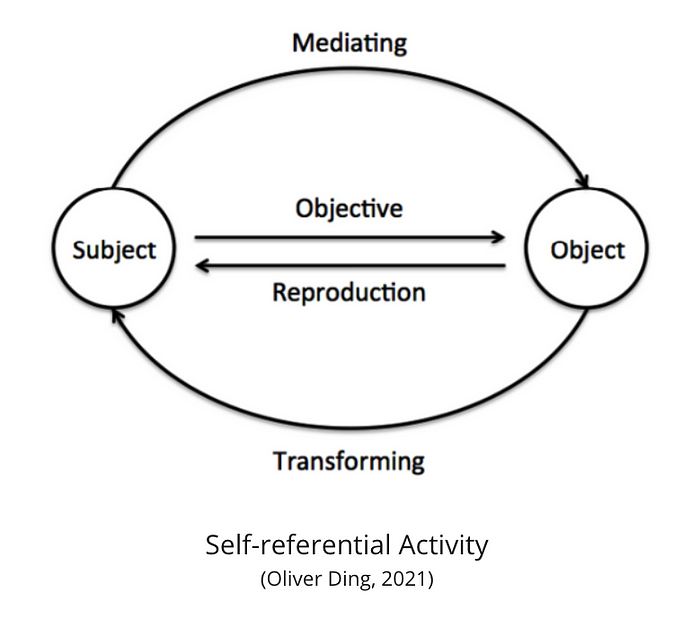
Let’s use the #4 Strategic Life Narrative Practice as an example. Its primary object is Creative Frameworks, which are about Concept Systems.
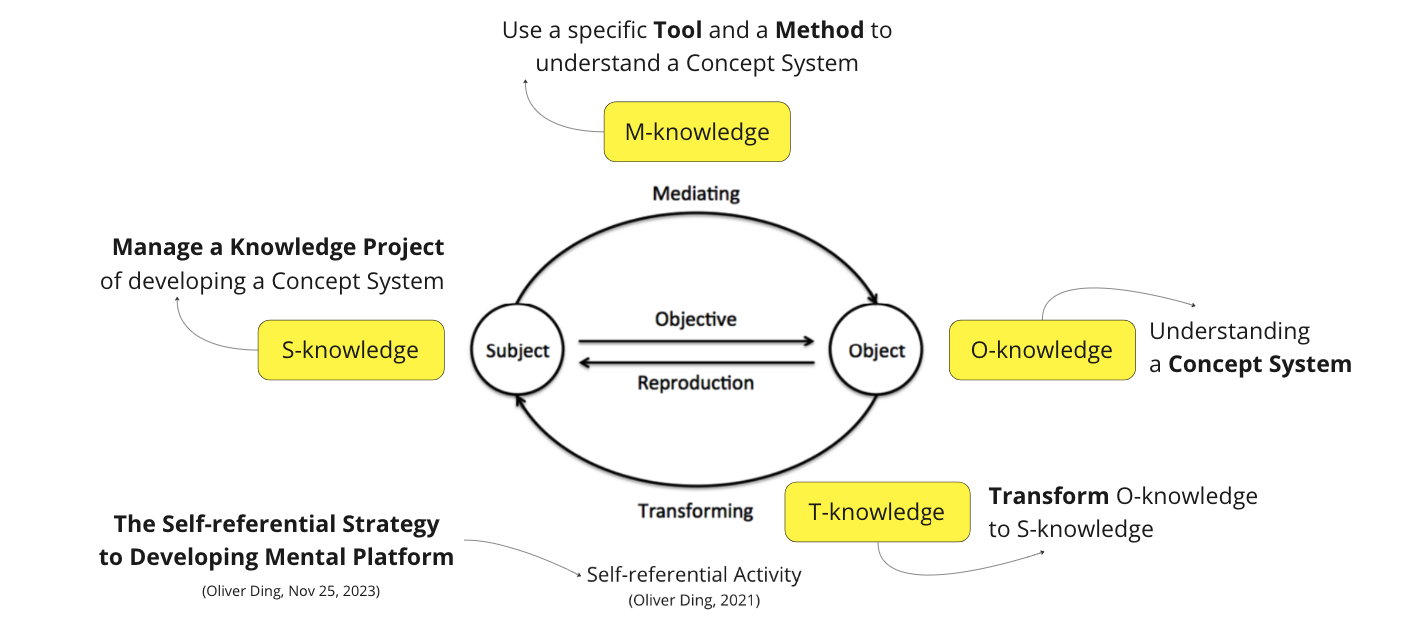
The model presented here is termed “Self-referential Strategy for Developing a Concept System.” Setting aside terms like “mental platform,” let’s concentrate on the essence of Concept Systems.
The model identifies four types of personal knowledge essential to building a Concept System.
- S-knowledge
- O-knowledge
- M-knowledge
- T-knowledge
S-knowledge refers to knowledge for self-awareness, self-improvement, self-regulation, and strategies for life discovery and management. In this context, it refers to Managing a Knowledge Project of Developing A Concept System.
O-knowledge refers to knowledge about the object of the work. For example, if the work is building a house, the O-knowledge is about how to build the house. In this discussion, O-knowledge refers to understanding a Concept System.
M-knowledge refers to knowledge about using tools and methods. For example, the skills of using some tools to build the house. For the present discussion, it means using a specific tool and a method to understand a concept system.
T-knowledge refers to knowledge about transforming O-knowledge to S-knowledge.
This model is relevant for the “Theory as Enterprise” practice. More details can be found in Self-referential Strategy for Developing Mental Platform and The Strategic Life Narrative Practice #0 (Introduction).
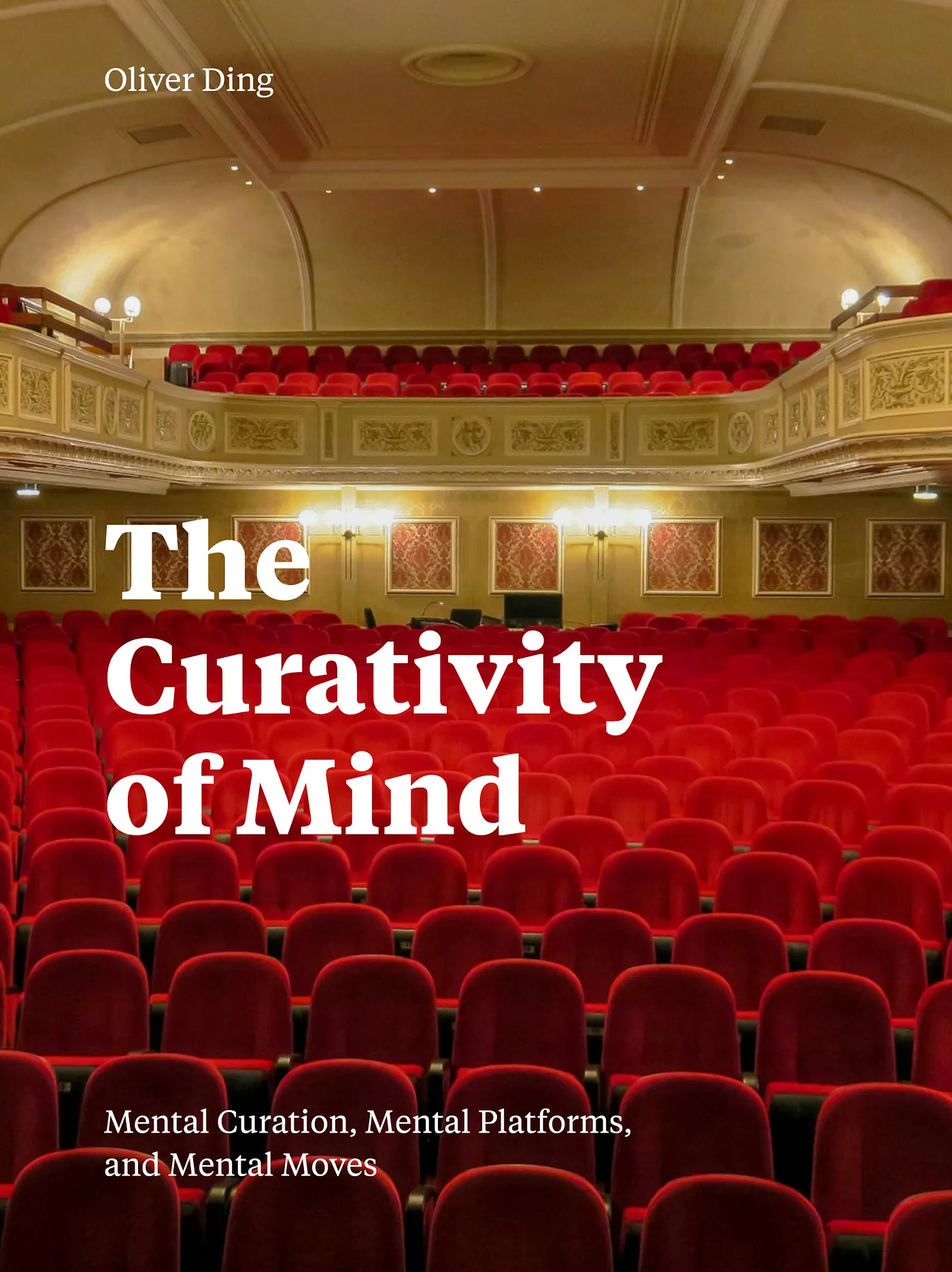
The Curativity of Mind
Mental Curation, Mental Platforms, and Mental Moves
The possible book is part of the Creative Life Theory (v3.0) project.
After reviewing the Creative Life Theory (v3.0) project and the development of the “Curativity of Mind” theme, I highlight the main parts of the book: Mental Curation, Mental Platforms, Mental Moves, and the Weave-the-Mind toolkit.
- December 13, 2025
For readers who want to grasp the essential frameworks quickly, I recommend prioritizing the following recent works:
Start Here:
- This Introduction: The Curativity of Mind: Function, Context, Knowledge, and Activity (Prologue)
Core Chapters:
- Chapter 6: The Art of Mental Curation
- Chapter 13: Building a Mental Platform
- Chapter 17: Mapping the Curativity of Mind
- Chapter 25: The Toolkit of Weave-the-Mind
- Chapter 29: Weave the Concept: Mental Elements, Mental Models, and Mental Platform
Applications:
- Chapter 31: The “Curativity” Perspective on Decision-making
- Chapter 31: [Situational Map] Knowledge System, Mental Platform, and Strategic Agency
End Here:
These articles together provide a complete view of the Mental Curation, Mental Platform, and Mental Moves frameworks, along with their practical applications through the Weave-the-Mind toolkit. If you wish to explore the historical development, detailed case studies, or specific applications beyond these foundational frameworks, the full table of contents will guide you to articles of particular interest.
Some numbers about v1.0 of the possible book:
- 7 parts
- 36 chapters
- 66 articles
- 763 minutes of reading time
- 202,195 words (about 404 single-spaced pages)
The “Function — Context — Knowledge — Activity” Framework
This framework was introduced in The Curativity of Mind.
- December 13, 2025
The primary theme of the new possible book is the mind.
What is the mind?
For over a century, psychologists have approached this question from many angles. Yet across diverse fields — from Gestalt perception to Piagetian development, from Jungian individuation to narrative identity — a common theme emerges:
Mind constantly organizes pieces into meaningful wholes.
- Gestalt psychologists discovered that perception doesn’t simply register sensory data — it organizes elements into coherent forms.
- Piaget showed that cognitive development doesn’t simply accumulate knowledge — it integrates experiences into increasingly complex structures.
- Jung revealed that psychological maturity doesn’t simply resolve conflicts — it achieves integration of the whole personality.
- Bruner demonstrated that identity doesn’t simply record life events — it weaves them into coherent narratives.
- Frankl argued that human existence doesn’t simply unfold — it seeks to discover unified meaning.
Despite using different terms — gestalt, schema, integration, narrative, meaning — these traditions converge on one insight:
The essence of mind is mental curation.
Mind is not merely a processor of information (the computational view). Mind is fundamentally an organizer of wholes — constantly turning scattered pieces of experience, knowledge, and action into meaningful patterns.
This is the curativity of mind.
Yet psychology has never fully articulated this insight. Each field sees one aspect — perceptual organization, cognitive integration, personality wholeness, narrative coherence — without recognizing the common principle.
This new book makes that principle explicit. It develops a comprehensive framework for understanding the mind as a mental curation activity across extended time periods — from momentary perception to lifelong creative enterprises.
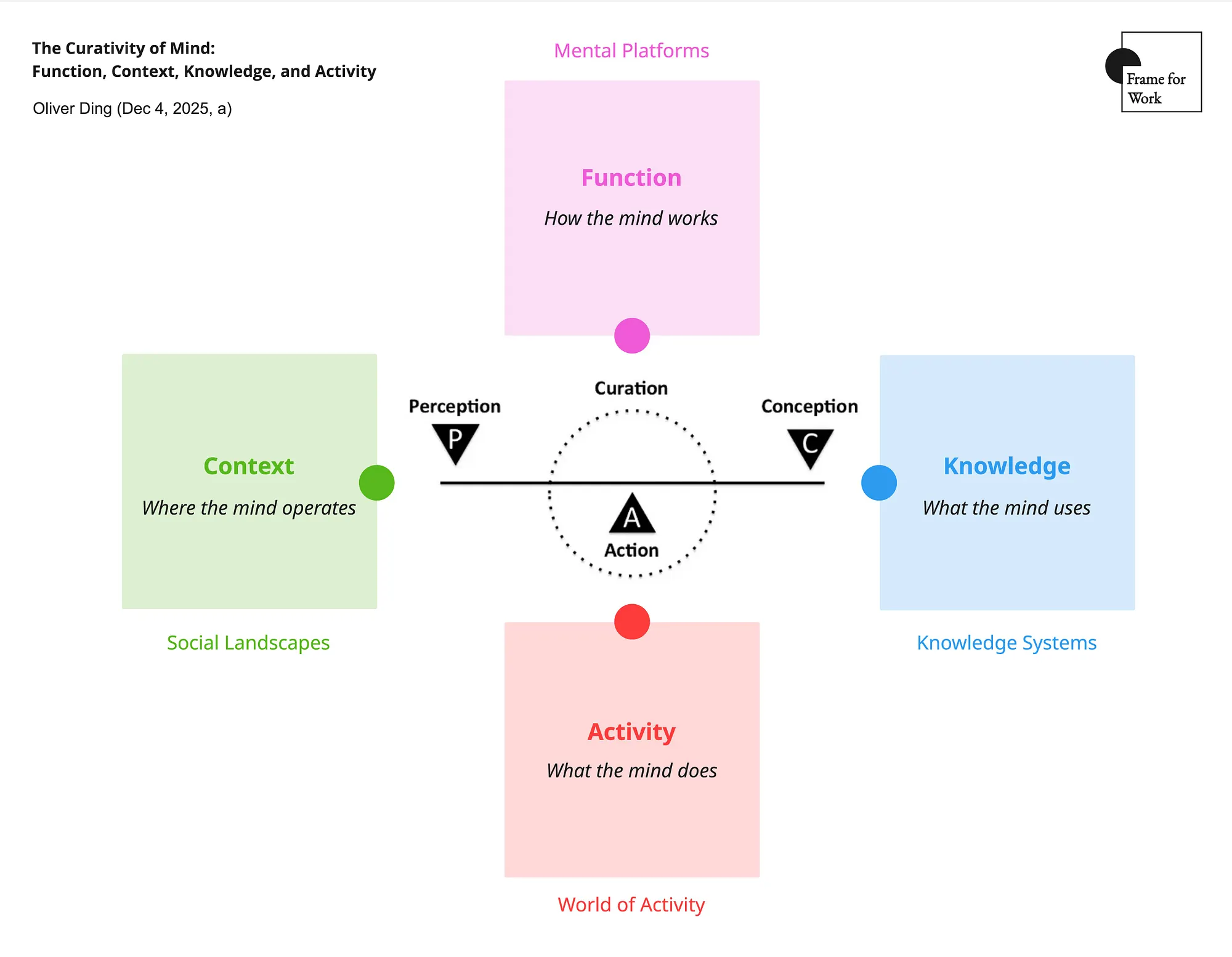
At the core of the framework is the “Perception — Action — Conception — Curation” schema. Researchers often discuss mind-related topics using the keywords “perception, conception, and action.” From the perspective of Curativity Theory, I propose expanding the foundation of these mind-related topics from three to four keywords. See the diagram below.

- Perception: How we sense and experience the world
- Conception: How we understand and think about the world
- Action: How we engage with and change the world
- Curation: How we turn pieces into meaningful wholes
The addition of Curation as a fourth foundation reflects a key insight: mind is not merely passive (perception) or active (action) or representational (conception). Mind is fundamentally curatorial — constantly selecting, organizing, integrating, and synthesizing experiences, concepts, and actions into coherent wholes.
This curatorial function operates across all three traditional foundations:
- In Perception, Curating sensory experiences into meaningful patterns.
- In Conception, Curating concepts into knowledge frameworks.
- In Action, Curating actions into purposeful projects.
Curation is thus both a fourth foundation and a meta-function that synthesizes the other three.
I originally named the above diagram “Epistemology of Curation.” I now refer to it as the “Curativity of Mind.”
The model above serves as a meta-framework, providing inspiration and guidance for the creation of various knowledge frameworks. The curatorial perspective allows us to see how mental elements, models, and platforms emerge through ongoing processes of organizing pieces into wholes — whether those pieces are perceptions, concepts, or actions.
Based on the core, I used the “Function — Context — Knowledge — Activity” schema to expand it into a practical framework for the Creative Life Theory (v3.0) project.
The framework is built on four dimensions:
- Function: How the mind works (by curating)
- Context: Where the mind operates (in social landscapes)
- Knowledge: What the mind uses (conceptual systems)
- Activity: What the mind does (developmental projects)
Over the past several years, I have been exploring relevant ideas in various knowledge projects. By using the “Function-Context-Knowledge-Activity” schema as a meta-framework, I can curate my articles on Mental Curation, Mental Platform, and Mental Moves into a new book.
Meta-frameworks
Creative Heuristics for Individual and Social Development
Moving beyond traditional views of meta-frameworks as purely cognitive instruments, this book situates them within the social world. It examines how meta-frameworks function as creative heuristics — how they are formed, tested, revised, and sometimes outgrown — and how these processes support both individual creative life and broader cultural development.
- Dec 31, 2025
On December 19, 2025, I released version 3.0 of the History{Life[Self(Body)]} framework (also known as the HLS framework), utilizing it as a meta-framework for the Meta-frameworks project.
After connecting the new framework (v3.0) with the Meta-frameworks project, I realized that the following four concepts represent the Four Mechanisms of Cultural Development:
- Mental Moves
- Social Moves
- Strategic Curation
- Generative Narrative
On December 21, 2025, I created the Weave-the-Culture Model to highlight these four mechanisms.
The central object of these four mechanisms is the Cultural Framework, which is a type of concept system. The central context is not only the Cultural System, but all five systems as a whole.
The “Four Mechanisms of Cultural Development” view is similar to the Context (Mind) view adopted in The Curativity of Mind; the two projects can be understood as mirror strategies, neither confined to traditional boundaries.
The development of Cultural Frameworks is situated not only within the Cultural System but also across the Mental, Behavioral, Historical, and Body Systems as a whole.
Starting in December 2024, I gradually shifted from Knowledge Engagement to Cultural Development. Over the past 12 months, I have worked on several projects related to Cultural Development, such as the Tiny Culture project (see the diagram below), the “Culture as Thematic Enterprise” Framework, the Frame-for-Work Canvas, and the Cultural Projection Model (2025).
On December 20, 2025, I formally started the Meta-frameworks project. After reflecting on the landscape, the journey, and the situation, I wrote three new articles to set the theoretical foundation for the new possible book:
- The History{Life[Self(Body)]} Framework (v3.0) — Part 1, Part 2, Part 3
- Six Faces of the Concept System
- Weave the Culture: One Meta-Framework and Four Mechanisms of Cultural Development
Finally, centered around the Weave-the-Culture Model, I curated a series of related knowledge models and methods, forming a comprehensive Weave-the-Culture toolkit.
Building on these foundational works, the new possible book, Meta-frameworks: Creative Heuristics for Individual and Social Development, is designed as eight parts:
- Preface: Creative Heuristics for Individual and Social Development
- Introduction: Theoretical Foundation
- Part 1: Frame for Frame — Historical Development
- Part 2: The “Self-Life-Mind” Journey and Reflection
- Part 3: Mental Moves
- Part 4: Social Moves
- Part 5: Strategic Curation
- Part 6: Generative Narrative
- Part 7: Embodied Social Forms
- Part 8: Create, Curate, and Weave
- Epilogue: Beyond Creative Life
Version 1.0 of the possible book collects new articles on the theoretical foundations, along with related articles I have written over the past several years. This collection also functions as a knowledge curation, weaving together insights developed across different projects into a coherent and meaningful whole.
Some numbers about v1.0 of the possible book:
- 8 parts
- 24 chapters
- 86 articles
- 1,494 minutes of reading time
- 395,910 words (about 792 single-spaced pages)
- Introduction
One Half-Year, Eight Possible Books (2026)
- July 10, 2026
Looking back at the first half of 2026, I've now released eight possible books:
- #1 — Lake 42: The Great Confluence (Feb 18, 2026)
- #2 — Anticipatory Cultural Sociology: Creation, Projection, and Agency (March 30, 2026)
- #3 — Revisiting and Rebuilding: A Strategy for Creative Identity Development (April 6, 2026)
- #4 — Weave the Life: The Life-as-Activity Approach (v4.0) and Personal Knowledge Ecology (April 30, 2026)
- #5 — Weave the Theory: The Art of Theoretical Activity and Knowledge Ecology (May 14, 2026)
- #6 — Appropriating Activity Theory: A Decade of Engaging with a Century-Old Tradition (June 10, 2026)
- #7 — Supportance: Self, Other, and Possible Support (June 29, 2026)
- #8 — Strategic Developmental Psychology: Situation, Gejunction, and Supportive Self-Actualization (July 9, 2026)
A note on what "Possible Book" means. These books are not written for formal commercial publication. They are a medium I use to close out a knowledge project, or to take stock of a knowledge enterprise at a particular stage — each one usually curated from a cluster of already-published articles.
Editing a possible book forces me to switch from a Creativity state to a Curativity state — the two diachronic lines I lay out in the Weave the Theory model itself. (The details are in the book of the same name.)
Most of this half-year's work grew out of the theoretical platform that took shape in the closing chapters of Lake 42 — first named the World of Life (World of Activity) Approach, and now carrying a simpler name: GO Theory.
I'm using a Spatial Heuristics series to trace how GO Theory, as a platform, has supported the development of both ACS and SDP. Two articles so far:
- Spatial Heuristics: From the Margins to the Center
- Spatial Heuristics: Developing a Pedagogy for Cognitive Hydrology
Weave the Theory
The Art of Theoretical Activity and Knowledge Ecology
- May 14, 2026
In March 2026, the Weave 42 project produced a methodological document that systematized the full Weave knowledge system: its Basic Form, its derived frameworks, its application strategies, and the relationships among its components. Weave 42 marked a shift from developing the framework to deploying it — from building the instrument to using it in sustained analytical work.
That deployment began in earnest in April 2026, with the first wave of Weave-the-Theory case studies. The Revisiting–Rebuilding practice, the Creative Watershed pattern, the Curativity knowledge enterprise, the AAS framework, and the Life-as-Activity Approach were each analyzed through the Weave-the-Theory lens, producing not only case studies but new analytical tools. By the end of April, the toolkit had a first version. Through May, the Activity Theory series extended and deepened that toolkit, adding the Genidentity Analysis Method, the Sandglass Model at the collective scale, Supportance Analysis, and a set of emerging concepts. Chapter 4 of this book documents the full toolkit and its development history.
The framework that began as a structural diagram in September 2025 had become, by May 2026, a living analytical practice — one that continues to develop through the cases it is used to analyze.
Theoretical activity is a special type of human activity. It encompasses the full range of practices through which creators engage with theoretical knowledge: building theories, developing frameworks, curating existing concepts, integrating traditions, and theorizing about observed phenomena. What distinguishes theoretical activity from other forms of knowledge work is not its subject matter but its orientation: it is activity that takes theoretical knowledge itself as its object.
I have been studying theoretical activity as a distinctive type for several years — not only as a general category, but through sustained engagement with specific cases. This book is the first comprehensive presentation of that work.
Three concepts are central to understanding theoretical activity at different scales.
Theoretical Enterprise names the sustained, project-based trajectory through which an individual creator develops a theoretical framework over time. It is theoretical activity from the inside — the subjective experience of building, extending, and returning to a body of theoretical work across years and decades. A theoretical enterprise has a guiding theme, a developing concept system, a body of material artifacts, and a developmental trajectory. The Curativity enterprise, the AAS framework, and the Life-as-Activity Approach are all theoretical enterprises in this sense: each organized around a thematic commitment, each developed through a series of projects, each producing a distinctive knowledge ecology.
Theoretical Tradition names the collective, multi-generational process through which a shared theoretical project develops across many contributors. It is theoretical activity from the outside — the objective process of a tradition unfolding through the developmental episodes of its contributors. A theoretical tradition has a Meta-framework (core concept systems and a coordination mechanism), a Thematic Enterprise (the full social and historical extension of the tradition's work), and a developmental arc that can be traced through the contributions of successive generations.
Theoretical Platform names what a theoretical tradition becomes when it has reached sufficient maturity to actively support the work of others — not merely as a resource to be drawn upon, but as a structured environment within which new theoretical enterprises can themselves develop. A Theoretical Platform has established its Essential Differences, built a broad social network, and accumulated enough Material artifacts to function as a developmental environment for contributors who may never have met its founders.
Activity Theory is the primary case study for all three concepts in this book. As a Theoretical Tradition, it has been developing for nearly a century — from Vygotsky's cultural-historical psychology in the 1920s through Leontiev's activity approach, Engeström's activity system model, Blunden's interdisciplinary theory, and the ongoing work of contributors across the world. As a Theoretical Platform, it reached its mature form by 1999, when the publication of Perspectives on Activity Theory declared it an interdisciplinary approach to the human sciences and opened its Work Deeply and Play Widely stages to a global community of researchers. The individual contributors analyzed in Part 3 of this book — Engeström, Nardi, Spinuzzi — each represent a different mode of engaging with Activity Theory as a Developmental Platform: developing its core framework, performing its second founding for a new community, and extending it through third-wave dialogue with other traditions.
This book is the most concentrated presentation to date of my research on theoretical activity as a distinctive domain. The cases range from individual theoretical enterprises developed over years to a large-scale theoretical tradition developed over a century. Together, they demonstrate that theoretical activity — whatever its scale, whatever its subject matter — follows recognizable structural patterns that can be analyzed, compared, and learned from.
The Weave-the-Theory Framework (v1, 2025)
The framework is the primary model of Weave the Theory: The Art of Theoretical Activity and Knowledge Ecology.
Over the past few years, I have worked on connecting theory with practice and developing knowledge frameworks. Eventually, I also studied how theorists develop their theories. While theorists always deal with abstract ideas, what they do can be considered a type of activity. I call this special type of activity Theoretical Activity, which encompasses activities such as building theories, theoretical curation, theory integration, and theorizing. I also distinguish between the individual cognitive level of theoretical projects and the collective, collaborative level involved in building a theoretical enterprise. Both levels belong to Theoretical Activity.
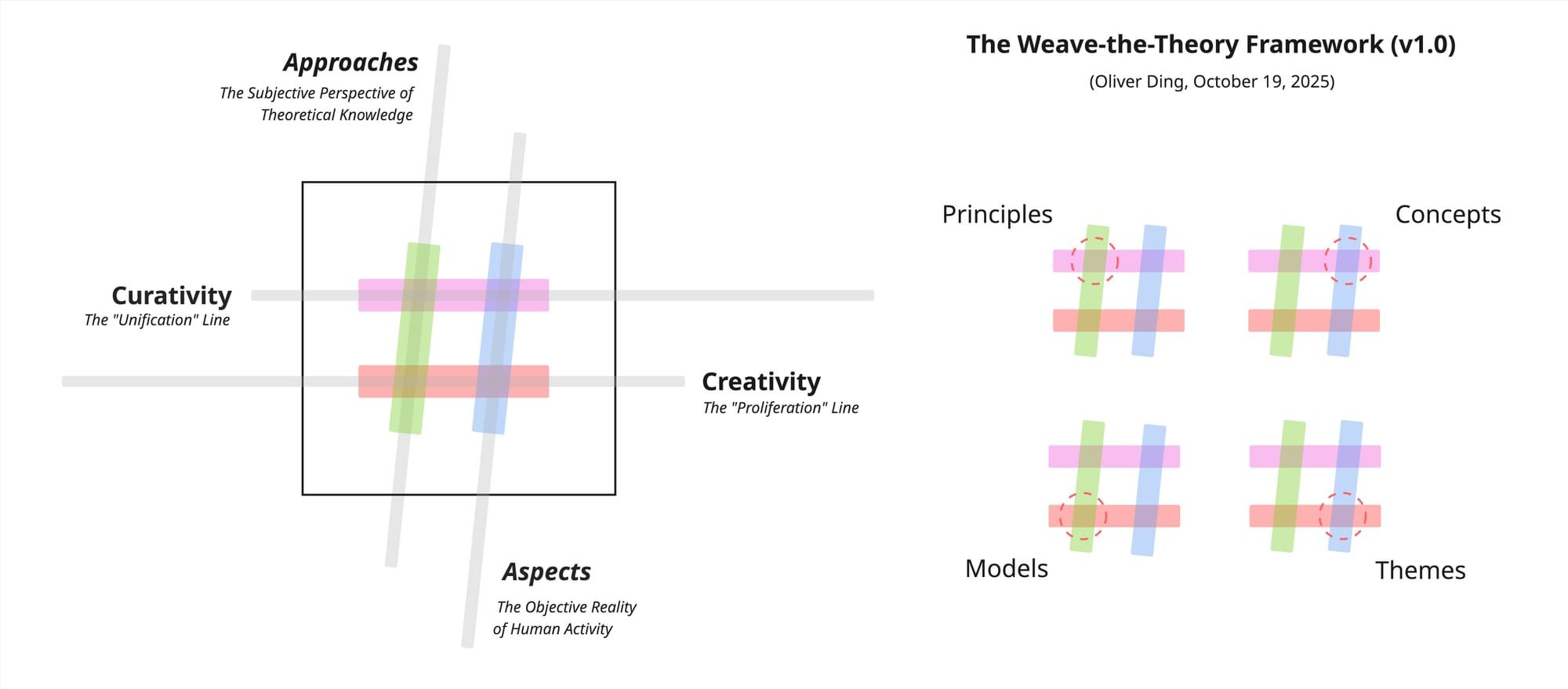
The diagram above provides an abstract model of Theoretical Activity, applied at both the individual and collective levels. It visualizes how theoretical work unfolds across cognitive and social dimensions, offering a conceptual map for understanding the structure and dynamics of theorizing as an activity.
In this model, two diachronic dimensions are defined as follows:
- Creativity: The "Proliferation" Line, representing the expansion and generation of new ideas.
- Curativity: The "Unification" Line, representing the integration and synthesis of existing ideas.
In general, any theory aims to explain practice. This tendency can be divided into two focal objects: Approaches and Aspects.
- Aspects: The objective reality of human activity
- Approaches: The subjective perspective of theoretical knowledge
There are many types of knowledge elements within theoretical approaches. For the Weave-the-Theory framework, I focus on the following four:
- "Principles"
- "Concepts"
- "Models"
- "Themes"
They are assigned to four weave-points, providing a mapping tool for further case studies.
Supportance
Self, Other, and Possible Support
- June 29, 2026
Though the Ecological Practice Approach centers on the people–environment relationship, I did not begin with a theory of social environment. Instead, I worked on developing a series of affordance-like concepts to describe different types of potential action opportunities — Curativity, Attachance, Supportance, Projectivity, and Genidentity — and then tested them across various fields.
In the past several years, this journey produced a series of book drafts, documenting the outcome of the approach and of each concept.
The recently developed Supportance-RelationField framework — particularly its application in the field of Intimate Relationships — inspired me to edit this new book, reflecting on the development of Supportance Theory and its current landscape. Unlike earlier book drafts, which focused on whole frameworks or other individual concepts, this book is the first to treat Supportance Theory as a subject in its own right.
This new book marks a watershed:
- Before: the "Supportance Theory" journey, focusing on theoretical development
- After: the "Supportance Analysis" journey, focusing on applications
This watershed is also a milestone for the Ecological Practice Approach and the GO Theory project. The completion of Supportance Theory establishes a foundation for other theoretical enterprises within the GO Theory platform — for example, the Supportance-RelationField framework has been adopted as part of the concept of Gejunction, which will become a foundational framework for the Strategic Developmental Psychology (SDP) project.
This book is organized into seven parts:
- Preface: One World, However Diverse
- Part 1: The Concept of Supportance
- Part 2: Modeling Social Environments
- Part 3: Women's Search for Supportance
- Part 4: Theoretical Platform
- Part 5: Supportive Life Discovery
- Part 6: Thematic Supportance
- Part 7: The Concept of Leeway
- Epilogue: The Future of Supportance Analysis
- Introduction and Table of Contents
Strategic Developmental Psychology (v2.0)
Situation, Gejunction, and Supportive Self-Actualization
- July 9, 2026
On July 9, I released a new possible book: Strategic Developmental Psychology: Situation, Gejunction, and Supportive Self-Actualization (SDP v2.0).
The book is organized into seven parts: Theoretical Psychology Revisited, Psychological Knowledge Engagement, Journey and Gejunction, Supportive Self-Actualization, Gejunction, Creative Engagement, and Agency and Mind. The most significant advance in v2.0 is structural: alongside the three irreducible complexities that anchored the earlier v1.2 landscape — Anticipation, Performance, and Relevance — a fourth complexity, Mind–Body, has now entered the framework. This addition is not an afterthought; it is where two previously separate lines of exploration, the Curativity of Mind and an ecological account of strategic cognition, converge with SDP.
The conceptual center of the new manuscript is Gejunction — the Unit of Synthesis within GO Theory. Gejunction weaves the diachronic structure of past–present–future together with the synchronic structure of social relations into a single meeting-point framework, and it gives SDP something it did not fully have before: theoretical independence from ACS. Around Gejunction, the book also gathers several recent developments — RelationField v3.0, Living Coordinate, and the Weave-points — into a coherent whole.
Everything in the book eventually points toward one question: what is this whole apparatus of situations, junctions, anticipatory modeling, and relational support actually for? The answer is Supportive Self-Actualization — across a three-layer architecture of Self (sub-individual, individual, and supra-individual), the ongoing anticipatory activity through which a self, in the company of others, moves from ecological potential toward realized actuality. That is both where the theoretical apparatus of SDP arrives, and where the book itself lands.
The book is organized into seven parts. Their sequence is intentional, but not all parts need to be read in order. A detailed reading guide follows this overview.
- Preface: One World, Many Dreams
- Part 1: An Investigation of Theoretical Psychology
- Part 2: Psychological Knowledge Engagement
- Part 3: Journey and Landscape
- Part 4: Supportive Self-Actualization
- Part 5: Gejunction
- Part 6: Creative Engagement
- Part 7: Agency and Cognition
- Introduction and Table of Contents
Gejunction in the Wild (Collection, v1, 2026)
- August 31, 2026
This is a thematic collection about the "Gejunction" concept, a Unit of Synthesis within GO Theory.
This collection is not a presentation of a mature method. It is a record of an exploration—a case study of a theorist in transition, using his own theoretical tools to understand his own situation, in real time. It documents the emergence of a potential analytical framework, laying the groundwork for what we might eventually call the Gejunction Analysis Method.

On June 16, 2026, a significant theoretical moment occurred. On that day, two developmental lines within the GO Theory platform—one searching for a precise English equivalent of the Chinese concept geju (格局), the other maturing four analytical structures on their own independent timelines—formally converged. The convergence yielded Gejunction: GO Theory's unit of synthesis, grounded in the History{Life[Self(Body)]} Framework (HLS), comprising four aspects—Weave-points, Living Coordinates, RelationFields, and Thematic Spaces.
Gejunction is a platform-level concept. It was not designed for any single theoretical enterprise such as SDP (Strategic Developmental Psychology); it is GO Theory's own unit of synthesis, made available to any enterprise built on the platform. It answers a specific question: How can a person's overall social standing be understood as a single, synthesized configuration rather than a decomposed set of variables? Crucially, this standing itself carries a potential dimension—relations not yet activated, positions not yet occupied, meanings not yet drawn out—which is precisely what a theory of strategy requires.
Yet, Gejunction had not been "used" in practice after its birth. It had been defined, elaborated, and placed within the theoretical architecture, but it had not yet been applied to a real, living, unscripted case.
August 2026 filled that gap.
Throughout the month, I produced a series of diagrams. Each served a different purpose—one traced how my theoretical system might extend into practice (Knowledge for Development), another mapped the direction of the AAI project (Living Coordinate), a third positioned AAI's knowledge niche between psychology and qualitative sociology (ECHO Way), a fourth mapped the creative landscape and identified the Phase III direction (GO Theory Phase III). At some point in mid-August, I realized: these diagrams were not random musings; they were spontaneous articulations of Gejunction's four aspects. I was using my own theoretical tools to understand my own situation—using Gejunction to observe the occurrence of Gejunction itself.
That is what "in the Wild" means. This is not a pre-designed analytical project with a research protocol, control variables, or standardized data collection. It is a theorist in real life, using a freshly proposed framework to understand a transition he is living through—a wild, unpolished, real-time case study.
World of Activity
An Ecological Approach to Activity Analysis and Intervention (AAI)
- September 14, 2026
This is the introduction of a new possible book: World of Activity: An Ecological Approach to Activity Analysis and Intervention (AAI).
World of Activity refers to the individual’s world within social life. The World of Activity approach takes this individual perspective as its starting point.
The book aims to provide a systematic view of the World of Activity Approach for AAI Analysts, helping them understand its foundational modules — such as the Ecological Formism meta-framework, the Coordinate-Center-Gejunction Framework, and the AAI method.
For other readers, the book is also a guide to exploring the approach — especially by applying the FFCC model (Flow-Focus-Center-Circle) to understand individual life development, or for whatever purpose they bring.
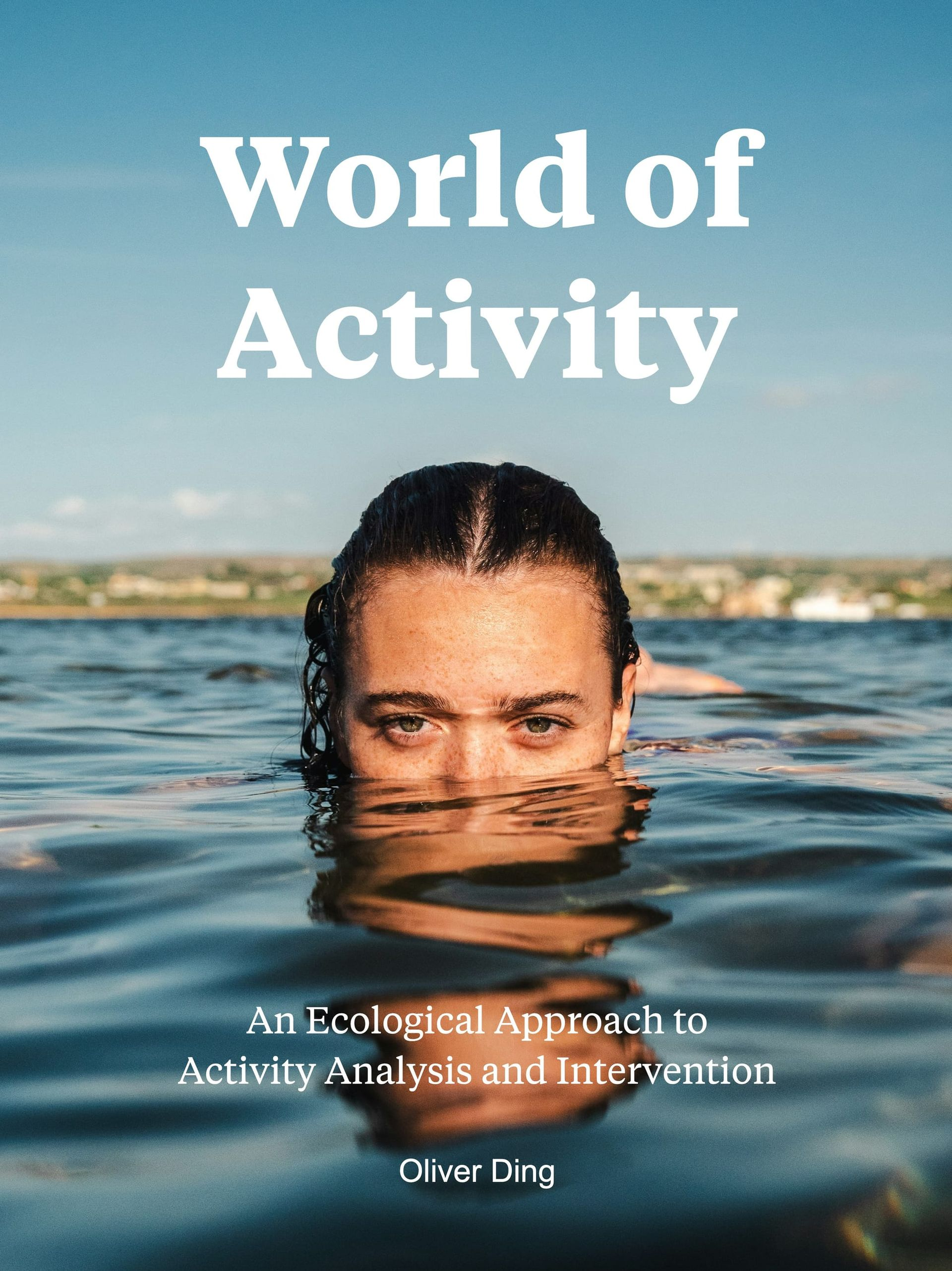
This possible book has 7 parts:
- Part 1: Theoretical Foundations
- Part 2: The FFCC Model
- Part 3: Thematic Maps as Toolkits
- Part 4: Living Coordinate
- Part 5: Gejunction
- Part 6: Case Studies and Emergent Insights
- Part 7: Activity Analysis and Intervention (AAI)
Some numbers about v1.0 of the possible book:
- 7 parts
- 23 chapters
- 56 articles
- 884 minutes of reading time
- 234,212 words (about 469 single-spaced pages)
- Introduction and Table of Contents
v1.0 - September 29, 2026 - 5,965 words