
The Weave-the-Strategy Toolkit (v1.0, 2026)
by Oliver Ding
September 29, 2026
The concept of Thematic Space does not remain at the abstract level. It appears in a series of toolkits, in the form of models and knowledge frameworks; these tools are the concrete ways in which the concept works in practice.
In October 2025, I introduced the Weave-the-Strategy Framework (v1.0), which curates several sub-models of my Strategic Life Theory around four concepts: Thematic Space, Social Landscape, Strategic Agency and Creative Workfield. Based on this framework, this article presents a three-level toolkit:
- Level 1: the Weave-the-Strategy Model
- Level 2: the Creative Workfield Map (the House of Slow Cognition)
- Level 3: the Thematic Map Method (also called Thematic Mapping)
The Thematic Map Method has been used to make the thematic maps of the past several years, and these maps led to a series of case studies of mental moves, social moves and strategic moves.
1. Weave-the-Strategy: Understanding Strategic Moves
Weave-the-Strategy belongs to the Weave-the-Mind toolkit, and the Weave-the-Mind toolkit belongs to the Mental Platform sequence. But Weave-the-Strategy is a comprehensive model specifically for understanding Strategic Moves.
The core definition of Weave-the-Strategy: Strategy as a process of Slow Cognition, encompassing both mental moves across thematic spaces and social moves across social landscapes.
The Weave-the-Strategy Framework uses the Weave diagram to curate several sub-models of Strategic Life Theory. It is a derived form of the Weave Basic Form, introduced on October 9, 2025, and its version 1.0 is dated October 15, 2025. In every Weave diagram, horizontal lines are diachronic and vertical lines are synchronic; a weave-point is where one of each crosses. In this framework the two vertical lines are the synchronic layouts of two kinds of Moves. The two horizontal lines are the diachronic lines this version considers.
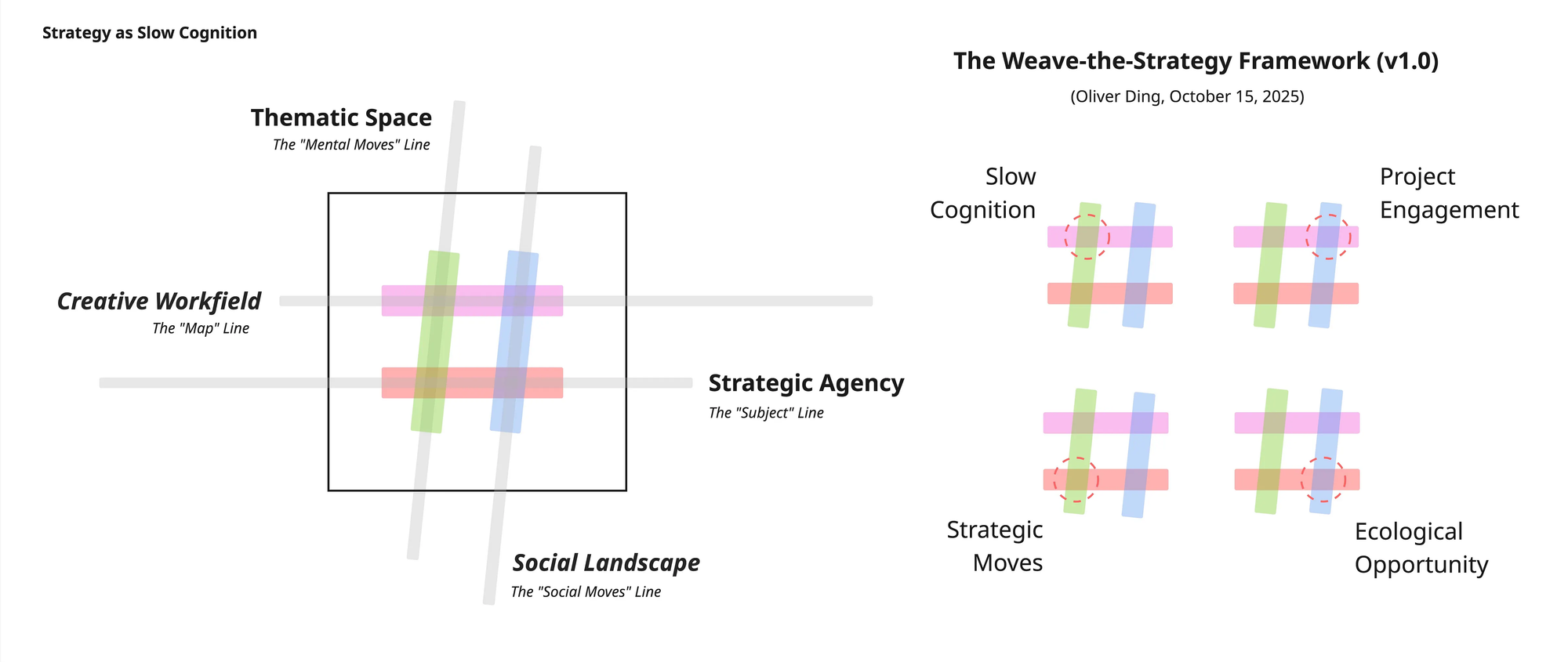
The model has four dimensions:
- Thematic Space → "Mental Moves" Line
- Social Landscape → "Social Moves" Line
- Strategic Agency → "Subject" Line
- Creative Workfield → "Map" Line
Thematic Space, the "Mental Moves" line. The line is the synchronic spatial configuration of mental moves, understood through Thematic Space. The concept comes from the Mental Moves book draft of 2023, which describes moving between Thematic Spaces and binds Thematic Space to Attachance. In the Thematic Space Toolkit (v1.0, 2025) the same pairing appears as two of its nine slots: Maps → Thematic Spaces and Moves → Attachance.
Social Landscape, the "Social Moves" line. The line is the synchronic spatial configuration of social moves, related to Social Landscape. It comes from the Social Moves book draft of 2023, on moving between Social Landscapes.
Creative Workfield, the "Map" line. The line is a meta-map, the House of Slow Cognition, taken up at level 2.
Strategic Agency, the "Subject" line. The aspects of agency were first introduced as eight in Advanced Life Strategy (late 2022), later extended to nine, and became the core model of Strategic Life Theory.
The concept of "Strategic Agency" refers to nine aspects of strategic action, featured in my 2025 book draft, Strategy as Curation:
- Anticipating
- Performing
- Discovering
- Producing
- Modeling
- Unfolding
- Storytelling
- Curating
- Perceiving
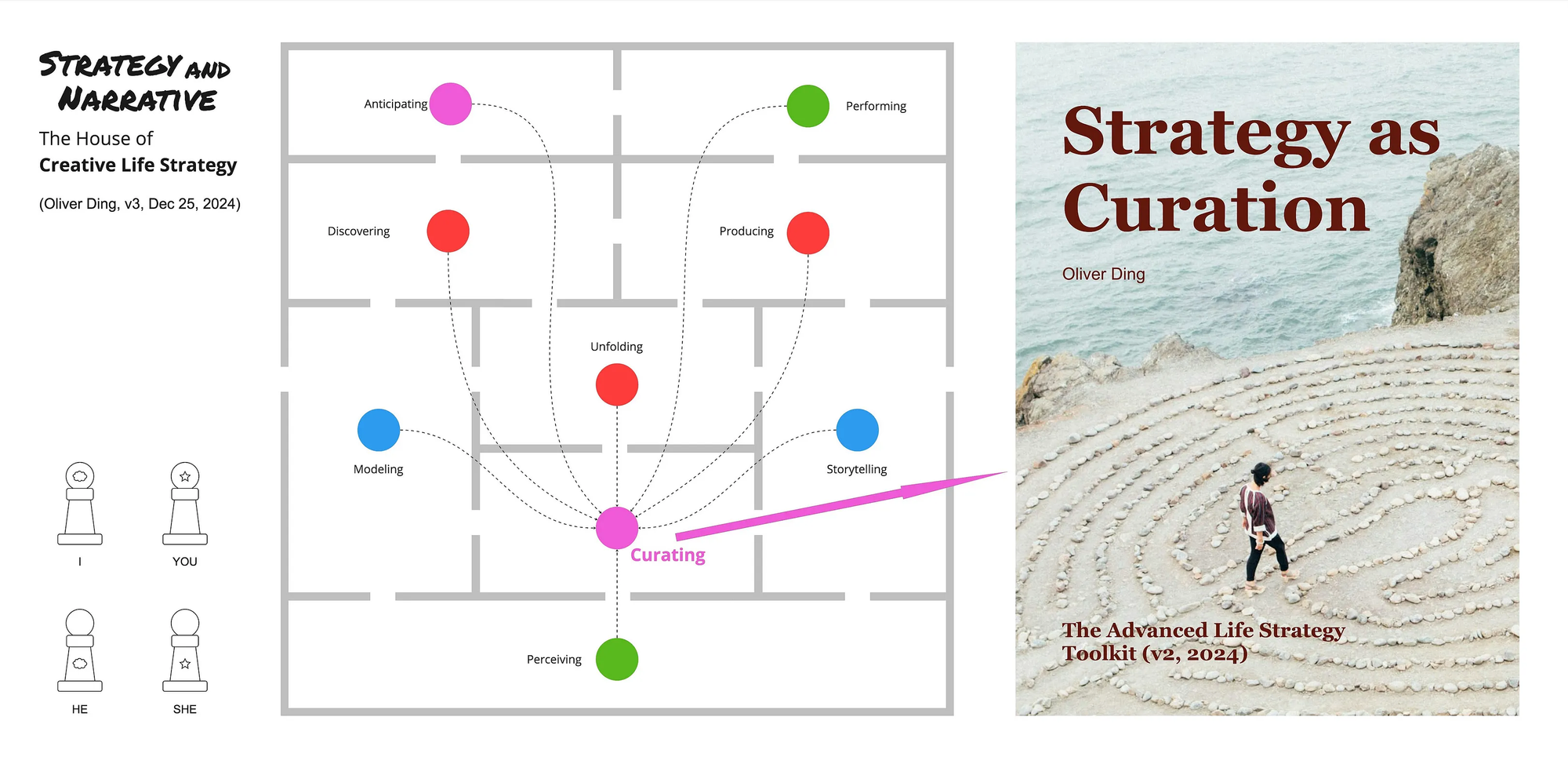
These nine aspects are assigned to four groups, corresponding to the four entities of the Curativity of Mind:
- Action: Discovering, Producing, Unfolding
- Perception: Perceiving, Performing
- Conception: Modeling, Storytelling
- Curation: Anticipating, Curating
Strategic Agency also fills a gap the Thematic Space Theory Toolkit (v1.0, 2025)left open. The Toolkit's Subjects slot holds Ecological Relevance because Thematic Space Theory has no theory of Subjects; on the Subject line of this framework, the concept is Strategic Agency.
The model consists of four Weave-points, each representing a structural nexus where one synchrony dimension intersects with one diachrony dimension:
- Thematic Space (Mental Moves) × Creative Workfield → Slow Cognition
- Thematic Space (Mental Moves) × Strategic Agency → Strategic Moves
- Social Landscape (Social Moves) × Creative Workfield → Project Engagement
- Social Landscape (Social Moves) × Strategic Agency → Ecological Opportunity
For this article, the "Slow Cognition" weave-point and the "Strategic Moves" weave-point matter because they are related to the Map-Move-Map schema. Level 2 and level 3 will unpack more details for understanding these two weave-points.
2. Creative Workfield: The House of Slow Cognition
Creative Workfield is the extension of the Map-Move-Model triad. In Weave-the-Strategy, Creative Workfield corresponds to the "Map" Line. It is a specific tool for Slow Cognition.
The concept of "Creative Workfield" refers to a thematic map: The House of Slow Cognition.
The Creative Workfield is a thematic map, the House of Slow Cognition, designed at the turn of 2025. It is a meta-map: it places the key concepts of slow cognition on one map, in seven rooms: Aspects, Attachances, Approaches, Maps, Models, Methods and Meanings. It integrates two earlier pieces, the 5A Slow Cognition Model (Aspirations, Aspects, Approaches, Attachances, Achievement) and the 5M method (Meaning, Moves, Map, Models, Methods). Slow Cognition here is the sense of Mind in the Toolkit: the long-term development of tacit knowledge and cognitive methods.
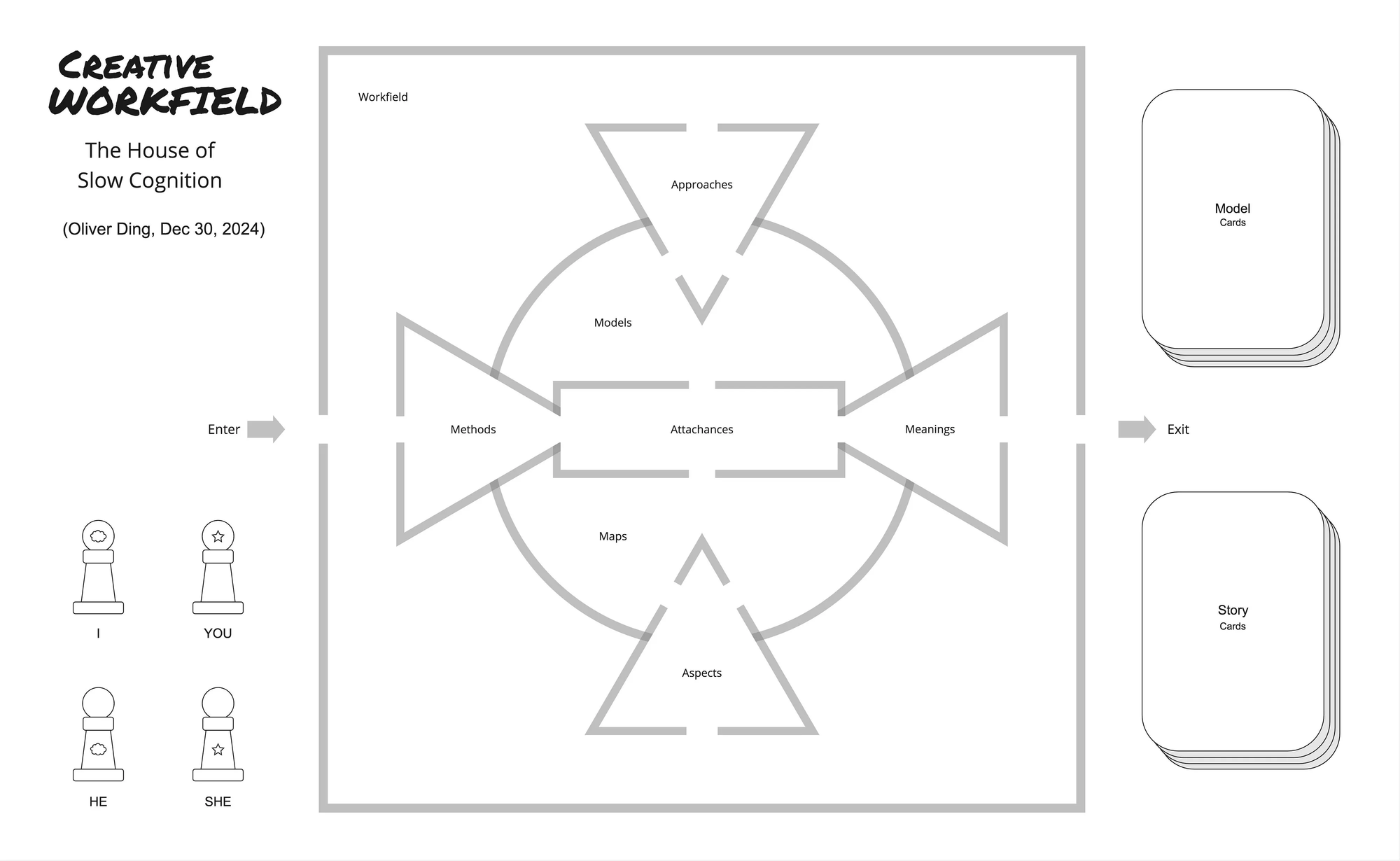
The 5M method has a worked example in Mapping Strategic Moves #14, the House of Creative Life Curation.
- Meaning: Achieving a creative life
- Moves: The real-life actions of creative life
- Maps: The House of Creative Life Curation, representing 12 key themes of the approach
- Models: The Lifescope Model, the Thematic Curation Framework, and the Creative Identity Engagement Framework
- Methods: The Creative Life Curation method, which uses Maps and Models to reflect on Moves
Creative Workfield provides the cognitive terrain and model tools for Mental Moves and Strategic Moves. It transforms the abstract structure of Thematic Space Theory into an operable work field. Through Creative Workfield, the knowledge worker can see the landscape of their cognitive activities, track their moves, and use models to interpret what they see.
The concept of Map, in any specific case, has its own thematic map. The Knowledge Discovery Canvas is one; the House of Knowledge Discovery and the House of Project Engagement are others. These case-level maps are the subject of level 3.
3. Thematic Map: Visualizing Knowledge Models as Maps
Thematic Mapping, the name the Toolkit gave to this practice, is the method for making a thematic map from a knowledge framework and developing relevant mapping methods. Its premise is the one set out in 1.1: a framework is a combination of Thematic Spaces, so it can be drawn.
Once visualized, a knowledge framework becomes a map, which can in turn be used to represent an individual's activity progress — and it is through this visualized, activity-tracking use that Thematic Space also connects to Social Moves. In practice, I choose a framework or model, take each of its concepts as a Thematic Space, lay them out on a canvas so that the whole becomes visible as a map, and then trace moves on the map.
A sequence of moves is a Path, and a map is richer than a single fixed structure: it holds many Paths. The Knowledge Discovery Canvas carries four such Paths: Robert Kegan's Knowledge Enterprise (2023), the Mental Moves Knowledge Project (2023), a Strategic Map for the Strategic Life Narrative (2024), and the House of Discovery and the Social Landscape Framework (2024). The previous article reads them Episode by Episode, in Part 4 of The Relationfield of Knowledge Engagement.
Thematic Space Theory employs thematic and knowledge maps to explore creative cognition, social cognition, and strategic cognition. In October 2025, I introduced the term "Creative Cartography" to describe this kind of practice. I also classified it into four purposes:
- Mapping Situational Themes
- Mapping Strategic Moves
- Mapping Social Landscapes
- Mapping Strategic Aspects
Four Houses serve as mapping tools:
- The House of Knowledge Discovery: For mapping the journey from themes to concepts—how we develop understanding of specific topics (Knowledge dimension).
- The House of Creative Life Curation: For mapping the curation of life experiences into meaningful narratives—how we organize our creative biography (Context dimension).
- The House of Project Engagement: For mapping engagement with developmental projects—how we navigate social landscapes through activities (Activity dimension).
- The House of Creative Life Strategy: For mapping strategic agency across nine aspects—how mental platforms guide enterprise development (Function dimension).
Together, these four Houses provide a comprehensive toolkit for mapping the Curativity of Mind across its four dimensions. Each House corresponds to one dimension, yet they all interconnect—just as the four dimensions themselves form an integrated whole.
The Thematic Map makes it possible for knowledge workers to "see" their cognitive terrain. It provides a visual reference for Mental Moves and strategic development.
4. Weave-the-Strategy in Context
Weave-the-Strategy is one framework within the Weave-the-Mind toolkit. The Weave-the-Mind toolkit is a member of the Mental Platform sequence. Placing Weave-the-Strategy within this larger context clarifies what it is for and how it relates to the development of a Mental Platform.
The Weave-the-Mind framework arranges its sub-frameworks along a developmental path: Meaning → Insight → Concept → Strategy (Decision). This progression illustrates how meaning evolves into insight, how insight forms concepts, and how concepts eventually support strategic decisions — a continuous movement from understanding to action. The sub-frameworks are:
- Weave the Meaning
- Weave the Insight
- Weave the Concept
- Weave the Strategy
- Weave the Decision
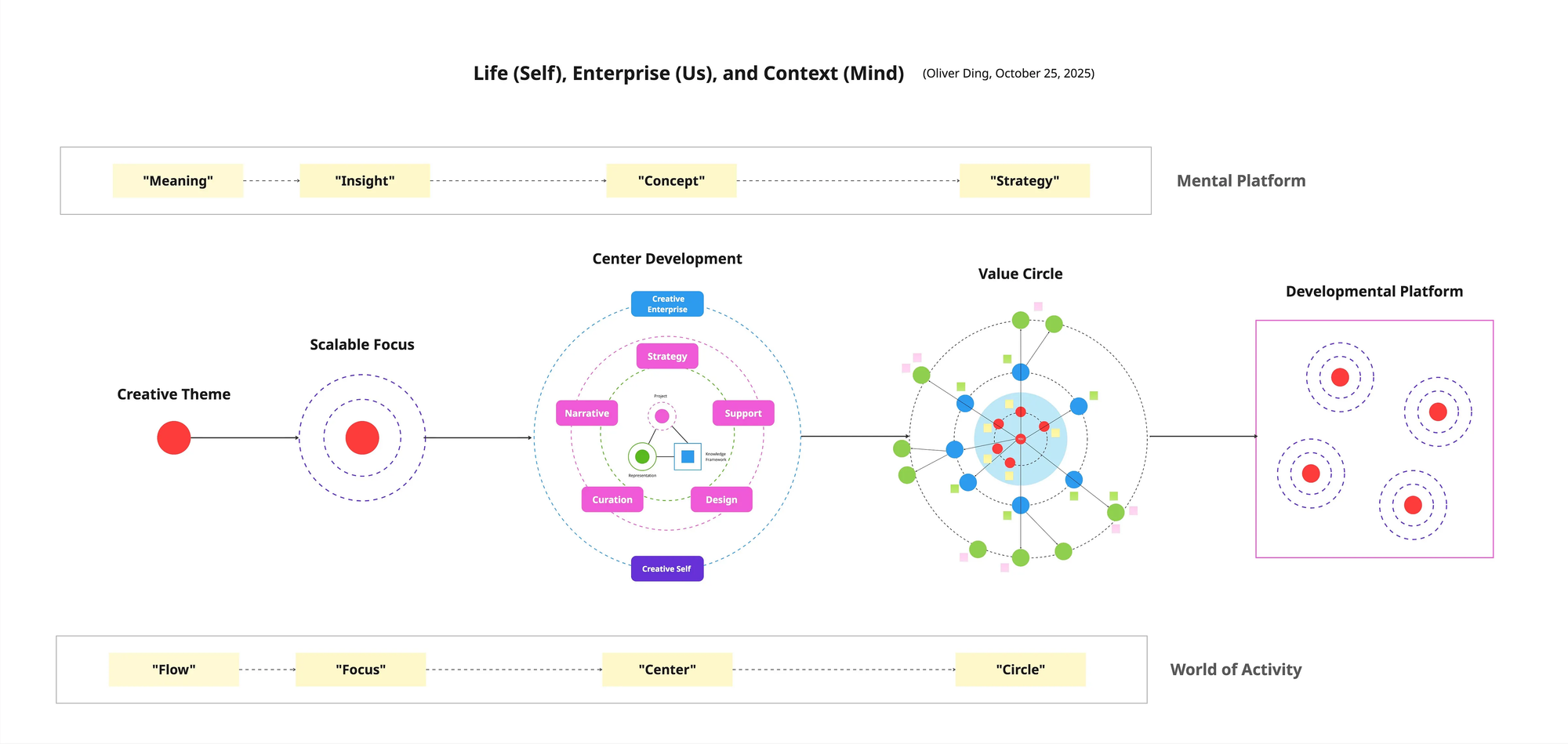
Within this sequence, the "Strategy (Decision)" end corresponds to the Strategic Moves weave-point of Weave-the-Strategy. This is where the framework connects directly to the Mental Platform sequence: Strategic Moves, Strategic Frameworks, Mental Platform, and Strategic Curation form a related group of concepts. The development of a Mental Platform is not separate from strategy. A Mental Platform is a concept system that supports the development of a Creative Enterprise; when that concept system is connected to a concrete context, it becomes the platform on which strategic thought and action depend. Strategic Moves are the moves made on that platform; Strategic Frameworks are the frameworks built from those moves; Strategic Curation is the work of weaving the pieces into a meaningful whole. These four concepts belong together.
Weave-the-Mind considers two directions of Knowledge Engagement: for use by oneself, and for use by others. The distinction runs through the whole toolkit. A framework can be a Concept System for Work, serving as an internal tool for the creator; it can also be a Concept System as Work, producing external results for others to use. Mental Platform belongs to the first direction; Knowledge Frameworks belong to the second. Both directions are present in the same practice, often in the same project.
Strategic Moves and Strategic Curation must be understood in both directions at once. A strategic move is not only a move for the creator's own cognitive development; it is also a move that shapes what can be offered to others. Strategic Curation, likewise, operates on both sides: it curates the creator's own materials into a coherent whole, and it curates what is presented to the world. The Weave-the-Strategy framework holds both directions in view.
v1.0 - September 29, 2026 - 1,846 words