
Cognitive Hydrology: Revisiting and Rebuilding the Thematic Engagement Toolkit
Thematic Cognition, Thematic Activity, Thematic Situation, and Thematic Enterprise
by Oliver Ding
October 23, 2026
This article is part of the Cognitive Hydrology v2.0 series.
Introduction
This article revisits the theme of “thematic engagement” and rebuilds it into a concept, together with its toolkit.
The notion has remained at the level of a theme, without a formal, theoretical concept definition; this article supplies that definition. The theme is rebuilt into a formal theoretical concept with four layers: thematic cognition, thematic activity, thematic situation, and thematic enterprise. The earlier articles of the series, which established the Experience–Narrative–Framework–Ecology schema and the Weave-the-Theme Framework, are now framed as the first of these layers, Thematic Cognition, and placed within the larger context of Thematic Engagement.
The theme of “Thematic Engagement” was discovered in September 2022 and led to the Thematic Engagement Toolkit (v1.0, 2022). In early 2023, I launched TALE (Thematic Analysis Learning Engagement) as an independent knowledge center to explore the theme and the toolkit further. From 2023 to 2025, this exploration produced a series of projects and book drafts, which later became known as the “Theme–Concept–Framework” transformation journey.
This article revisits that journey and rebuilds the toolkit. The v1.0 toolkit gathered diagrams, models, and concepts from different approaches; the present version rebuilds them on the basis of work done since 2023, and gives thematic engagement the concept definition it previously lacked. Using the Weave-the-Theory model, I set out the concept of “Thematic Engagement” with its principles, models, and themes. The outcome is a four-layer toolkit, version 2.0 of the Thematic Engagement Toolkit.
Part 1 reviews the journey, explains why thematic engagement remained at the level of a theme, and sets out the four layers in which it is now rebuilt. Parts 2 to 5 present each layer with its principle and its model. Part 6 approaches the toolkit through Ecological Formism, reading the four layers together, connecting them to the World of Activity (FFCC), and outlining the scope and limitations.
Contents
Part 1: Revisiting and Rebuilding Thematic Engagement
1.1 The Theme of “Thematic Engagement”
1.2 From TALE to the Theme–Concept–Framework Transformation
1.3 Four Principles and Four Layers
1.4 The Thematic Engagement Toolkit (v2.0, 2026)
Part 2: Thematic Cognition - The Invariant Layer
Principle: T as Theme. Model: The Weave-the-Theme Framework.
2.1 Theme (Concept): The Ontological Setting
2.2 Thematic Space: A Cognitive Container for Dynamic Development
2.3 The Weave-the-Theme Framework
Part 3: Thematic Activity - The Quasi-invariant Layer
Principle: S-T-O. Models: The Sandglass Model; The Semiotic System Diagram.
3.1 The S-T-O Principle
3.2 The Sandglass Model: Capturing the Cycles
3.3 The Five Analysis Units and the Semiotic Diagram
3.4 Creative Life Theory (v2), 2023
3.5 The Hermeneutics of Creative Life (2023)
3.6 The Creative Life Square, 2026
Part 4: Thematic Situation - The Variable Layer
Principle: Themes of Practice. Models: The Knowledge Discovery Canvas, the Frame for Work Canvas, and the Thematic Matrix.
4.1 Themes of Practice
4.2 Model 1: The Knowledge Discovery Canvas
4.3 Model 2: The Frame for Work Canvas
4.4 The Meta-canvas: Thematic Matrix Canvas
4.5 From Situation to Social Landscape
Part 5: Thematic Enterprise - The Invariant Set
Principle: Evolving Concept System. Models: Center Development and Project Engagement.
5.1 The Evolving Concept System
5.2 Model 1: Center Development
5.3 Model 2: Project Engagement
5.4 From Enterprise to Ecology: Weave the Culture
Part 6: An Ecological Formism Approach to Thematic Engagement
6.1 What is Ecological Formism?
6.2 Reading the Four Layers Together
6.3 Connecting to the World of Activity (FFCC)
6.4 Scope and Limitations
Conclusion
Appendix
Ecological Formism
Part 1: Revisiting and Rebuilding Thematic Engagement
Part 1 traces the historical development of Thematic Engagement, explaining why it remained at the level of a theme despite the rich theoretical enterprise it generated. It then introduces the structural solution: rebuilding the theme into a formal concept composed of four principles and four corresponding layers, utilizing the Weave-the-Theory model.
1.1 The Theme of “Thematic Engagement”
Thematic Engagement is, at its core, a simple theme. It names the “Person–Theme” relationship and interaction: how a person engages with a theme, and how that engagement shapes both the person and the theme. As a knowledge center, TALE (Thematic Analysis Learning Engagement) considers this relationship its primary object. The term was coined to highlight the abstract aspect of social practices: while traditional craftsmen focus on materials, contemporary knowledge workers must navigate a web of concepts and themes.
The naming of this theme is not arbitrary: “Thematic” is drawn from the Themes of Practice approach (2019, 2021), and “Engagement” from the Project Engagement approach (2021, 2022). While the theme itself is simple, its birth is not. Because the name is a fusion of these two theoretical enterprises, the theme emerged from their long, creative dialogue. This dialogue was not planned; it was an emerging process. It took place within a creative boundary space—what I call the Echozone—where two distinct theoretical containers, my "Activity" thematic space and my "Opportunity" thematic space, intersected. The term "ECHO" refers to the moments of resonance when ideas from one approach significantly illuminated the other.
Between 2019 and 2022, this emerging dialogue produced six distinct echoes that eventually crystallized into the Thematic Engagement framework.
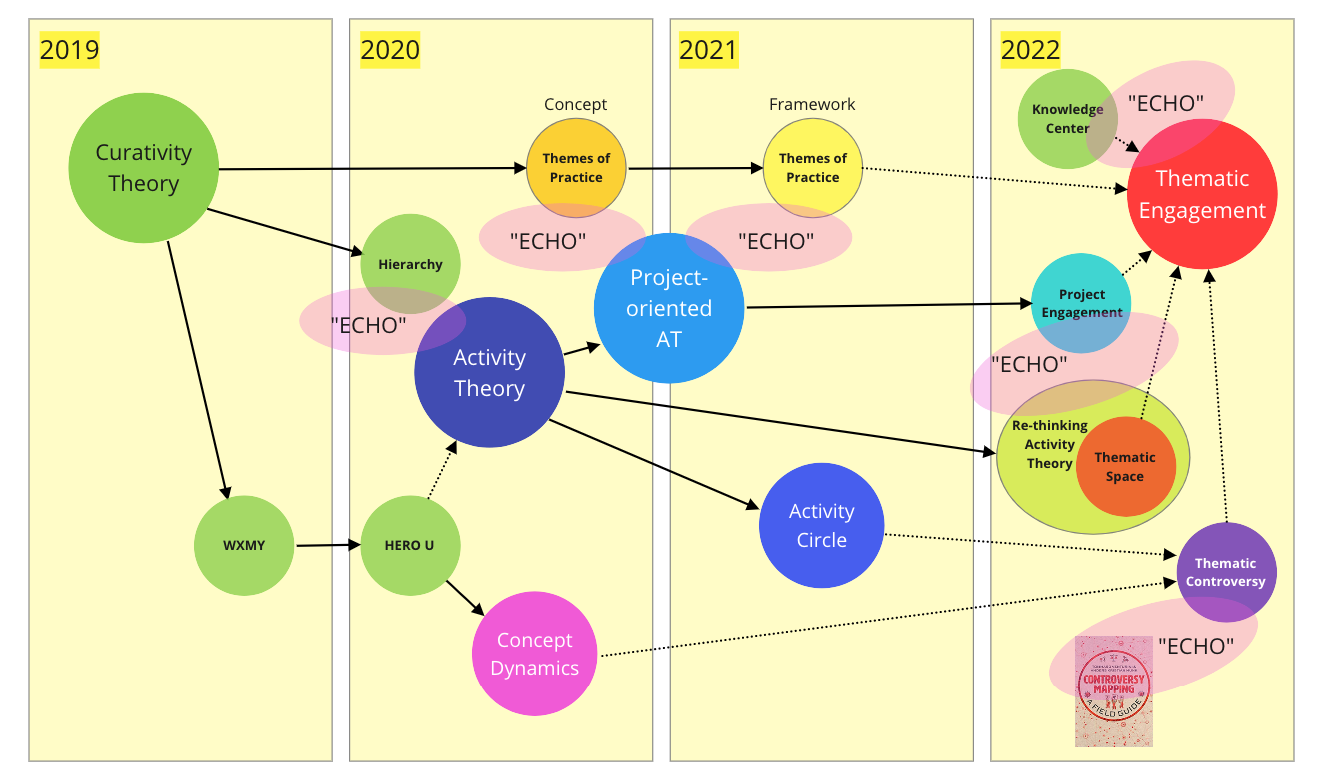
- Echo 1 (Sept 29, 2020): The “Hierarchy” of Human Activity. While writing about Activity Theory, I found a resonance with the concept of “Themes of Practice” from Curativity Theory. This revealed how a theme could serve as a higher-level concept uniting various activities.
- Echo 2 (Dec 26, 2020): “Formation of Concept” and “Themes of Practice.” Reading Andy Blunden’s account of “Formation of Concept” provided a theoretical foundation for Themes of Practice, linking the cognitive and social dimensions of a theme.
- Echo 3 (April 2021): The “Themes of Practice” Framework. I designed a new diagram for Themes of Practice. It unexpectedly provided a concrete framework that echoed with the operational concepts of Project-oriented Activity Theory (Concept, Project, Activity).
- Echo 4 (July 20, 2022): Rethinking Activity Theory. Re-learning Activity Theory led to a meta-framework connecting Blunden's approach with Project Engagement. Crucially, it introduced the concept of the “Thematic Space” as new to both approaches.
- Echo 5 (July 31, 2022): Controversy Mapping and the Thematic Controversy Project. Reading Controversy Mapping inspired a Diagram Blending process, leading to the idea of “Thematic Controversy,” which further shaped the notion of Thematic Engagement.
- Echo 6 (Sept 6, 2022): Grow A Knowledge Enterprise. The concept of the “Knowledge Center” became a primary focus, showing how an individual idea could grow into a collective project. I sent an email explicitly naming this application “Thematic Engagement.”
These echoes were not merely a sequence of events but a meaningful whole. On September 15, 2022, this multi-year dialogue culminated in the launch of the Thematic Engagement Toolkit (v1.0). The toolkit was the outcome of this thematic dialogue, marking both the end of one specific conversation and the beginning of the Thematic Engagement project.
While Thematic Engagement was defined simply as the “Person–Theme” interaction at the time of TALE’s launch, without a formal, theoretical concept definition, this simple thematic setting was highly productive. It framed a problem space and an exploratory direction, and it guided the many creative projects that followed in the years to come.
1.2 From TALE to the Theme–Concept–Framework Transformation
TALE was launched in early 2023 as an independent knowledge center to host the Thematic Engagement project. It quickly became a rich field of practice. One of its first major outcomes was the Strategic Thematic Exploration framework, which mapped a linear, six-stage process of how a theme evolves into a knowledge framework: from a possible theme without a clue, to a possible theme with a clue, to a primary theme, to a primary theme with its network, to a knowledge concept with a working definition, and finally to a knowledge framework with a set of interrelated concepts.
This framework identified three types of transformation: the “Possible–Primary” Transformation (discovering the strategic intent), the “Theme–Concept” Transformation (turning raw themes into conceptual forms), and the “Concept–Framework” Transformation (curating concepts into a coherent whole). From 2023 to 2025, this model guided a series of projects and book drafts, moving from Meaning Discovery (clues) and Thematic Exploration (themes) to Grasping the Concept (concepts) and Frame for Work (frameworks). By the end of 2025, with the publication of Meta-frameworks, the entire Knowledge System layer was complete. The long arc from “Clues” to “Meta-frameworks” had closed.
It is worth noting a strategic consideration behind this journey. When TALE was established, I deliberately focused on Knowledge Engagement. Although I had already considered the broader domain of Cultural Engagement, I intentionally restricted the concrete case studies and exploratory projects to the knowledge domain to maintain analytical focus.
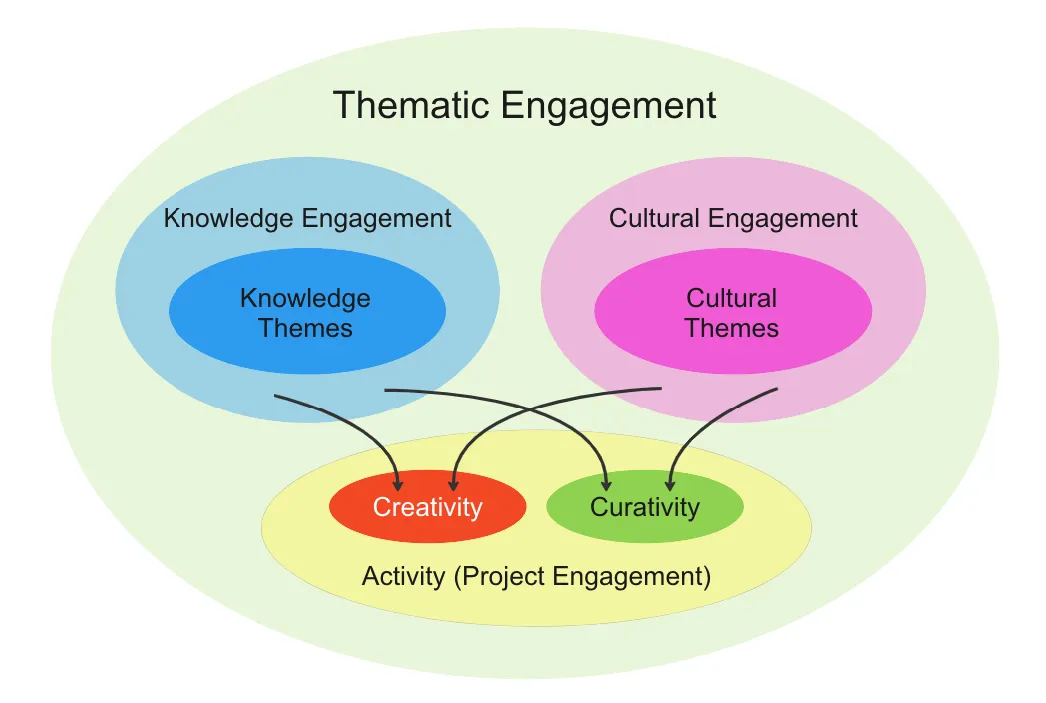
This context has now changed. By early 2026, my theoretical enterprise shifted toward Cultural Innovation. The knowledge frameworks developed under TALE proved to be adaptable—by replacing "knowledge" with "creative" or "cultural," the underlying logic scaled successfully. But this transition exposed a striking paradox: despite the thriving theoretical enterprise it had generated, “Thematic Engagement” itself—the very subject that hosted these transformations—had remained merely a theme. It was an object of inquiry and a name for a project, but it was never raised to the level of a formal concept that could organize the work across different domains.
This article addresses both the paradox and the transition. The revisit-rebuild here does not merely elevate thematic engagement from a theme to a concept; it constructs a new concept designed to adapt to different applications. It must be robust enough to hold both the Knowledge Engagement of the past and the Cultural Innovation of the present.
1.3 The Solution: Weaving Principles and Concepts
Why did Thematic Engagement fail to become a formal concept despite the rich theoretical enterprise it generated? The problem lies in the method of conceptualization itself.
To solve this, I am not simply extracting a concept from a theme in a linear, step-by-step way. Instead, I adopt the Weave-the-Theory framework to rethink its overall structure. As I explored in my recent Weave-the-Theory book draft through multiple case studies (such as the development of the Anticipatory Activity System), theoretical knowledge does not grow as a linear progression. It grows through a weaving process organized around four interweaving points: Themes, Models, Concepts, and Principles.
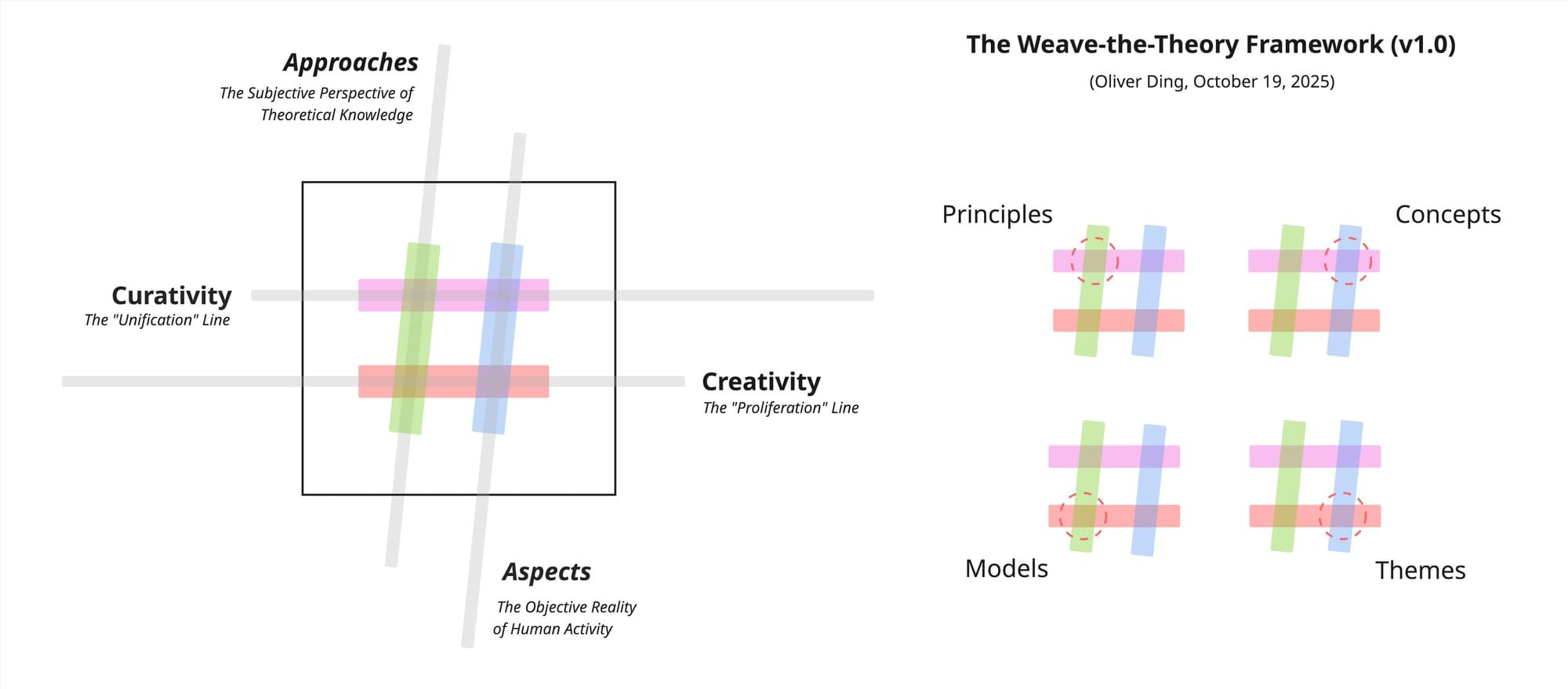
Applying this model to Thematic Engagement, the solution is to consider "principles" and "concepts" simultaneously. Based on years of inquiry, I have summarized four governing principles. They do not stand alone; rather, they map directly onto the four parts of Thematic Engagement as a theoretical concept:
- T as Theme. It concerns the theme itself and its crystallization. Its corresponding concept is Thematic Cognition (the Invariant layer).
- S-T-O. It adds S (subjectification) and O (objectification) to T, embedding the theme in concrete activity. Its corresponding concept is Thematic Activity (the Quasi-invariant layer).
- Themes of Practice. It adds the social situation in which the activity takes place. Its corresponding concept is Thematic Situation (the Variable layer).
- Evolving Concept System. It describes how concepts develop and scale into broader enterprises over time. Its corresponding concept is Thematic Enterprise (the Invariant Set).
However, the Weave-the-Theory model itself does not dictate how these principles and concepts should correspond to one another or how they should be organized. To provide a structural foundation for this relationship, I rely on the four-layer structure of Ecological Formism (see the Appendix).
| Layer of Ecological Formism | Layer of thematic engagement | Principle |
|---|---|---|
| Invariant | Thematic cognition | T as Theme |
| Quasi-invariant | Thematic activity | S–T–O |
| Variable | Thematic situation | Themes of Practice |
| Invariant set | Thematic enterprise | Evolving Concept System |
The first three principles are nested: each contains the one before it, unfolding within a wider field. The fourth principle provides the wider context within which the other three operate.
Once these principles and concepts are synchronized and layered, the structural backbone of the new concept is established. However, a concept system cannot remain purely abstract. It requires the other two weave-points—Models and Themes—to become operational. This leads us to the v2.0 Thematic Engagement Toolkit.
1.4 The Thematic Engagement Toolkit (v2.0, 2026)
If the previous section established the structural backbone of the concept, this section provides its operational flesh. The complete architecture of the v2.0 toolkit is visually captured in the diagram Mapping the landscape of "Thematic Engagement". By placing the Weave-the-Theory model onto a spatial map, the diagram reveals how the four weave-points interact to form a coherent knowledge enterprise.
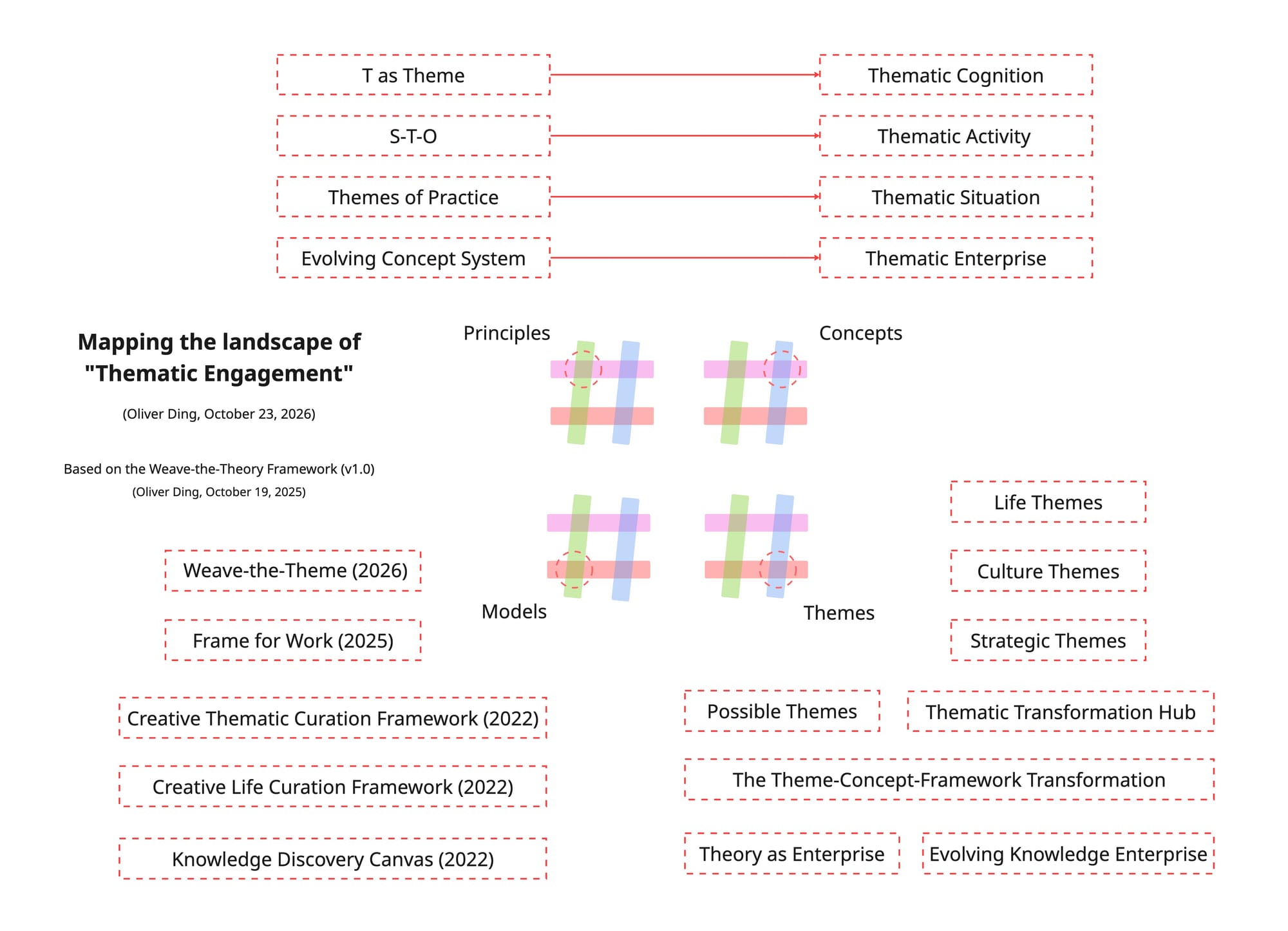
The left side of the diagram displays the abstract dimensions: Principles and Concepts. As established in Section 1.3, the four principles (T as Theme, S-T-O, Themes of Practice, and Evolving Concept System) are mapped directly onto the four concepts (Thematic Cognition, Thematic Activity, Thematic Situation, and Thematic Enterprise). These form the fixed, conceptual skeleton of the toolkit.
Moving down the left side, we see the Models. These are the concrete frameworks developed over the years that operationalize the abstract principles. For instance, the Weave-the-Theme Framework (2026) and Frame for Work (2025) serve as models for Thematic Cognition, while the Creative Thematic Curation Framework (2022) and Knowledge Discovery Canvas (2022) exemplify Thematic Activity and Thematic Situation. Because models are illustrative examples, they remain open to revision as the work develops.
The right side of the diagram maps the Themes. If principles and models provide the structural logic, themes provide the living context. The landscape includes specific thematic domains such as Life Themes, Culture Themes, Strategic Themes, and Possible Themes. It is here that methodologies like the Thematic Transformation Hub and the Theme-Concept-Framework Transformation operate dynamically.
It is also at this thematic level that the specific insight of Theory as Enterprise finds its home. It functions not as a universal principle, but as a conclusion drawn from specific cases of growing a knowledge enterprise, sitting comfortably alongside other frameworks like the Evolving Knowledge Enterprise.
To summarize this structure, the core mapping of layers, principles, concepts, and models can be presented as follows:
| Layer | Principle | Concept | Models (Examples) |
|---|---|---|---|
| Invariant | T as Theme | Thematic Cognition | Weave-the-Theme Framework; Frame for Work |
| Quasi-invariant | S-T-O | Thematic Activity | Creative Life Curation Framework; Semiotic system diagram |
| Variable | Themes of Practice | Thematic Situation | Knowledge Discovery Canvas; Canvases of the thematic matrix |
| Invariant Set | Evolving Concept System | Thematic Enterprise | Center development; Project engagement |
By weaving principles, concepts, models, and themes together, the landscape diagram demonstrates how a previously vague subject has been transformed into a structured, multi-layered concept. The Thematic Engagement Toolkit (v2.0) is now robust enough to adapt to different applications, from Knowledge Engagement to Cultural Innovation.
Having established this overall architecture in Part 1, the rest of the article will now develop this toolkit layer by layer, beginning with the invariant layer of Thematic Cognition in Part 2.
Part 2: Thematic Cognition — The Invariant Layer
Principle: T as Theme.
Model: the Weave-the-Theme Framework.
Part 2 turns to the foundational layer of our toolkit: Thematic Cognition. Governed by the principle T as Theme, this layer addresses the ontological relationship between a theme and a concept. It explores how a theme is held within a concept, how it develops within a Thematic Space, and how the Weave-the-Theme Framework maps this cognitive evolution.
2.1 Theme (Concept): The Ontological Setting
The principle T as Theme rests on a foundational distinction: a theme is not the same entity as a concept. A theme emphasizes subjective experience and understanding—it is lived, felt, and discovered. A concept, by contrast, emphasizes objective meaning and definition—it is defined, bounded, and shared. To build a rigorous concept of Thematic Engagement, we must clarify how these two entities relate.
I express this difference using Container Thinking, a model developed within the Ecological Practice approach. The origin of this thinking can be traced back to a specific moment in 2017, when I observed a sideways flower pot in a local supermarket. As someone unfamiliar with gardening, I was surprised to see plants growing horizontally out of the pot, rather than upward. This dramatic experience shifted my attention from the static "boundary" of the container to the dynamic relationship between the Container and the Containee (the things contained).
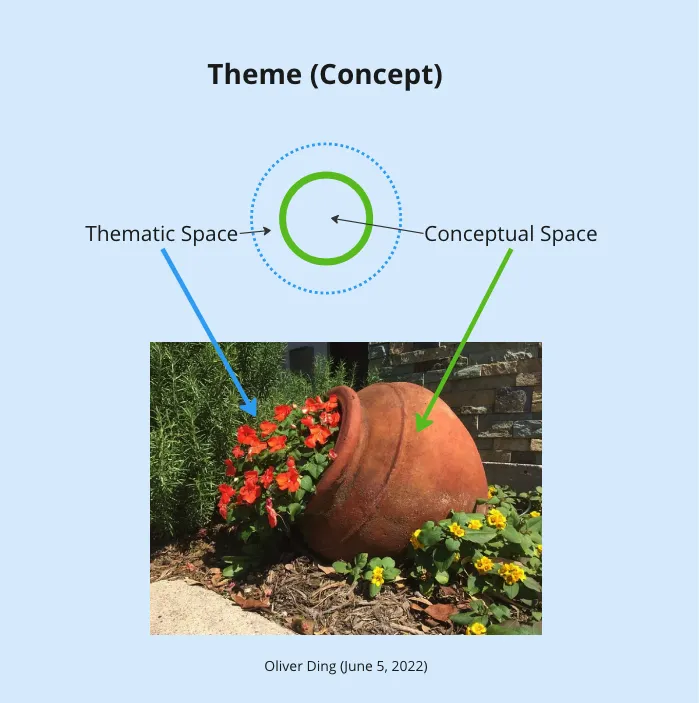
In this ontology, a Concept is the Container, and a Theme is the Containee. The boundary of the container is the Conceptual Space; the living space occupied by the containee is the Thematic Space. Because plants can spill out of a pot, the Thematic Space can be smaller or larger than the Conceptual Space. This Spilling Space is dynamic—it connects the interior space of the concept with the exterior space of reality. Therefore, a theme can exceed the concept meant to hold it, and a concept can be wider than the theme it was drawn from.
Two kinds of relations follow from this distinction. The semantic relation concerns the meaning of themes—how they stand in relation to one another conceptually and linguistically. The genetic relation concerns the practice of themes—the real, historical development of the projects and activities in which the themes arise.
Because theme and concept are not the same kind of entity, their transition is not a simple translation or a perfect fit. Instead, their relationship is characterized by a dynamic tension. Thanks to the Spilling Space, a lived theme can connect to an objective concept without breaking either. The principle T as Theme describes this exact process: how a theme crystallizes into a shared, definable form while continuously spilling over its boundaries, retaining its experiential depth.
2.2 Thematic Space: A Cognitive Container for Dynamic Development
If a concept is the container and a theme is the containee (as established in 2.1), where does the theme actually live and grow? The answer is the Thematic Space. A thematic space is a living cognitive container that holds the creative elements related to a particular theme—insights, experiences, models, and questions. It is bounded yet dynamic. It establishes a cognitive boundary around a theme, gathers related elements, distinguishes the theme from others, and allows for transformation over time.
Within this space, the theme's name gains meaning through the elements that gather within it—just as a person's name gains meaning through the story it carries. The thematic space is therefore the containee's living space; it can be smaller or larger than the conceptual space that holds the concept, constantly expanding through what I call Spilling Space.
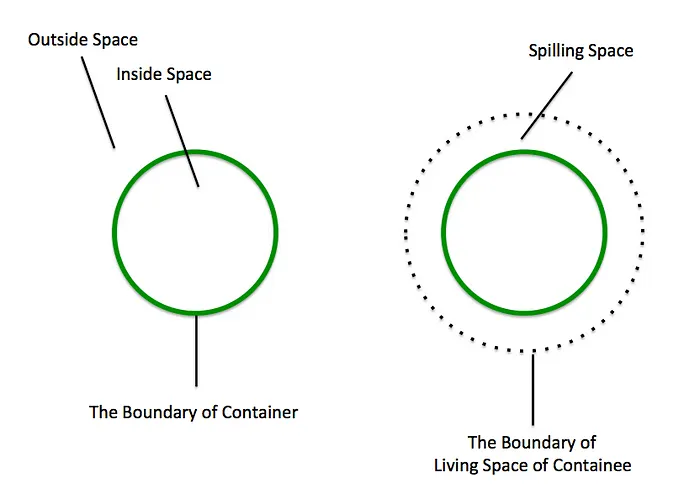
What a thematic space does is described by five operations, which can be understood through the lens of Attachance (the act of attaching or detaching mental focus):
- Separation of name and reality. Every thematic space has a core theme with two layers: its lexical expression (the name) and its specific meaning (the reality). The name remains constant as an identifier, while the meaning evolves. This allows a theme to keep its identity while it transforms: the name provides continuity, and the reality provides growth.
- Injection and outflow. Creative elements enter a thematic space through experience, reading, and reflection. They leave it through objectification into artifacts or by detaching when they are no longer relevant. A thematic space is a dynamic flow system, not a static container.
- Juxtaposition. In the early stages, elements are placed side by side without imposing categorization. They coexist spatially rather than sequentially. This counters linear thinking and allows patterns to emerge that a strictly logical arrangement would obscure.
- Continuous curation. As elements accumulate, they are curated through higher-order operations: comparison, classification, prioritization, renaming, merging, and separating. These operations transform loose collections into structured concept systems.
- Strategic moves. Elements move between different thematic spaces. The experience of such use becomes new material that flows back to the original thematic space, creating feedback loops that enrich the source themes.
The core premise of this theory is that every knowledge framework or model can be understood as a combination of concepts, and each concept corresponds to a thematic space. A framework is therefore a combination of thematic spaces, and it can be drawn as a map. This insight is crystallized in what I call the Map-Move-Model principle, which represents the three levels of Thematic Space Theory (TST):
- The "Map (Move)" Realism holds that any Move, any activity, admits a Map representing its own structure. For instance, when viewing Concept Development as a social practice, this Realism takes the specific shape of the "THEORY(PRACTICE)" model (the Knowledge Discovery Canvas), which emphasizes the dual developmental trajectories of practice and theory.
- The "Model (Map)" Hermeneutics is the interpretation of this Realism. Each thematic area provides a map; actors then adopt various perspectives and knowledge frameworks to interpret their moves within that map.
Map, Moves, and Models are not external tools but TST's own architecture. This principle provides a bridge between Mental Moves and Social Moves: once a social reality is read against a map, Social Moves can be modeled directly on it, and the Mental Moves they correspond to can be observed—a relationship that runs in both directions.
Thematic Space Theory itself began in early 2022 as the name of a canvas for studying tacit knowledge. It then evolved into an ontological entity in the Life-as-Project approach, became a theoretical concept bound to Attachance in 2023, and eventually separated from both Curativity Theory and Attachance Theory to become an independent methodological theory. In 2025, the Thematic Space Theory Toolkit (v1.0) finally gave it the form of a specific theory.
2.3 The Weave-the-Theme Framework (v1.0, 2026)
Sections 2.1 and 2.2 established the ontology of the theme (Theme vs. Concept) and the cognitive container (Thematic Space) in which it develops. This section turns to the Model that gives these ideas their visual and structural form.
As noted earlier, the Weave-the-Theory model organizes the toolkit around four points: principles, concepts, models, and themes. Within this invariant layer, the principle T as Theme occupies the principle point, and the Weave-the-Theme Framework occupies the model point.
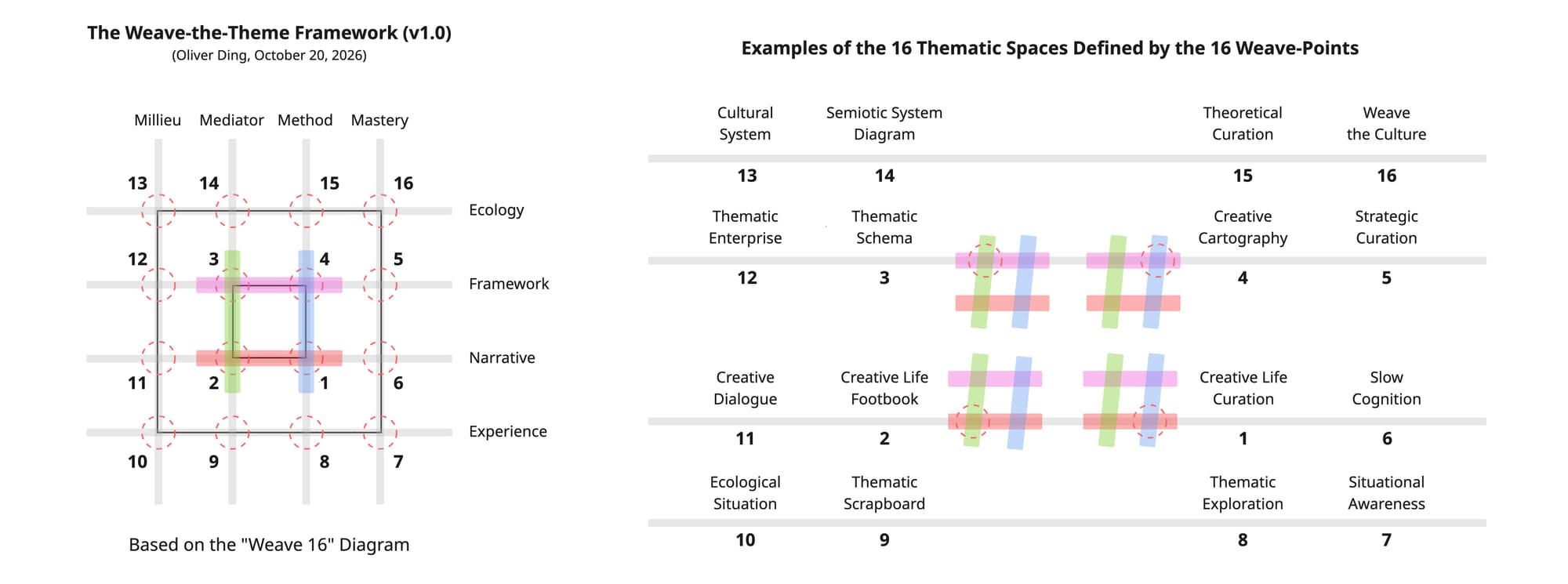
The framework is built upon a 4x4 structure. Its vertical axis is the Experience–Narrative–Framework–Ecology schema. This axis directly operationalizes the Theme-Concept-Framework Transformation discussed in Part 1. A theme begins as a pre-linguistic Experience. It then becomes a Narrative where a single theme meets a single concept. As it develops, it forms a Framework where a network of themes and a system of concepts take composite form. Finally, it reaches an Ecology, where the framework is related to a wider knowledge ecology. This schema names four spaces of one movement, applicable across different fields, regardless of the subject matter.
The horizontal axis is the Milieu–Mediator–Method–Mastery schema. It looks at thematic cognition from an ecological perspective: it asks how a person's thinking about a theme is set within its milieu, carried by its mediators, operated through its methods, and brought toward mastery. This places cognition within its ecological conditions without yet making the activity itself the subject (which is reserved for the quasi-invariant layer).
The intersection of these four rows and four columns generates sixteen weave-points, named by dimension and space. For example, the "Milieu" row intersects with "Experience" to form a specific weave-point. These weave-points are presented in a "1 + 3" form in the full framework, where one representative thematic element is followed by three additional elements at the same coordinate.
It is important to note that the elements anchoring these weave-points are illustrative examples, not a fixed classification. The framework is a curatorial map whose portals continue to grow. Almost all of the elements are drawn from my own creative work and theoretical enterprises developed over the years. The framework therefore gathers results that were previously scattered across many projects into a single display.
(Note: The full details of the 16 weave-points, their dimensions, and their specific thematic elements are presented in the previous article in this series, Cognitive Hydrology: The Weave-the-Theme Framework (v1.0, 2026).)
Part 3: Thematic Activity — The Quasi-invariant Layer
Principle: S–T–O.
Models: applications of the principle in different periods, which may be revised.
Part 3 moves from static cognition to dynamic activity. Governed by the S-T-O (Subjectification–Thematic Crystallization–Objectification) principle, this layer explains how a theme is not merely thought about, but lived and acted upon. It introduces the Sandglass Model to capture the cyclical nature of creative work and the Semiotic System Diagram to map how experience is objectified into cultural themes.
3.1 The S–T–O Principle and Its Applications
S-T-O represents the fundamental cycle of thematic activity.
- S (Subjectification) is turning the world into a person's experience. It has two orders: first-order experience (immediate, everyday action) and second-order experience (reflective, deliberate analysis).
- T (Thematic Crystallization) is the crucial hinge. It is discovering a match between an individual's life themes and the collective cultural themes around them.
- O (Objectification) is turning that experience into artifacts for the world. It takes three forms: symbolic (verbal/visual), instrumental (designed/found objects), and practical (branded/shared forms).
The principle gives both elements and an abstract cycle. It is a basic principle of Creative Life Theory, and it presupposes that a creator always makes creations, so that the cycle moves from subjectification through thematic crystallization to objectification. In thematic activity, O lies close to the outcome of the activity, as in traditional activity theory. The principle is general, however, and it should not be turned into a simple linear model in each framework. Concrete frameworks take the cycle in their own ways: the sandglass model, for instance, includes several rounds of back and forth between subjectification and objectification rather than a single pass.
The principle is the fixed core. It is applied in several models, which differ across periods: the sandglass model, the five analysis units and the semiotic diagram of the Creative Life Curation book, the Hermeneutics of Creative Life in Creative Life Theory (v2), and the Creative Life Square of 2026. Each model expresses the same principle in a different form, and each may be changed without changing the principle.
3.2 The Sandglass Model: Capturing the Cycles
To visualize this principle, I developed the Creative Thematic Curation framework, also known as the Sandglass Model (first introduced in 2022 book draft Creative Life Curation).
It was primarily positioned as a specific life strategy for knowledge creators. However, the underlying theoretical model and knowledge framework are fundamentally about the intentional act of turning individual life experiences into developmental resources and meaningful achievements. It is not merely about recording events; it is the curation of one's lived history—discovering hidden patterns, distilling them into present knowledge, and weaving scattered pieces into a coherent thematic narrative.
The model unfolds through five dynamic movements:
- Explore Widely: Encountering diverse theories, experiences, and practices.
- Inquire Deeply: Diving deeply into specific domains to build tacit knowledge.
- Crystallize Thematically: The pivotal turning point where one discovers a match between individual life themes and collective cultural themes.
- Work Deeply: Transforming the crystallized theme into concrete artifacts, knowledge frameworks, or books.
- Play Widely: Engaging with a broader audience, turning these outcomes into shared cultural experiences.
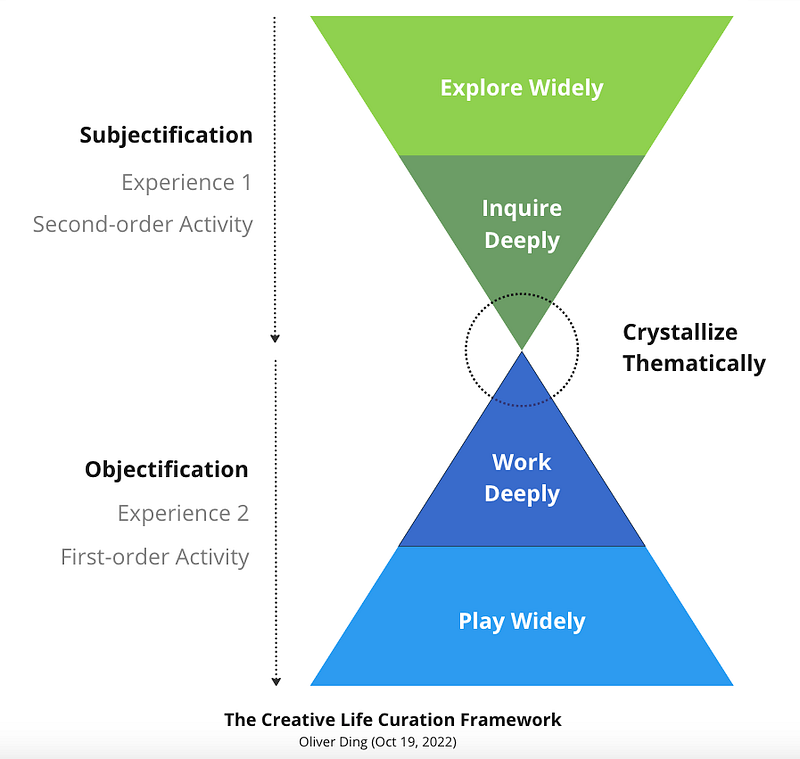
To apply it to real-life case studies, the model also suggests three waves of development that express the S-T-O tendency—moving back and forth between subjectification and objectification rather than a single linear pass:
- First-wave development is the sandglass itself, where the creator explores widely, crystallizes a theme, and objectifies it into a work.
- Second-wave development returns from objectification back to subjectification, opening a new cycle. It does not require that all five parts be carried out in each cycle; it is a simple application of the S-T-O principle.
- Third-wave development emphasizes the creative dialogue between a thematic enterprise and the thematic enterprises outside it, expanding the scope of objectification.
Because the S-T-O principle applies at different scales, these waves allow the model to accommodate complex, long-term case analysis.
3.3 The Five Analysis Units and the Semiotic Diagram
The S-T-O principle was applied to the Creative Life Curation book (2022) to establish five analysis units for a creative life, arranged in a sequence: Creative Actions, Creative Projects, Creative Journey, Creative Landscape, and Creative Lifespace. Each unit is developed through S–T–O. Together, the five units form a large semiotic diagram, which curates the models, methods, and insights drawn from its case analyses.
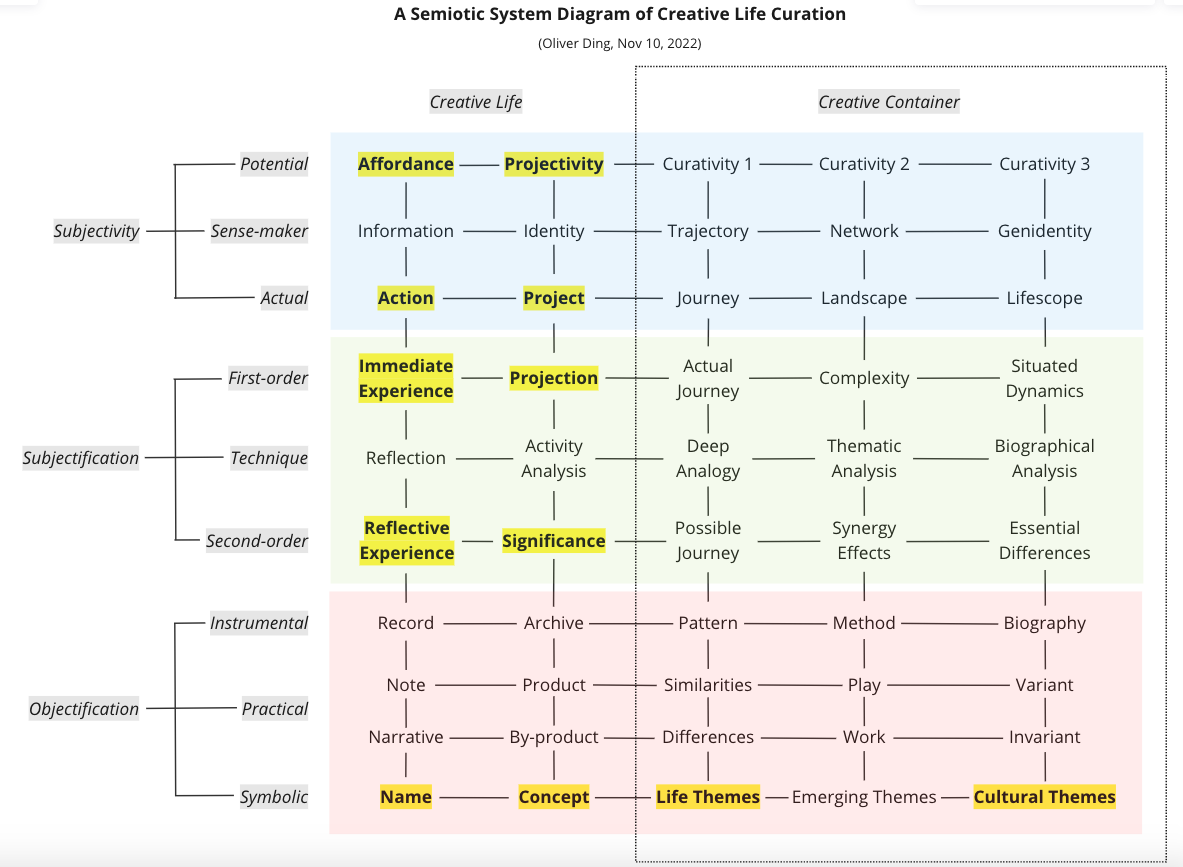
The semiotic system diagram is organized as a three-by-five structure. Its three core elements are S (subjectivity), S (subjectification), and O (objectification). Two elements are part of the S-T-O principle, and the diagram adds further elements around them, such as subjectivity.
Along the other axis run the five analysis units of the Creative Life Curation book, in the order Creative Actions, Creative Projects, Creative Journey, Creative Landscape, and Creative Lifescope. The T element unfolds at the "Symbolic" line under "Objectification": Name -> Concept -> Life Themes -> Emerging Themes -> Cultural Themes. The diagram is read from the top left, where experience lies, toward the bottom right, where cultural themes lie.
The diagram is read from the top left, where experience lies, toward the bottom right, where cultural themes lie. More details can be found in A Semiotic System Diagram for Creative Life Curation.
Because it was used to curate a series of insights I captured from various Creative Life Curation case studies, this semiotic system diagram is now also called the Creative Life Curation Framework (2022).
3.4 Creative Life Theory (v2), 2023
In 2023, I worked on editing a book draft titled Creative Life Theory (v2): Building a Knowledge Enterprise. In that book, I raised the S–T–O principle to the most basic principle of Creative Life Theory. The sandglass is its visual form, and the sign of the version places it at the centre.
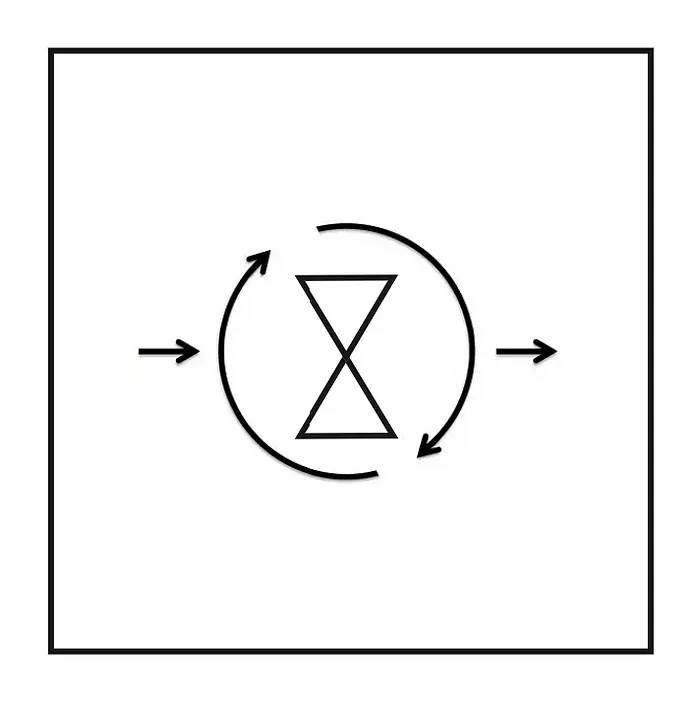
The sign is read as follows. At its centre is the hourglass, which is the S–T–O principle. Around it runs a circle of arrows, the network of knowledge centers and creative dialogue. The enclosing square is the boundary of a person's World of Activity. The arrows that enter from the left and leave to the right are the entry of experience and the output of achievement. The principle is therefore the centre around which the rest of the version is arranged.
3.5 The Hermeneutics of Creative Life, 2023
The 2023 book also introduces a model, The Hermeneutics of Creative Life. Its origin lies in a reading of the first chapter of Ping-keung Lui's 2017 book Gaze, Actions, and the Social World, which takes up Paul Ricoeur's notion of action as text. Even so, the model can also be seen as an application of the S–T–O principle, since it describes the same movement from experience to objectified achievement.
As illustrated in the diagram, the model forms a diamond structure bounded by four poles: Theme (top), Practice (bottom), Knowledge (left), and Creator (right).
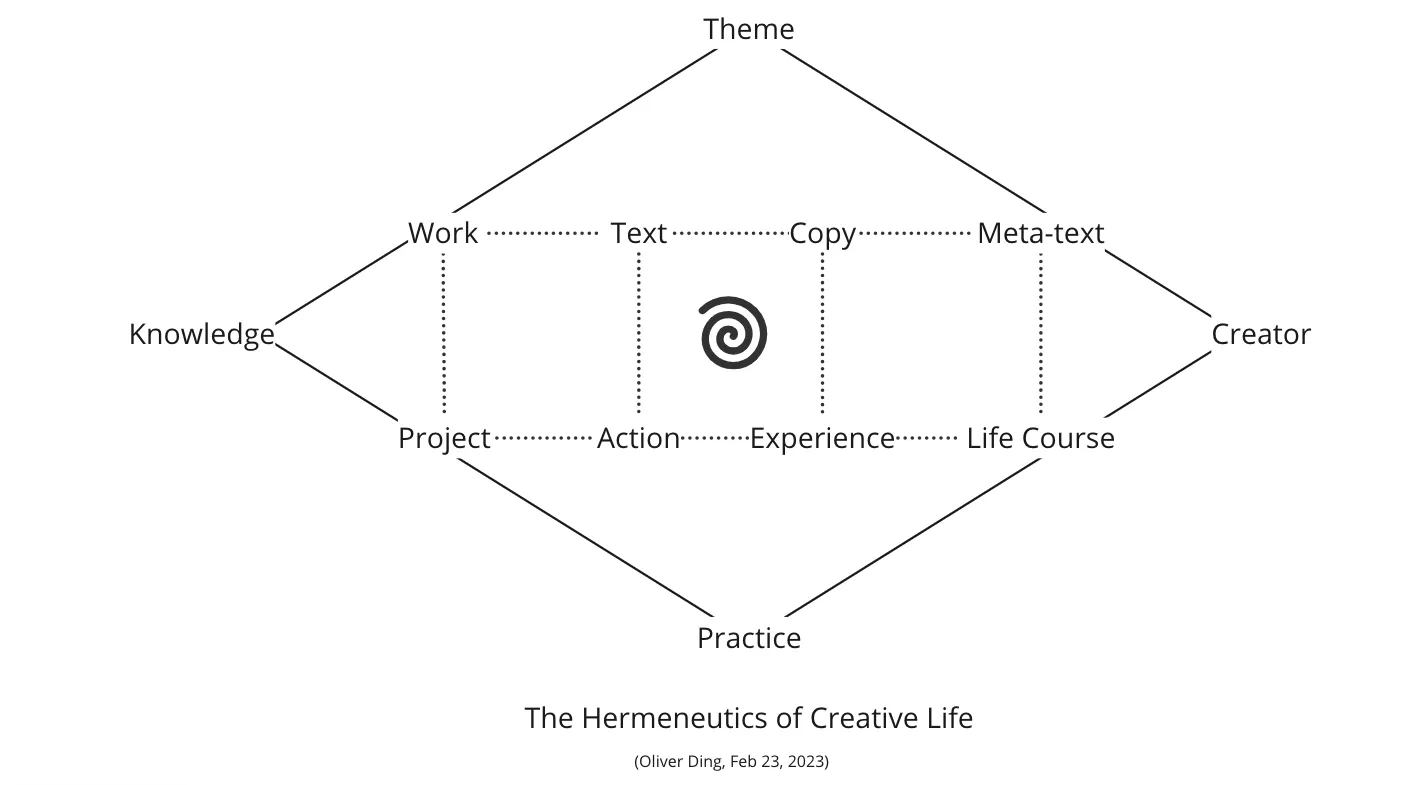
Expanding from the central Text-Action relationship, the diagram presents two symmetrical sequences:
- The upper sequence (Textual): Work → Text → Copy → Meta-text.
- The lower sequence (Actional): Project → Action → Experience → Life Course.
The vertical dotted lines indicate the direct correspondence between these two tracks. Life is understood as a series of projects, and the biography of a creator is the meta-text of the life course.
At the very center of this structure is the Spiral of Creative Work, formed by four inner elements: Action, Experience, Copy, and Text.
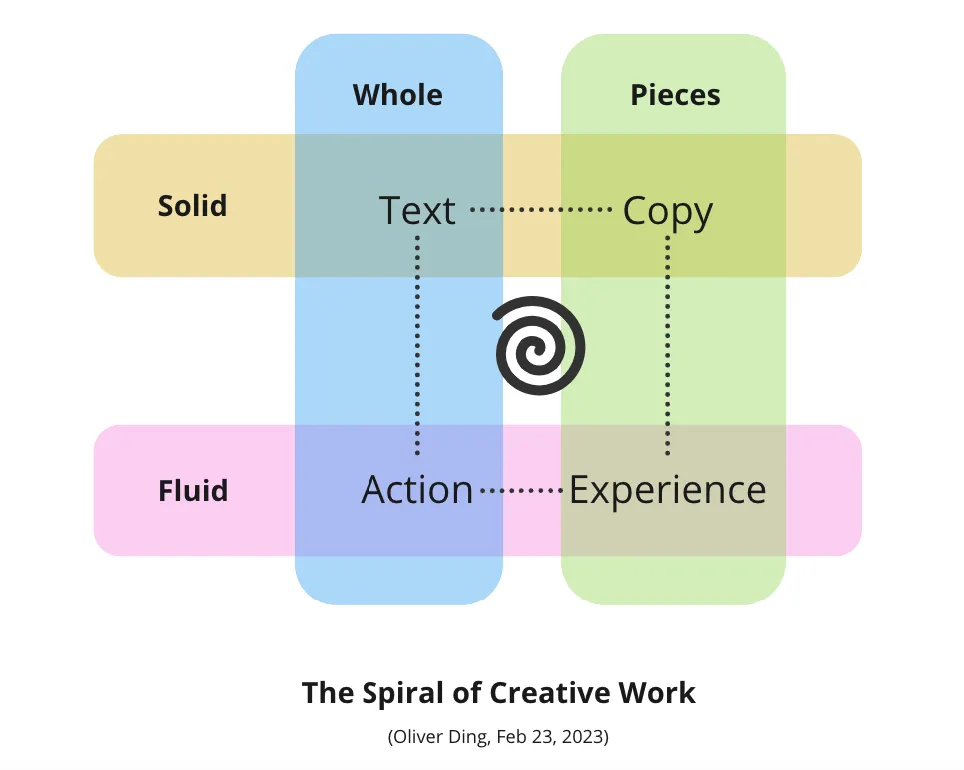
As shown in the diagram above, these four elements are mapped onto two intersecting dimensions: Whole-Pieces and Solid-Fluid. This matrix reveals a dynamic process:
- The source of Experience (“Fluid-Pieces”) is Action (“Fluid-Whole”), because if we don’t take any action, we can’t have action-based Experience.
- The outcome of the objectification of Experience is Copy (“Solid-Pieces”).
- Ultimately, the goal of creative work is to turn Experience (“Fluid-Pieces”) into Text (“Solid-Whole”).
This spiral represents the continuous oscillation between the fluidity of action/experience and the solidity of text/copy. This is the secret of the World of Works and Creative Life.
3.6 The Creative Life Square, 2026
The previous four models were developed mainly between 2022 and 2023. After 2023, I practiced the Creative Life Curation method, and the S-T-O principle moved from a model into my actual creative work. As that practice expanded, I gradually moved from a single pairing—Creative Life Curation with Possible Books—toward exploring more forms of practice and creation.
In August 2026, to make these wider practices and creations visible, I applied the S-T-O principle to design an 8×8 matrix: the Creative Life Square, inspired by the GO Square series diagrams. See the diagram below.
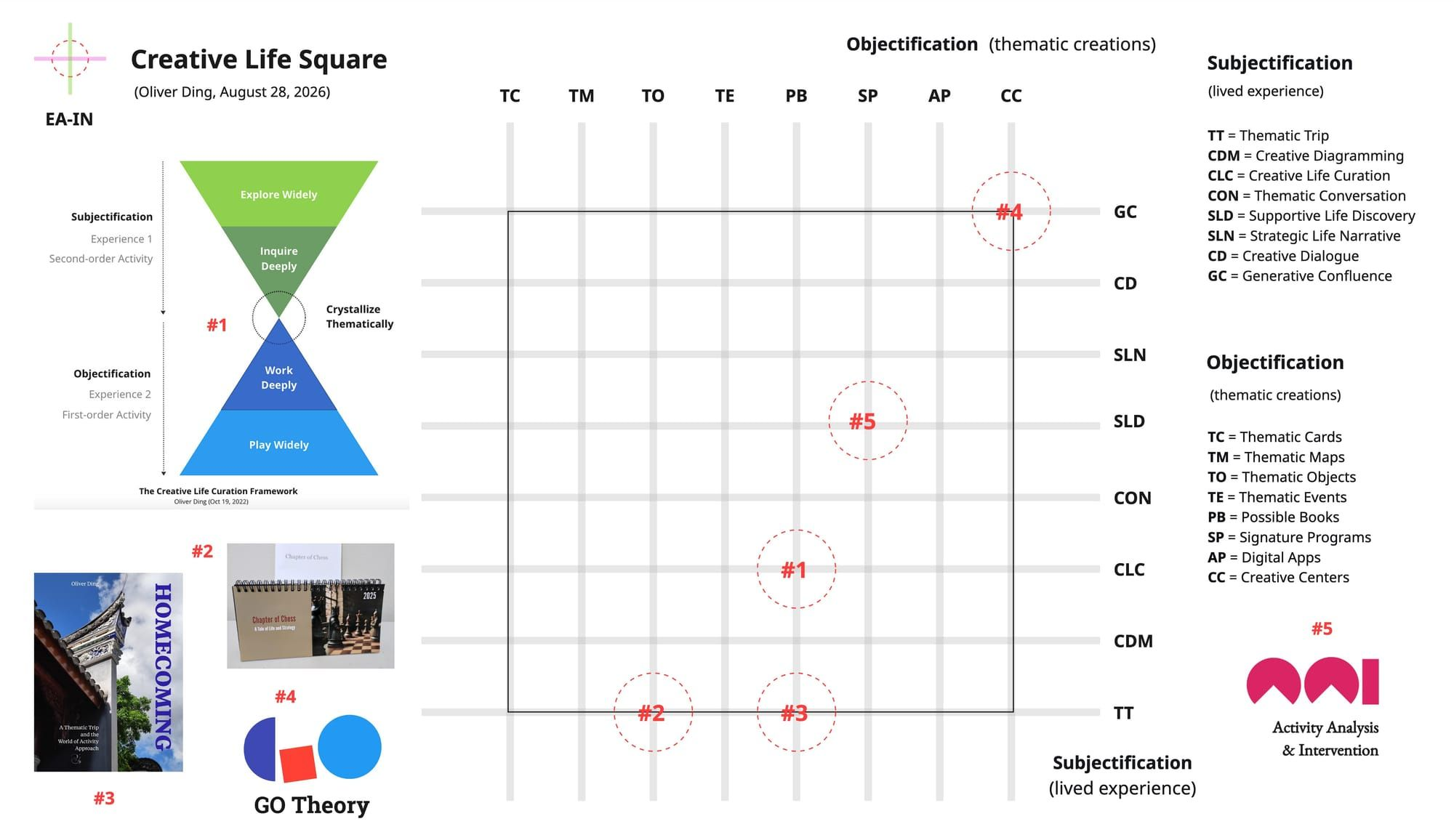
The GO Square series diagrams are built on two dimensions: the diachronic dimension (temporal unfolding) and the synchronic dimension (structural positioning). In the Creative Life Square diagram, these two dimensions map directly onto the two poles of the S-T-O principle. Subjectification—lived experience—unfolds over time, through a life; it is diachronic. Objectification—thematic creations—can be positioned and classified in structural terms; it is synchronic.
The square follows GO Square’s 8×8 format. Its vertical axis, Subjectification, names eight types of lived experience by increasing complexity:
- Individual: Thematic Trip (TT), Creative Diagramming (CDM), Creative Life Curation (CLC).
- At least two people: Thematic Conversation (CON), Supportive Life Discovery (SLD), Strategic Life Narrative (SLN).
- Multi-theme enterprises: Creative Dialogue (CD), Generative Confluence (GC).
The horizontal axis organizes thematic creations into eight types, ordered by increasing complexity of production and artifact type:
- Thematic Cards (TC)
- Thematic Maps (TM)
- Thematic Objects (TO)
- Thematic Events (TE)
- Possible Books (PB)
- Signature Programs (SP)
- Digital Apps (AP)
- Creative Centers (CC)
In the square, each weave-point names a T: the crystallization that occurs when a particular experience meets a particular form of creation. The sequence is not abolished; it can be entered at any point, and each point is a specific configuration of S and O.
The square provides 64 weave-points, each opening a thematic space for exploring the S-T-O principle in practice. Compared with the earlier models, these 64 spaces offer a richer and more operational field for S-T-O. They also move beyond the limits of my own practice: what the square maps is not only where I have been, but a heuristic that others can use to explore methods and forms that fit their own creative lives.
More details can be found in Spatial Heuristics: Introducing the Creative Life Square.
Part 4: Thematic Situation — The Variable Layer
Principle: Themes of Practice.
Models: the canvases of the thematic matrix, including the Knowledge Discovery Canvas and the Frame-for-Work Canvas.
In the previous two layers, we examined T as Theme (thematic cognition) and S-T-O (thematic activity). However, both layers remain highly abstract. They describe the cognitive evolution of a theme and the dynamic cycle of objectification, but they do not account for the specific contextual differences in which these activities take place. A thematic activity does not happen in a vacuum; it occurs within a specific social ecology.
To ground the toolkit, we must move to the Variable Layer: the Thematic Situation. A thematic situation is the social context in which a thematic activity operates. It is shaped by the communities, institutions, and environments that determine how themes emerge and are actualized.
Part 4 situates thematic activity within its broader social context. Governed by the Themes of Practice principle, this layer explores the Thematic Situation—the specific social ecology in which a thematic activity takes place. It introduces the Knowledge Discovery Canvas and the Frame for Work Canvas to demonstrate how we can map and navigate different social landscapes.
4.1 Themes of Practice
I first developed this concept in 2019 for Curativity Theory to bridge a persistent gap in social science: the divide between life themes (studied in psychology and career counseling) and cultural themes (studied in anthropology by scholars like Morris Opler). Themes of Practice is designed to connect these two poles.
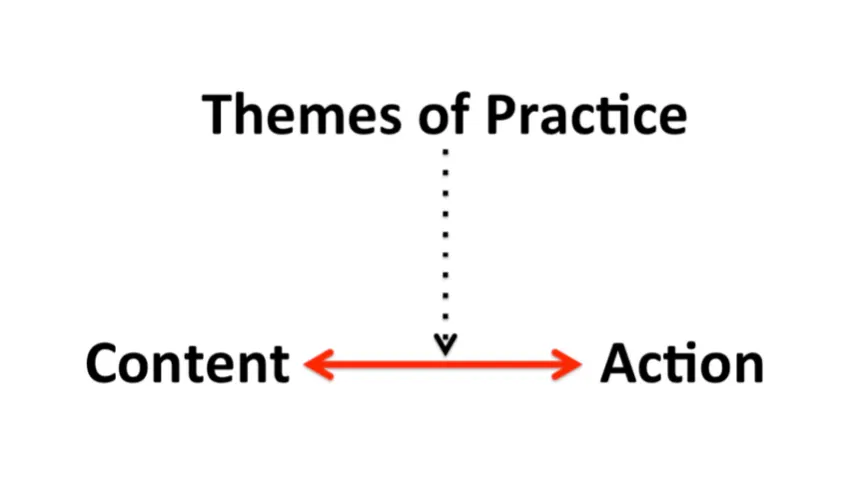
The figure above serves as the starting point for understanding the Thematic Situation. It illustrates Themes of Practice as a mediating process between Content and Action.
I developed this framework in 2019 to bridge the gap between subjective meaning and concrete practice. Interestingly, it resonates deeply with the Hermeneutics of Creative Life I developed later in 2023 (Section 3.5). Here, Action refers to concrete practices and lived reality. Content is the textual manifestation of actions—once an action is recorded or described, it becomes a Text. It is through Content that a Theme becomes visible.
The bidirectional arrow between Content and Action reveals a vital mechanism of transformation. If you merely consume Content—watching a film or reading a knowledge book—you only grasp its Cultural Themes at a distance; without action, it remains just that: an external theme. However, when you take Action and put those themes into practice, they are transformed from external Cultural Themes into Life Themes woven into your own life course.
Therefore, Themes of Practice is not a static "substance" type of concept, but a "process" type of concept. This foundational tension is highly generative and gives rise to two critical forms:
- When abstracted into a cognitive and activity framework, it manifests as the dynamic interplay between Activity and Concept.
- When situated within the broader social ecology, it unfolds as the continuous transformation between Individual Life Themes and Collective Cultural Themes.
This aligns with Andy Blunden's "Hegel-Marx-Vygotsky" account of the "Formation of Concept," where a theme is initialized, objectified, and eventually institutionalized within a social context. Because a thematic situation is a dynamic social process rather than a fixed background, we need spatial frameworks to map it. This leads us to the two specific models developed to operationalize this Variable Layer: the Knowledge Discovery Canvas and the Frame for Work Canvas.
4.2 Model 1: The Knowledge Discovery Canvas
In 2022, I developed the Knowledge Discovery Canvas (KDC) for my book draft Knowledge Discovery. At that time, the canvas was designed to map the internal cognitive process of how individuals develop tacit knowledge. However, by the time I wrote Castle and Forest: The Landscape of Concept-related Knowledge Engagement in 2025, the focus of the same canvas had expanded significantly. While retaining its original insights into internal knowing, the KDC was adapted to analyze the external social ecology of knowledge engagement, adding new analytical layers to the same spatial structure.
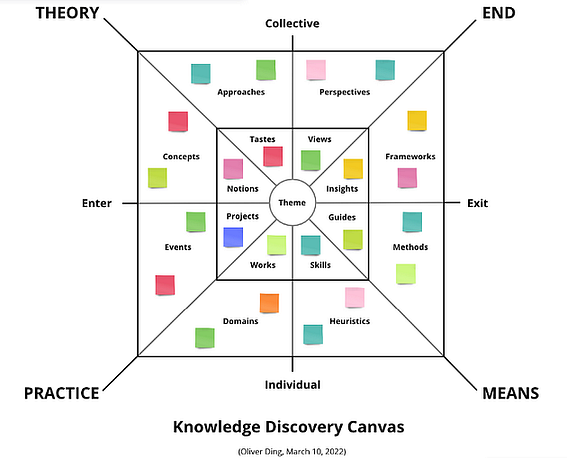
To map this expanded social ecology, I use the metaphor of "Castle and Forest". The Forest signifies objective, public knowledge and the broader scientific community, while the Castle represents subjective, personal knowledge and specialized domains of thought.
The canvas is guided by the "Theory–Practice–End–Means" schema, which divides the social ecology into four distinct thematic areas. Each area corresponds to a specific type of actor with distinct purposes and cognitive orientations:
- THEORY: The domain of Theorists ("Knowing-for-All"). This is where meta-theory and specific theories are built to explain the structure of reality.
- END: The domain of Empirical Researchers ("Bounding the Case"). This area focuses on testing abstract claims against specific observed reality through empirical research.
- MEANS: The domain of Professionals ("Knowing-for-Us"). Here, theoretical knowledge is translated into practical tools, concrete models, and interventions for specific professional contexts.
- PRACTICE: The domain of General Actors ("Knowing-for-Me"). This is where individuals discover personal meaning and develop tacit knowledge through lived experience, often using metaphorical stories.
This design directly addresses four fundamental gaps in the knowledge ecosystem: the THEORY–PRACTICE Gap, the INDIVIDUAL–COLLECTIVE Gap, the END–MEANS Gap, and the THEME–CONCEPT Gap. Structurally, the canvas uses an Inner Space and an Outer Space. The Inner Space represents personal, subjective knowing (e.g., Notions and Tastes), while the Outer Space represents public, social interactions (e.g., Concepts and Approaches).
Crucially, despite mapping this broad social ecology, the design of the KDC remains fundamentally centered on a single Theme. The canvas is not designed to map the entire world at once; rather, it maps the world as it organizes around a specific theme or concept. All four areas and their internal dynamics are analyzed in relation to this primary thematic focus.
Therefore, this social ecology is not a static background. As illustrated by the case study of psychologist Robert Kegan's knowledge enterprise, an actor can make Social Moves—navigating and switching between these four thematic areas over time while remaining anchored to the core theme. A theorist can move to the MEANS area to become an intervenor, or shift to the PRACTICE area to reflect on their own life. By mapping these four areas around a central theme, the KDC provides a navigational chart for creators to see where they are situated and to deliberately move across the social landscape of thematic engagement.
4.3 Model 2: The Frame for Work Canvas
While the Knowledge Discovery Canvas effectively maps the social ecology of Knowledge Engagement, my theoretical enterprise underwent a strategic transition in late 2024 and early 2025. I gradually shifted my focus from Knowledge Engagement to Cultural Innovation. This expansion required a new spatial model—one that could map how cultural frameworks are developed, validated, applied, and reflected upon in real-world practices. This led to the creation of Model 2: The Frame for Work Canvas.
Just as the KDC is guided by the "Theory–Practice–End–Means" schema, the Frame for Work Canvas is guided by a new schema specifically designed for cultural development: "Ideation–Validation–Application–Reflection". This schema divides the thematic space of cultural frameworks into four distinct areas:
- IDEATION: The area of Concept Creation and Theoretical Integration. Here, a cultural concept is formed as the core of a framework, drawing on resources like Concept Dynamics Theory and Ecological Formism.
- VALIDATION: The area where a cultural framework is established. This includes Referential Comparison (external validation through dialogue with other frameworks) and Immanent Development (internal validation through tracing the historical-cognitive process).
- APPLICATION: The area of Creative Diagramming and Cognitive Representation. Here, frameworks are represented in real situations through diagrams, or internalized as mental models by actors.
- REFLECTION: The area where the individual actor's experience becomes the primary focus. This includes Project Engagement (embedding a framework into actual projects) and Meaning Discovery (thematic exploration).
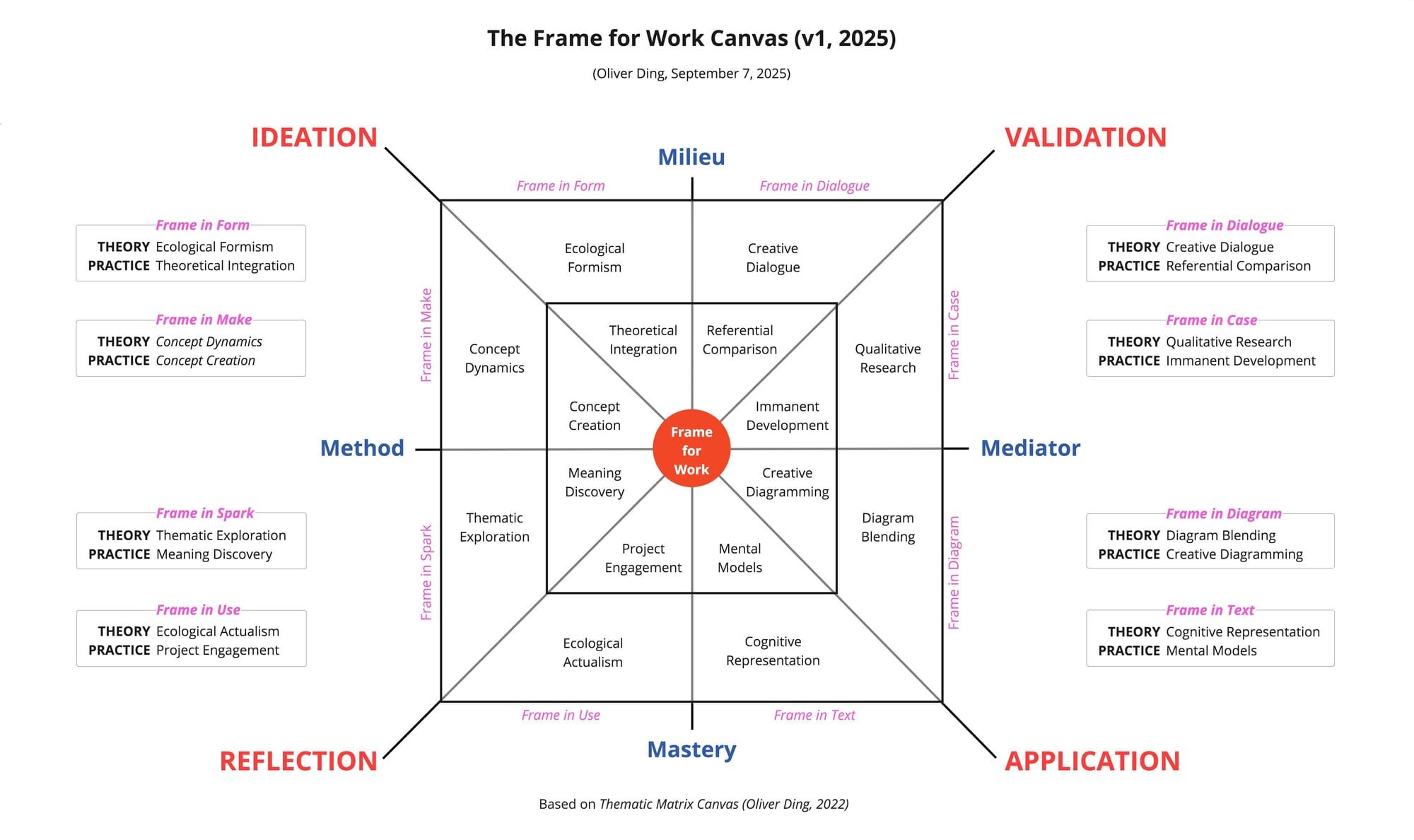
Both the KDC and the Frame for Work Canvas share the same underlying architecture: the Thematic Matrix Canvas. This meta-canvas provides a pure, abstract spatial structure (Inner/Outer spaces, four quadrants, and dimensions) that can be populated with different content depending on the domain. While the KDC fills this structure with knowledge actors and activities, the Frame for Work Canvas fills it with cultural perspectives and practices.
In this expanded cultural landscape, the Frame for Work Canvas serves as the situational model for actors engaging in cultural innovation. It provides a structured map for navigating the complexities of building, validating, and applying cultural frameworks, thereby operationalizing the Themes of Practice principle for the domain of cultural development.
4.4 The Meta-canvas: Thematic Matrix Canvas
While the Knowledge Discovery Canvas and the Frame for Work Canvas serve different domains, they are both built upon a shared foundational architecture: the Thematic Matrix Canvas (originally called the Thematic Space Canvas in 2022).
The Thematic Matrix Canvas is a meta-canvas. Unlike domain-specific canvases that contain concrete frameworks and concepts, a meta-canvas is an abstract spatial structure not tied to any single field. Its purpose is to provide a universal spatial grammar—a way to visualize a holistic view and make sense of a dynamic, meaningful whole.
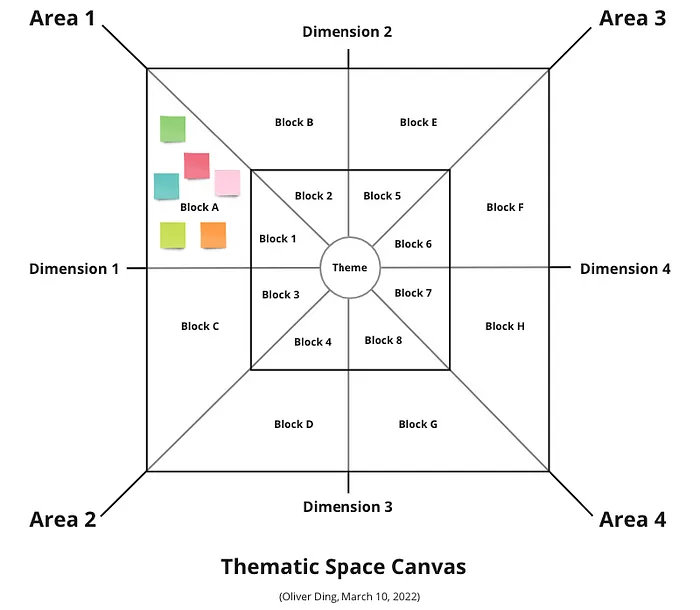
The spatial structure of this meta-canvas is defined by several key elements:
- Four Significant Areas and Four Dimensions, which frame the outer boundaries of the situation.
- Two Subspaces: The Inner Space (representing personal, subjective knowing) and the Outer Space (representing public, objective knowledge).
- Sixteen Blocks (organized into eight pairs), which serve as the fundamental units for placing notes, insights, and concepts.
- A Primary Theme located at the very center, acting as the anchor for all activities.
What makes the Thematic Matrix Canvas unique is its explicit adoption of the Activity Theory perspective. The entire process of using the canvas is considered an activity. The division between Inner and Outer Space directly operationalizes the "Internalization–Externalization" principle of Activity Theory. For example, in the context of developing tacit knowledge, the Outer Space represents Objective Knowing while the Inner Space represents Subjective Knowing.
Because it is purely structural, this meta-canvas is highly generative. It has given rise to a family of domain-specific canvases beyond the KDC and Frame for Work, including the Life Discovery Canvas, the Meaning Discovery Canvas, and the Optimal Context Canvas. Each canvas takes this abstract spatial structure and fills it with specific thematic content relevant to its domain, demonstrating how a single spatial grammar can adapt to different situational contexts.
4.5 From Situation to Social Landscape
The models discussed above—the KDC, the Frame for Work Canvas, and the Thematic Matrix—provide structured charts of the Thematic Situation. However, a situation is never merely a static background. When actors navigate within these spatial structures, they are engaging in what I call Social Moves.
To understand this dynamic, we must distinguish between two parallel types of movement. Within the internal cognitive space, actors make Mental Moves across Thematic Spaces. But within the external social ecology, they make Social Moves across a Social Territory. While Mental Moves concern subjective cognitive shifts, Social Moves describe the changes in an actor's position within a social landscape. They involve navigating social norms, institutional boundaries, and collective expectations. By understanding Social Moves, we can track how an individual’s subjective intent begins to acquire objective weight within the "Outside" world.
As I developed in the Social Landscape Framework (v2, 2025), these structured situations can be organized using the layers of Ecological Formism:
- Variant: Specific Social Norms.
- Quasi-invariant: Significant Social Forms (SSF).
- Invariant: Basic Ecological Forms.
- Invariant Set: The Social Landscape itself.
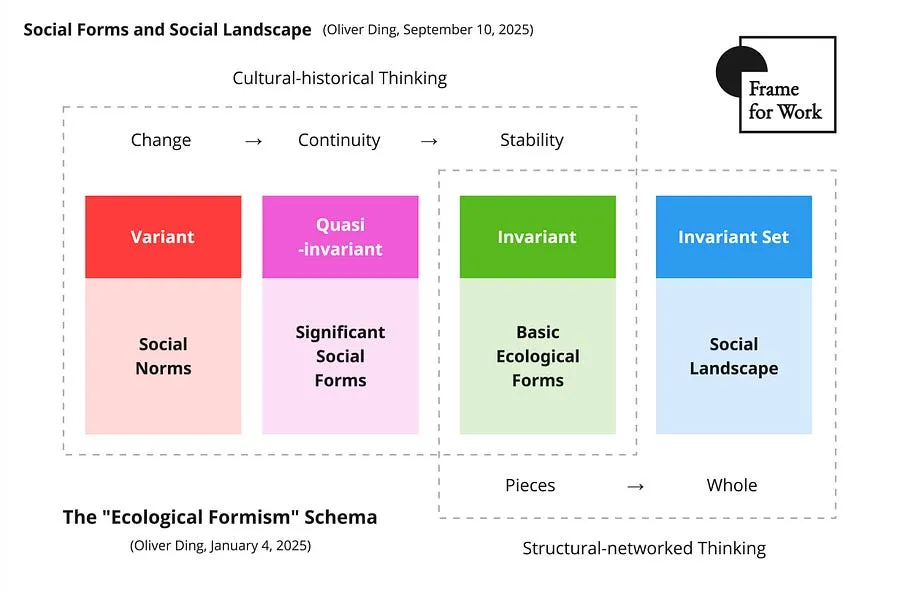
Because the social ecology is rich and diverse, the two schemas we explored earlier—"Theory–Practice–End–Means" and "Ideation–Validation–Application–Reflection"—do not exhaust all possible situations. They are merely two concrete examples of Significant Social Forms. The true value of the Social Landscape Framework lies not in providing a fixed list of tools, but in offering a methodological blueprint. It allows us to continue developing new spatial frameworks and tools to map different aspects of the social landscape as new thematic situations arise.
Therefore, the Variable Layer reveals that a theme's development is always situated. It begins with the Themes of Practice principle, is mapped onto spatial canvases, and ultimately unfolds as a dynamic Social Landscape where actors make strategic moves. It is within this vast social landscape that a thematic enterprise grows, which brings us to the final and most encompassing layer of our toolkit.
Part 5: Thematic Enterprise - The Invariant Set
Principle: Evolving Concept System.
Models: Center development, Project engagement, and Weave the Culture.
In the previous layers, we explored how a theme is cognized, acted upon, and situated within social landscapes. However, when thematic engagement matures and scales, it surpasses the boundary of a single project or a static knowledge framework to become a Thematic Enterprise.
Part 5 reaches the outermost layer of our framework: Thematic Enterprise. Governed by the Evolving Concept System principle, this layer examines what happens when thematic engagement scales beyond a single project. It explores how a concept system enters continuous objectification, sustained by the twin operational models of Center Development and Project Engagement, ultimately contributing to a broader cultural ecology.
5.1 The Evolving Concept System
As established in Part 1, the governing principle of the Thematic Enterprise layer is the Evolving Concept System.
When thematic engagement matures, it enters the stage of Continuous Objectification. At this stage, the primary object is no longer just a concept, but a dynamic, evolving system. It is precisely at this moment—when a concept system begins to continuously manifest and scale in the real world—that a Thematic Enterprise naturally takes shape.
To understand this system, we must distinguish between three types of concept systems: the Scientific Concept System (established academic theories), the Defined Concept System (designed by the founder to guide the enterprise), and the Spontaneous Concept System (the subjective, lived understanding of individuals).
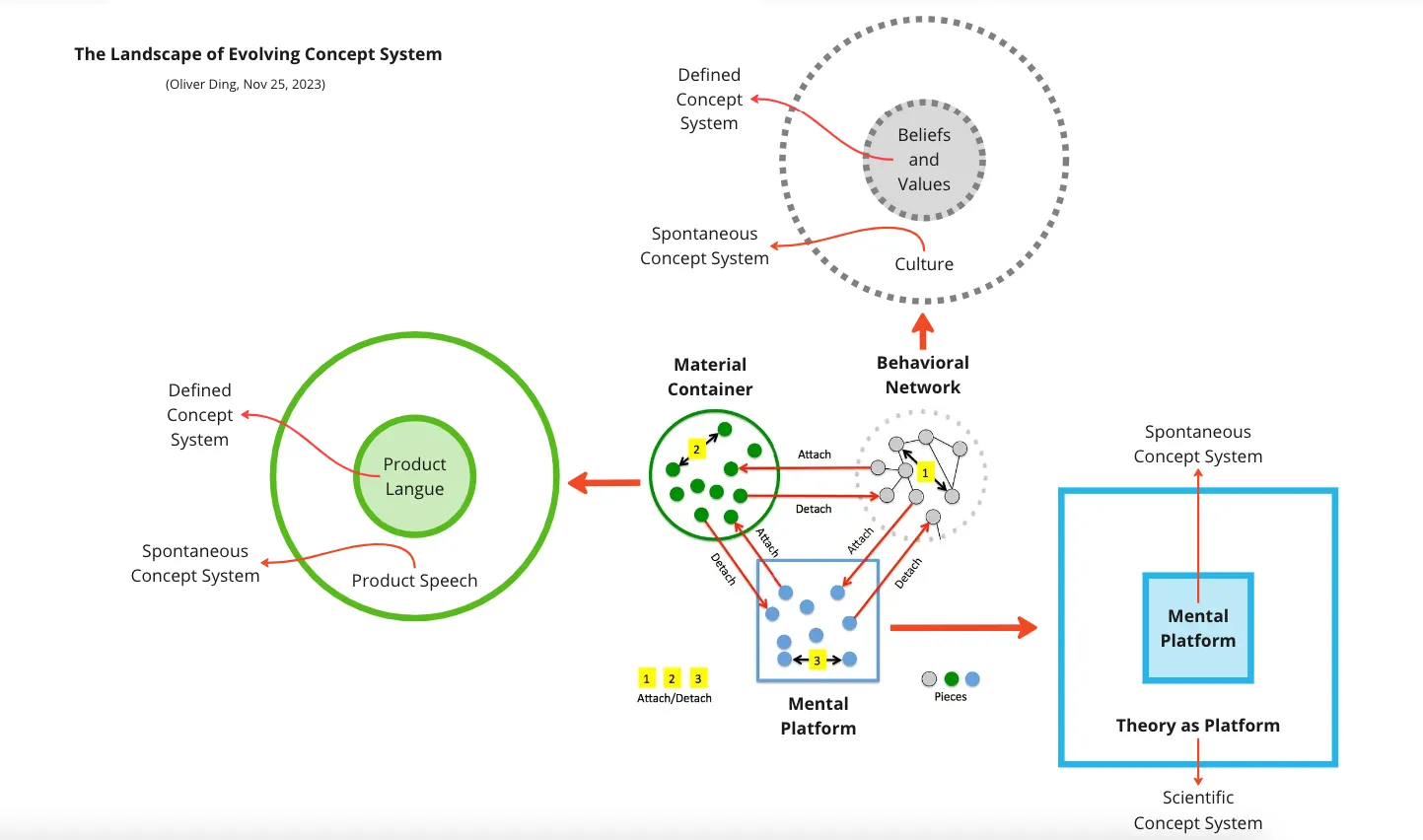
A Thematic Enterprise is not merely a collection of static frameworks. It is the natural evolutionary outcome of a concept system undergoing continuous objectification. This evolution unfolds simultaneously across three core dimensions: the Mental Platform (how you think), the Behavioral Network (how you do), and the Material Container (what you make). To operationalize this evolution, we rely on two core models: Center Development and Project Engagement.
5.2 Model 1: Center Development
To sustain the evolving concept system, a thematic enterprise requires an organizational and structural home. This brings us to Center Development. As explored in the Wonder and Wander project, Center Development is the continuous orchestration of a Creative Center across three distinct levels.
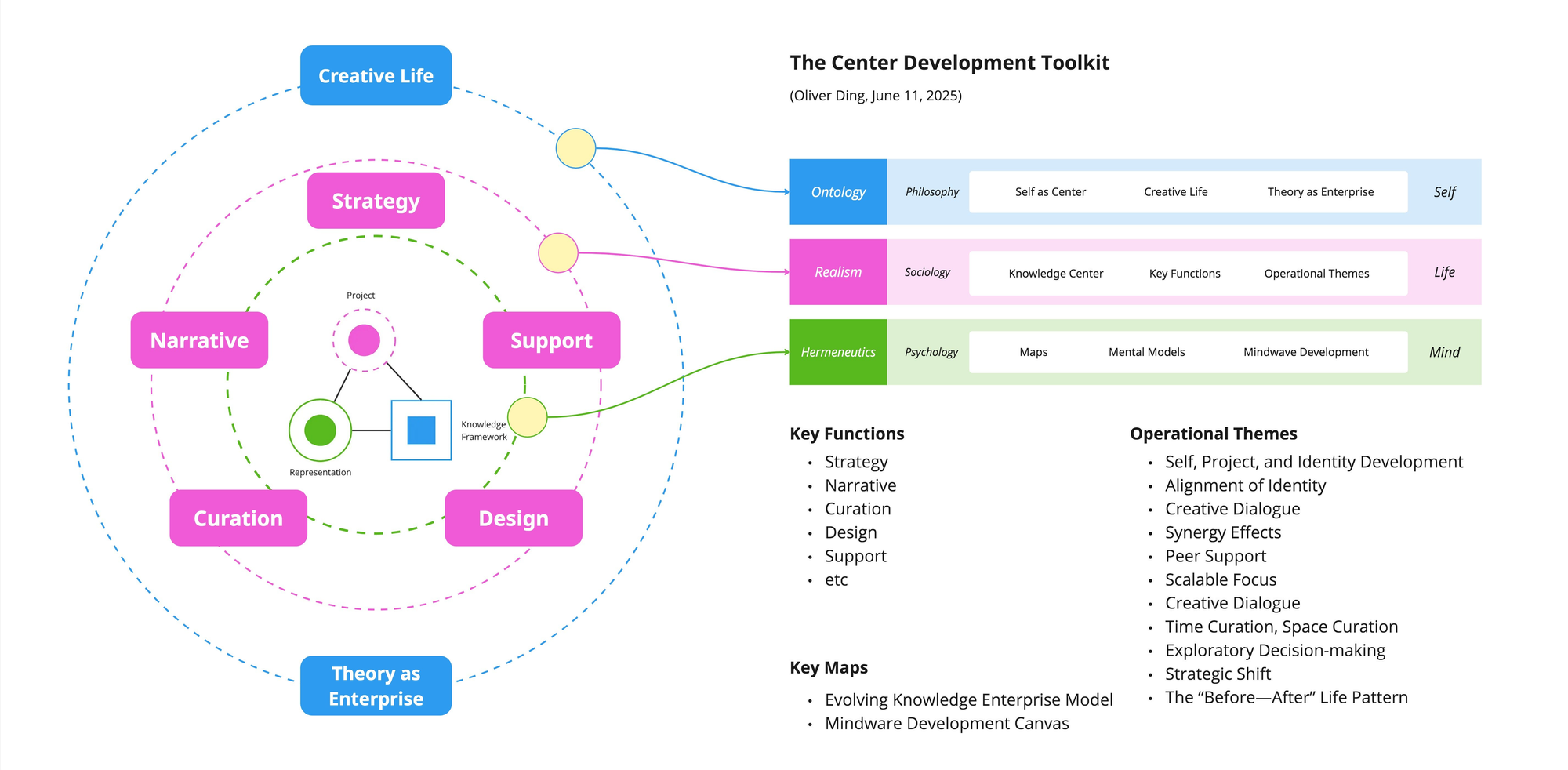
Ontology: Self as Center
Drawing on Howard E. Gruber’s concept of the "Self as Center," the creator is not a fixed point in the complex web of knowledge, but a "mobile center of synthesis and orientation." The center begins as an internal focus, helps balance the creator's broader Creative Life, and eventually organizes the entire enterprise.
Realism: Knowledge Center and Key Functions
At the sociological level, the Center moves from an internal focus to a real-world Knowledge Center. This process follows a developmental trajectory: from a Single Theme to a Single Project, solidifying into a Single Knowledge Center, expanding into a Single Knowledge Enterprise, and finally forming a Value Circle with others. To sustain this, creators must manage key functions such as Strategy, Narrative, Curation, Design, and Support.
Hermeneutics: Maps and Mindware Development
At the cognitive level, managing the complexity of a Center requires tools. The Evolving Knowledge Enterprise model functions as a Map to chart the Center's global structure, supporting reflection and strategic decision-making. These maps are internalized as mental models and become Mindware—the cognitive tools used to navigate the enterprise.
Together, these three levels provide the structural container that holds the Evolving Concept System together.
5.3 Model 2: Project Engagement
While Center Development provides the structural home, Project Engagement provides the dynamic unit of activity. Following Andy Blunden’s notion of the "project as a unit of analysis," a project is a social container that organizes actions around a specific theme.
The core of this model is the Developmental Project Model (DPM). While the DPM identifies eight elements that describe a developmental project, its beating heart lies in the dynamic interplay between two core elements: Theme and Identity.
- Theme represents the subjective, lived experience and the crystallization of meaning. It is what the project is about.
- Identity represents the objectification of that theme into a recognizable social role or a shared commitment. It is who the project becomes.
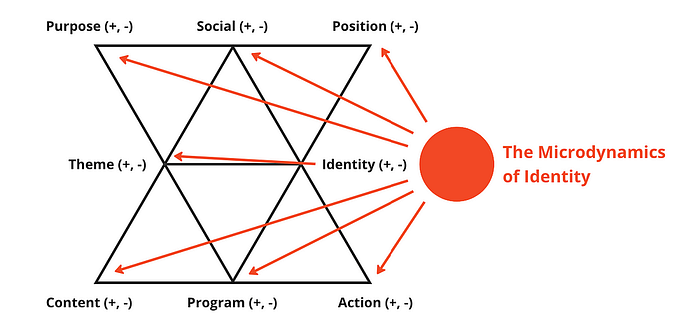
The dynamic process behind these two elements is mapped through the Thematic Identity Curation Framework. It traces how a creator moves from the initial discovery of a theme (Thematic Echo), integrates it with other themes (Thematic Blend), launches it into the world (Creative Projects), and ultimately consolidates it into a stable, recognized identity (Identity Development).
Through Project Engagement, an abstract Evolving Concept System continuously generates concrete, identity-bearing outcomes.
5.4 From Enterprise to Ecology: Weave the Culture
Ultimately, a thematic enterprise is not an isolated island. As it matures, it enters the broader knowledge-cultural ecosystem—corresponding to the Ecology space in the Weave-the-Theme framework.
At this final stage, the governing mastery is Weave the Culture. This is the ultimate state where an individual's thematic creation is no longer just a personal project, but a contribution to the ongoing evolution of culture itself. It relies on four mechanisms of cultural development:
- Mental Moves: Shifts in cognitive perspectives.
- Social Moves: Navigating norms and collective expectations.
- Strategic Curation: The art of weaving elements into an enterprise.
- Generative Narrative: The continuous storytelling that sustains the culture.
A fully realized Thematic Enterprise is grounded in the broader Cultural System. It draws on existing Cultural and Institutional Frameworks, while pushing the boundaries of Spiritual and Knowledge Frameworks. In this macro-ecology, the enterprise becomes a living contribution to the ongoing evolution of culture.
Part 6: An Ecological Formism Approach to Thematic Engagement
Throughout this article, we have explored the four layers of Thematic Engagement: Cognition, Activity, Situation, and Enterprise. However, these four layers are not an arbitrary classification. They are strictly constructed according to the layers of Ecological Formism. This alignment is not merely structural decoration; it is the key to making the toolkit operational across different theoretical domains.
6.1 What is Ecological Formism?
Ecological Formism is the epistemological framework of the GO Theory platform, introduced in the book Ecological Formism (v1, 2025). It classifies patterns according to their degree of universality. The framework has a single organizing schema—a four-layer structure:
- Invariant: A stable basic form that serves as the ontological foundation of a system.
- Quasi-invariant: A pattern that recurs across cases, and adjusts to each of them.
- Variant: A particular case, bound to a specific situation.
- Invariant Set: A group of other ecological forms in a part-to-group relation with the invariant.
Two features of Ecological Formism are crucial for this article. First, it is scale-free: an object's layer depends on the scale at which it is analyzed. Second, it is generative: the layering can be applied to its own outputs, allowing frameworks to be reorganized by the same principle.
To illustrate this generative and recursive nature, consider the nested structure of the frameworks themselves. The entire Thematic Engagement Toolkit is organized into four layers based on Ecological Formism: Thematic Cognition (Invariant), Thematic Activity (Quasi-invariant), Thematic Situation (Variant), and Thematic Enterprise (Invariant Set).
If we zoom in on just the first layer—Thematic Cognition—we find the Weave-the-Theme Framework. This framework is structured along two axes, one of which is the Experience–Narrative–Framework–Ecology Schema. Remarkably, this schema is itself organized according to the exact same four layers of Ecological Formism: Experience (Variant), Narrative (Quasi-invariant), Framework (Invariant), and Ecology (Invariant Set).
This fractal-like nesting demonstrates how a single ontological grammar can generate coherent, interoperable structures across vastly different scales—from the macro-architecture of a toolkit to the micro-structure of a single schema.
6.2 Reading the Four Layers Together
Applying Ecological Formism to this toolkit, the four layers of Thematic Engagement map perfectly onto its four levels:
- Invariant (Thematic Cognition): The stable basic form (T as Theme). It holds across all cases, defining how a single theme couples with a concept.
- Quasi-invariant (Thematic Activity): The recurrent pattern (S-T-O). It recurs across cases but adjusts to each, describing how a theme develops over time.
- Variant (Thematic Situation): The particular case (Themes of Practice). It is bound to specific social situations and changes from case to case.
- Invariant Set (Thematic Enterprise): The part-to-group relation (Evolving Concept System). It holds the wider context in which the other three layers operate.
While this mapping to Ecological Formism establishes the structural rigor of the toolkit, its true vitality comes from how these layers are woven together. As introduced in Part 1, the Weave-the-Theory model organizes each layer across four weave-points: Principles, Concepts, Models, and Themes.
Within this framework, the Principles and Concepts are relatively fixed, forming the structural backbone of the theory. However, the Models (such as the Knowledge Discovery Canvas or Frame for Work) and the Themes (such as Life Themes or Culture Themes) are highly open and adaptable. They can be revised, replaced, and expanded as new situations arise.
Read in this way, each of the four layers of Ecological Formism corresponds to one thematic space, and each thematic space can be understood and displayed through the Weave-the-Theory model. This division of layers, principles, concepts, and models can be summarized as follows:
| Layer | Thematic Space | Principle | Concept | Model | Theme |
|---|---|---|---|---|---|
| Invariant | Thematic Cognition | T as Theme | Thematic Cognition | Weave-the-Theme Framework | The individual's thematic cognition |
| Quasi-invariant | Thematic Activity | S-T-O | Thematic Activity | Semiotic system diagram; Creative Life Square | Themes developing within concrete activity |
| Variable | Thematic Situation | Themes of Practice | Thematic Situation | Canvases of the thematic matrix | The social situations of thematic activity |
| Invariant Set | Thematic Enterprise | Evolving Concept System | Thematic Enterprise | Center development; Project engagement | The larger context of the enterprise |
This table represents a creative dialogue between Ecological Formism and the Weave knowledge system. Ecological Formism gives the Weave system a basis for its layers, arranged by scale and stability. The Weave-the-Theory model gives Ecological Formism a form in which each layer can be shown, so that its principles, concepts, models, and themes each have a place.
Because of this combination of a fixed backbone and an open frontier, the Thematic Engagement toolkit is not a rigid, closed taxonomy. It is an evolving, open system that invites creators to weave their own models and themes into the shared architecture.
6.3 Connecting to the World of Activity (FFCC)
Because both Thematic Engagement and the World of Activity approach are built upon the grammar of Ecological Formism, they are structurally isomorphic.
The World of Activity model organizes the social world around the FFCC Schema:
- Flow (the stream of experience)
- Focus (the thematic concentration)
- Center (the organizing core)
- Circle (the social network)
We can clearly see the direct isomorphism between the two frameworks:
- Variant corresponds to Flow.
- Quasi-invariant corresponds to Focus.
- Invariant corresponds to Center.
- Invariant Set corresponds to Circle.
What makes this connection particularly powerful is how the World of Activity Toolkit (v2.0, 2026) has evolved. In v2.0, the four FFCC thematic spaces are no longer just descriptive; they now simultaneously carry multiple dimensions: forms, themes, identities, methods, moves, and achievements.
This directly mirrors the logic of the Thematic Engagement toolkit, especially regarding the Themes dimension. In World of Activity v2.0, the Quasi-invariant layer is populated with thirteen cross-human developmental themes described in FFCC vocabulary (such as Cutting the Flow, Setting the Focus, or Anchoring the Center). Meanwhile, the Variant layer remains an open category receiving "situational life events and themes." This perfectly echoes our conclusion in Section 6.2: while the structural Principles and Concepts are fixed, the Themes remain a highly open frontier.
Beyond themes, World of Activity v2.0 also integrates Identities (via the Creative Identity Cascade) and Methods (via the L3D model). This shows that the Thematic Engagement toolkit is not an isolated system. Because they share the same ontological grammar, Cognitive Hydrology, Weave-the-Theme, and the World of Activity can be seamlessly nested and integrated. Thematic Engagement provides the methodological framework for curation and cognition, while World of Activity provides the rich, lived landscape of ecological forms. This shared foundation facilitates future collaborative operations, allowing creators to translate concepts and practices smoothly across different theoretical systems.
6.4 Scope and Limitations
The toolkit presented in this article is explicitly designed for individual thematic cognition. It addresses how an individual recognizes, develops, and articulates a theme.
It does not address how a group dynamically develops shared themes and concepts. Complex interpersonal interaction, collective negotiation, and social cooperation—which a Thematic Enterprise must also handle—belong to other theoretical enterprises (such as the collective stages of the Anticipatory Cultural Sociology framework).
Furthermore, while the Ecology space represents the widest context of a theme, it remains a matter of individual thinking at the ecological level. Finally, the specific contents of the 4x4 Weave-the-Theme Framework are not yet fixed. The toolkit is an open map, meant to be tested, stretched, and revised.
These boundaries are not deficits; they are deliberate design choices. By explicitly limiting the scope to the individual, the Thematic Engagement Toolkit (v2.0) is positioned precisely within the broader Cognitive Hydrology project. The fundamental mission of Cognitive Hydrology is to help individuals enhance their thematic cognition and concept creation capabilities. The four-layer architecture and the open map presented here serve as the foundational cognitive infrastructure for that mission, providing the tools individuals need to navigate the vast waters of their own knowledge and creative enterprises.
Conclusion
This article has rebuilt Thematic Engagement from a mere theme into a formal theoretical concept, organizing it into a structured toolkit. Its primary results are threefold.
First, it resolves the long-standing paradox of Thematic Engagement. It is no longer just an object of inquiry or the name of a project, as it had been in TALE and in the years since 2019. It is now a formal theoretical concept composed of four principles and four corresponding parts.
Second, the four parts form a rigorously aligned four-layer architecture: Thematic Cognition (governed by T as Theme), Thematic Activity (governed by *S-T-O*), Thematic Situation (governed by Themes of Practice), and Thematic Enterprise (governed by the Evolving Concept System). Crucially, this structure is built upon Ecological Formism, ensuring structural isomorphism with other major frameworks like the World of Activity (FFCC). While these principles and concepts form a fixed backbone, the illustrative models and applied themes remain an open frontier, allowing the toolkit to be continuously revised and expanded.
Third, it clearly defines the boundary of the toolkit as individual thematic cognition. Interpersonal interaction and collective cooperation, which an enterprise also involves, belong to other theoretical enterprises. This deliberate boundary positions Thematic Engagement (v2.0) perfectly within the broader Cognitive Hydrology project, serving as the foundational cognitive infrastructure to help individuals enhance their thematic cognition and concept creation capabilities.
Appendix: Ecological Formism
Ecological Formism is the epistemological framework of the GO Theory platform. It was introduced in the book Ecological Formism (v1, 2025), and its current version, Ecological Formism Framework (v2.0), was developed on November 3, 2025. The LARGE Method (v3.0, 2026) names it as the epistemology of the platform, with the History{Life[Self(Body)]} framework as its ontology and the LARGE Method as its methodology.
The framework has a single organizing schema: a four-layer structure in which patterns are classified according to their degree of universality. The four layers are:
- Invariant. A stable basic form that serves as the ontological foundation of a system. In the World of Activity toolkit (v2.0), the Invariant layer is the FFCC schema, consisting of four basic ecological forms.
- Quasi-invariant. A pattern that recurs across cases, and adjusts to each of them. In the same toolkit, the Quasi-invariant layer is a series of movements described in the FFCC vocabulary. It contains thirteen themes across the four FFCC positions, drawn from three sources.
- Variant. A particular case, bound to a specific situation. In the World of Activity toolkit, the Variant layer is an open category of situational life events and themes, which can receive new themes as new situations are analyzed.
- Invariant Set. A group of other ecological forms in a part-to-group relation with the invariant. In the same toolkit, the Invariant Set connects the FFCC schema to other basic ecological forms, for example the six forms of Before–After, Slow–Fast, Up–Down, Left–Right, Inside–Outside, and Center–Periphery, later joined by Virtual–Real, Near–Far, and Part–Whole.
The framework is applied across twelve units of analysis, organized in four dimensions. Creating (Theme–Culture) contains Concept, Framework, and Diagram. Doing (Life–History) contains Life (Self), Activity, and Social Landscape. Thinking (Mind–Body) contains Affordance, Context (Mind), and Thematic Space. Saying (Self–Other) contains Narrative, Relation, and Supportance. Each unit corresponds to a knowledge system I have developed over the years.
Two features of the principle matter for the present toolkit.
The first is that it is scale-free. An object does not have a fixed layer in itself. Its layer depends on the scale at which it is analyzed. The same object may be an invariant at the scale of a whole platform and a continuum of stages at its own scale.
The second is that it is generative. The FFCC model, which describes the basic ecological forms of an individual's career and activity, was itself produced by the layering of Ecological Formism. The layering is therefore applied to its own outputs, and the frameworks it produces are then organized again by the same principle.
Ecological Formism should be distinguished from the Meta-frameworks collection. Ecological Formism concerns a single meta-framework, while Meta-frameworks examines the concept of a meta-framework itself, together with a collection of thirty-eight meta-frameworks released on December 31, 2025.
For the present toolkit, this principle gives the four layers within which each framework is placed. A framework is placed by how far it holds across cases and at what scale it is analyzed.
v1.0 - October 23, 2026 - 10,975 words