
GO Theory: The Weave-the-Strategy Toolkit (v2.0)
by Oliver Ding
October 13, 2026
This article is part of a possible book: Developmental Strategy: Strategic Actor and the Weave-the-Strategy Toolkit.
The Weave-the-Strategy Framework (v1.0) was created as a part of the Weave-the-Mind Framework on October 15, 2025. At that time, I used the term "Strategic Agency" as a dimension.
From January to July 2026, while working on the ACS (Anticipatory Cultural Sociology) project and the SDP (Strategic Developmental Psychology) project, I made a distinction between Strategic Agency and Strategic Mind:
- Strategic Agency presents the study of action patterns derived from empirical life cases, identifying recurring patterns and the strategic responses they afford.
- And Strategic Mind presents the study of cognitive structures derived from the AAS framework, identifying nine aspects of strategic cognition.
Following this distinction, the v2.0 uses "Strategic Mind" to replace "Strategic Agency."
More significantly, the framework expands from a single weave-point—Slow Cognition, which was the focus of the v1.0 Toolkit—to all four weave-points: Slow Cognition, Strategic Moves, Project Engagement, and Ecological Opportunity. Each weave-point is elaborated across three levels, resulting in a 4×3 toolkit of twelve interconnected modules.
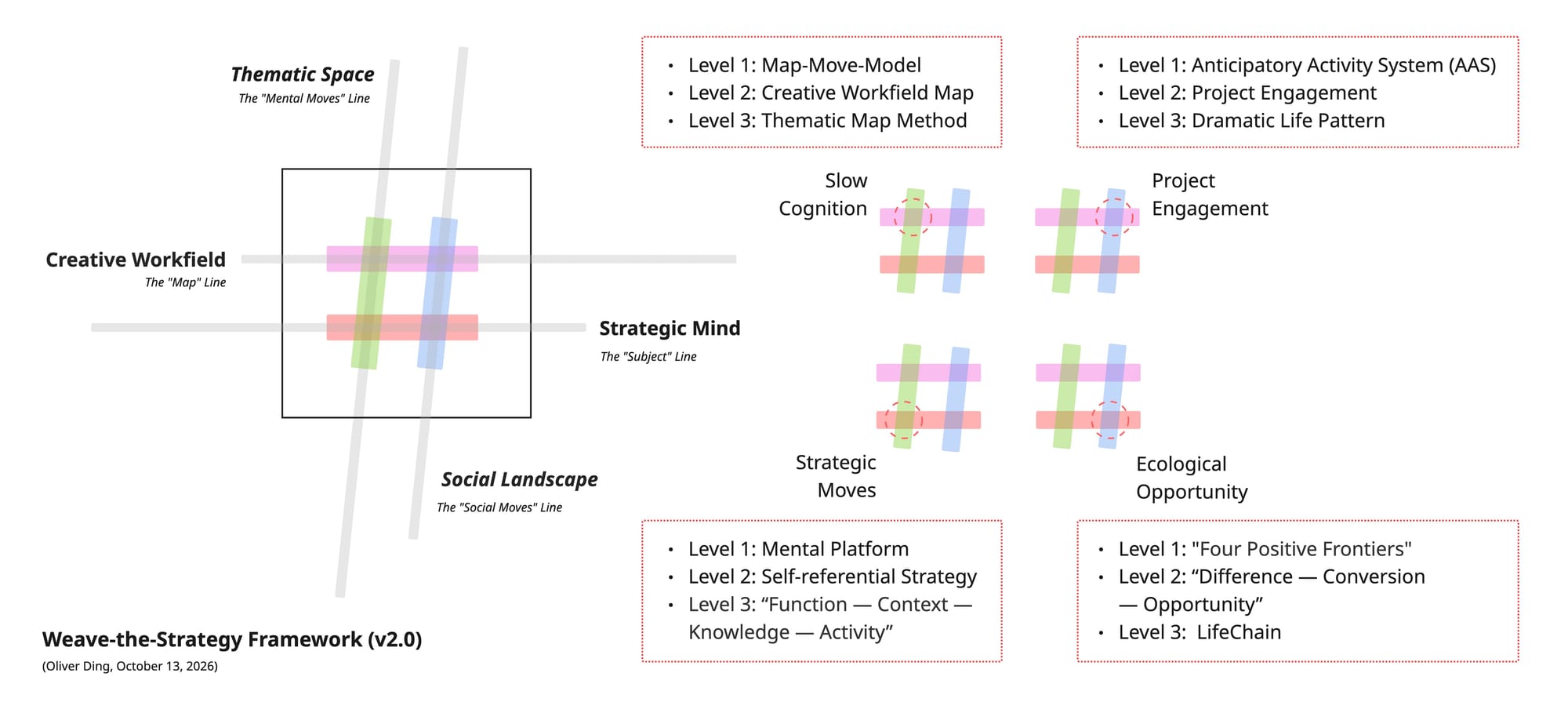
This article presents the new version, detaches the Weave-the-Strategy Framework from the Weave-the-Mind Framework, and attaches it to the GO Theory platform. The reattachment is not merely structural: it points toward a larger inquiry into the relationship between strategy, subjectivity, and agency, which will be explored in the Postscript.
Contents
Part 1. Background
1.1 The “Weave” Basic Form
1.2 The Weave-the-Mind Frameworks
1.3 Building a Mental Platform
Part 2. The Weave-the-Strategy Framework
2.1 Version 1.0 (2025)
2.2 Version 2.0 (2026)
2.3 From Framework to Toolkit
Part 3. The “Thematic Space” Dimension
3.1 Attachance, Thematic Space, and Mental Moves (book, 2023)
3.2 The Curativity of Mind: Mental Moves and Mental Platform
3.3 Mental Moves and Meta-frameworks
3.4 Thematic Space and Mental Moves
3.5 Mental Moves, Thematic Space, and GO Theory
Part 4. The “Social Landscape” Dimension
4.1 Social Moves and Social Cognition (2023)
4.2 Social Landscape and the House of Project Engagement (2024)
4.3 The Social Landscape Framework (v2, 2025)
4.4 Social Moves and Meta-frameworks (2025)
4.5 Social Moves, Social Landscape, and GO Theory
Part 5. The “Creative Workfield” Dimension
5.1 Creative Workfield: The House of Slow Cognition
5.2 Thematic Maps
Part 6. The “Strategic Mind” Dimension
6.1 Nine Aspects of Strategic Mind
6.2 Mental Platforms and Strategic Frameworks
6.3 Strategic Curation
Part 7. The “Slow Cognition” Weave-point
7.1 The Map-Move-Model Schema
7.2 Creative Workfield: The House of Slow Cognition
7.3 The Thematic Map Method
Part 8. The “Strategic Moves” Weave-point
8.1 Mental Platform and Strategic Framework
8.2 The Mental Platform Framework (Level 1)
8.3 The Self-referential Strategy (Level 2)
8.4 The “Function — Context — Knowledge — Activity” Schema (Level 3)
8.5 Case Study: The Container Thinking Journey
Part 9. The “Project Engagement” Weave-point
9.1 The Anticipatory Activity System (AAS) Framework (Level 1)
9.2 The Project Engagement Approach (Level 2)
9.3 The “Dramatic Life Pattern” Series (Level 3)
Part 10. The “Ecological Opportunity” Weave-point
10.1 The “Four Positive Frontiers” Framework (Level 1)
10.2 The “Difference — Conversion — Opportunity” Schema (Level 2)
10.3 The Lifechain Model (Level 3)
Postscript
Subjectivity, Agency, and Mind
Part 1. Background
In 2025, the Weave-the-Strategy Framework was born for exploring the Creative Mind, a section of Creative Life Theory (v3.0).
1.1 The "Weave" Basic Form
In October 2025, I introduced the Weave-the-Strategy Framework (v1.0), which was based on the "Weave" Basic Form.
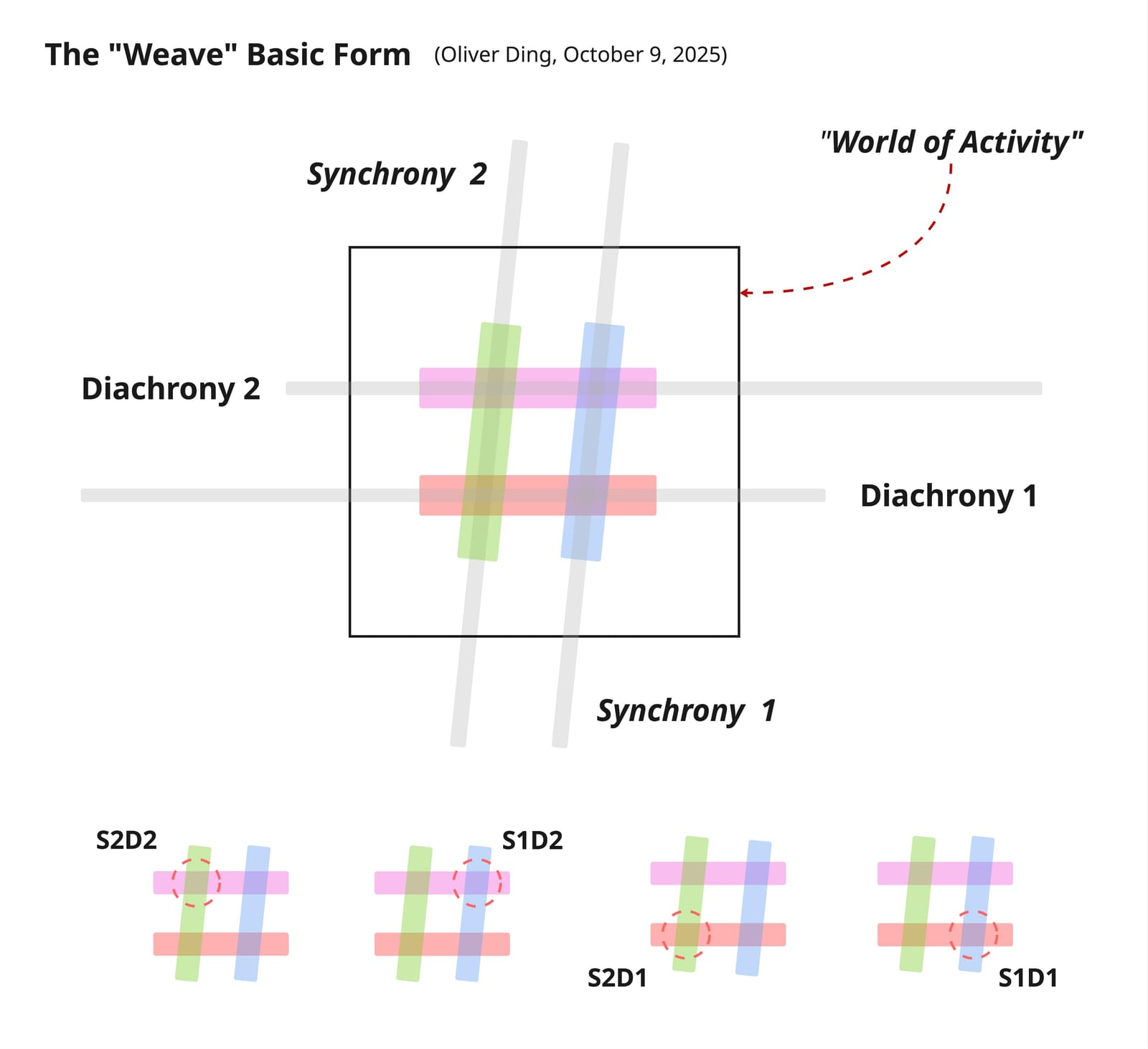
The "Weave" Basic Form is a super-simple diagram that frames the activity within the World of Activity as the synthesis of two diachronic dimensions and two synchronic dimensions. The model consists of four Weave-points (S1D1, S1D2, S2D1, S2D2), each representing a structural nexus where one synchrony dimension intersects with one diachrony dimension.
As an abstract model, the “Weave” basic form serves as the foundation for generating derived forms and situational frameworks. More details can be found in [Meta-framework] The “Weave” Basic Form.
The Weave Basic Form functions as a meta-framework. It can be used to curate knowledge elements and develop new frameworks for situational research and reflection.
1.2 The Weave-the-Mind Frameworks
Guided by this powerful methodology, the Weave-the-Mind Framework (v2.0) offers a series of Weave diagrams, covering five key themes:
- Weave the Meaning: Transforming fragmented life experiences into deep, coherent narrative meaning.
- Weave the Insight: Using four ways of awareness to explore, represent, and curate knowledge and mental activity.
- Weave the Concept: Realizing the architecture of the Mental Platform by systemizing mental elements and models.
- Weave the Strategy: Viewing Strategy as a process of Slow Cognition, encompassing both mental moves across thematic spaces and social moves across social landscapes.
- Weave the Decision: Integrating Exploratory Decision-making with Thematic Enterprise Theory.
These diagrams serve as a toolkit for practice application and examples of how the Weave Basic Form can be used to generate situational models.
1.3 Building a Mental Platform
The Weave-the-Mind framework makes a major milestone in the development of Creative Life Theory (v3.0).
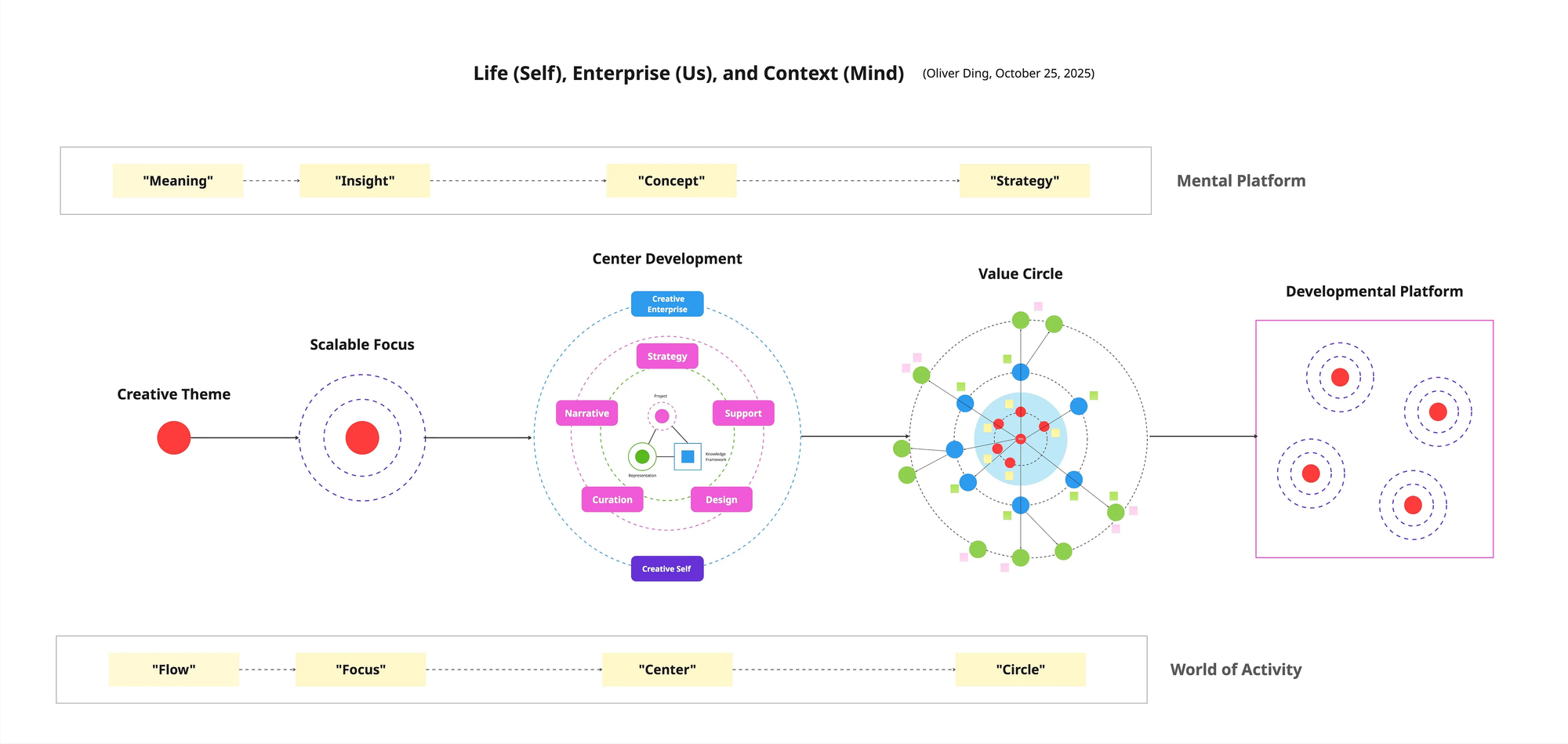
When we arrange the names of the Weave-the-Mind diagrams in sequence, we can trace a clear developmental path — a process of building a Mental Platform:
- Meaning → Insight → Concept → Strategy (Decision)
This progression illustrates how meaning evolves into insight, how insight forms concepts, and how concepts eventually support strategic decisions — a continuous movement from understanding to action.
By integrating this perspective into the Enterprise Development Framework, we can see how a creative enterprise grows not only through external development but also through the construction of an inner mental architecture.
See the diagram below.
Later, the Weave-the-Mind framework was featured in The Curativity of Mind (book, v1, 2025), releasing on December 13, 2025.
Part 2. The Weave-the-Strategy Framework
A brief history of the Weave-the-Strategy Framework.
2.1 Version 1.0 (2025)
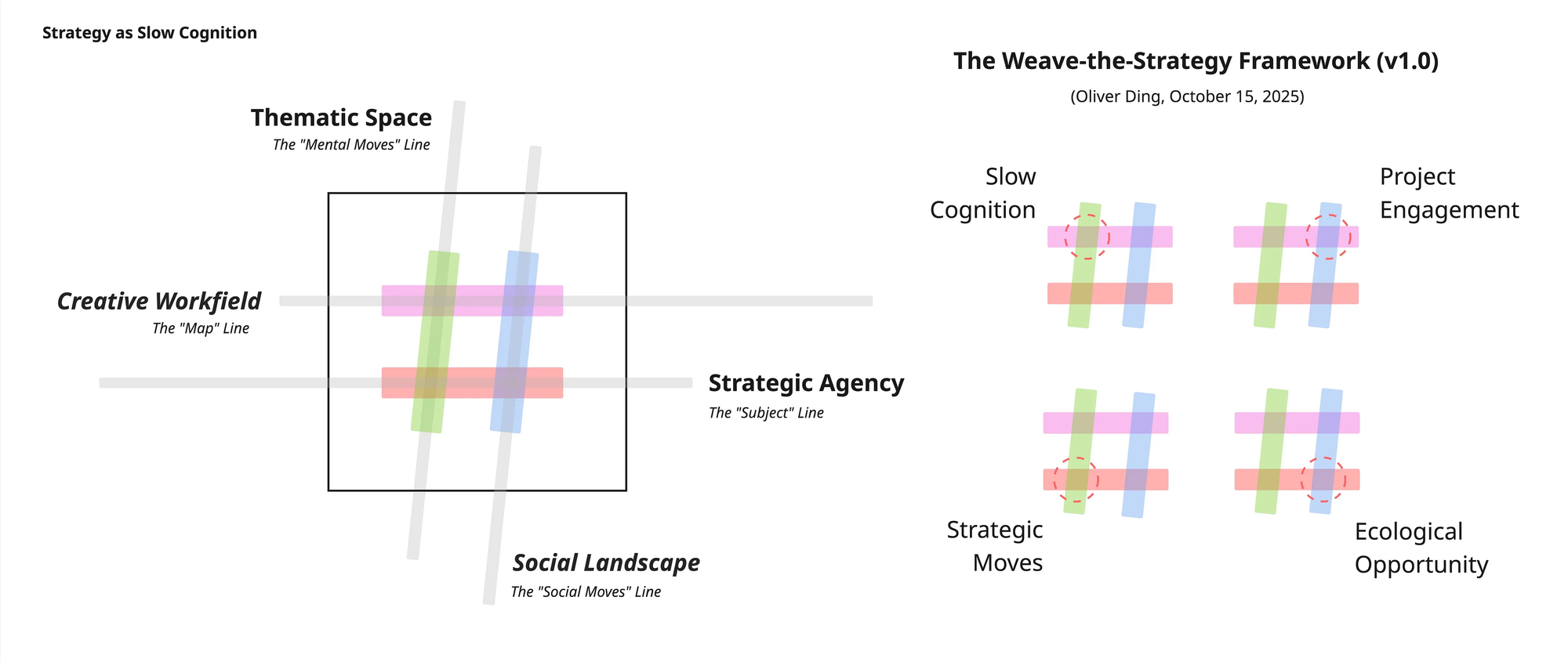
In October 2025, I introduced the Weave-the-Strategy Framework (v1.0), which curates several sub-models of my Strategic Life Theory around four concepts: Thematic Space, Social Landscape, Strategic Agency and Creative Workfield.
From June to December 2025, I worked on developing Creative Life Theory (v3.0), representing by several book drafts including The Curativity of Mind: Mental Curation, Mental Platforms, and Mental Moves.
After reviewing the Creative Life Theory (v3.0) project and the development of the “Curativity of Mind” theme, I highlight the main parts of the book: Mental Curation, Mental Platforms, Mental Moves, and the Weave-the-Mind toolkit.
The Weave-the-Strategy Framework (v1.0) belongs to the Weave-the-Mind toolkit, and the Weave-the-Mind toolkit belongs to the Mental Platform sequence. In particular, Weave-the-Strategy is a comprehensive model specifically for understanding Strategic Moves, which is related to Mental Moves.
The model has four dimensions:
- Thematic Space → "Mental Moves" Line
- Social Landscape → "Social Moves" Line
- Strategic Agency → "Subject" Line
- Creative Workfield → "Map" Line
Why did I select these dimensions?
The core idea of Weave-the-Strategy was based on a working definition: Strategy as a process of Slow Cognition, encompassing both mental moves across thematic spaces and social moves across social landscapes. It was based on my three book drafts from 2023-2024:
- Mental Moves: The Attachance Approach to Ecological Creative Cognition (2023)
- Social Moves: The Attachance Approach to Social Cognition (2023)
- Strategic Moves: Mapping Knowledge Engagement and Structural Choice (2024)
In this matter, two diachronic dimensions were defined as the "Subject" line and the "Map" line, considering Cognition is not a pure thinking within the brain, but also a process of engaging with tools such as maps. This idea was by Activity Theory and Ecological Psychology.
The term "Creative Workfield" refers to a meta-map titled the House of Slow Cognition, which represented an operational model of Slow Cognition.
The term "Strategic Agency" refers to Nine Aspects of Strategic Agency, which were introduced by the Anticipatory Activity System (AAS) framework.
The model consists of four Weave-points, each representing a structural nexus where one synchrony dimension intersects with one diachrony dimension:
- Thematic Space (Mental Moves) × Creative Workfield → Slow Cognition
- Thematic Space (Mental Moves) × Strategic Agency → Strategic Moves
- Social Landscape (Social Moves) × Creative Workfield → Project Engagement
- Social Landscape (Social Moves) × Strategic Agency → Ecological Opportunity
2.2 Version 2.0 (2026)
As mentioned above, the term "Strategic Agency" was replaced by "Strategic Mind" in order to follow the recent theoretical development.
From January to July 2026, while working on the ACS (Anticipatory Cultural Sociology) project and the SDP (Strategic Developmental Psychology) project, I made a distinction between Strategic Agency and Strategic Mind:
- Strategic Agency presents the study of action patterns derived from empirical life cases, identifying recurring patterns and the strategic responses they afford.
- And Strategic Mind presents the study of cognitive structures derived from the AAS framework, identifying nine aspects of strategic cognition.
Following this distinction, the v2.0 uses "Strategic Mind" to replace "Strategic Agency."
2.3 From Framework to Toolkit
In September 2026, while writing an article title The Thematic Space of Knowledge Engagement, I developed the Weave-the-Strategy Toolkit (v1.0).
The concept of Thematic Space does not remain at the abstract level. It appears in a series of toolkits, in the form of models and knowledge frameworks; these tools are the concrete ways in which the concept works in practice.
Thematic Space Theory is a key theoretical resource behind the Weave-the-Strategy Framework (v1.0), which curates several sub-models of my Strategic Life Theory around four concepts: Thematic Space, Social Landscape, Strategic Agency and Creative Workfield. Also, Slow Cognition and Strategic Moves, two of four weave-points of the framework, are related to Thematic Space Theory.
After reflecting on the theory and the framework, I presents a three-level toolkit around the "Slow Cognition" weave-point:
- Level 1: the Weave-the-Strategy Model
- Level 2: the Creative Workfield Map (the House of Slow Cognition)
- Level 3: the Thematic Map Method (also called Thematic Mapping)
The Thematic Map Method has been used to make the thematic maps of the past several years, and these maps led to a series of case studies of mental moves, social moves and strategic moves.
However, the v1.0 toolkit is only about one weave-point. In this article, v2.0 apply the same method to other three weave-points.
Part 3. The "Thematic Space" Dimension
The "Thematic Space" Dimension and the "Mental Moves" line refer to a long-term exploration on the "Thematic Space" theme and the "Mental Moves" theme.
3.1 Attachance, Thematic Space, and Mental Moves (book, 2023)
I coined the term Attachance by combining Attach and Chance in 2018 to discuss some ideas related to Affordance, a core idea of Ecological Psychology.
Affordance means potential action opportunities offered by environments. I want to highlight the meaning and value of actual action itself, however, the term Affordance only refers to potential actions. Thus, I coined the term Attachance to emphasize the potential opportunities offered by actual actions, especially the attaching act and the detaching act.
In 2022, the development of Attachance was tied to the development of Thematic Space, referring to a specific type of container: cognitive container.
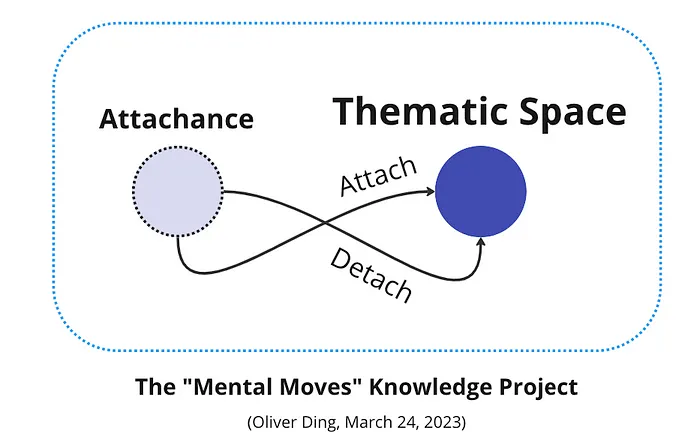
In 2023, I conducted a series of case studies of "Moving between Thematic Spaces" around several knowledge frameworks, resulting a book draft titled Mental Moves: The Attachance Approach to Ecological Creative Cognition.
3.2 The Curativity of Mind: Mental Moves and Mental Platform
On December 13, 2025, I released a book draft titled The Curativity of Mind: Mental Curation, Mental Platforms, and Mental Moves. The "Mental Moves" theme is one of three main themes of the book.
The book was organized by the “Function — Context — Knowledge — Activity” schema and the "Mental Moves" theme was framed as about Activity and Agency.
Mental Moves forms the essential theme of Activity. This theme explores the strategic practices and actions — the purposeful curatorial movements — that leverage the structures of the Mental Platform to engage effectively with the World of Activity.
By focusing on Moves, we articulate how the Mind translates its concept systems into meaningful actions within the framework of Thematic Space Theory, thus completing the theoretical arc for the Mind dimension.
3.3 Mental Moves and Meta-frameworks
On December 31, 2025, I released a book draft titled Meta-frameworks: Creative Heuristics for Individual and Social Development.
Moving beyond traditional views of meta-frameworks as purely cognitive instruments, the book situates them within the social world. It examines how meta-frameworks function as creative heuristics — how they are formed, tested, revised, and sometimes outgrown — and how these processes support both individual creative life and broader cultural development.
In the book, I introduced the Weave-the-Culture Model, highlighting four mechanisms of cultural development:
- Mental Moves
- Social Moves
- Strategic Curation
- Generative Narrative
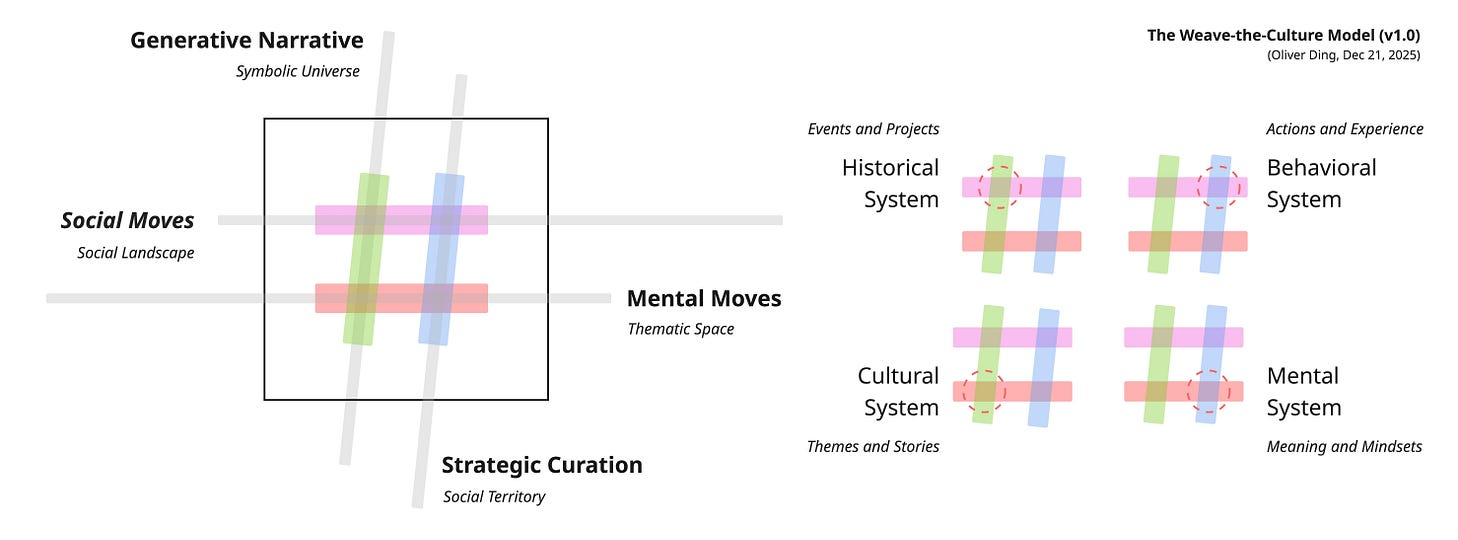
In the Weave-the-Culture Model, Mental Moves and Social Moves are two diachronic dimensions, while Strategic Curation and Generative Narrative are two synchronic dimensions.
In the book, "Mental Moves" refer to the internal shifts in an individual’s cognitive perspective. Whether it is switching between different Predictive Models or reframing a problem through a new Mental Platform, these moves are the starting point of all cultural creation. The concept of Mental Moves and its associated methods provide a practical framework for studying individual engagement with concept systems.
In Part 3 of the book, I explore the three dimensions of these cognitive transformations:
- Moves to Others (As Means): Using meta-frameworks as tools to facilitate external knowledge engagement and problem-solving.
- Moves to Self (As End): Treating the meta-framework as the object of development itself, leading to a top-down construction.
- Self-driven Mental Shifts: The internal, often spontaneous, reorganization of one’s mental moves between different mental platforms.
3.4 Thematic Space and Mental Moves
Thematic Space is not a single-level concept. It has different positions and functions at different theoretical levels. In Thematic Space Theory (TST), it is an abstract theoretical concept. In the History{Life[Self(Body)]} framework (HLS), it is a theoretical concept within a collaborative whole. In the Gejunction framework, it is an operational concept that faces individual actors directly.
Thematic Space Theory is based on the Theme (Concept) ontology and the concept of Thematic Space. A Thematic Space is a cognitive space where a person's ideas, activities and practices revolve around one theme. A theme can be an established theory such as Activity Theory, a general concept such as Platform or Life, or something in between, such as Design Thinking or UX.
The theory has three levels:
- The "Theme (Concept)" Ontology
- The "Map(Move)" Realism
- The "Model (Map)" Hermeneutics
Any knowledge framework can be understood as a set of Thematic Spaces: a Map. Once a social reality is read against such a map, Social Moves become something that can be modeled directly on it, with the Mental Moves they correspond to observed in turn — and the relationship runs the other way as well, from Mental Moves back to the Social Moves they imply. This is the bridge TST actually provides, between Mental Moves and Social Moves, through whatever Map a given knowledge framework happens to supply.
Read this way, TST's own three levels define the Map-Move-Model schema: the Map (Move) Realism supplies the Map, representing whatever Moves it is built to describe; the Model (Map) Hermeneutics supplies the Model, interpreting the Moves. Map, Moves, and Models are not a framework borrowed from outside TST to organize this article — they are TST's own architecture, read at a different grain.
3.5 Mental Moves, Thematic Space, and GO Theory
In 2026, Mental Moves and other three mechanisms of cultural development became the foundation of GO Theory platform and the ACS (Anticipatory Cultural Sociology) project.
Thematic Space became an aspect of HLS framework, the ontological foundation of GO Theory platform.
Part 4. The "Social Landscape" Dimension
The "Social Landscape" Dimension and the "Social Moves" line refer to a long-term exploration on the "Social Landscape" theme and the "Social Moves" theme.
4.1 Social Moves and Social Cognition (2023)
Late 2023, following the Mental Moves project, I worked on the Social Moves project, introducing the Attachance Approach to Social Cognition. The diagram below shows three layers of the approach.
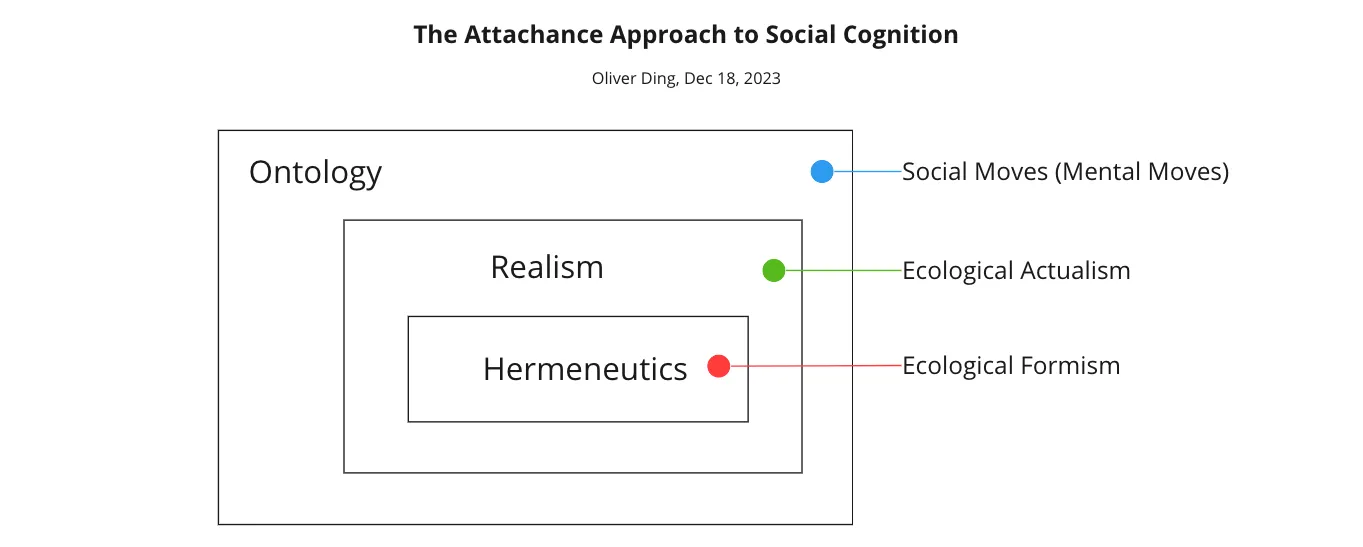
- Ontology: Social Moves (Mental Moves)
- Realism: the Ecological Actualism framework
- Hermeneutics: the Ecological Formism framework
While “Social Moves” are about Social Actions, “Mental Moves” are about related Mental Activities.
Social Cognition = Social Moves (Mental Moves)
Both “Mental Moves” and “Social Moves” shared the concept of “Thematic Space” and the concept of “Attachance”.
For the Social Moves project, “Thematic Spaces” and “Social Territory” are two types of “Container”.
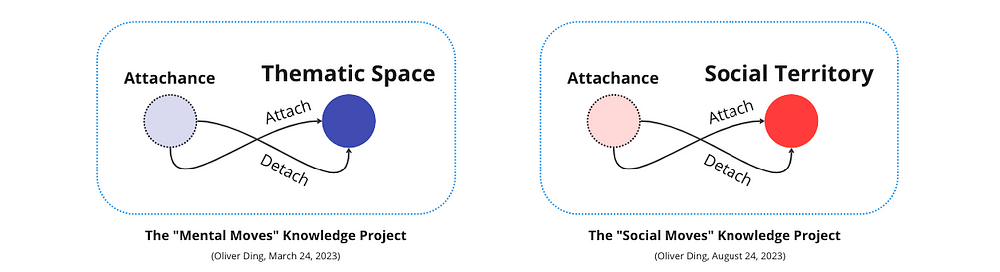
- Mental Moves: Thematic Space
- Social Moves: Social Territory
At the Ontology level, both concepts are very abstract. We need to see them at the Realism level and the Hermeneutics level. More details can be found in a book draft Social Moves: The Attachance Approach to Social Cognition.
4.2 Social Landscape and the House of Project Engagement (2024)
In May 2024, I developed version 3.1 of the Project Engagement approach — a theoretical toolkit.
From May to July 2024, I discussed Project Engagement (v3.1) with friends. I spent four weeks in China in June and July caring for a family member undergoing surgery. I developed the tool “The House of Project Engagement” during this time, using “Thematic Rooms” as a metaphor to represent different social structures. I later named this group of rooms and their social structures “Social Landscape”.
In July 2024, after returning to the U.S., I completed Project Engagement (v3.1) with a Chinese-language thesis. However, I detached the concept of Social Landscape from the thesis and developed it into a standalone framework, which I later applied to the Strategic Moves project in September 2024.
What does the framework look like? See the diagram below.
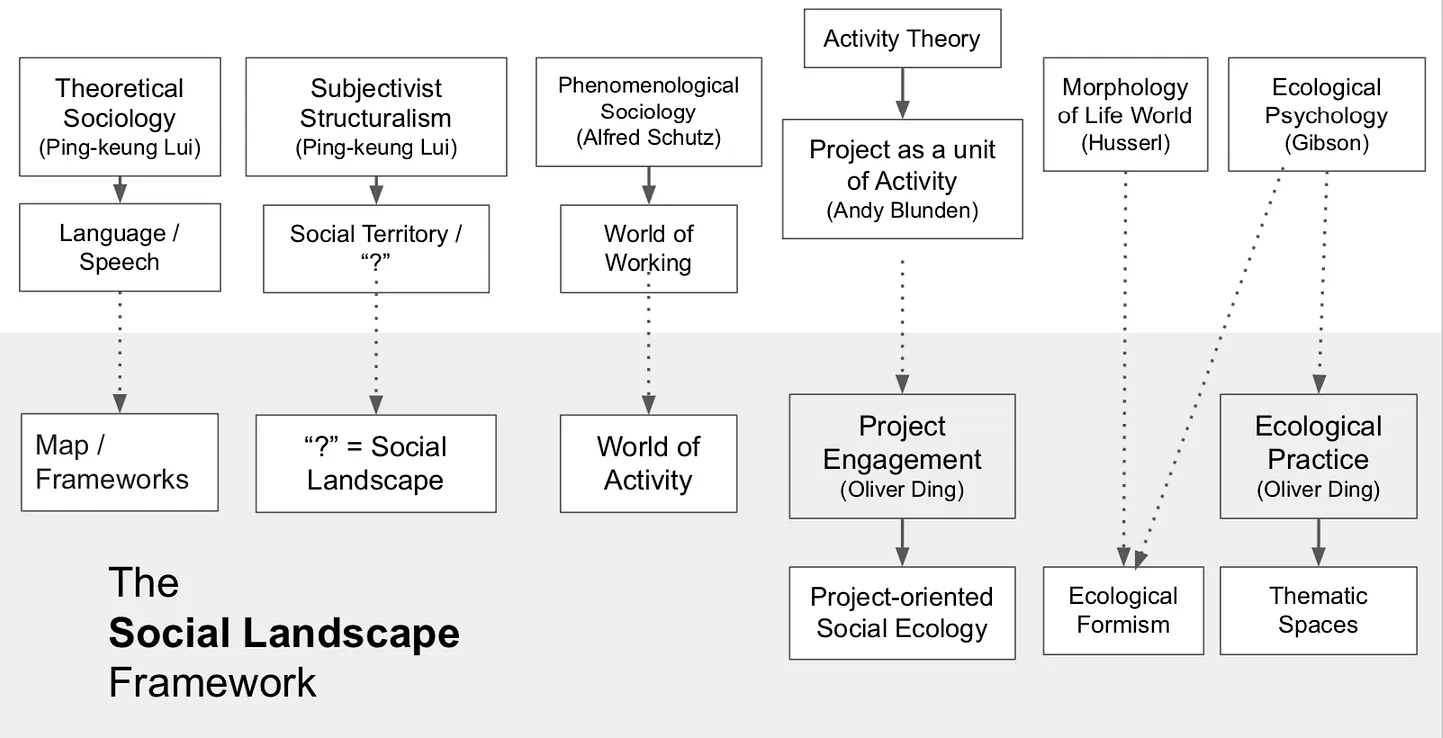
As illustrated, the Social Landscape Framework is inspired by several theoretical resources.
4.3 The Social Landscape Framework (v2, 2025)
In 2025, after publishing Homecoming, I used the Ecological Formism schema to organize my ideas about Significant Social Forms, Basic Ecological Forms, and my previous work on the Social Landscape framework. The outcome is a new model that incorporates the Social Landscape framework and the latest ideas on social forms.
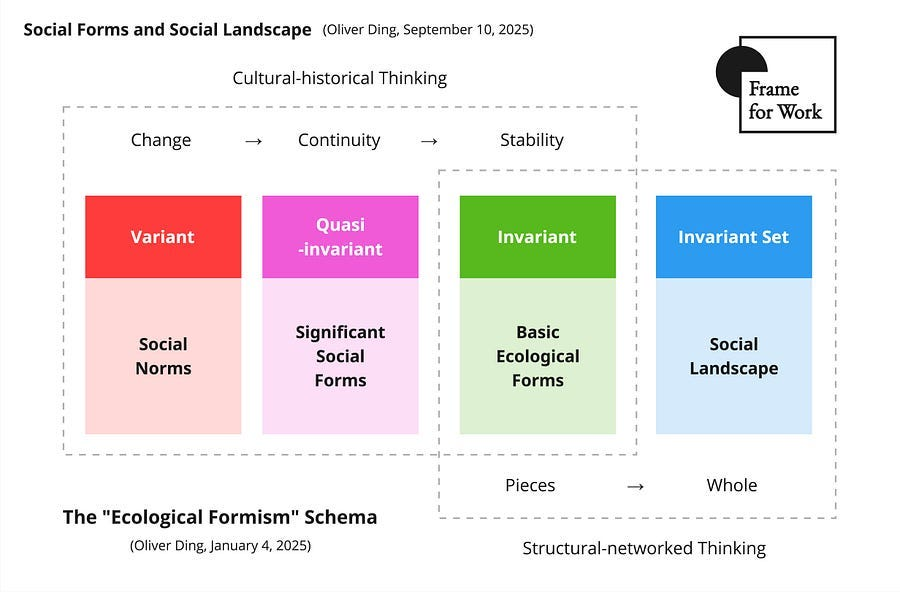
- Variant: Social Norms
- Quasi-invariant: Significant Social Forms
- Invariant: Basic Ecological Forms
- Invariant Set: Social Landscape
This is also significant progress for the Ecological Formism framework, as it offers a solution to connect embodied cognition with social cognition.
I use the following five schemas to name several Significant Social Forms (SSF).
- SSF in general: [Beginning — End — Language — Environment]
- SSF of interpersonal interaction: [Self — Other — Present — Future]
- SSF of Sociotech: [Tech — Tool — Culture — Project]
- SSF of Cultural Innovation: [Ideation — Validation — Application — Reflection]
- SSF of Creative Life: [Whole — Pieces — Solid — Fluid]
Each schema names a distinct social form:
The “Beginning — End — Language — Environment” schema is a Derived Form of the Basic Form of the World of Activity: the “Heaven — Earth — Birth — Death” schema.
The “Self — Other — Present — Future” schema was discovered in 2021. Later, it led to the Anticipatory Activity System framework and a book draft titled Advanced Life Strategy.
The “Whole — Pieces — Solid — Fluid” schema was discovered in February 2023, when I created the “Hermeneutics of Creative Life” framework.
More details can be found in The Social Landscape Framework (v2, 2025).
4.4 Social Moves and Meta-frameworks (2025)
The theme of "Social Moves" is also featured in the book draft Meta-frameworks.
As the counterpart to Mental Moves, Social Moves describe the changes in an actor’s position within a Social Landscape. They involve navigating social norms, institutional boundaries, and collective expectations. By understanding Social Moves, we can track how an individual’s subjective intent begins to acquire objective weight within the “Outside” world.
4.5 Social Moves, Social Landscape, and GO Theory
In 2026, Social Moves and other three mechanisms of cultural development became the foundation of GO Theory platform and the ACS (Anticipatory Cultural Sociology) project.
Social Landscape became an aspect of HLS framework, the ontological foundation of GO Theory platform.
Part 5. The "Creative Workfield" Dimension
The "Creative Workfield" dimension refers to using the Slow Cognition method which adopt creative diagramming technique to create knowledge maps and thematic maps for cognitive operations, including mental moves and social moves.
5.1 Creative Workfield: The House of Slow Cognition
The term "Creative Workfield" also refers to a thematic map, the House of Slow Cognition, designed on December 30, 2024. It is a meta-map: it places the key concepts of slow cognition on one map, in seven rooms: Aspects, Attachances, Approaches, Maps, Models, Methods and Meanings. It integrates two earlier pieces, the 5A Slow Cognition Model (Aspirations, Aspects, Approaches, Attachances, Achievement) and the 5M method (Meaning, Moves, Map, Models, Methods). Slow Cognition here is the sense of Mind in the Toolkit: the long-term development of tacit knowledge and cognitive methods.
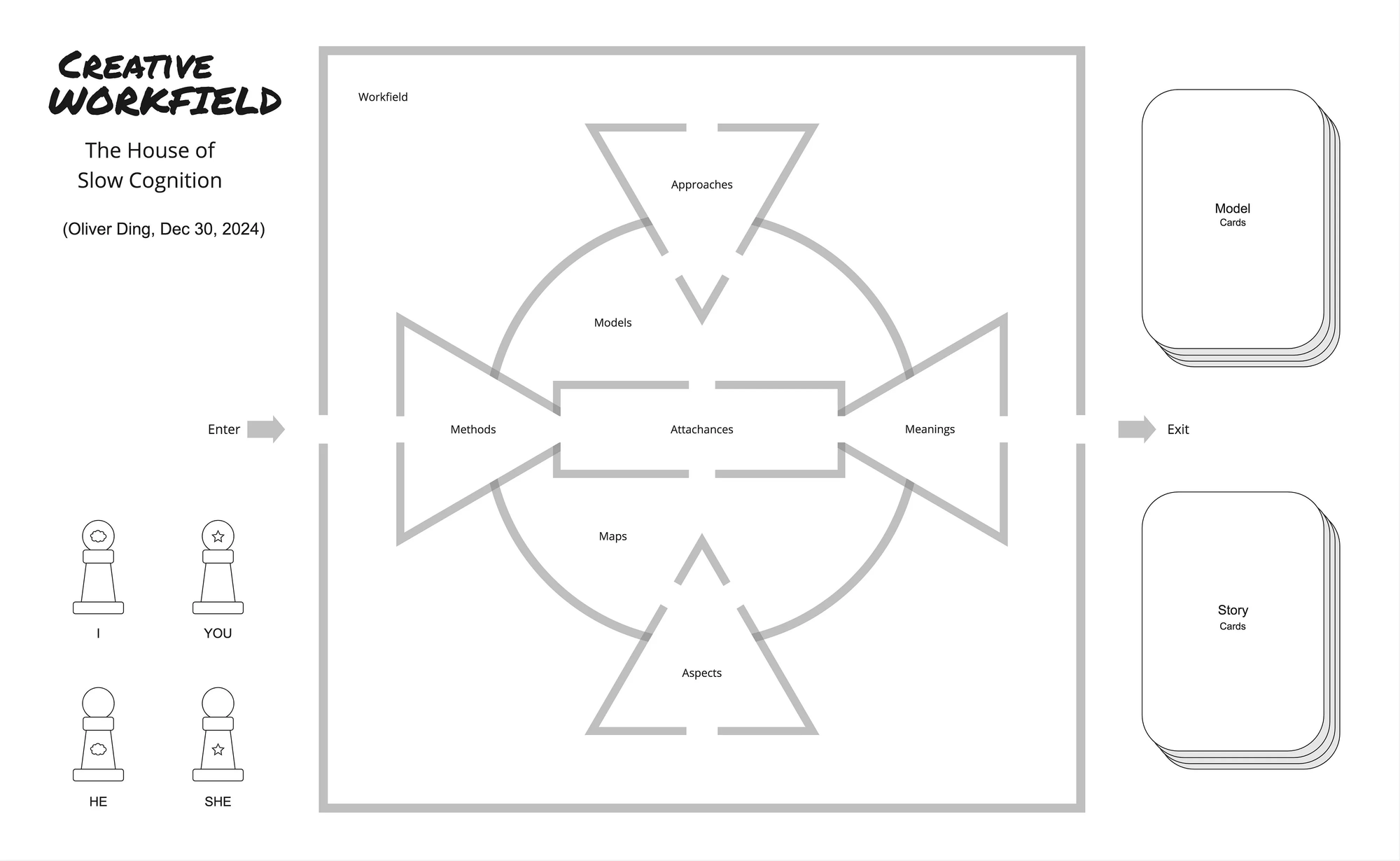
The 5M method has a worked example in Mapping Strategic Moves #14, the House of Creative Life Curation.
- Meaning: Achieving a creative life
- Moves: The real-life actions of creative life
- Maps: The House of Creative Life Curation, representing 12 key themes of the approach
- Models: The Lifescope Model, the Thematic Curation Framework, and the Creative Identity Engagement Framework
- Methods: The Creative Life Curation method, which uses Maps and Models to reflect on Moves
Creative Workfield provides the cognitive terrain and model tools for Mental Moves and Strategic Moves. It transforms the abstract structure of Thematic Space Theory into an operable work field. Through Creative Workfield, the knowledge worker can see the landscape of their cognitive activities, track their moves, and use models to interpret what they see.
5.2 Thematic Maps
The concept of Map, in any specific case, has its own thematic map. The Knowledge Discovery Canvas is one; the House of Knowledge Discovery and the House of Project Engagement are others.
Details can be found in 7.3.
Part 6. The "Strategic Mind" Dimension
The "Strategic Mind" dimension refers to the actor's mind from the strategic perspective.
In the context of the GO Theory platform, the term "Strategic Mind" refers to a series of related concepts:
- Nine Aspects of Strategic Mind
- Mental Platforms
- Strategic Frameworks
- Strategic Curation
- Strategic Moves
6.1 Nine Aspects of Strategic Mind
The aspects of strategic mind were first introduced as "aspects of strategic agency" in Advanced Life Strategy (late 2022), later extended to nine, and became the core model of Strategic Life Theory.
The concept of "Strategic Agency" refers to nine aspects of strategic action, featured in my 2025 book draft, Strategy as Curation:
- Anticipating
- Performing
- Discovering
- Producing
- Modeling
- Unfolding
- Storytelling
- Curating
- Perceiving
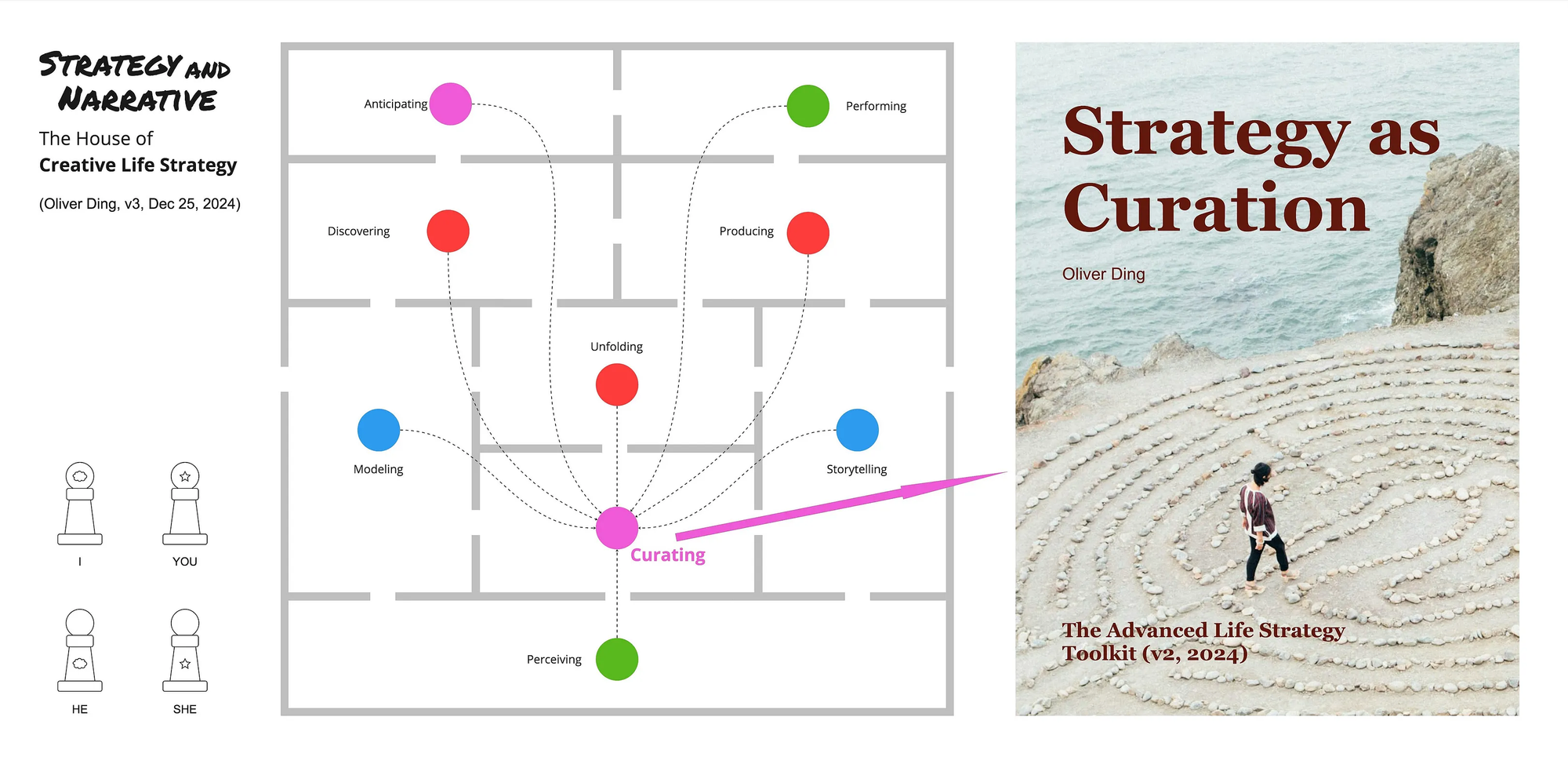
These nine aspects are assigned to four groups, corresponding to the four entities of the Curativity of Mind:
- Action: Discovering, Producing, Unfolding
- Perception: Perceiving, Performing
- Conception: Modeling, Storytelling
- Curation: Anticipating, Curating
As mentioning at the beginning, the distinction between Strategic Agency and Strategic Mind led to the renaming of these aspects.
6.2 Mental Platforms and Strategic Frameworks
Mental Platforms and Strategic Frameworks are two faces of the concept system, located in the bottom part of the HLS framework, the ontology of GO Theory. See the diagram below.
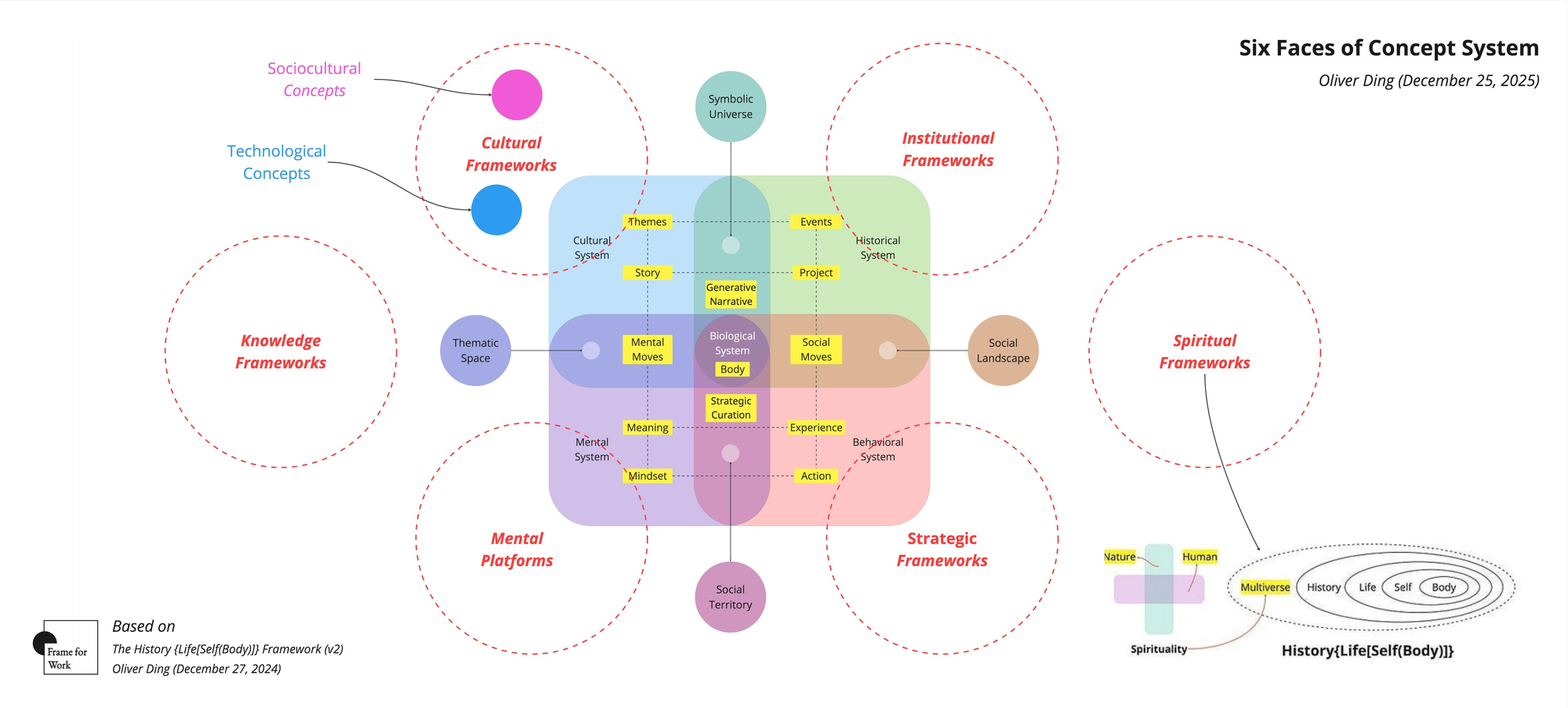
Based on the HLS framework, in late 2025, I identified six faces of the concept systems:
- Knowledge Frameworks
- Cultural Frameworks
- Institutional Frameworks
- Mental Platforms
- Strategic Frameworks
- Spiritual Frameworks
In the middle of the diagram, we observe four mappings between four faces of the concept system and four core systems of the social world:
- Mental Platforms — Mental System
- Strategic Frameworks — Behavioral System
- Cultural Frameworks — Cultural System
- Institutional Frameworks — Historical System
Outside this central area, two types of concept systems — Knowledge Frameworks and Spiritual Frameworks — do not correspond directly to the core map of the social world. Their displacement toward the extreme poles of truth and meaning is a topic for another occasion.
These mappings also reveal that two models share the same deep structure. The HLS Framework is a nested Anticipatory Activity System (AAS) structure: the Behavioral System (Mental System) represents the micro-AAS, while the Historical System (Cultural System) represents the macro-AAS. The micro-AAS corresponds to individuals, and the macro-AAS to collective society.
At the individual level, Mental Platforms belong to people, serving as the source of Strategic Frameworks, which target particular creative enterprises composed of a series of developmental projects.
At the collective level, Cultural Frameworks belong to social groups, while Institutional Frameworks emerge as evolving outcomes of Cultural Frameworks. In other words, past generations of Cultural Frameworks serve as the source of present Institutional Frameworks.
While Institutional Frameworks represent the crystallized history of human activity, Spiritual and Knowledge Frameworks represent the anticipatory horizon, pushing the Cultural System beyond its current limits.
Concept systems at individual and collective levels can influence each other. Individuals may adopt Cultural Frameworks to develop their Mental Platforms, while publicly shared Mental Platforms can contribute to new Cultural Frameworks. Similarly, some Institutional Frameworks can inspire Strategic Frameworks, and shared Strategic Frameworks can become part of Institutional Frameworks.
This is not a simple typology, but a dynamic map of evolving concept systems.
6.3 Strategic Curation
The "Strategic Curation" refers to a long-term exploration between 2022 to 2026.
In 2022, it refers to a five-space strategic curation framework, featured in a book draft Advanced Life Strategy.
In 2024, the book draft Strategy as Curation highlights nine aspects of strategic mind. In the article The Advanced Life Strategy Toolkit (v2, Dec 2024), I reviewed the development of Advanced Life Strategy from 2022 to 2024. During this process, I realized that the “Curating” thematic room serves as the hub of the nine thematic rooms in the House of Creative Life Strategy, representing the core themes of Advanced Life Strategy.
In 2025, in the book draft Meta-frameworks, the theme "Strategic Curation" was featured as one of four mechanisms of cultural development.
In Part 5 of the book, Strategic Curation refers to the art of “weaving” disparate elements — ideas, objects, and people — into a meaningful whole. Operating primarily on the individual side, this mechanism focuses on the Achievement Chain. It explains how a creator curates various frameworks to achieve an “Objective-Object Fit,” transforming fragmented life experiences into coherent Thematic Enterprises (or Tiny Culture).
Part 7. The "Slow Cognition" Weave-point
The "Slow Cognition" weave-point refers to the "Strategy as Slow Cognition" perspective, which is the initial idea behind the Weave-the-Strategy Framework.
In this article, I expand it into a three-level structure to curate a series of knowledge frameworks:
- Level 1: the Map-Move-Model Schema
- Level 2: the Creative Workfield Map (the House of Slow Cognition)
- Level 3: the Thematic Map Method (also called Thematic Mapping)
This three-level structure was based on the Weave-the-Strategy Toolkit (v1.0, 2026).
7.1 The Map-Move-Model Schema
The Map-Move-Model Schema is a key principle of Thematic Space Theory. It gives a method for reading any knowledge framework as a set of Thematic Spaces.
- Map: Each thematic area provides a map for Concept Development.
- Model: Each actor can adopt various perspectives and knowledge frameworks for their Concept Development activities.
- Move: Real actions
Map, Moves, and Models are not a framework borrowed from outside TST to organize this article — they are TST's own architecture, read at a different grain.
7.2 Creative Workfield: The House of Slow Cognition
The concept of Thematic Space does not remain at the abstract level. It appears in a series of toolkits, in the form of models and knowledge frameworks; these tools are the concrete ways in which the concept works in practice.
Creative Workfield: The House of Slow Cognition is a meta-map that describes the Slow Cognition method in a thematic map. Details can be found in 5.1.
7.3 The Thematic Map Method
Thematic Mapping, the name the Toolkit gave to this practice, is the method for making a thematic map from a knowledge framework and developing relevant mapping methods. Its premise is the one set out in 1.1: a framework is a combination of Thematic Spaces, so it can be drawn.
Once visualized, a knowledge framework becomes a map, which can in turn be used to represent an individual's activity progress — and it is through this visualized, activity-tracking use that Thematic Space also connects to Social Moves. In practice, I choose a framework or model, take each of its concepts as a Thematic Space, lay them out on a canvas so that the whole becomes visible as a map, and then trace moves on the map.
A sequence of moves is a Path, and a map is richer than a single fixed structure: it holds many Paths. The Knowledge Discovery Canvas carries four such Paths: Robert Kegan's Knowledge Enterprise (2023), the Mental Moves Knowledge Project (2023), a Strategic Map for the Strategic Life Narrative (2024), and the House of Discovery and the Social Landscape Framework (2024). The previous article reads them Episode by Episode, in Part 4 of The Relationfield of Knowledge Engagement.
Thematic Space Theory employs thematic and knowledge maps to explore creative cognition, social cognition, and strategic cognition. In October 2025, I introduced the term "Creative Cartography" to describe this kind of practice. I also classified it into four purposes:
- Mapping Situational Themes
- Mapping Strategic Moves
- Mapping Social Landscapes
- Mapping Strategic Aspects
Four Houses serve as mapping tools:
- The House of Knowledge Discovery: For mapping the journey from themes to concepts—how we develop understanding of specific topics (Knowledge dimension).
- The House of Creative Life Curation: For mapping the curation of life experiences into meaningful narratives—how we organize our creative biography (Context dimension).
- The House of Project Engagement: For mapping engagement with developmental projects—how we navigate social landscapes through activities (Activity dimension).
- The House of Creative Life Strategy: For mapping strategic agency across nine aspects—how mental platforms guide enterprise development (Function dimension).
Together, these four Houses provide a comprehensive toolkit for mapping the Curativity of Mind across its four dimensions. Each House corresponds to one dimension, yet they all interconnect—just as the four dimensions themselves form an integrated whole.
The Thematic Map makes it possible for knowledge workers to "see" their cognitive terrain. It provides a visual reference for Mental Moves and strategic development.
Part 8. The "Strategic Moves" Weave-point
Moves are actions. Strategic Moves are significant actions. This concept forms a sequence with Mental Moves and Social Moves, originally emerging from three projects:
- Mental Moves: The Attachance Approach to Ecological Creative Cognition (2023)
- Social Moves: The Attachance Approach to Social Cognition (2023)
- Strategic Moves: Mapping Knowledge Engagement and Structural Choice (2024)
It is closely related to Thematic Space Theory’s Map-Move-Model schema. Strategic Moves can be understood as the concrete actions related to strategy that actually occur.
8.1 Mental Platform and Strategic Framework
Before unfolding the three levels of Strategic Moves, we need to establish a key connection: the Mental Platform and the Strategic Framework are two aspects of the same concept system.
In the Six Faces of the Concept System, Mental Platforms belong to the individual level and serve as the source of Strategic Frameworks. When a Mental Platform is connected to a concrete context and activity, it becomes a Strategic Framework—the concept system that guides action. In other words, the Strategic Framework is not something external to the Mental Platform; it is the functional expression of the Mental Platform when it faces a specific activity.
Therefore, when we consider how Strategic Moves unfold, it is crucial to prioritize how the Mental Platform develops. Strategic Moves are not isolated decisions; they are the concrete operation of the Mental Platform within activity. Based on this understanding, the three-level expansion of Strategic Moves is as follows:
- Level 1: The Mental Platform Framework — examines the definition and internal/external features of the Mental Platform: what it is, what it is composed of, and how it connects to external knowledge systems.
- Level 2: The Self-referential Strategy — examines how the Mental Platform develops through activity: how it is constructed, refined, and deployed through self-referential activity.
- Level 3: The “Function — Context — Knowledge — Activity” Schema — examines how internalized knowledge is used in activity. This is, in effect, the concrete framework through which the Mental Platform transforms into a Strategic Framework—the concept system moving from an internal mental structure to external strategic action.
Together, these three levels form a coherent unfolding: from the ontological structure of the Mental Platform, to its developmental mechanism, to its transformation into a Strategic Framework that guides concrete activity.
8.2 The Mental Platform Framework (Level 1)
A Mental Platform is a concept system that supports a creative enterprise. It emerges from the transformation of Mental Elements into Mental Models, and then into a Mental Platform—a dynamic, self-organizing system of concepts that the mind continuously builds to support purposeful activity.
Mental Platforms are not isolated cognitive structures. They operate within a broader architecture that includes Mental Curation (how the mind works), Mental Platforms (what the mind uses), and Mental Moves (what the mind does). They bridge the Function and Knowledge dimensions of the Curativity of Mind, providing the cognitive terrain on which Strategic Moves become possible.
This level also addresses the internal and external features of the Mental Platform. Internally, it is a Spontaneous Concept System—a personal, evolving system of concepts that the creator curates for self-use. Externally, it connects to Scientific Concept Systems and can be externalized as Theory as Platform—a public, stabilized system for others’ use. The distinction between internal (private, subjective) and external (public, objective) is crucial: it explains how an individual’s Mental Platform can both draw from and contribute to the broader knowledge ecology.
8.3 The Self-referential Strategy (Level 2)
The Self-referential Strategy is the method for building a Mental Platform. It draws on the model of Self-referential Activity, which extends traditional Activity Theory by adding a fourth component—Transforming—to the basic triad of Subject, Mediating, and Object.
In this model, building a Mental Platform is not merely an activity that employs self-reference as a deliberate strategy. Self-referential Activity is its essential nature. The Subject of the activity is also its direct Object and Beneficiary. The Mental Platform is continuously constructed, refined, and deployed within a generative, self-reinforcing loop.
The Self-referential Strategy distinguishes four types of personal knowledge:
- S-knowledge: knowledge for self-awareness, self-improvement, and managing a knowledge project
- O-knowledge: knowledge about the work’s object—understanding a concept system
- M-knowledge: knowledge about using tools and methods
- T-knowledge: knowledge about transforming O-knowledge into S-knowledge
The key to T-knowledge is to switch Means and End. When a learned theory is seen as a Means for one’s own actions rather than an End in itself, O-knowledge becomes S-knowledge. The theory is no longer just understood; it is used to transform the Subject’s own development. This is the self-referential strategy in practice: using the concepts one learns to build the very platform that supports one’s creative work.
8.4 The “Function — Context — Knowledge — Activity” Schema (Level 3)
The third level situates the Mental Platform within a broader meta-framework: the Function — Context — Knowledge — Activity schema.
- Function: How the mind works (by curating)
- Context: Where the mind operates (in social landscapes)
- Knowledge: What the mind uses (conceptual systems)
- Activity: What the mind does (developmental projects)
These four dimensions are not independent modules but interdependent aspects of a single integrated whole. A Mental Platform (Function) operates within Social Landscapes (Context), drawing upon Knowledge Systems (Knowledge), and is enacted through Developmental Projects (Activity). Each dimension presupposes the others.
At the intersection of these four dimensions lies the fundamental process of Curation—turning pieces into meaningful wholes. This is the Curativity of Mind: the ongoing process of building and maintaining integrated mental-practical-social systems that support creative life across extended time.
The “Function — Context — Knowledge — Activity” schema provides the comprehensive lens through which Strategic Moves can be understood—not as isolated actions, but as the concrete enactment of a Mental Platform within a specific context, drawing on specific knowledge, and oriented toward a specific developmental project. This is how the internalized knowledge of the Mental Platform is used in activity, transforming into a Strategic Framework that guides action.
8.5 Case Study: The Container Thinking Journey
The three-level expansion of Strategic Moves is exemplified in the Container Thinking Journey, a case study within the Wonder and Wander Framework. This case traces how a Mental Platform was built through Self-referential Strategy, and how Strategic Moves were made within the Function—Context—Knowledge—Activity schema across a multi-year creative journey. It demonstrates the transformation of internalized knowledge into strategic action, and the ongoing development of the Mental Platform through self-referential activity. The journey is not merely a record of projects; it is the living process of a concept system becoming a Strategic Framework.
Part 9. The "Project Engagement" Weave-point
The "Project Engagement" weave-point refers to the Life-as-Activity Approach, a series of knowledge frameworks mainly inspired by the Activity Theory tradition.
Activity Theory understands human activity as a hierarchical structure. Different activity theorists specify that structure differently. In the Life-as-Activity approach, I set it as:
- Operation
- Action
- Project
- AAS (Anticipatory Activity System)
A series of related actions composes a project; the abstracted, systemic form of projects is activity; and the lower form of action is operation. At a higher organizational level, the Anticipatory Activity System (AAS) framework connects multiple projects into a future-oriented, self-referential system.
Based on this understanding, the three-level expansion of Project Engagement is as follows:
- Level 1: The Anticipatory Activity System (AAS) Framework
- Level 2: The Project Engagement Approach
- Level 3: The “Dramatic Life Pattern” Series
The AAS-Project-Pattern structure goes the top-down approach. The lowest level looks at the different patterns of project engagement within the real world. A series of patterns have identified.
9.1 The Anticipatory Activity System (AAS) Framework (Level 1)
The Anticipatory Activity System (AAS) Framework is a flagship framework of the Life-as-Activity Approach. First applied to life strategy exploration in 2022, this direction has since developed into Strategic Life Theory (2025) and Strategic Developmental Psychology (SDP, 2026), forming a sustained theoretical enterprise.
AAS is composed of two types of activity: First-order Activity and Second-order Activity. First-order Activity is goal-directed: you know what you are trying to achieve, and you act toward it. Second-order Activity is the activity of discovering what your goal should be in the first place. Before you can pursue a direction, you need to find it. The two are not rivals; they form a self-referential loop. The outcome of Second-order Activity produces the Significant Insights that give direction to First-order Activity. The outcome of First-order Activity generates results and rewards that feed back into Second-order Activity.
Their concrete form is always projects—but projects of different natures. A Second-order Activity project is oriented toward discovery and orientation; a First-order Activity project is oriented toward execution and production.
AAS focuses on a Significant Social Form (SSF): Self–Other–Present–Future. This SSF is the key to understanding strategy. Any meaningful strategic situation involves the simultaneous presence of self and other, present and future. The AAS framework makes this structure visible and workable. It also contains a set of operational concepts, such as Object / Objective, Result / Reward, and others—tools for analyzing how a strategic situation is structured and how it unfolds.
9.2 The Project Engagement Approach (Level 2)
The Project Engagement Approach is a project-centered social theory inspired by Andy Blunden’s notion of the “project as a unit of analysis of activity.” Since 2021, its development has aimed to establish “Project” as a conceptual foundation for cross-disciplinary research, creative dialogue, and deeper reflection on human development.
The Developmental Project Model is a core component of the Project Engagement approach. The diagram below illustrates the standard Developmental Project Model, which outlines eight elements that describe a developmental project:
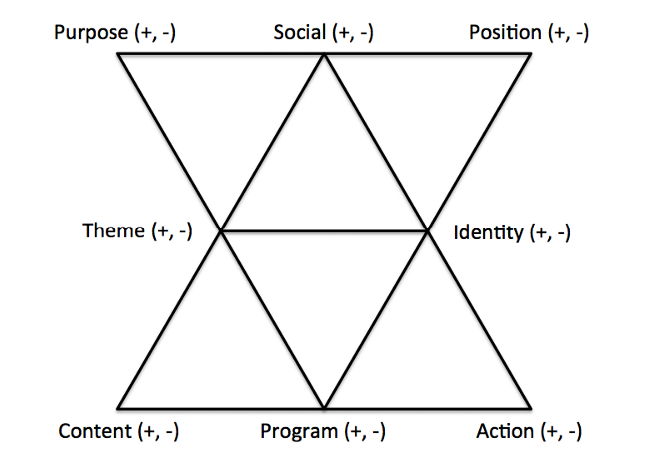
- Purpose: Why do you want to initiate or join the project?
- Position: What is the social structure of the project?
- Program: Does the project follow formal organizational processes?
- Social: How do you connect with others through your participation?
- Content: What new information and knowledge do you acquire by joining the project?
- Action: What concrete actions do you take in the project?
- Theme: Does the project introduce new and meaningful themes for your life development?
- Identity: How do you perceive your identity before and after joining the project?
“Theme” and “Identity” are two key elements of the Developmental Project Model. Between 2021 and 2024, I developed several knowledge frameworks focused on themes, identity, and related concepts.
Your identity is shaped by how others view “what you do” and “who you are,” but it’s also a part of your self-knowledge. From the perspective of the Project Engagement approach, identity is a core element of the Developmental Project Model and is deeply interconnected with the other elements.
Every time you join or leave a project, your identity evolves. This ongoing evolution is what I refer to as the Microdynamics of Identity.
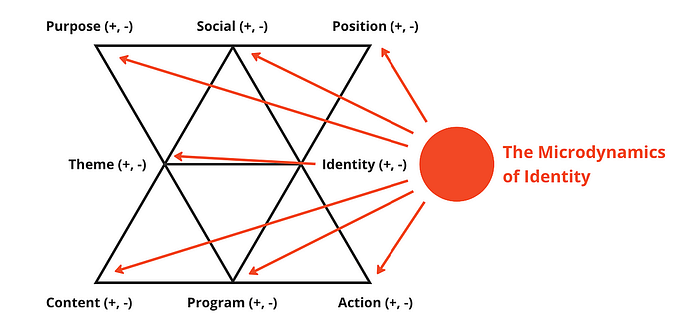
Life is a chain of projects, it is also a projection of social life. By adopting the Developmental Project Model, we gain a structured way to reflect on the development of both personal and social life, allowing us to connect psychology, sociology, and other disciplines in a single unit of analysis.
More details can be found in the Developmental Project Model, World of Activity #4: The Thematic Identity Curation Framework, and Developmental Projects: The Project Engagement Approach to Adult Development.
9.3 The “Dramatic Life Pattern” Series (Level 3)
The concept of Dramatic Life Pattern refers to the structural configurations of project engagement that recur across creative lives and can be recognized, named, and strategically engaged. The Creative Watershed and Revisiting–Rebuilding patterns are the primary cases.
Patterns are not functions. While functions describe what people do (curate experiences, discover possibilities, develop strategies), patterns describe the structural configurations through which development unfolds across time and space. They are topological rather than functional — concerned with positions, relations, sequences, and timing rather than with categories of action.
The early seed of the series was GAP Project (2023).
GAP Projects represent a temporal pattern: the structural opportunities that exist between formal projects. These “After” and “Before” projects — such as Creative Life Curation and Creative Life Discovery — occupy the gaps between major endeavors. They serve as reflection points, transition spaces, and moments of strategic choice. The timing of GAP projects is itself a pattern: recognizing when to pause, curate, or explore can dramatically affect developmental outcomes.
Several patterns have already emerged through the projects documented in my book drafts, though they have not yet been fully theorized.
I categorized these patterns in the following four categories:
- The Before - After dimension
- The Subject - Object dimension
- The Objective - Outcome dimension
- The Part – Whole dimension
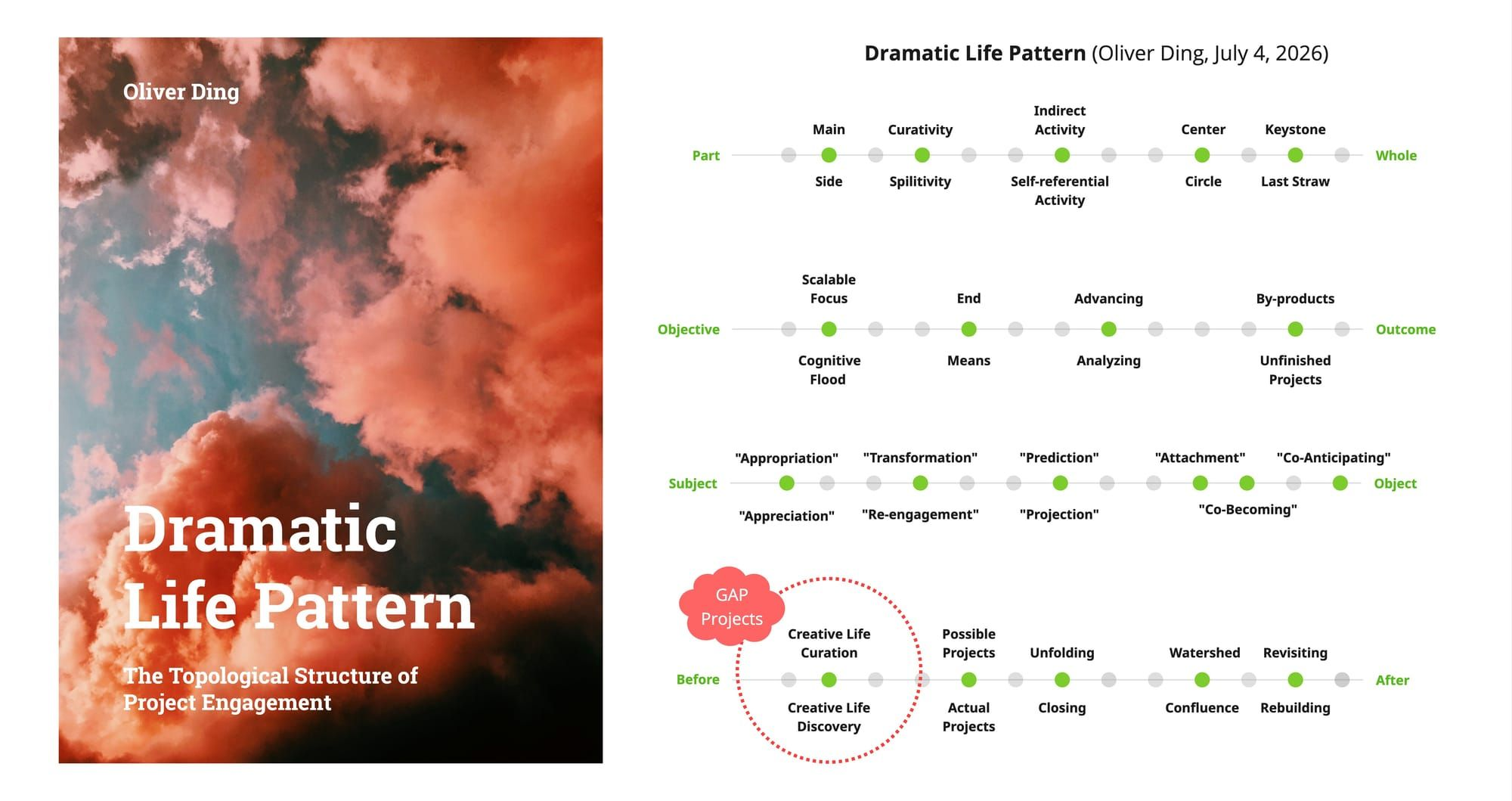
The concept of Dramatic Life Pattern points toward a methodological innovation: ecological validity as a practice for actors, not just researchers. Details can be found in Toward Dramatic Life Pattern.
Part 10. The "Ecological Opportunity" Weave-point
The concept of "Ecological Opportunity" refers to a major part of the Ecological Practice Approach. The early development of the Ecological Practice Approach was inspired by ecological psychology, especially Affordance Theory. It focuses on a set of opportunity-related concepts.
The three-level expansion of Ecological Opportunity is as follows:
- Level 1: The "Four Positive Frontiers" Framework
- Level 2: The “Difference — Conversion — Opportunity” Schema
- Level 3: The Lifechain model
10.1 The "Four Positive Frontiers" Framework (Level 1)
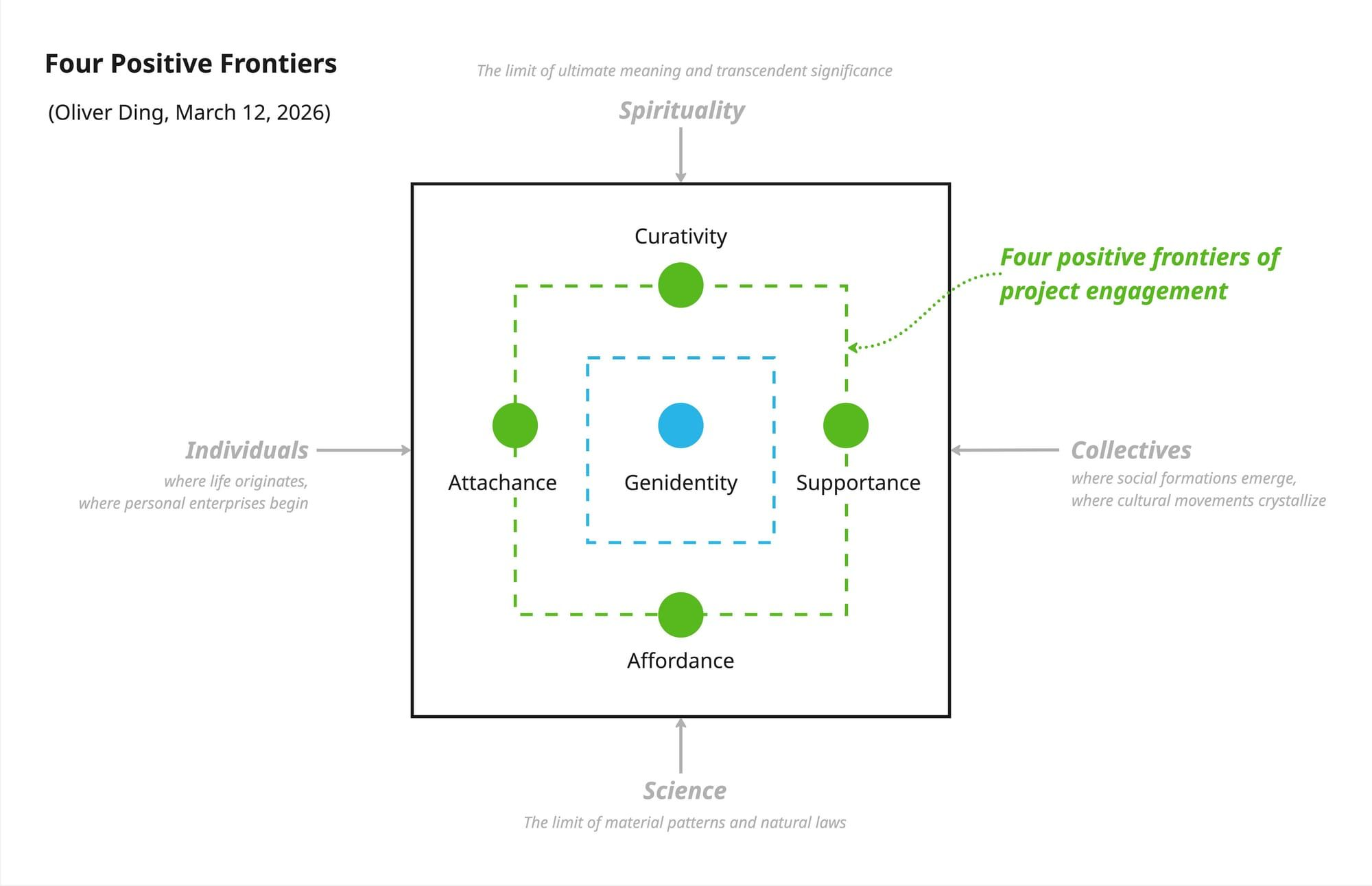
In GO Theory platform, four types of Ecological Opportunity are identified as Four Positive Frontiers: Affordance, Supportance, Attachance, and Curativity.
In GO Theory platform, the World of Life is a framework for understanding the boundaries of a human life in its full ecological context. It has four boundaries:
- Spirituality (upper): the limit of ultimate meaning and transcendent significance
- Science (lower): the limit of material patterns and natural laws
- Individuals (left): where life originates, where personal enterprises begin
- Collectives (right): where social formations emerge, where cultural movements crystallize
The diagram below places Genidentity at the center, surrounded by four opportunity concepts — one at each boundary. This is not arbitrary. Each concept was developed specifically to describe the action opportunities available in the environment that corresponds to its boundary.
Affordance refers to the potential action opportunities that environments and material objects offer. The term was coined by ecological psychologist James J. Gibson, who observed that what an organism perceives in its environment is not abstract properties but possibilities for action. A flat surface affords walking. A handle affords grasping. A doorway affords passing through.
The practical orientation corresponding to Affordance is Material Adaptability: a person's ability to perceive and actualize the action opportunities embedded in material environments.
Supportance describes potential supportive action opportunities offered by social environments. It extends the logic of affordance from the physical world into the social world, asking: what does this community, this platform, this institutional context offer to someone who enters it with genuine intent to participate?
The practical orientation corresponding to Supportance is Social Adaptability: the ability to perceive and actualize the supportive opportunities embedded in social environments.
Attachance focuses on potential action opportunities provided by actual actions, particularly those involving attaching and detaching. Every act of attaching to a new context — joining a project, entering a community, taking on a role — opens new possibilities. Every act of detaching — leaving a context that no longer serves development, releasing an identity that has been outgrown — creates new freedom.
The practical orientation corresponding to Attachance is Sense of Boundarylessness: the felt quality of a life in which the constraints that boundaries impose have been reduced through skillful attaching and detaching.
Curativity refers to the potential action opportunities of turning pieces into a meaningful whole. The underlying assumption is: to curate pieces into a meaningful whole, containers are needed to hold and shape these pieces. Curativity Theory recognizes three statuses of things: Things-in-Pieces, Things-in-Container, and Things-in-Whole. The movement from Pieces to Whole — through the work of curation — is the fundamental act of meaning-making.
The practical orientation corresponding to Curativity is Sense of Wholeness: the felt experience of a life whose fragments have been gathered into coherence, whose separate pieces have been recognized as belonging together.
More details can be found in World of Life: Four Positive Frontiers of Project Engagement.
10.2 The “Difference — Conversion — Opportunity” Schema (Level 2)
The four positive frontiers described above — Affordance, Supportance, Attachance, and Curativity — are not the only ecological opportunities available in the World of Life. They are four that have been developed and named. But the underlying mechanism that generates them can generate many more.
This mechanism is what I call the Difference–Conversion–Opportunity Schema — the primary model of the Ecological Practice Approach.
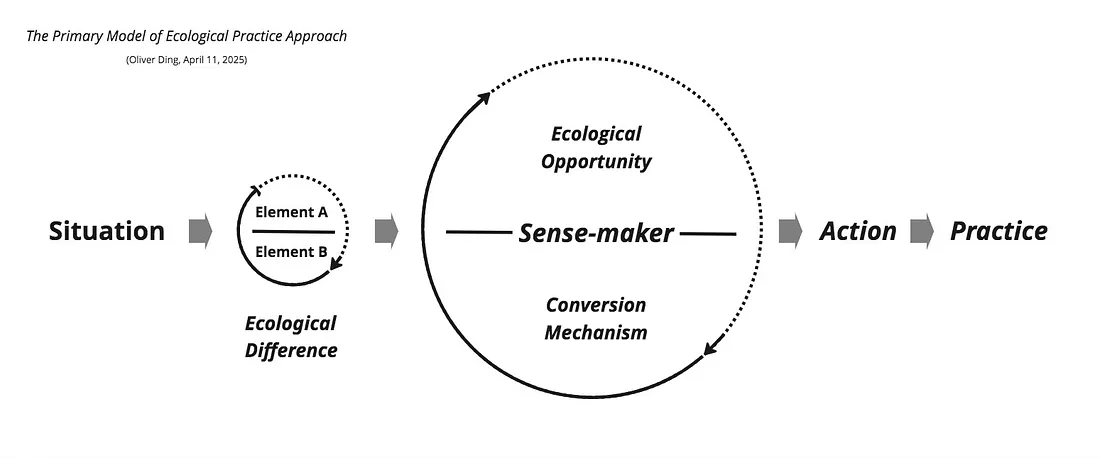
The schema works as follows:
Every situation contains Ecological Differences — structural distinctions present in the environment that, once recognized as convertible, become opportunities for action. An Ecological Difference is not merely a logical contrast (married vs. unmarried, expert vs. novice). It is a practical boundary that, when recognized and mediated, can enable new forms of action.
Between the two elements of an Ecological Difference, there are Conversion Mechanisms — processes by which one element can become another. Some are natural, arising from the regular development of things. Others are based on human intervention. What matters most is not whether the mechanism is natural or designed, but whether the actor has the capacity to operate it.
When a Conversion Mechanism is available, an Ecological Opportunity is born.
Each of the four frontier concepts embodies this schema:
- Affordance: The ecological difference between Possible and Potential in the natural environment; the conversion through Perception; the opportunity of Material Adaptability.
- Attachance: The ecological difference between Attach and Detach in the individual's movement through contexts; the conversion through Action; the opportunity of Sense of Boundarylessness.
- Supportance: The ecological difference between Intended and Unintended in social action; the conversion through Social Moves; the opportunity of Social Adaptability.
- Curativity: The ecological difference between Pieces and Whole in thematic environments; the conversion through Curation; the opportunity of Sense of Wholeness.
But the schema itself is open. Any structural difference in any environment — material, social, mental, or thematic — that contains a viable Conversion Mechanism is a potential Ecological Opportunity waiting to be named and cultivated.
More details can be found in The “Difference — Conversion — Opportunity” Schema.
10.3 The Lifechain Model (Level 3)
The Lifechain Model, also called the Potential–Focus–Actual Schema (v1, 2025).
It interprets the chain of actions within the Ecological Practice approach, emphasizing the transformation between Potential (action opportunities) and Actual (actions) in the Subject — Object relationship. Moreover, I also used “Focus” to describe “Thing” within this framework, forming the “Potential — Focus — Actual” schema (see the diagam below).
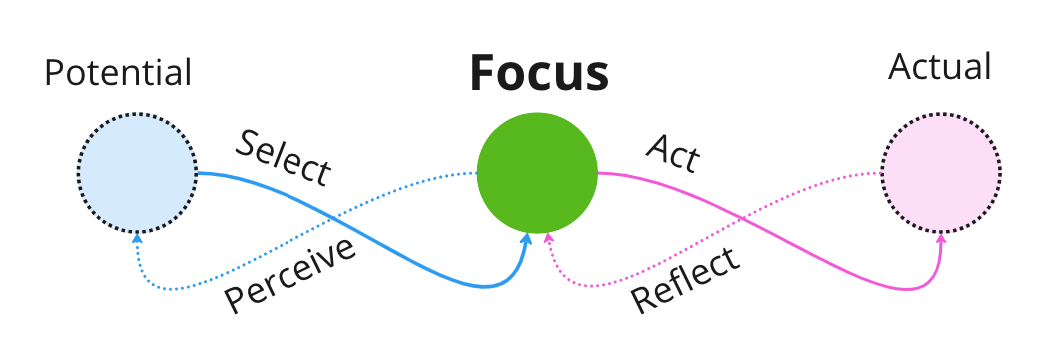
The Potential–Focus–Actual Schema describes a dynamic cycle within the Subject–Object relationship, explaining how potential possibilities of action become actualized through focus and reflection.
Potential refers to the open field of opportunities for a person to act with a particular thing — a horizon of possible interactions between Subject and Object. When the Subject perceives, multiple potentials emerge, each representing a different way of engaging with the thing.
Focus designates the specific thing the person is currently acting upon — the center that organizes both perception and action. From the field of potential, the Subject selects one or several possibilities to engage with, transforming potential into actuality through concrete actions.
Actual refers to realized actions — what the person has actually done with the thing. Once an action occurs, the Subject observes its outcome and reflects upon it. Through reflection, the Subject reconsiders previous choices and reorients perception, thus opening new potentials for future action.
This ongoing movement — perceive, select, act, reflect — forms a continuous cycle of transformation between potential and actual. It expresses the rhythmic structure of human actions: how potential becomes actual, and how the actual, in turn, expands potential.
Situated within the broader framework of the Life Coordinate, this schema corresponds to the vertical tendency described as Lifechain.
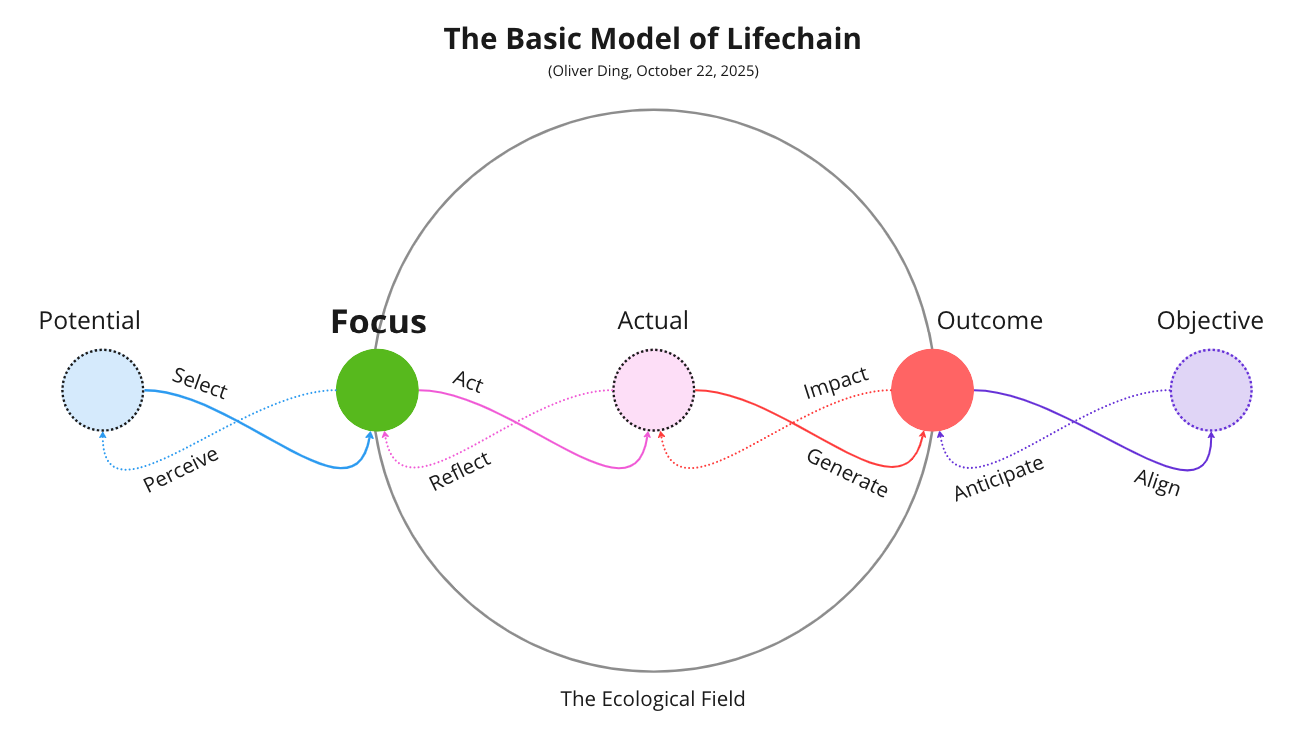
The diagram above expands the Potential — Focus — Actual Schema to the basic model of lifechain. In this model, the triad Actual–Outcome–Objective describes how realized actions generate results, impacts, and alignments that sustain the developmental flow of activity.
- Actual → Outcome (Generate)
When an action occurs, it produces certain results — tangible or intangible changes in the situation. This transition from Actual to Outcome represents how doing leads to becoming, how acts generate effects that extend beyond the moment of action.
- Outcome → Actual (Impact)
Every outcome, in turn, exerts an impact on both the environment and the subject. Through these impacts, the situation evolves, and the subject’s conditions for future action are reshaped. What was once an effect becomes part of the new field of potential acts.
- Outcome → Objective (Align)
Through reflection, the subject interprets the outcomes and seeks to align them with intended objectives. Alignment involves evaluating whether the realized results correspond to the guiding aims, thus bridging what is achieved with what is desired.
- Objective → Outcome (Anticipate)
Before action occurs, objectives serve to anticipate possible outcomes. Anticipation frames expectations, shaping how the subject envisions the effects of action and prepares for their realization.
Finally, we see a cyclic rhythm within the lifechain:
Focus → Perceive → Select → Act → Reflect → Generate → Impact → Align → Anticipate → Outcome
This cyclical sequence illustrates the reflexive continuity between action, result, and intention. Each phase transforms the Subject–Object relationship — actions generate results, results reshape environments, outcomes prompt alignment with objectives, and objectives anticipate new outcomes.
More details can be found in Creative Life Coordinate (2025).
Postscript: Subjectivity, Agency, and Mind
As I was completing this article, a pattern that had been implicit across several recent projects became visible.
The concept of Strategic Agency and Strategic Mind belong together, but they are not the same thing. Strategic Agency names the study of action patterns — how a person exercises agency across social worlds, how agency cascades through levels, how it resonates, where it meets thresholds, and what frontiers it opens. Strategic Mind names the cognitive structures that organize strategic thought — the nine aspects, the mental platforms, the strategic frameworks, the work of curation. They are two dimensions of the same actor, not two names for the same thing.
This distinction matters because it points toward a larger structure. If we place it alongside the concept of Subjectivity — the unfolding of a person's lived experience across Body(Self), Life(Self), and History[Life(Self)] — a threefold pattern emerges:
Subjectivity — Agency — Mind
These three are not separate domains. They are three analytical aspects of the same unfolding, and they map onto the Self–Life–Mind schema that has been developed within the Strategic Developmental Psychology (SDP) project:
- Subjectivity corresponds to Self: the ontological aspect — where the actor is located, what the actor is, how the actor's existence is constituted.
- Agency corresponds to Life: the realist aspect — what the actor does across social worlds, how action unfolds, what patterns it takes.
- Mind corresponds to Mind: the hermeneutic aspect — how the actor organizes strategic thought, what cognitive structures guide action.
This mapping is not a coincidence. It is the same structure appearing at a different grain. The Weave-the-Strategy Framework, with its four weave-points, can now be read as a set of specific intersections between these three dimensions. Each weave-point names a concrete configuration through which Subjectivity, Agency, and Mind meet and transform one another.
The Weave-the-Strategy Toolkit v2.0 is therefore not only a toolkit for strategy. It is an entry point into a broader investigation of how a person becomes an actor — how subjectivity unfolds into agency, how agency is organized by mind, and how mind in turn reshapes subjectivity. Strategy, in this view, is the name we give to the ongoing work of holding these three dimensions together.
This points toward a final observation: Subjectivity and Strategy are mutually constitutive. Without Subjectivity, there is no one to make a strategy — strategy would collapse into mere calculation or environmental reaction. Without Strategy, Subjectivity cannot unfold — it would remain an unactualized interior, unable to navigate the complexities of the social world. Subjectivity provides the ontological ground: who is acting. Strategy provides the methodological path: how the unfolding happens. Their relationship is circular, not linear — an instance of Self-referential Activity in the domain of strategy. The Weave-the-Strategy Toolkit is an attempt to hold both sides of this circle together.
This investigation will continue in subsequent work. The present article has established the structure; what follows will explore its implications.
v1.0 - October 13, 2026 - 9,243 words