
Developmental Strategy: Revisiting the “Strategy” Theme from the GO Theory Perspective
by Oliver Ding
October 10, 2026
For many years, I have used terms such as “Advanced Life Strategy,” “Strategic Life Development,” “Ecological Strategic Cognition,” “Knowledge Strategy,” “Life Strategy,” "Strategic Life Narrative," "Strategy as Curation," "Strategic Themes," and “Strategic Developmental Psychology.”
In September 2026, I made the Knowledge for Development diagram and further developed it as a principle for the Activity Analysis & Intervention (AAI) 2026. Today, while working on developing the v2.0 of the Weave-the-Strategy toolkit, I got a new idea—using a new term, “Developmental Strategy,” to frame the creative space where I engage with the “Strategy” theme.
This new idea did not come out of nowhere. It emerged from a specific occasion and a larger reflection.
Contents
Part 1: Why Revisit the “Strategy” Theme
1.1 The Immediate Occasion: Revisiting-and-Rebuilding the Knowledge Strategy Series
1.2 The Larger Reflection: Strategy as a Theme, Not Just a Project
1.3 The New Condition: GO Theory as a Mature Platform
Part 2: Three Lenses for Developmental Strategy
2.1 Developmental Functionalism: Why “Developmental Strategy”
2.2 Thematic Space Theory: Strategy as Ecological Strategic Cognition
2.3 Ecological Formism: Organizing Strategic Knowledge Across Levels
2.4 Three Principles, Three Questions
Part 3: What Is Development? What Is Strategy For?
3.1 Platform for Development (2021)
3.2 Advanced Life Strategy (2022)
3.3 Being by Doing (2025)
3.4 GO Theory (2026)
Part 4: The Unfolding of Subjectivity
4.1 Several Ecological Forms
4.2 World of Activity and Gejunction Analysis
Part 5: The Development of Thematic Enterprise
5.1 The Enterprise Development Framework
5.2 Strategy as One of Six Functions
Part 6: The Development of Thematic Creation
6.1 Three Modes of Thematic Creations
6.2 The Agency Cascade: From Mindentity to Worldentity
Part 7: Understanding the Social World
7.1 Five Systems of the Social World
7.2 Five Aspects of the Social World
7.3 Strategy as Anticipatory Activity
7.4 Symbolic Universe and Six Faces of the Concept System
7.5 Social Territory and the FFCC Model
7.6 The Social Landscape Framework (v2.0, 2025)
7.7 Thematic Space and Ecological Strategic Cognition
Part 8: Developmental Strategy as a Knowledge Ecology
8.1 Researcher vs. Actor: Two Types of Strategic Knowledge
8.2 Four Types of Actors
8.3 Ecological Formism as a Meta-Framework
Part 9: Matrix, Toolkit, and Criterion
9.1 The 3×3 Matrix
9.2 A Toolkit
9.3 The “Telos – End” Criterion
9.4 Testing Our Own Framework
Postscript
Part 1: Why Revisit the “Strategy” Theme
Before presenting the concept of Developmental Strategy, I want to explain why I am returning to the “strategy” theme now.
1.1 The Immediate Occasion: Revisiting-and-Rebuilding the Knowledge Strategy Series
In September 2026, I have been working on an ongoing project called [Revisiting-and-Rebuilding] The Knowledge Strategy Series. The project began with a specific question left unanswered in my 2025 book draft Castle and Forest: what happens when two knowledge creators meet?
With new tools—particularly the RelationField framework and the Gejunction lens—I revisited that question and wrote The Relationfield of Knowledge Engagement. After finishing it, I realized that Gejunction could be used to reflect on the entire Knowledge Strategy trilogy from 2025. The revisiting widened from there.
The outcome so far is a new thematic collection: The Gejunction of Knowledge Engagement (Collection, v1, 2026).
The details of that project belong to the collection itself. What matters here is what it led to next.
1.2 The Larger Reflection: Strategy as a Theme, Not Just a Project
The RR project prompted me to step back and reflect on something larger: my engagement with the “strategy” theme over the past several years.
I realized that “strategy” has never been merely a concept to define. It has been a theme to live with—a thematic space I keep returning to, a focus that has gradually become a center. From Strategic Life Narrative to Strategy as Curation, from the Ecological Strategic Cognition Framework to the Weave-the-Strategy model, each project was a move within the same thematic space.
For the full reflection of the journey from 2021 to 2025, see [Wonder and Wander] The Aion Journey (2021–2025). Three key movements from 2025 to 2026 are featured here.
- January 2025: The Landscape of Strategic Life Theory. By the end of January 2025, I had edited two possible books—Strategic Life Narrative (January 29) and Knowledge Strategy (January 31)—and curated the landscape of Strategic Life Theory using the House of Creative Life Strategy. That landscape organized nine themes, five models, and nineteen possible books. The nine themes—Anticipating, Performing, Discovering, Producing, Modeling, Unfolding, Storytelling, Curating, Perceiving—were assigned to four groups corresponding to the four entities of the Curativity of Mind.
- October 2025: The Weave-the-Strategy Framework. In October 2025, I introduced the Weave-the-Strategy Framework, which curates several sub-models of Strategic Life Theory around four concepts: Thematic Space, Social Landscape, Strategic Agency, and Creative Workfield. The framework showed how strategy as a process of Slow Cognition encompasses both mental moves across thematic spaces and social moves across social landscapes.
- July 2026: Strategic Developmental Psychology (v2.0). The SDP project began with a curious question: why has psychology never developed a proper theoretical concept of strategy—a construct with the same standing as emotion, cognition, or personality? By July 2026, SDP v2.0 introduced two major developments: a three-layer architecture of Self (Sub-individual, Individual, Supra-individual) grounded in the structure of Persons Acting in Concert, and the concept of Gejunction as a unit of synthesis for grasping a person’s overall standing in the social world.
Looking back across this several-year creative journey, a pattern becomes visible. My work on strategy has not been a series of disconnected projects, but a sustained thematic exploration—a slow cognition process through which a theme gradually becomes a concept system.
1.3 The New Condition: GO Theory as a Mature Platform
What makes this moment different is that GO Theory has matured as a theoretical platform.
GO Theory is a short name for the World of Life (World of Activity) Approach which was initially introduced in December 2025, within the book draft: Meta-frameworks.
This platform has its own knowledge ecosystem, built on a series of meta-frameworks completed between November 2025 and September 2026:
- Ontology: The History{Life[Self(Body)]} Framework (HLS Framework, v3.0, 2025) — the map of the social world, introduced in Meta-frameworks: Creative Heuristics for Individual and Social Development (book, v1.0, 2025), December 2025; The World of Activity Approach and the Coordinate–Center–Gejunction framework (book, v1.0, 2026), September 2026.
- Epistemology: The Ecological Formism Framework (v2.0, 2025) — the structure of knowledge systems, introduced in Ecological Formism (book, v1, 2025), November 2025; Thematic Space Theory — A foundational epistemological framework for how themes become concepts and how concept systems take shape across contexts, March 2025; Six Faces of the Concept System — An epistemological reflection on the concept system in the abstract: not six fixed types, but six faces across contexts, December 2025.
- Methodology: The LARGE Method (v3.0, 2026) — the meta-method governing all methods within the platform, February 2026; the notion of Developmental Functionalism - a methodological lens for constructing and selecting developmental concepts by their function in context, June 2026; the Activity Analysis & Intervention (AAI) method (2026) - a method for developing supportive programs, introduced in August 2026.
- Pedagogy: Cognitive Hydrology Pedagogy (v.1.0) — a pedagogical framework for thematic development and concept creation.
- Unit of Synthesis: The concept of Gejunction — a way of grasping a person's overall standing in the social world as a single, coherent configuration. Its four aspects—Thematic Spaces, Living Coordinates, Relationfields, and Weave-points—refer to four knowledge systems. It was introduced in Strategic Developmental Psychology (book, July 2026).
These meta-frameworks are not external scaffolding. They are the internal architecture of GO Theory itself — the ontological, epistemological, and methodological foundations on which several theoretical enterprises build.
With these tools, I can now explore the “strategy” theme at a level that was not possible before. The concept of Developmental Strategy is the first product of this new exploration.
Part 2: Three Lenses for Developmental Strategy
GO Theory now contains a rich ecosystem of meta-frameworks. To revisit the “strategy” theme, I do not need all of them. I select three lenses, each offering a distinct perspective on strategy as a developmental phenomenon.
- Developmental Functionalism clarifies why the concept is called Developmental Strategy—it defines strategy by its function in development.
- Thematic Space Theory illuminates how strategy operates as ecological strategic cognition.
- Ecological Formism provides a way to organize strategic knowledge across levels, thereby addressing the theory-practice gap.
Together, these three lenses prepare the ground for the 3×3 matrix introduced in Part 3.
2.1 Developmental Functionalism: Why “Developmental Strategy”
The name “Developmental Strategy” comes from Developmental Functionalism, a methodological lens I named in June 2026.
Developmental Functionalism does not ask what development is in essence. It asks how developmental concepts function in concrete contexts—what they do, what they support, how they operate. It is a functional lens for identifying what counts as developmentally relevant across different domains and scales.
This naming pattern is not new in my work. Over the years, I have developed a family of concepts that share the same functional orientation: Developmental Project, Developmental Episode, Developmental Platform, and more recently Developmental Culture. Each names a functional unit or aspect of development rather than an essence. Each asks not “what is it?” but “what does it do in the process of development?”
When applied to strategy, this lens shifts the question from “What is strategy?” to “What does strategy do in the development of an enterprise?”
Here I invoke another line of thinking: Knowledge for Development. This principle treats Developmental Science as a cross-disciplinary field—not confined by the boundaries of psychology, sociology, or any single discipline. Development is a phenomenon that cuts across domains. By adopting this cross-disciplinary stance, I do not need to decide whether strategy belongs to psychology, management, or sociology. The question becomes simply: what does strategy do in the process of development, wherever that process unfolds?
This is why the concept is called Developmental Strategy and not simply “strategy.” The adjective “developmental” specifies the functional role: strategy as a way of supporting development. The term does not belong to a single discipline. It belongs to the cross-disciplinary space of human development.
2.2 Thematic Space Theory: Strategy as Ecological Strategic Cognition
The second lens is Thematic Space Theory. It has been applied to the “strategy” theme multiple times. In 2025 alone, I used it three times: early in the year to develop the Ecological Strategic Cognition Framework (v2.0) and its related toolkits; later in the year to understand strategy as Slow Cognition encompassing both mental moves and social moves; and then, based on that understanding, to create the Weave-the-Strategy Framework.
For Developmental Strategy, what matters most is Thematic Space Theory’s own architecture: the “Theme — Map — Model” schema. The theory has three levels:
- “Theme (Concept)” Ontology — a Thematic Space is a cognitive space where a person’s ideas, activities, and practices revolve around one theme. The concept was born as an application of the Container (Containee) ontology: Theme (Concept). Here I distinguish between “Theme” and “Concept”—Theme emphasizes subjective experience and understanding, while Concept pertains more to objective meaning and definition.
- “Map (Move)” Realism — any Move, any activity, admits a Map representing its own structure.
- “Model (Map)” Hermeneutics — each thematic area provides a map for Concept Development; each actor can adopt various perspectives and knowledge frameworks for their activities.
Read this way, the theory’s own three levels define the Map–Move–Model schema: the Map (Move) Realism supplies the Map; the Model (Map) Hermeneutics supplies the Model; and Moves are what unfold between them. Map, Moves, and Models are not borrowed from outside—they are Thematic Space Theory’s own architecture, read at a different grain.
The Map–Move–Model schema offers a guiding suggestion for Developmental Strategy: a strategy knowledge system must distinguish three things—the maps that represent objective aspects of the social environment of strategic activity, the moves that constitute strategic activity itself, and the theoretical knowledge and strategic frameworks that interpret those moves.
It is worth noting that the “Model” in this schema can be further differentiated into three types. The first is the theoretical knowledge produced by theorists. The second is the strategic frameworks used by actors themselves—including predictive models and other operational tools. The third, between these two, is the knowledge frameworks adopted by analysts, which mediate between theory and practice.
2.3 Ecological Formism: Organizing Strategic Knowledge Across Levels
The third lens is Ecological Formism. It is a meta-framework that applies the “Variant–Quasi-invariant–Invariant–Invariant Set” schema to any knowledge system. It asks: how is a body of knowledge structured across levels of stability and change? How do universal principles, mid-range frameworks, and situational practices relate to one another?
The World of Activity Toolkit (v2.0, 2026) offers a concrete example. The FFCC schema—Flow, Focus, Center, Circle—is the Invariant: four basic ecological forms that do not change across contexts. The Quasi-invariant layer contains a series of movements named with FFCC vocabulary—Cutting the Flow, Setting the Focus, Anchoring the Center, Flourishing the Circle—cross-human developmental patterns that are widespread but not universal. The Variant layer holds situationally-triggered themes, named by their situational content. The Invariant Set connects FFCC to other ecological forms, such as the Embodied Social Forms. This four-layer architecture allows the same framework to accommodate both universal principles and open-ended empirical diversity.
Strategy can be organized through the same schema:
- Variant: concrete strategic practices, cases, situational strategies
- Quasi-invariant: strategic frameworks, strategy models, toolkits
- Invariant: basic forms of strategy, core principles
- Invariant Set: other functions within development, such as design and curation
This hierarchical structure works in both directions. Top-down, a theorist develops a strategic knowledge system, which can then generate mid-range knowledge frameworks applicable to actors’ concrete situations. Bottom-up, an actor’s tested strategic frameworks can be shared, refined into mid-range knowledge frameworks, and contributed back to the development of a strategic knowledge system. The same schema accommodates both theory-driven and practice-driven knowledge production.
This perspective not only provides a method for organizing strategic knowledge across levels. It also draws attention to the functional differentiation and interaction among four roles in a strategy knowledge community:
- Theorists develop strategic theory, working at the Invariant and Invariant Set levels.
- Empirical Researchers test strategic theories against concrete cases, working at the Quasi-invariant level.
- Analysts mediate between theory and practice, translating principles into mid-range frameworks and operational tools —also working at the Quasi-invariant level.
- Actors test and refine strategic frameworks in their own situations, working at the Variant level.
Ecological Formism offers a way to see how these four roles relate—not as a hierarchy, but as a division of labor within a shared knowledge ecology.
2.4 Three Principles, Three Questions
The three lenses above are not merely perspectives. Together they yield a set of guiding principles for thinking about Developmental Strategy.
Developmental Functionalism tells us that strategy is defined by its function in development, not by its essence. Thematic Space Theory tells us that a strategy knowledge system must distinguish maps, moves, and models—and that models themselves come in different types, produced by theorists, analysts, and actors. Ecological Formism tells us that strategy knowledge can be organized across levels, and that this organization works both top-down and bottom-up, involving theorists, analysts, and actors in a shared knowledge ecology.
These principles raise three questions that the rest of this article will explore:
- What is the purpose of strategic knowledge and strategic practice? What does development itself mean?
- What maps and models on the GO Theory platform can be used for Developmental Strategy?
- How should the knowledge community around Developmental Strategy develop?
The following parts will explore the GO Theory platform in more detail—its maps, its models, its roles and functions—and return to these questions with concrete answers.
Part 3: What Is Development? What Is Strategy For?
The first question raised in Part 2 was: What is the purpose of strategic knowledge and strategic practice? What does development itself mean? This Part answers that question by revisiting how I have handled it in previous works, and then showing how GO Theory’s current state allows a more general answer.
3.1 Platform for Development (2021)
In Platform for Development: The Ecology of Adult Development in the 21st Century (2021), I introduced the Ecological Approach to Adult Development. The core model framed development as the transformation between the Potential Self and the Actual Self, linked to the transformation between Supportance (potential action possibilities offered by the social environment) and Actual Action.
At that time, the question of development was framed ecologically: development happens in the interaction between a person and their social environment. Strategy, in this view, would be the practice of navigating that interaction—identifying and actualizing supportances.
3.2 Advanced Life Strategy (2022)
In Advanced Life Strategy: Anticipatory Activity System and Life Achievements (2022), the scope was narrower. This book was written for knowledge workers, not for all adults. As part of the Creative Life Theory v1.0 series, it anchored the purpose of strategy in life achievement—how knowledge workers could attain creative accomplishments. Strategy was the anticipatory activity system that oriented present action toward future achievement.
3.3 Being by Doing (2025)
In Being by Doing: World of Activity and Creative Life Theory (v3.0) (2025), the picture expanded. The book introduced Creative Life Theory v3.0 and the World of Activity knowledge system. Here, the development of the Creative Self and the development of the Creative Enterprise are intertwined. What was previously framed as “life achievement” became the concrete development of a Creative Enterprise.
Because I emphasize the thematic nature of enterprises, I often use the term Thematic Enterprise. Development, at this stage, is not only about the individual’s life arc but about how a thematic enterprise—a sustained creative endeavor—forms, grows, and transforms.
3.4 GO Theory (2026)
In the first half of 2026, the GO Theory platform advanced the ACS and SDP projects, and the World of Activity Approach matured further. These developments laid the foundation for thinking about a general theory of adult development, rather than one limited to a specific group such as knowledge workers.
In light of these recent developments, I now frame the development that Developmental Strategy serves through three focal points:
#1 Subject: The Unfolding of Subjectivity.
This comes from recent developments in the World of Activity Approach, particularly the Coordinate–Center–Gejunction framework. Development here means the unfolding of subjectivity—how a person’s lived experience becomes located (Living Coordinate), organized (Creative Center), and synthesized (Gejunction).
#2 Enterprise: The Development of Thematic Enterprise.
This comes from recent developments in the Life-as-Activity approach, especially the distinction between Activity and Enterprise. Development here means the formation, growth, and transformation of a thematic enterprise—from Creative Theme to Scalable Focus to Center Development to Value Circle to Developmental Platform.
#3 Creation: The Development of Thematic Creation.
This comes from the ACS project, particularly its ontological account of thematic creation. Development here means the transformation of a thematic creation from Mindentity to Folkentity to Worldentity—from individual psychological ownership to collective givenness.
These three focal points are not separate domains. They are nested layers of the same unfolding. In Activity Theory terms, they address the classic triad of activity (subject–object): #1 corresponds to the subject, #2 corresponds to the activity itself (the mediating process through which subject and object interact), and #3 corresponds to the object. In phenomenological terms, they unfold across subjectivity (#1), intersubjectivity (#2, since enterprise development always involves collaboration and shared endeavor), and objectivity (#3).
In concrete strategic situations, they are entangled with one another: a Living Coordinate may be discovered through an enterprise; an enterprise may take shape around a thematic creation; a thematic creation may reshape the subjectivity that first imagined it. They operate simultaneously and interpenetrate, rather than forming three parallel tracks.
Each will be explored in detail in the following Parts:
- Part 4 addresses the Subject: the unfolding of subjectivity.
- Part 5 addresses the Enterprise: the development of thematic enterprise.
- Part 6 addresses the Creation: the development of thematic creation.
Together, they answer the first question: Development is the unfolding of subjectivity, the development of thematic enterprise, and the development of thematic creation—and Developmental Strategy is the functional way of supporting this threefold unfolding.
Part 4: The Unfolding of Subjectivity
The Unfolding of Subjectivity: The Coordinate–Center–Gejunction Framework describes three nested layers of subjectivity.
Body (Self) is the embodied individual—the starting point of subjectivity. It is not an abstract point; it is the actual position of a person's lived experience, where the stream of life has reached and where attention has landed. The ecological form corresponding to this layer is the Living Coordinate.
Life (Self) is the Self as lived through activities and engagements in the world. Here subjectivity becomes organized—not just located, but structured around a theme and an identity. The ecological form corresponding to this layer is the Creative Center.
History [Life (Self)] is the Self as situated within historical and cultural contexts. Here subjectivity becomes synthesized—a structured grasp of one's overall standing in the social world. The ecological form corresponding to this layer is the Gejunction.
These three layers are not stages in a linear sequence. Every individual exists in all three layers at every moment—the differences lie in whether and how they are perceived, and to what extent. I present them as three states for the purpose of explanation, not as a developmental sequence.
The framework asks: Where is my life's center of gravity? What is my theme and identity? How do I grasp my overall standing in the social world?
4.1 Several Ecological Forms
The World of Activity approach identifies a family of seven ecological forms: Boundary, Coordinate, Flow, Focus, Center, Circle, and Gejunction.
Boundary is the most foundational form. It marks the distinction between inside and outside—what is included in a World of Activity and what is excluded. Boundaries are not fixed walls; they are active differentiations that shape what can be attended to and what can be acted upon.
Coordinate is the second foundational form. A Living Coordinate is born at the moment Flow is cut by Focus. It belongs to Body(Self) and is the first way subjectivity becomes located. It is not yet a stable center—it is a living position. In the World of Activity approach, the Living Coordinate appears in two forms: the Thematic Living Coordinate (the coordinate at a Center's forming stage, dynamic and growing) and the Belief Living Coordinate (the coordinate that operates beneath a Center once it already exists, functioning like an operating system).
Flow is the continuous stream of lived experience—changing, open, undifferentiated. It is the raw material from which all development proceeds.
Focus is the intentional structure that emerges when attention organizes the stream. When scattered activities begin to coalesce around a theme, Focus appears.
Center is the stable organizing structure of sustained creative work—the person's core thematic and practical commitments. A Center emerges when a Living Coordinate is sustained through attention, action, and resources. It grows through repeated Strategic Curation and Developmental Projects. A Joint Center is a Center shared by multiple people—a third-person object simultaneously held by two or more first-person perspectives.
Circle is the network of connected Centers—the broader social and cultural context that links individual Worlds of Activity to collective enterprises. Circle is where individual Centers connect, interact, and form a larger ecology. It is the point where the World of Activity touches the World of Life.
Gejunction is the seventh member of this family, but it is a different kind of concept: a Unit of Synthesis within GO Theory. It belongs to History[Life(Self)] and captures a person's grasp of their overall standing in the social world—not a momentary situation, but a broader structural position.
The first six forms are ecological forms. Four of them—Flow, Focus, Center, and Circle—form the FFCC model, the central model of the World of Activity approach. Boundary and Coordinate are more foundational forms that underlie the FFCC model.
4.2 World of Activity and Gejunction Analysis
The ultimate purpose of Developmental Strategy is to support the unfolding of subjectivity. Our theoretical frameworks describe formal structures, but within a specific individual's World of Activity, perception, cognition, and action differ. Developmental Strategy exists to support the concrete, situated unfolding of subjectivity—to help individuals move from Living Coordinate to Creative Center to Gejunction.
Gejunction is a Unit of Synthesis within GO Theory. It offers a way of grasping a person's overall standing in the social world as a single, coherent configuration. It has four aspects:
- Thematic Spaces represent the thematic aspect. They reveal what a particular social life configuration is about, and how attention, interest, and commitment become organized around a theme.
- Weave-points represent the symbolic aspect. They identify points where concepts, narratives, values, and meanings become woven together within a broader symbolic universe.
- RelationFields represent the relational aspect. They capture the intersubjective configurations through which people, resources, opportunities, and social environments are constituted.
- Living Coordinates represent the territorial aspect. They describe how a person becomes situated within a concrete life world.
These four aspects are not separate entities. They are four analytical perspectives on the same social unit.
Gejunction analysis is not a fixed model but an adaptive practice. The four aspects provide four entry points. An analyst can begin with any one of them, depending on the case at hand, and move across the others as the analysis develops. Together, they allow a person to grasp their Gejunction not as a vague feeling, but as a structured configuration.
At this level, Developmental Strategy is not a technique or a plan. It is a functional way of supporting the unfolding of subjectivity within the World of Activity—helping individuals move from Living Coordinate to Creative Center to Gejunction, and to grasp their overall standing in the social world.
Part 5: The Development of Thematic Enterprise
While Part 4 focuses on subjectivity, this part moves to activity—what a subject does. However, I adopt the concept of Enterprise in the Life-as-Activity Approach (v3.0, 2026) rather than the more familiar concept of Activity.
In the Life-as-Activity approach, Enterprise and Activity form a key distinction.
Activity Theory typically studies activity as an object of analysis from the researcher's perspective. Enterprise, by contrast, re-centers the actor's own experience: it refers to the sustained, self-determined line of endeavor as lived from the inside. This concept has no direct counterpart in traditional Activity Theory.
Enterprise does not stand alone. It forms a pair with Activity—the same structural pairing that operates at the Part level between Event and Project, but enlarged to the Whole. At the Part level, one person's lived project is another person's observed event, and these two perspectives are bound together by the act of projecting. At the Whole level, the same mechanism applies: one actor's sustained enterprise is, for an observer, a collective activity—and the same projecting dynamic bridges the two.
An enterprise, in this usage, is any sustained creative endeavor that unfolds over time—a knowledge center, a theoretical platform, a life's work. It has both an individual and a collective aspect.
5.1 The Enterprise Development Framework
As an operational framework, the Enterprise Development Framework maps the full journey of a thematic enterprise across five interconnected stages:
- Creative Theme: ideas and intentions are conceived around a guiding theme
- Scalable Focus: the enterprise identifies directions and opportunities that can be scaled
- Center Development: core structures, resources, and capabilities are built
- Value Circle: relationships, collaborations, and networks generate sustained impact
- Developmental Platform: the enterprise becomes a mature configuration that supports ongoing innovation and new enterprises
This framework was inspired by the World of Activity model (Flow–Focus–Center–Circle) and is part of Creative Life Theory (v3.0).
More recently, from the perspective of the Life-as-Activity approach, I have come to understand enterprise development as unfolding across three broad layers:
- Developmental Project: the early stage of an enterprise, existing in the form of a Creative Center
- Developmental Platform: when a Center grows strong enough to support other Centers, it becomes a platform
- Developmental Culture: around a platform, a Tiny Culture may develop—a Developmental Culture
This sequence corresponds to the three layers of the unfolding of subjectivity. The Developmental Project corresponds to the Life(Self) layer—the Creative Center where subjectivity becomes organized. The Developmental Platform corresponds to the threshold between Life(Self) and History[Life(Self)]—where a Center begins to support other Centers. The Developmental Culture corresponds to the History[Life(Self)] layer—where a Tiny Culture settles into the social world as a given.
5.2 Strategy as One of Six Functions
The Enterprise Development Framework above is a diachronic perspective: it views enterprise development along the dimension of time. In 2025, I also developed a Center Development framework, which examines the key functions of a thematic enterprise from a synchronic perspective—the spatial configuration of functions at a given moment. At present, I identify six such functions:
- Strategy: giving direction and orientation to the enterprise
- Narrative: creating narratives that coordinate meaning
- Curation: gathering and weaving disparate elements into a whole
- Support: providing supportive conditions for development
- Design: shaping the material and structural conditions of activity
- Discovery: finding significant insights and defining objectives
Strategy is not the most important of these. It is one function among six, and it can only be understood in relation to the others. But it is the function that gives direction, coherence, and orientation to the enterprise as a whole. It is how the enterprise’s unfolding is intentionally supported.
For enterprise development, Developmental Strategy is the functional way of supporting the journey—helping an enterprise move from Creative Theme to Scalable Focus to Center Development to Value Circle to Developmental Platform. This is not a matter of making plans or setting goals in the abstract. It is a matter of supporting the concrete, situated unfolding of an enterprise through the six functions. Developmental Strategy is what gives the enterprise its direction, its coherence, and its orientation.
Part 6: The Development of Thematic Creation
Part 4 focused on the Subject: the unfolding of subjectivity. Part 5 focused on Activity: what a subject does, framed through the concept of Enterprise. This Part focuses on the Object: what is created through that activity—thematic creations.
Together, these three focal points—Subject, Activity, and Object—constitute the classic concern of Activity Theory: activity as the triadic relation between a subject, an object, and the mediating activity itself. My approach retains this triadic structure but reframes each element through the meta-frameworks of GO Theory.
Development, in this third focal point, means the transformation of a thematic creation from Mindentity to Folkentity to Worldentity—from individual psychological ownership to collective givenness.
6.1 Three Modes of Thematic Creations
One of the key outcomes of the Anticipatory Cultural Sociology (ACS) project is an ontological account of thematic creation. It identifies three modes of existence for thematic creations in the social world.
This account is grounded in the Self–Us–Awe schema, inspired by Ping-keung Lui’s theoretical sociology (Subjectivity → Intersubjectivity → Otherness). The schema maps three domains of creative life:
- Self (Subjectivity): the domain of individual creative activity, psychological ownership, and personal investment
- Us (Intersubjectivity): the domain of collective engagement, shared ownership, and community development
- Awe (Otherness): the domain of what exceeds human agency—the given structures of the world that we encounter as “already there”
Guided by this schema, three ontological concepts emerge:
Mindentity exists in the Self domain. It is anchored in the creator’s psychological ownership—control, intimate knowledge, self-investment—and begins its journey toward ecological objectification. A Mindentity is the first mode of existence for any thematic creation: before it becomes a product, an organization, or a cultural landmark, it exists as a Mindentity.
Folkentity exists in the Us domain. It is collectively held, collectively reproduced, and collectively developed—sustained by the distributed psychological ownership and generative projectivity of a community of participants. A Folkentity is neither “mine” nor “already there for the world”—it is, in a precise sense, ours.
Worldentity exists in the Awe domain. It has transcended its creators and communities to become a given structure in the World of Life. A Worldentity is “already there”—encountered by subsequent generations as a structural feature of their world, independent of any individual’s ownership or any community’s ongoing effort. The Egyptian pyramids, a two-hundred-year-old village couplet, a mother tongue: these are Worldentities.
Together, these three concepts form a complete ontological spectrum—Mindentity, Folkentity, Worldentity—distributed across the three domains of Self, Us, and Awe.
6.2 The Agency Cascade: From Mindentity to Worldentity
How does a thematic creation move from one mode of existence to the next? The dynamic engine of this transformation is the Agency Cascade.
The Agency Cascade operates across four levels, each structured by the Activity Circle (Self / Other / Thing / Think). At each level, the “Other” of that level becomes the “Self” of the next. Agency does not simply reside within individuals—it cascades through levels of social structure, each anticipating and enabling the next.
- Level 1 — Pre-Activity: Creator and Supporter. The Thing is the Mindentity; the Think is the Tiny Folkentity—the imagined community of early participants. The new human relationship is between Creator and Supporter.
- Level 2 — Activity: Curator and Weaver. The Thing is the Tiny Folkentity; the Think is the Meso Folkentity. The community must engage in ecological objectification: developing conceptual documents, material tools, and social networks.
- Level 3 — First-Order Analysis: Influencer and Follower. The Thing is the Meso Folkentity; the Think is the Mega Folkentity. The creation achieves substantial social thickness, expanding beyond its original community into broader social consciousness.
- Level 4 — Second-Order Analysis: Canonizer and Receiver. The Thing is the Mega Folkentity; the Think is the Worldentity. When the anticipation is realized, the Mega Folkentity collapses into Worldentity—no longer sustained by Us, now simply encountered as Awe.
What drives movement between levels is Attachance—the ecological process of attaching and detaching between containers. Each transition is an Attachance event with two simultaneous dimensions: a Mental Move (perceiving a new possibility) and a Social Move (entering a new human relationship). Mental Move and Social Move co-occur, each enabling the other.
For the development of thematic creation, Developmental Strategy becomes the functional way of supporting this transformation—from Mindentity through Folkentity toward Worldentity.
Part 7: Understanding the Social World
GO Theory adopts the History{Life[Self(Body)]} framework (HLS v3.0) as its ontological map of the social world. The HLS framework can itself be understood as a map and a set of models.
- Map: the five systems of the social world
- Model 1: the five aspects of the social world
- Model 2: the four aspects of Gejunction
Since the four aspects of Gejunction were already discussed in Part 4.2, this Part focuses on the first two.
7.1 Five Systems of the Social World
GO Theory adopts the HLS framework to understand the social world through a five-system lens:
- Body System: the embodied individual—the starting point of subjectivity, where lived experience first takes shape
- Mental System: the cognitive and affective dimension—how meaning, mindset, and mental models are formed and sustained
- Behavioral System: the dimension of action and interaction—how people engage with projects, tools, and each other
- Cultural System: the dimension of shared meanings, values, and symbolic forms—how cultures emerge and evolve through thematic enterprises
- Historical System: the dimension of institutional structures and long-term continuity—how cultural forms settle into given structures across generations
These five systems are not separate layers stacked on top of one another. The HLS framework conceptualizes the social world as a nested Anticipatory Activity System (AAS): the Behavioral System (Mental System) corresponds to the micro-AAS, while the Historical System (Cultural System) corresponds to the macro-AAS. The micro-AAS corresponds to individuals, and the macro-AAS to collective society. The Body System is the foundation of the whole.
7.2 Five Aspects of the Social World
Within the HLS framework, five aspects of the social world can be identified. Each aspect corresponds to a distinct aspect of social life, and each occupies a specific position within the five-system structure.
- Project Engagement — the activity aspect. It is located in the Body System, at the center of the social world. This is where subjects engage with objects through developmental projects. It is the central axis, connecting individual actors to collective enterprises.
- Symbolic Universe — the symbolic aspect. It is located at the boundary between the Cultural System and the Historical System. This is the domain of concepts, narratives, values, and meanings—the broader symbolic space within which all human activity is situated.
- Social Territory — the territorial aspect. It is located at the boundary between the Mental System and the Behavioral System. This is how a person becomes situated within a concrete life world—the perceived social structure that shapes one’s sense of position and possibility.
- Social Landscape — the relational aspect. It is located at the boundary between the Historical System and the Behavioral System. This is the intersubjective configuration through which people, resources, opportunities, and social environments are constituted.
- Thematic Space — the thematic aspect. It is located at the boundary between the Cultural System and the Mental System. This is the cognitive space where ideas, activities, and practices revolve around a theme—the domain of attention, interest, and commitment.
Among these five, Project Engagement is elaborated in detail by the Life-as-Activity approach. Its Anticipatory Activity System (AAS) framework understands Strategy as Anticipatory Activity—the continuous movement by which a subject orients present action toward future achievement.
The other four aspects correspond to specific units of analysis in the Ecological Formism Framework (v1, 2025):
- Symbolic Universe corresponds to the “Concept” unit of analysis—the transformation between themes and concepts.
- Social Territory corresponds to the “Life (Self)” unit of analysis—the World of Activity where the self develops.
- Social Landscape corresponds to the “Social Landscape” unit of analysis—connecting ecological basic forms with social forms.
- Thematic Space corresponds to the “Thematic Space” unit of analysis—the cognitive container behind thematic exploration.
Each unit of analysis has its own knowledge system, developed through years of theoretical work. Selected frameworks from these systems will be presented in the following sections.
7.3 Strategy as Anticipatory Activity
Among the five faces of the social world, Project Engagement is elaborated in detail by the Life-as-Activity approach. Its core framework is the Anticipatory Activity System (AAS).
Activity Theory understands human activity as a hierarchical structure. Different activity theorists specify that structure differently. In the Life-as-Activity approach, I set it as:
- Operation
- Action
- Project
- AAS
AAS is composed of two types of activity: First-order Activity and Second-order Activity. First-order Activity is goal-directed: you know what you are trying to achieve, and you act toward it. Second-order Activity is the activity of discovering what your goal should be in the first place. Before you can pursue a direction, you need to find it. The two are not rivals; they form a self-referential loop. The outcome of Second-order Activity produces the Significant Insights that give direction to First-order Activity. The outcome of First-order Activity generates results and rewards that feed back into Second-order Activity.
Their concrete form is always projects—but projects of different natures. A Second-order Activity project is oriented toward discovery and orientation; a First-order Activity project is oriented toward execution and production.
AAS focuses on a Significant Social Form (SSF): Self–Other–Present–Future. This SSF is the key to understanding strategy. Any meaningful strategic situation involves the simultaneous presence of self and other, present and future. The AAS framework makes this structure visible and workable. It also contains a set of operational concepts, such as Object / Objective, Result / Reward, and others—tools for analyzing how a strategic situation is structured and how it unfolds.
Strategy, from this perspective, is anticipatory activity: the continuous movement by which a subject orients present action toward a future that has not yet taken shape.
7.4 Symbolic Universe and Six Faces of the Concept System
The Symbolic Universe is the symbolic aspect of the social world. It is located at the boundary between the Cultural System and the Historical System. This is the domain of concepts, narratives, values, and meanings—the broader symbolic space within which all human activity is situated.
In the Ecological Formism Framework, the Symbolic Universe corresponds to the “Concept” unit of analysis. This unit is about the transformation between themes and concepts:
- Variant: Situational Themes
- Quasi-invariant: Creative Themes
- Invariant: Concepts
- Invariant Set: General Terms
In 2023, I created the diagram Themes of Practice: Concept, Activity, and Cognition to show the relationships among these elements.
In 2025, building on the HLS framework’s five systems, I further defined the Six Faces of the Concept System:
- Knowledge Frameworks
- Mental Platforms
- Strategic Frameworks
- Cultural Frameworks
- Institutional Frameworks
- Spiritual Frameworks
In the middle of the diagram, four mappings are observed between four faces of the concept system and four core systems of the social world:
- Mental Platforms — Mental System
- Strategic Frameworks — Behavioral System
- Cultural Frameworks — Cultural System
- Institutional Frameworks — Historical System
Outside this central area, two types of concept systems—Knowledge Frameworks and Spiritual Frameworks—do not correspond directly to the core map of the social world. Their displacement toward the extreme poles of truth and meaning is a topic for another occasion.
These mappings also reveal that two models share the same deep structure. The HLS Framework is a nested Anticipatory Activity System (AAS) structure: the Behavioral System (Mental System) represents the micro-AAS, while the Historical System (Cultural System) represents the macro-AAS. The micro-AAS corresponds to individuals, and the macro-AAS to collective society.
At the individual level, Mental Platforms belong to people, serving as the source of Strategic Frameworks, which target particular creative enterprises composed of a series of developmental projects.
At the collective level, Cultural Frameworks belong to social groups, while Institutional Frameworks emerge as evolving outcomes of Cultural Frameworks. In other words, past generations of Cultural Frameworks serve as the source of present Institutional Frameworks.
While Institutional Frameworks represent the crystallized history of human activity, Spiritual and Knowledge Frameworks represent the anticipatory horizon, pushing the Cultural System beyond its current limits.
Concept systems at individual and collective levels can influence each other. Individuals may adopt Cultural Frameworks to develop their Mental Platforms, while publicly shared Mental Platforms can contribute to new Cultural Frameworks. Similarly, some Institutional Frameworks can inspire Strategic Frameworks, and shared Strategic Frameworks can become part of Institutional Frameworks.
For Developmental Strategy, the Six Faces of the Concept System provides a big picture for seeing strategic frameworks. Essentially, a strategic framework is itself a concept system—one of six faces. In practice, it also transforms into and from other faces of the concept system. Mental Platforms at the individual level are the source of Strategic Frameworks; Strategic Frameworks guide action in the Behavioral System; and shared Strategic Frameworks can become part of Institutional Frameworks at the collective level. The Symbolic Universe is the broader domain within which all these faces of the concept system are situated.
7.5 Social Territory and the FFCC Model
Social Territory is the territorial aspect of the social world, located at the boundary between the Mental System and the Behavioral System. This is how a person becomes situated within a concrete life world—the perceived social structure that shapes one's sense of position and possibility.
In the Ecological Formism Framework, Social Territory corresponds to the "Life (Self)" unit of analysis. The central model for this unit is the FFCC model—Flow, Focus, Center, Circle.
The FFCC model organizes the World of Activity around four basic ecological forms:
- Flow: the continuous stream of lived experience—changing, open, undifferentiated.
- Focus: the intentional structure that emerges when attention organizes the stream.
- Center: the stable organizing structure of sustained creative work.
- Circle: the network of connected Centers—the broader social ecology.
These four forms are not sequential stages. They are simultaneously active aspects of any creative life.
Built on the Ecological Formism schema, the model maps these forms across four levels:
- Flow is Variant
- Focus is Quasi-invariant
- Center is Invariant
- Circle is Invariant Set
The model resonates with Howard E. Gruber's notion of the Self as Center—the self not as a fixed point but as a mobile center of synthesis and intention.
For Developmental Strategy, the FFCC model and its associated toolkits and thematic maps provide a complete set of instruments for examining the condition of an individual's World of Activity—and thereby for understanding one's current situation.
The World of Activity Toolkit (v2.0, 2026) expands the FFCC model into a four-layer architecture: the Invariant layer (FFCC schema), the Quasi-invariant layer (movements named with FFCC vocabulary), the Variant layer (situationally-triggered themes), and the Invariant Set (other ecological forms). The House series presents these forms as thematic maps—toolkits an analyst can enter, finding the room that matches their case.
Within the FFCC model, Center occupies a pivotal position. It connects downward and upward within the nested structure of subjectivity.
Downward, Center connects to the Living Coordinate—born at the moment Flow is cut by Focus, belonging to Body(Self). A Center emerges when a Living Coordinate is sustained through attention, action, and resources.
Upward, Center connects to the Gejunction—a person's overall standing in the social world, grasped through four aspects. The Center is where subjectivity becomes organized; the Gejunction is where subjectivity becomes synthesized.
This vertical connection—Living Coordinate → Center → Gejunction—is the spine of the three-layer framework introduced in Part 4.
7.6 The Social Landscape Frameworks (v2.0, 2025)
Social Landscape is the relational aspect of the social world, located at the boundary between the Historical System and the Behavioral System. This is the intersubjective configuration through which people, resources, opportunities, and social environments are constituted.
In the Ecological Formism Framework, Social Landscape corresponds to the “Social Landscape” unit of analysis—connecting ecological basic forms with social forms.
After publishing Homecoming, I used the Ecological Formism schema to organize my ideas about Significant Social Forms, Basic Ecological Forms, and my previous work on the Social Landscape framework. The outcome is a new model that incorporates the Social Landscape framework and the latest ideas on social forms.
I now use the model to build a hierarchical structure of the Social Landscape framework. Four layers are named as follows:

- Variant: Social Norms
- Quasi-invariant: Significant Social Forms
- Invariant: Basic Ecological Forms
- Invariant Set: Social Landscape
This is also significant progress for the Ecological Formism framework, as it offers a solution to connect embodied cognition with social cognition.
I use the following five schemas to name several Significant Social Forms (SSF).
- SSF in general: [Beginning — End — Language — Environment]
- SSF of interpersonal interaction: [Self — Other — Present — Future]
- SSF of Sociotech: [Tech — Tool — Culture — Project]
- SSF of Cultural Innovation: [Ideation — Validation — Application — Reflection]
- SSF of Creative Life: [Whole — Pieces — Solid — Fluid]
Each schema names a distinct social form:
The “Beginning — End — Language — Environment” schema is a Derived Form of the Basic Form of the World of Activity: the “Heaven — Earth — Birth — Death” schema.
The “Self — Other — Present — Future” schema was discovered in 2021. Later, it led to the Anticipatory Activity System framework and a book draft titled Advanced Life Strategy.
The “Whole — Pieces — Solid — Fluid” schema was discovered in February 2023, when I created the “Hermeneutics of Creative Life” framework.
For Developmental Strategy, the Social Landscape Framework provides the relational map—the intersubjective terrain within which strategic activity unfolds. The Significant Social Forms are not abstract categories. They are the recurring configurations through which social life becomes intelligible. Understanding them is essential for understanding how strategy operates within the social world.
7.7 Thematic Space and Ecological Strategic Cognition
Thematic Space began in January 2022 as the name of a canvas for studying the development of tacit knowledge, later renamed the Knowledge Discovery Canvas. Within months it had become an ontological entity in the Life-as-Project approach, where Life = Project = Thematic Space. In 2023 it became a theoretical concept, bound to Attachance through two book drafts, Mental Moves and Social Moves, which applied the Attachance Perspective to creative and social cognition. Attachance itself refers to moves. The Strategic Moves project followed in 2024.
In 2025, Thematic Space Theory became independent of Curativity Theory because Themes of Practice, the precursor of the Theme–Concept distinction, belonged to that theory. It separated from Attachance Theory because the three Moves manuscripts of 2023–2024, written to develop Attachance Theory, needed Thematic Space to supply the maps, moves and models for their case studies.
Thematic Space Theory has many applications. Its Map–Move–Model schema is a key principle. Thematic Spaces also serve as a dimension in the Gejunction framework. Its sub-concepts, Mental Moves and Social Moves, are members of the five mechanisms of the HLS framework. Among these applications, the Ecological Strategic Cognition Framework is the most direct.
On February 26, 2025, the Thematic Space Theory Toolkit (v1.0) gave the theory the form of a specific theory. I made it while developing the Ecological Strategic Cognition Framework (v2.3), a thematic map of nine spaces.
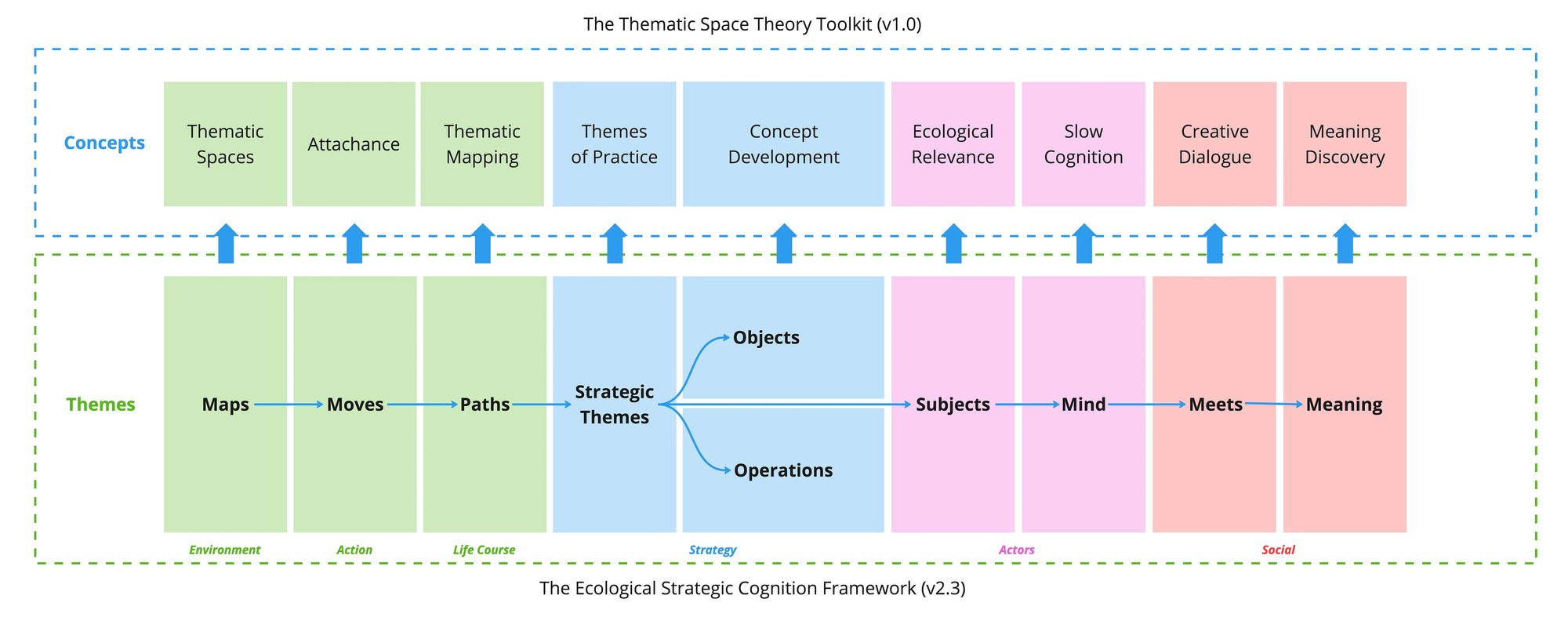
For each space, I chose one concept from TST:
| Space in Ecological Strategic Cognition | Concept from TST |
|---|---|
| Maps | Thematic Spaces |
| Moves | Attachance |
| Paths | Thematic Mapping |
| Strategic Themes | Themes of Practice |
| Objects / Operations | Concept Development |
| Subjects | Ecological Relevance |
| Mind | Slow Cognition |
| Meets | Creative Dialogue |
| Meaning | Meaning Discovery |
For Developmental Strategy, the Thematic Space framework and its Ecological Strategic Cognition toolkit provide the cognitive map for strategic activity. Strategy is not an abstract calculation; it is a situated, embodied, and relational activity—how we move within the World of Activity. Thematic Space is where that movement becomes visible, nameable, and workable.
Part 8: Developmental Strategy as a Knowledge Ecology
We now return to the third question raised in Part 2: How should the knowledge community around Developmental Strategy develop?
8.1 Researcher vs. Actor: Two Types of Strategic Knowledge
In the Life-as-Activity approach, the concept of Enterprise introduced a crucial distinction between the researcher and the actor.
The researcher studies activity from the outside, producing analytical knowledge about how enterprises develop, how strategies are formed, and how projects unfold. The actor lives the enterprise from the inside, producing practical knowledge about what works, what fails, and what must be done next in a concrete situation.
For Developmental Strategy, this distinction reveals two types of strategic knowledge. One is the knowledge that researchers produce: theoretical frameworks, abstract models, and general principles. The other is the knowledge that actors produce: situated judgments, operational heuristics, and tacit understandings that emerge from direct engagement with a specific World of Activity.
This distinction reflects the classic theory–practice gap. Researchers and actors often operate in separate spheres, with different languages, different criteria of validity, and different time horizons. The researcher seeks generalizable knowledge; the actor seeks workable solutions. The gap between them is not a failure of either side—it is a structural feature of the relationship between theoretical knowledge and practical action.
8.2 Four Types of Actors
The binary distinction between researcher and actor is useful but too coarse. There are many ways to understand the theory–practice gap, and in 2022 I developed a more granular model of four types of actors.
The model draws on Kant’s fractal tree, as discussed by sociologist Andrew Abbott in Chaos of Disciplines (2001). Abbott observed that Kant did not simply split reason into pure and practical; he then repeated the same pure–practical distinction within each branch. The result is not a normal hierarchy but a fractal distinction—a pattern that repeats itself at every level.
- Actors — work at the level of Practice within Practice
- Curators — work at the level of Theory within Practice
- Empirical Sociologists — work at the level of Practice within Theory
- Theoretical Sociologists — work at the level of Theory within Theory
These four types—Actors, Curators, Empirical Sociologists, and Theoretical Sociologists—were developed for the Creative Life Curation project. For Developmental Strategy, I use a parallel set of terms that describe the same functional positions: Actors (the same), Analysts (corresponding to Curators), Empirical Researchers (corresponding to Empirical Sociologists), and Theorists (corresponding to Theoretical Sociologists). The mapping is not exact—Analysts in Developmental Strategy may work with a broader range of tools than Curators did—but the structural logic is the same: a fractal distinction between theory and practice, repeated at each level.
- Theorists engage in theoretical development. They build abstract strategic knowledge systems—the basic forms, core principles, and conceptual architectures that define what strategy is and how it functions in development. Their work operates at the Invariant and Invariant Set levels of Ecological Formism.
- Empirical Researchers engage in empirical research. They test strategic theories against concrete cases, data, and observed reality. Their work bounds the case, refines the theory, and provides the evidence that distinguishes a viable framework from an unverifiable speculation. They operate at the Quasi-invariant level, translating abstract claims into testable propositions.
- Analysts engage in intervention application. They translate theoretical principles and empirical findings into operational tools, educational programs, consulting methods, and curated frameworks. The Weave-the-Strategy Toolkit and the Enterprise Development Framework are products of this analytical work. Analysts operate at the intersection of theory and practice—mediating between the abstract and the situated.
- Actors engage in self-reflection. They use strategic knowledge in their own World of Activity, reflecting on their situation, making situated judgments, and adapting frameworks to their own development. Actors do not need to produce formal theory or build toolkits; their engagement is first-person and practical. Yet their reflective use of strategy generates the tacit knowledge and lived experience that feed back into the entire ecology.
These four modes of engagement are not separate tracks. They form a cycle of strategic knowledge: theoretical development produces frameworks; empirical research tests and refines them; analysts translate them into usable tools; actors apply them in their own lives and generate new insights; and those insights, in turn, can be shared, refined, and contributed back to theoretical development.
For the knowledge ecology of Developmental Strategy, this four-type model clarifies that no single role can substitute for another. Theorists provide foundations. Empirical researchers provide validation. Analysts provide mediation. Actors provide the living ground. The health of the ecology depends on maintaining the openness of exchange among all four—so that strategic knowledge remains connected to the real situations it seeks to support, and so that the unfolding of strategy continues to be nourished by the diverse forms of engagement that sustain it.
8.3 Ecological Formism as a Meta-Framework
Ecological Formism provides the meta-framework for organizing the knowledge system of the Developmental Strategy ecology. Its four-layer schema—Variant, Quasi-invariant, Invariant, Invariant Set—offers a principled way to locate different forms of strategic knowledge and to understand how they relate to one another.
At the Invariant and Invariant Set levels, we find the basic forms and core principles of strategy. These are the foundational contributions of theorists, who build abstract strategic knowledge systems. They define what strategy is and how it functions in development.
At the Quasi-invariant level, we find mid-range knowledge frameworks and models. Empirical researchers operate here, testing theoretical claims against concrete cases and refining them into testable propositions. Analysts also work at this level, translating theoretical principles into operational tools, educational programs, and consulting methods.
At the Variant level, we find situated strategic practices and cases. Actors operate here, using strategic knowledge in their own World of Activity, reflecting on their situation, and adapting frameworks to their own development. Their lived experience generates the tacit knowledge that feeds back into the entire ecology.
Ecological Formism thus organizes the knowledge system not as a fixed hierarchy, but as a dynamic ecology. Knowledge flows in two directions. Top-down: theorists produce principles that empirical researchers test and analysts translate into tools for actors. Bottom-up: actors’ situated practices generate insights that analysts refine into mid-range frameworks, which empirical researchers test and theorists integrate into more comprehensive systems.
This meta-framework also clarifies the nature of the theory–practice gap. The gap is not a single divide to be bridged, but a series of transitions across levels. Each transition—from Invariant to Quasi-invariant, from Quasi-invariant to Variant—requires specific work and specific roles. Theorists, empirical researchers, analysts, and actors each contribute to different parts of this ecology. No single role can substitute for another.
For Developmental Strategy, Ecological Formism provides the architectural blueprint for the knowledge ecology. It shows where each type of knowledge belongs, how it relates to other types, and how the entire system can remain open and adaptive. By using this meta-framework, the Developmental Strategy community can maintain the distinctiveness of each role while enabling the exchange that keeps the ecology alive.
Part 9: Matrix, Toolkit, and Criterion
Drawing together the discussions above, we can now assemble a 3×3 matrix and a toolkit composed of a series of knowledge frameworks. In addition, we need a principle—or rather, a critical criterion—for judging whether a strategy theory harbors hidden teleological inclinations.
9.1 The 3×3 Matrix
The three focal points of Developmental Strategy can be understood in relation to one another through two vocabularies.
In the terms of Activity Theory, they address the classic triad of activity (subject–object). In the terms of phenomenological philosophy, they unfold across three domains: subjectivity (#1), intersubjectivity (#2, since enterprise development always involves collaboration and shared endeavor), and objectivity (#3). The third domain extends further toward otherness in its Worldentity stage, but for the purposes of this article, the three domains suffice.
Each focal point has its own layers of unfolding, roughly three in number. These layers do not map onto one another exactly. To organize them into a coherent matrix, I borrow a distinction from Hegel's theory of concepts: the Universal (the most general, abstract category), the Particular (the intermediate, determinate category), and the Individual (the concrete, singular instance). Hegel used this triad to describe how thought moves from abstract universality through particular determination to concrete individuality.
I use this Hegelian triad as a creative heuristic for constructing the 3×3 matrix below. It provides a useful frame for aligning the three layers of each focal point. However, the specific frameworks within each focal point—Coordinate, Center, Gejunction; Developmental Project, Developmental Platform, Developmental Culture; Mindentity, Folkentity, Worldentity—were not developed from Hegel's theory. They emerged from the theoretical work presented in Parts 4, 5, and 6. The Hegelian triad serves only as an organizing device, not as a deductive foundation.
Guided by this, Developmental Strategy can be understood as a 3×3 matrix:
| Dimension | Individual | Particular | Universal |
|---|---|---|---|
| 1. The Unfolding of Subjectivity | Coordinate | Center | Gejunction |
| 2. Enterprise Development | Developmental Project | Developmental Platform | Developmental Culture |
| 3. The Development of Thematic Creations | Mindentity | Folkentity | Worldentity |
This matrix is a new map for examining the concrete concerns of Developmental Strategy at a glance. It does not replace the three lenses introduced in Part 2. It is the integrated terrain those lenses converge upon.
The three dimensions are not separate domains. They are nested layers of the same unfolding. They correspond to the Hegelian distinction between the Individual, the Particular, and the Universal.
Most importantly, these three dimensions operate simultaneously and interpenetrate in concrete situations. The unfolding of subjectivity, the development of an enterprise, and the birth of a thematic creation are not three parallel tracks. In real strategic situations, they are entangled with one another. A Living Coordinate may be discovered through an enterprise; an enterprise may take shape around a thematic creation; a thematic creation may reshape the subjectivity that first imagined it. The matrix is an analytical map, not a prescription for how life actually unfolds.
9.2 A toolkit
Drawing together the models and frameworks discussed throughout this article, we can assemble a toolkit for Developmental Strategy. The toolkit falls into two broad categories: maps and models.
Maps provide the terrain—the structural layout of the social world and the regions within it.
- HLS Framework — the five systems of the social world (Body, Mental, Behavioral, Cultural, Historical), plus the five faces that correspond to each region.
- Six Faces of the Concept System — the six types of concept systems and their mappings to the HLS systems.
- The FFCC Model — Flow, Focus, Center, Circle, as the basic ecological forms of the World of Activity.
- The House Series — thematic maps for each ecological form, usable as analytical toolkits.
- The Ecological Strategic Cognition Framework — a thematic map of nine spaces.
- The Social Landscape Framework (v2.0) — the hierarchical structure of Social Norms, Significant Social Forms, Basic Ecological Forms, and Social Landscape.
- The 3×3 Matrix of Developmental Strategy — the integrated map of Developmental Strategy across its three dimensions.
Models provide the analytical instruments—the frameworks for interpreting what the maps reveal.
- Anticipatory Activity System (AAS) — understands strategy as anticipatory activity, composed of First-order and Second-order Activity, structured by the Self–Other–Present–Future schema.
- World of Activity Toolkit (v2.0) — the four-layer architecture (Invariant, Quasi-invariant, Variant, Invariant Set) for organizing developmental themes and movements.
- Developmental Functionalism — the lens that defines strategy by its function in development.
- Ecological Formism — the Variant–Quasi-invariant–Invariant–Invariant Set schema for organizing strategic knowledge across levels.
These maps and models are not meant to be applied as a fixed sequence. They are resources to be assembled case by case, according to the situation and the question at hand.
9.3 The "Telos - End" Criterion
In concluding the discussion of Developmental Strategy, we need a criterion—not a principle of construction, but a standard of judgment, to guard against a hidden danger: the tendency of strategy theories to slide into teleological inclinations.
In Listening and Speaking: A Sociological Email Collection (2012–2013) (ISBN 9787516155592), theoretical sociologist Ping-keung Lui discussed the issue with several young social scholars and pointed out a crucial distinction: Telos (the ultimate purpose in a teleological sense) versus End (the concrete goal or outcome in a practical sense).
Lui made this distinction to address the scientific project of sociology—guarding it against unverifiable teleological inclinations. But the distinction itself carries broader implications. For Developmental Strategy, it provides a necessary warning.
Lui points out that a teleological structure takes the form of “Telos – Hypothesis.” It posits an ultimate given fact as the purpose of a higher, unverifiable hypothesis. Because the data’s probability distribution is fundamentally determined by the null hypothesis, such a teleological assumption can never be tested or falsified. It belongs to philosophical speculation, not to scientific or practical projects.
In contrast, End belongs to the “End – Means” structure. An “End” is not an unverifiable given fact, but a concrete, determinate goal derived from research and situated action. As Lui emphasizes, even a comprehensive developmental scheme such as “cultivating oneself, regulating the family, governing the state, and bringing peace to the world (Nèi Shèng Wài Wáng, 内圣外王)” is not a teleology, because these are not given facts—they are choices that can be pursued, tested, and revised through specific means. Such an “End–Means” structure, even when it offers a general developmental scheme, remains fundamentally distinct from a teleology.
This distinction has profound implications for Developmental Strategy.
First, Developmental Strategy must not be built upon a preordained Telos. It should not assume that there is a single, ultimate state of “complete development” that every individual or enterprise must reach. Such a teleological view would make strategy unverifiable, and it would impose an external, absolute standard upon unique lives.
Second, Developmental Strategy operates through an End–Means logic. The “Ends” are concrete objectives and outcomes that emerge within specific contexts—the results of First-order Activity, the discoveries of Second-order Activity, the movements in the 3×3 matrix. They are not pre-written destinies; they are anticipated, pursued, and revised.
Third, the value of a strategy is not measured by its fidelity to a transcendent Telos, but by its capacity to support the ongoing unfolding of subjectivity, enterprise, and creation. A good strategy is one that helps an actor identify, pursue, and actualize concrete Ends that are meaningful within their own World of Activity, while remaining open to the emergence of new possibilities.
9.4 Testing Our Own Framework
The principle above is not merely an abstract warning. It is a test we must apply to our own theory.
Returning to our three focal points of development, we must ask whether they constitute a teleological structure. The answer is no—and the reason requires a precise understanding of what we mean by “the unfolding of subjectivity.”
The unfolding of subjectivity is not a temporal sequence to be completed. It is an ontological condition—something that is happening at every moment, for every person. Its structure is not a ladder of stages but a set of nested layers: Body(Self), Life(Self), and History[Life(Self)].
These three layers are not stages to be sequentially overcome. Every individual exists in all three at every moment. Body(Self) is the embodied individual; Life(Self) is the self as lived through activities and engagements; History[Life(Self)] is the self as situated within historical and cultural contexts. The differences between them lie not in temporal progression, but in the extent to which they are perceived, analyzed, and made workable.
The technical division of these layers into specific analytical terms—Living Coordinate, Creative Center, Gejunction—is a methodological abstraction introduced by the theorist for the purpose of analysis. It is not a preordained blueprint. It is not a destiny. An individual does not “move from” Coordinate to Center to Gejunction in a linear fashion, nor is one required to. One is always already situated across all three layers simultaneously.
Because of this, Developmental Strategy does not prescribe a perfect final state. It does not treat Gejunction, Developmental Culture, or Worldentity as a Telos. Instead, it provides a set of analytical tools and practical means (Means) for actors to understand their current unfolding—at this very moment, across all nested layers—and to make situated choices about what to do next.
A person’s unfolding might shift between different configurations. An enterprise might stabilize or dissolve. A creation might fade into oblivion or crystallize into a Worldentity. None of these outcomes are “failures” of a preordained plan. They are the real, ecological expressions of a life in process.
By rejecting teleological inclinations, Developmental Strategy remains truly developmental—not because it promises a perfect future, but because it honors the open, situated, and ongoing nature of the present.
Postscript
Developmental Strategy is the first product of GO Theory as a mature platform. It is also one of six functions within Center Development—Strategy, Narrative, Curation, Support, Design, and Discovery. This raises a natural question: if strategy can be revisited through the lenses of Developmental Functionalism, Thematic Space Theory, and Ecological Formism, can the other five functions be explored in a similar way?
The question is not rhetorical. Each function has its own knowledge ecology, its own practitioners, and its own theory–practice gap. Each could be examined through the same three lenses, yielding concepts like Developmental Narrative, Developmental Curation, Developmental Support, Developmental Design, and Developmental Discovery. Whether these concepts will emerge as fully developed frameworks remains to be seen. But the possibility is now open—and that openness is itself a sign of the platform’s maturity.
There is something different about this revisit. In previous engagements with the “strategy” theme, I worked primarily from the perspective of the actor—how an individual or enterprise develops strategy. This time, I approached it from the perspective of knowledge ecology—how knowledge about strategy is produced, organized, mediated, and used. The focus shifted from doing strategy to knowing strategy, from strategic action to strategic knowledge engagement.
This shift is rare in theoretical work. Most theorists develop a theory and then apply it. Fewer stop to reflect on the knowledge ecology that sustains the theory itself—who produces it, who mediates it, who uses it, and how these roles relate. This is what theory as enterprise makes possible: a perspective that treats a theoretical enterprise not only as a body of ideas but as a living ecology of knowledge production and use. Developmental Strategy is an attempt to think with that perspective, not just about it.
In developing this concept, I have been using Weave-the-Theory as a reflective model to revisit my own creative journey with the “strategy” theme over the years. According to that model, Developmental Strategy belongs at the Principle position—a governing insight that unifies the whole. Alongside it, two other principles have emerged from this reflection: Ecological Strategic Cognition and Strategy as Anticipatory Activity. Each names a different dimension of how strategy functions in development. Their relationship to Developmental Strategy, and to one another, will be explored in a separate article.
For now, it is enough to note that the journey continues. Developmental Strategy is not a final answer. It is an opening—a way of seeing strategy as a functional, ecological, and developmental phenomenon. And like all openings, it invites further exploration.
v1.0 - Published on October 12, 2026 - 11,737 words