
Weave the Theme: The Typology of Theme and Beyond
Revisiting and Rebuilding the Thematic Engagement ToolkitPart
by Oliver Ding
October 26, 2026
In the previous article Revisiting and Rebuilding the Thematic Engagement Toolkit, I revisit the theme of “thematic engagement” and rebuild it into a concept, together with its toolkit.
Using the Weave-the-Theory model, I set out the concept of “Thematic Engagement” with its principles, models, and themes. The outcome is a four-layer toolkit, version 2.0 of the Thematic Engagement Toolkit. However, the article focuses on the model and the "Principle - Concept" line.
In this article, I move to the "Model - Theme" line and explore the "Theme" weave-point, which reflects my years of exploring thematic engagement at the Thematic Situation level. At this level, one typical practice of theoretical enterprise is developing a typology.
A typology is a way of sorting things into kinds. Every typology rests on a basis, and the basis decides which distinctions appear and which disappear. This article does not propose a final typology of theme. It gathers the attempts I have made over several years to classify themes, sets out the detail of each, and asks what distinguishes them.
The article is organized into four parts. Part 1 sets out the context by examining the landscape diagram of Thematic Engagement and the various kinds of themes that run through it. Part 2 reviews four distinct approaches I have taken to classify themes, each with its own basis, project, and limits. Part 3 expands on the specific trajectories of three key themes: Life Themes, Cultural Themes, and Strategic Themes. Finally, Part 4 aligns these typologies with the four layers of the Thematic Engagement Toolkit, demonstrating how a static classification transforms into a strategic framework and ultimately points toward the dynamic reality of Project Engagement.
Contents
Part 1: The Context of Theme
1.1 The Landscape of Thematic Engagement
1.2 Life Themes, Cultural Themes, and Strategic Themes
1.3 Other Examples at the "Theme" Weave-point
Part 2: Attempts at a Typology
2.1 A Benchmark by Origin
2.2 A Ladder of Abstraction: Category, Experience, and Principle
2.3 Multiple-perspective Reflection: Nine Categories
2.4 Alignment with the Six Faces of the Concept System
Part 3: Expanding the "Theme" Weave-point
3.1 Life Themes and Cultural Themes: A Long Question
3.2 Strategic Themes: Strategy as Cognitive Representation
3.3 Knowledge Themes and Cultural Themes: A Strategic Restriction
Part 4: Typology and Engagement
4.1 Four Concepts of Thematic Engagement
4.2 From Typology to Strategy
4.3 From Zones to Layers
4.4 From Classification to Project Engagement
Conclusion
Postscript
The Creativity of Themes of Practice
Part 1: The Context of Theme
Before we can classify themes, we must first understand the landscape in which they live. This part establishes the foundational context for our exploration of thematic typology. By examining the landscape diagram of Thematic Engagement, we will map out the "Theme" weave-point and introduce the three primary kinds of themes—Life, Cultural, and Strategic—that run through the theoretical enterprise. This contextual overview will provide the necessary vocabulary and framework for the attempts at classification that follow.
1.1 The Landscape of Thematic Engagement
The landscape diagram Mapping the Landscape of Thematic Engagement (October 23, 2026) is based on the four weave-points of the Weave-the-Theory model: Principles, Concepts, Models, and Themes. The principles and concepts of the toolkit occupy the upper left and the upper right of the diagram, and the theme weave-point, with its examples, occupies the lower right. The diagram is based on the Weave-the-Theory framework (v1.0, October 19, 2025).
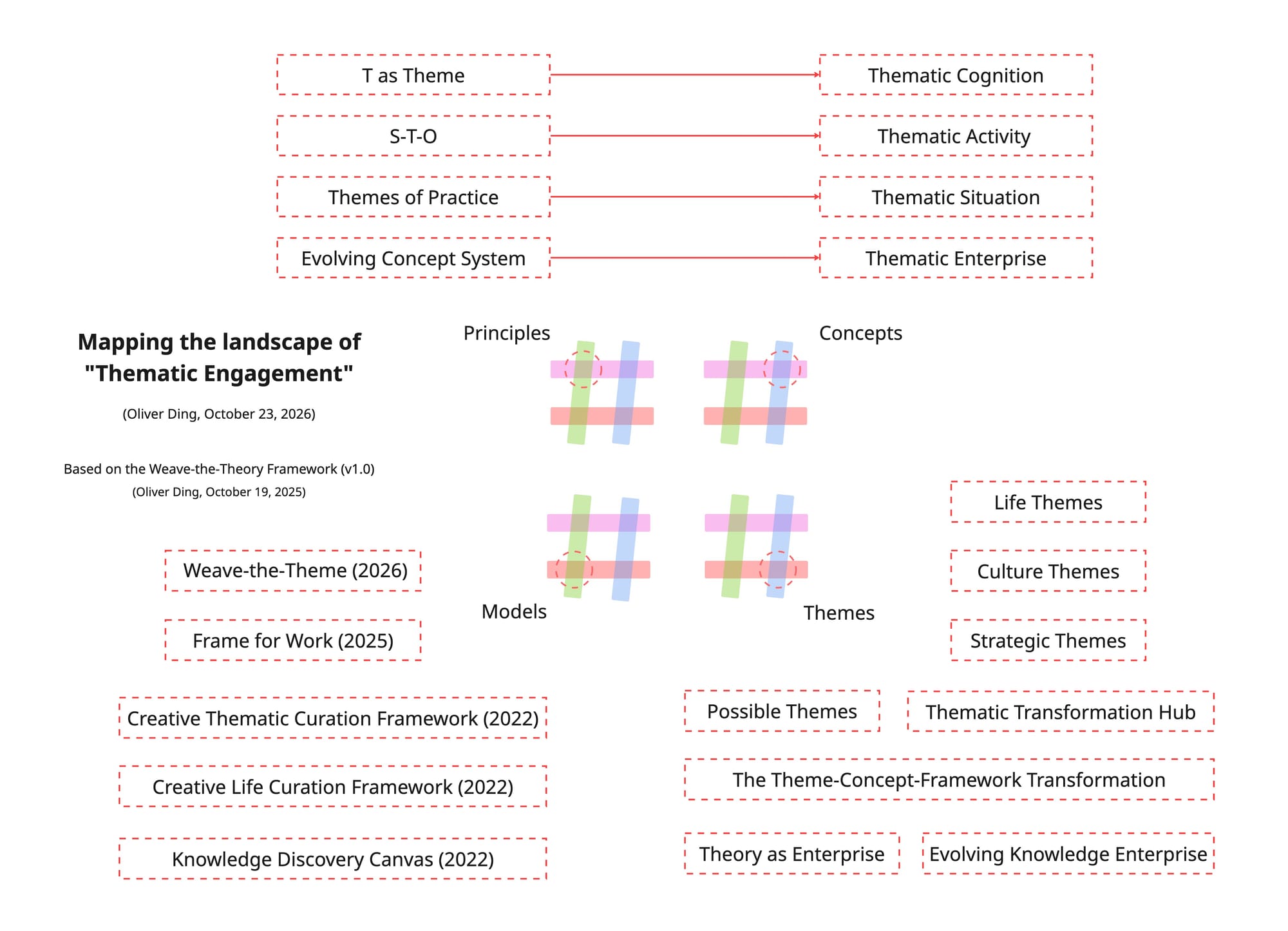
The diagram follows several earlier articles of the series. The first established the Experience–Narrative–Framework–Ecology schema. The second, The Weave-the-Theme Framework, built the 4×4 structure. The third, Revisiting and Rebuilding the Thematic Engagement Toolkit, rebuilt the four concepts and their layers. None of these articles treated the "theme" weave-point in detail, and this article turns to it.
1.2 Life Themes, Cultural Themes, and Strategic Themes
Three kinds of theme appear at the "theme" weave-point, and each has its own origin.
Life themes come from the concerns that run through a person's life. The term was used in career counseling and psychology long before my own work. In my inquiry, it entered through the study of creative themes in people's life stories, in which the lives of individuals were the source of the themes. A life theme is the form a concern takes when a person lives it.
Cultural themes come from the recurring dispositions of a culture. I took the notion from the anthropologist Morris Opler (1945), who used themes to study culture. In 2019, when I developed Themes of Practice for Curativity theory, I used cultural themes to connect with life themes, and the purpose of that connection was to bring together the two sides of a long debate in the social sciences, between the individual and the collective.
Strategic themes come from the work of a project. They appear when the strategic intent of a project is worked through in practice, and they are named in the course of the work. They were first clearly visible in the Ecological Strategic Cognition work of 2025, in which strategy was understood as a long-term process of cognition rather than as a static plan. Part 3 expands all three.
These three kinds of theme are introduced briefly here; their fuller stories are traced in Part 3.
1.3 Other Examples at the "Theme" Weave-point
The other examples at the theme weave-point have their own histories, and each is tied to a project instead of a single theoretical system.
Possible Themes are themes that have not yet taken a settled form. From June 2023 it became a series of TALE posts. Each possible theme is a post of its own, with a fixed template: a name, a clue, a type, the contributors, the references, and related themes.
The Thematic Transformation Hub is a function of a knowledge center rather than a kind of theme. In the Ecological Practice approach, TALE's unique function is taking thematic attachances: the process of attaching mental focus to a primary thematic space, and detaching it again, through which themes and concepts are generated. TALE joined the network of knowledge centers in January 2023, within a network of seven knowledge centers that I had built over the preceding fourteen months. The Hub is therefore the place in that network where themes are turned into knowledge elements.
The Theme–Concept–Framework transformation names a creative journey rather than a model. The journey was guided by the Strategic Thematic Exploration framework, which describes how a theme passes through the stages of a possible theme, a primary theme, a concept, and a framework. The journey unfolded across many projects over several years, from 2023 onward, and it was later extended to the layer of knowledge systems.
Theory as Enterprise is a claim proposed in Wonder and Wander (2025). It treats a theoretical approach as an enterprise that develops over time, and it is an output of specific cases rather than a general principle.
The Evolving Knowledge Enterprise is a model, built in April 2024, that describes a knowledge enterprise going beyond the mental dimension to its behavioral network and its material container.
Each of these examples belongs to a project, and the relation between a theme and its project is the subject of the discussion that follows the typology. The examples are therefore not a fixed classification. They show that a theme is always developed within a project, and that the terms which name its kinds arise from that development.
Part 2: Attempts at a Typology
Over the past several years, classifying themes has been a recurring thread in my exploration of the subject. The methods have differed from one period to another and from one project to another. Taken together, they amount to four approaches:
- #1. A benchmark by origin. Themes are sorted by whether they come from the life of a person or the culture of a collective. The project is where such an origin takes place, so it is part of this approach. This approach is brief here, because Part 3 develops it.
- #2. A ladder of abstraction. A theme is read at the level of a category, of experience, or of principle.
- #3. Multiple-perspective reflection. It adopts perspectives from several disciplines, and it moves from the micro to the macro level, to examine the different situations of themes and concepts within a knowledge ecology.
- #4. Alignment with the six faces of the concept system. The typology is aligned with the six faces, which the GO Theory platform offers as a basis for concept systems in their social context.
This is also how typologies generally develop. A typology is always tied to a particular project, it has a particular perspective, and it has a particular context. The approaches above follow that pattern. The newest, the alignment with the six faces of the concept system, was developed within the context of the GO Theory platform.
2.1 A Benchmark by Origin
The first approach is less a classification than a method of reading. It holds that a theme is understood through the project from which it came, and that its place among the kinds of theme depends on that project. It is therefore tied to the discussion of theme and project that follows the typology.
Over the past several years, I have used a series of terms to define special types of themes, such as:
- Life Themes
- Cultural Themes
- Career Themes
- Strategic Themes
- Creative Themes
These themes are not drawn from a fixed list; they emerge in my projects, and they cannot be read apart from the project that gave rise to them.
For example, the term "Career Themes" was coined for my work on the Career Curation project in 2021. In the project, Career Themes refers to study themes of practice within a person's career. For example, "UX (User Experience)" was identified as an example of a career theme. A series of related terms were developed as operational concepts.
- Pairs of Opposite Themes, which are significant differences between career themes;
- Meta-themes, which use one high-level theme to curate similar career themes;
- Development of Themes, which is the transformation of career themes.
Opposite themes were treated as the starting point of innovation, since the tensions between them can become creative opportunities.
2.2 A Ladder of Abstraction: Category, Experience, and Principle
The second approach reads a theme as a ladder of three levels. In January 2023, while working at the early stage of TALE (Thematic Analysis Learning Engagement), I developed a typology of creative themes. Details can be found in Find 100 People’s Life Stories and Creative Themes.
What are Creative Themes? Put simply, creative themes are abstract, meaningful keywords that transcend specific contexts, capturing a person's work, career, or life.
A person can use many keywords to highlight their work, career, or life. However, they may not claim that all keywords are meaningful keywords. Only a few keywords are perceived as meaningful.

If we write a biography for a person, then the title of the biography is a creative theme. A book’s title can be a phrase or a sentence. Moreover, many authors also use sub-titles for their books. What we can learn from publishing is that we can use both Phrases and Sentences for creative themes.

The above examples also highlight two major categories of creative themes: Life and Work. While the “Life” category refers to general cultural activities and Cultural Engagement, the “Work” category refers to professional knowledge activities and Knowledge Engagement.

We can also use the above “Category — Experience — Principle” schema as a typology of creative themes. For example, “Try something new for 30 days” is an Experience while “Creators need an immediate connection to what they’re creating” is a Principle.
The management scholar Amy Wrzesniewski found three views of work: a job, a career, and a calling. From this, I developed a hierarchy in 2016, with three levels for career themes. At the level of category, a person treats job positions as career themes. At the level of experience, a person treats the subjective feelings of working as the theme, and several positions may share the same feelings, so experience is more abstract than category. At the level of principle, a person treats abstract principles as the theme, which is the highest level of abstraction. Bret Victor's Inventing on Principle is an example: he spent about ten years discovering a principle for his work.
2.3 Multiple-perspective Reflection: Nine Categories
The third approach adopts perspectives from several disciplines, and it moves from the micro to the macro level, to examine the different situations of themes and concepts within a knowledge ecology. It was set out in Themes of Practice: Concept, Activity, and Cognition (September 2, 2023). In that diagram, a theme sits at the centre, with concept, activity, and cognition around it, and the nine categories fall into four zones.
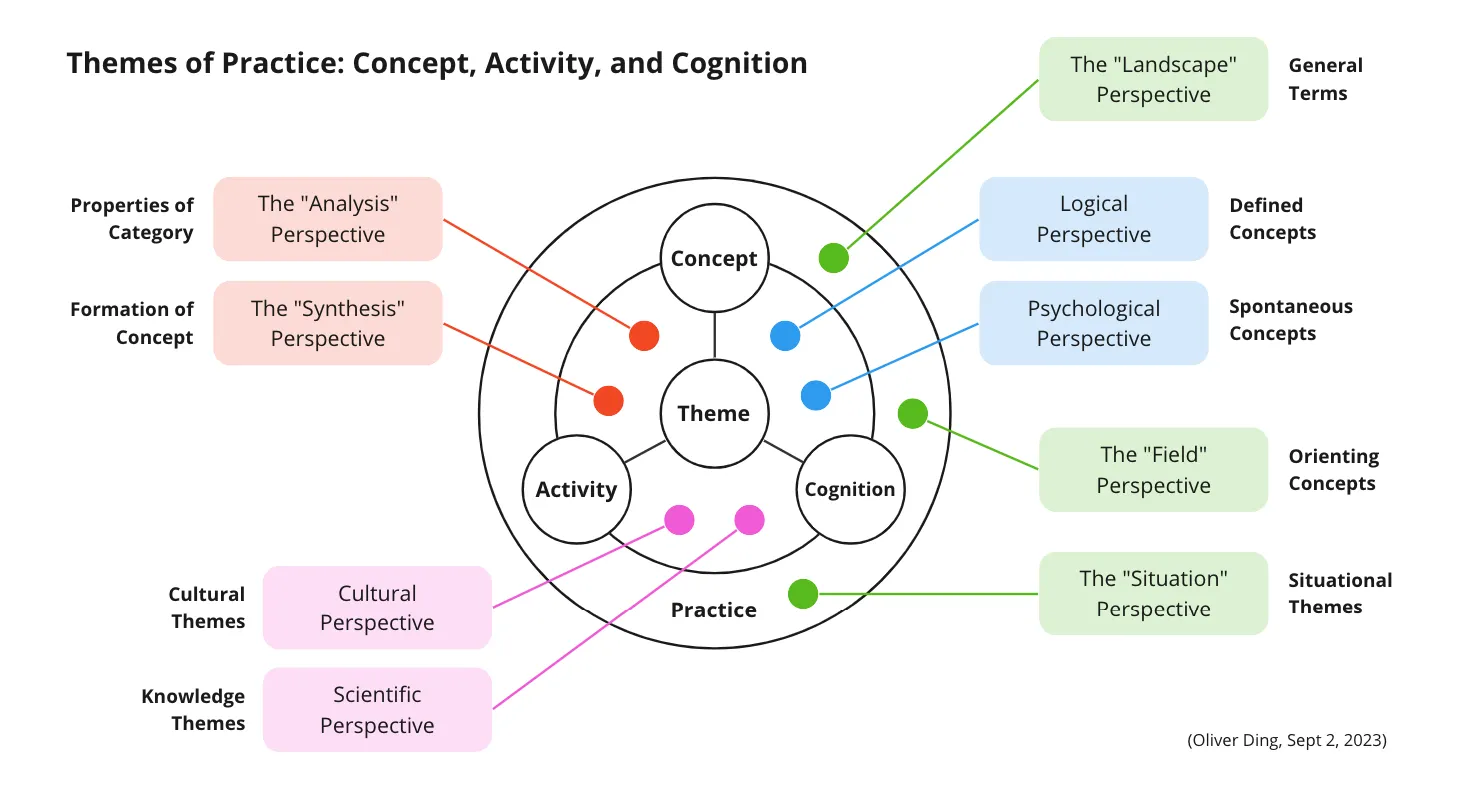
The concept–theme–activity zone (the red block) lies between concept and activity. It holds properties of category and formation of concept. The "Analysis" perspective, from contemporary cognitive psychology, treats a concept as a bundle of attributes and defines it, and it distinguishes concepts as mental representations from categories as the classes themselves; its category is properties of category. The "Synthesis" perspective follows Hegel, Marx, and Vygotsky, as Andy Blunden presents them, and it treats a concept as something whose formation is its internal development; its category is formation of concept.
The concept–theme–cognition zone (the blue block) lies between concept and cognition. It holds defined concepts and spontaneous concepts. The "Logical" perspective takes defined concepts, with the criteria for hierarchies of concepts that Piaget set out. The "Psychological" perspective emphasizes individual differences in understanding, and it takes spontaneous concepts, which Vygotsky set against scientific concepts.
The activity–theme–cognition zone (the pink block) lies between activity and cognition. It holds cultural themes and knowledge themes. The "Cultural" perspective takes cultural themes, which I developed in the Curativity work and the TALE knowledge center. The "Scientific" perspective takes knowledge themes, which are similar to scientific concepts but more flexible in the early discovery of knowledge engagement.
The outer zone (the green block) is the last block, and it lies outside the inner ring, around the practice circle. It holds three bands, which form the three regions of the nine categories. The first band lies above the practice circle, outside it, and it holds general terms. The "Landscape" perspective takes up the distinction between singular terms, which denote particular individuals or objects, and general terms, such as "car" or "chair", which apply to many things. It is drawn from analytic philosophy, and it resembles Saussure's distinction between langue and parole.
The second band crosses the boundary of the practice circle, and it holds orienting concepts. The "Field" perspective follows Derek Layder, who described orienting concepts as having two sides, one objective and one subjective, and as referring to social processes that unfold over time and space. Career is his example, and the perspective uses it to guide research into a field.
The third band lies at the lower part of the practice circle, within practice, and it holds situational themes. The "Situation" perspective distinguishes situational themes from creative themes. Situational themes are short keywords that capture immediate experience. During a ten-day road trip in June and July 2023, I could not write full notes, so I used short meaningful keywords while taking photographs, and these keywords became situational themes of that journey.
The approach distinguishes a defined concept from a spontaneous one, and a cultural theme from a knowledge theme. It does not explain how a theme becomes a category, and it does not treat the categories as stages.
2.4 Alignment with the Six Faces of the Concept System
This article is part of the Revisiting and Rebuilding Thematic Engagement project, and it aligns with the newest context, the GO Theory platform, in order to develop a new typology.
The platform offers a five-system map as the ontological structure of the social world. Based on that map, the six faces of the concept system were proposed. The Revisiting and Rebuilding project aims to provide the genesis of the concept system, because a concept system originates from a theme, and from a thematic network formed by several themes. The new typology therefore aligns itself with the six faces.
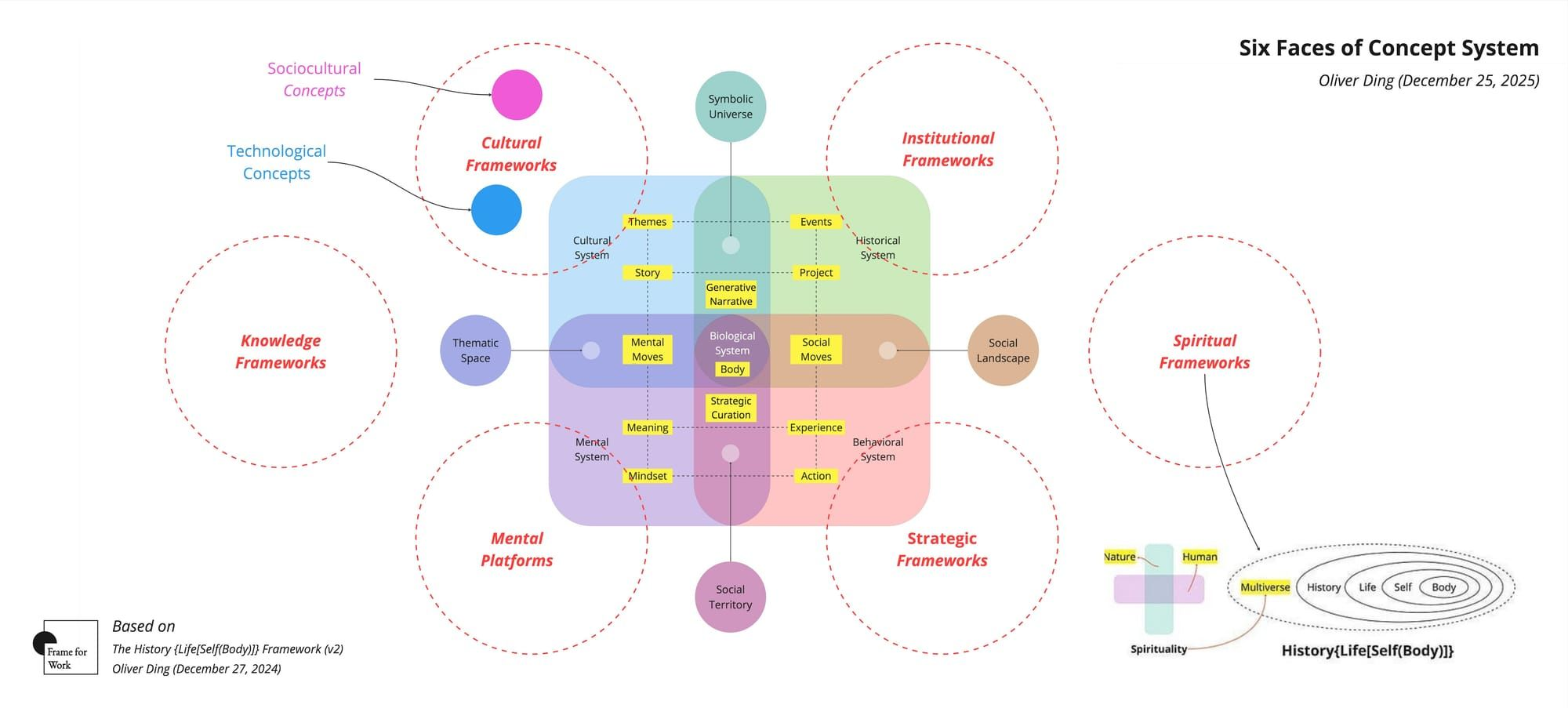
The five systems of the social world are the Body System, the Mental System, the Behavioral System, the Cultural System, and the Historical System, as defined by the History{Life[Self(Body)]} framework. Four of the six faces correspond to four of these systems:
- Mental Platforms -> Mental System
- Strategic Frameworks -> Behavioral System
- Cultural Frameworks -> Cultural System
- Institutional Frameworks -> Historical System
The Body System has no face of its own among the six. Knowledge Frameworks and Spiritual Frameworks are not tied to a single system. They stand as the anticipatory horizon that pushes the Cultural System beyond its present limits.
The six faces are set out in Six Faces of the Concept System. Knowledge frameworks aim at objective truth, and they are the concept systems of knowledge in its public form. Mental platforms are the personal cognitive infrastructure that supports an individual's development. Strategic frameworks are concept systems that translate understanding into long-term action. Cultural frameworks are concept systems through which values and meanings are negotiated collectively. Institutional frameworks are the historical crystallization of cultural frameworks over time. Spiritual frameworks are concept systems oriented toward transcendent meaning.
Because every concept system originates from a thematic network, these six faces directly yield a corresponding typology of six themes:
- Knowledge Themes correspond to Knowledge Frameworks.
- Life Themes correspond to Mental Platforms.
- Strategic Themes correspond to Strategic Frameworks.
- Cultural Themes correspond to Cultural Frameworks.
- Institutional Themes correspond to Institutional Frameworks.
- Spiritual Themes correspond to Spiritual Frameworks.
This alignment reveals that the typology of themes is not an arbitrary categorization. Each type of theme is the generative seed of a specific kind of concept system, functioning within a distinct system of the social world. By aligning with the six faces, the typology finds its ontological grounding.
Part 3: Expanding the "Theme" Weave-point
Part 1 introduced life themes, cultural themes, and strategic themes as three reference points. This part expands them. Each kind of theme is traced to its origin, to the work in which it was developed, and to the question it carries. Read together with the attempts in Part 2, these expansions show that the distinctions between kinds of theme are not fixed boundaries, but moments in longer lines of work.
3.1 Life Themes and Cultural Themes: A Long Creative Journey
The distinction between life themes and cultural themes is not a simple classification for me. It represents a long creative journey—a core motif of my exploration that has run through several successive projects. The underlying inquiry is older than the terms themselves: how does an individual's lived experience become part of a collective culture?
This inquiry first took the form of Themes of Practice. In March 2019, when I completed the manuscript for Curativity theory, I used “Themes of Practice” as one of its five core concepts. It was specifically designed to connect the two ends of the spectrum: a life theme is the concern a person lives through, while a cultural theme is a disposition that recurs across a culture. In the working documents from 2019 to 2021, I framed them as the two sides of the long-standing individual versus collective debate in the social sciences, tracing the mechanism between them through six levels: Theme, Protocol, Program, Project, Participation, and Process.
This inquiry also has a deeply practical origin. "Curation" has been a significant theme throughout my own professional career, which directly led me to create Curativity theory. Later, in 2022, this theory gave rise to the Creative Life Curation method. I subsequently applied this methodological framework to analyze and research my own recent creative journey. By applying professional methods to personal experience, I was able to uncover the underlying creative themes, which generated many new research cases that were eventually compiled into numerous book drafts.
This motif continued to develop in recent projects in 2026. For instance, in the Anticipatory Cultural Sociology (ACS) project, I explored the ontological setting of Thematic Creation. Meanwhile, in the Strategic Developmental Psychology (SDP) project, I established the Dramatic Life Pattern project, where each pattern is essentially a Creative Theme. Thus, the life theme and the cultural theme remain in a single lineage; the distinction between them is not a fixed boundary, but a moment in this long creative journey.
3.2 Strategic Themes: Strategy as Cognitive Representation
Strategic themes are a core focus of the Ecological Strategic Cognition (ESC) project in 2025. In this project, the strategic theme holds a central position in the framework, serving as the cognitive representation of strategy. To define it precisely, the strategic theme was given a criterion in the ESC 2.0 series: Each strategic theme is matched with three elements—an object, an objective, and operations. If a theme describes all three, or if it includes the objective, it is classified as a strategic theme. Rather than being a static plan or a list of goals, a strategic theme is the mental and linguistic unit through which a creator or an organization conceptualizes their strategic direction.
This view opens the door to empirical research. We can study how an individual or a team uses language to describe their strategic themes, and then observe whether these described themes align with their actual practices. Such inquiry highlights a key perspective from my recent Developmental Strategy manuscript: Strategy as Cognitive Representation. The strategic theme is the exact unit where strategic cognition becomes externalized and open to examination.
Compared to cultural themes, which emphasize shared meanings and collective ways of life, strategic themes are more directly instrumental and action-oriented. They are specifically tied to purposeful choices about the future. However, this distinction is analytical; in actual practice, strategic themes and cultural themes often overlap and inform each other.
Ultimately, strategic themes serve as the foundational layer of strategic frameworks. As argued in the Developmental Strategy manuscript, a strategic framework is essentially a concept system. The origin of any such concept system can be traced back to a set of interrelated strategic themes. By curating, organizing, and integrating these foundational themes, a coherent strategic framework is built.
3.3 Knowledge Themes and Cultural Themes: A Strategic Restriction
The distinction between knowledge themes and cultural themes was worked out in detail in the TALE case, and it arose from a deliberate choice. In the early period of TALE, I restricted thematic engagement to knowledge themes on purpose. The restriction kept the analysis focused. It allowed the knowledge domain to be studied closely, before the broader cultural domain was taken up.
The restriction was later reconsidered. The emergence of the theme "Closure and Unfolding" exposed this limitation. While pairing Creative Life Curation with the "possible book" worked well for knowledge themes, it proved too restrictive for cultural themes, which often demand alternative forms of manifestation—such as an exhibition—not just a text-based product. The possible book, by itself, could not fully accommodate the broader expression of a cultural theme. This limit made me rethink the pairing of method and product, and it led to the Creative Life Square, which I developed as a diagram.
The Creative Life Square extends the S–T–O principle into sixty-four weave-points. Each point pairs a kind of experience with a kind of product, so that the same principle can describe a wider range of possibilities, including cultural works that a possible book does not produce. In this sense, the distinction between knowledge and cultural themes is not only a classification of themes. It is also a reason for widening the method through which themes are curated.
The distinction shows that the same typology can be seen from more than one origin. The knowledge theme was first named in the TALE case, from the knowledge domain. The cultural theme was first named in the Curativity work, from the broader question of experience and culture. The two are linked through the Creative Life Square, which allows them to be curated in the same space.
Part 4: Typology and Engagement
In this part, we further associate the typology of themes to the Thematic Engagement Toolkit (v2.0).
4.1 Four Concepts of Thematic Engagement
As introduced in the previous article, the four concepts of thematic engagement expand one another, layer by layer, and each layer keeps the one before it.
- Thematic Cognition, governed by T as Theme, concerns the theme and its crystallization.
- Thematic Activity, governed by S–T–O, adds subjectification and objectification, so that the theme is embedded in activity.
- Thematic Situation, governed by Themes of Practice, adds the social situation in which the activity takes place.
- Thematic Enterprise, governed by Evolving Concept System, describes how concept systems develop and scale into a wider enterprise, and it provides the context of the other three.
These four concepts are organized within a four-layer framework. It can be further used as a meta-framework to frame the four approaches of the typology of themes.
4.2 From Typology to Strategy
The four approaches of Part 2 take their places within this sequence, and each sits at one layer.
- The ladder of abstraction, of category, experience, and principle, is a purely cognitive analysis. It has nothing to do with the origin of a theme or with the activity that carries it, and so it belongs to Thematic Cognition.
- The six faces describe concrete kinds of thematic fit within the four systems of the social world. They remain highly abstract, and they stand at the same level as S–T–O, so they belong to Thematic Activity.
- The multiple-perspective reflection of 2.3 consists of perspectives that depend on different disciplines, and the differences between disciplines are differences of concrete situation. It therefore belongs to Thematic Situation.
- The benchmark by origin could be placed under Thematic Situation, but it is placed here under Thematic Enterprise. Different enterprises are different types of enterprise, and each corresponds to a different set of themes. The enterprise also changes across its stages, and the selection and function of its themes change with it. In an early stage, an enterprise takes the form of a center, and a center arises from several thematic foci. How to choose among those foci is then the central question.
This placement carries the typology beyond classification. Once the choice of themes depends on the stage of an enterprise, and on how its foci are weighed against one another, the typology becomes a strategy: a way of selecting and ordering themes in the course of an enterprise. The typology is in this sense upgraded to a strategic theory.
4.3 From Zones to Layers
The nine categories of 2.3 can be placed in the same sequence once their concrete content is considered. The two zones of the diagram that lie inside the inner ring each hold categories that belong to one layer.
Thematic Cognition and the concept–theme–cognition zone. This zone holds defined concepts and spontaneous concepts. A defined concept is one whose criteria are set out, and a spontaneous concept is one that a person forms in the course of understanding. Both are held within the cognition of an individual, which is where Thematic Cognition begins, with the theme and its crystallization.
Thematic Activity and the concept–theme–activity zone. This zone holds properties of category and formation of concept. The first describes how a category is analyzed into its attributes, and the second describes how a concept is formed through its own development. Both are activities of concept formation, which is where Thematic Activity begins, with the theme embedded in activity.
Thematic Situation and the activity–theme–cognition zone. This zone holds cultural themes and knowledge themes. They are the same theme seen in two social situations, one of collective culture and one of disciplinary knowledge. Thematic Situation is the layer at which the social situation of an activity is taken into account, and this zone is where the two situations are distinguished.
Thematic Enterprise and the outer zone. This zone holds general terms, orienting concepts, and situational themes, in its three bands. General terms are the shared vocabulary of the enterprise's landscape, orienting concepts give direction to its field, and situational themes are the concrete situations on which it draws. Together they form the context of the enterprise, which is where Thematic Enterprise provides the context for the other three layers.
The diagram and the four layers therefore align, and each can be translated into the other. A reader who begins from the diagram can read off the four layers, and a reader who begins from the four layers can locate each zone and each category in the diagram. The typology has, in this way, two readings that correspond one to one: the zones of the diagram and the layers of the concepts.
4.4 From Classification to Project Engagement
While the typology provides a static map and the strategic layer offers principles for selection, neither captures the dynamic reality of how themes actually live and breathe. To bridge this gap, we must turn from classification to Project Engagement.
In my life-as-activity theoretical system, the concrete operational unit of an activity is the Project, which crystallizes a series of actions into a meaningful whole. Therefore, what we call Thematic Activity is, in practice, carried out through a series of specific projects.
This brings us to the Developmental Project Model, which highlights two core elements: Theme and Identity. A project begins with a Theme (what it is about, the subjective crystallization of experience) and aims toward an Identity (what it becomes, the objectification into a recognizable social role or enterprise).
As we saw in Section 1.3, the examples on the landscape diagram—such as Possible Themes, the Thematic Transformation Hub, and Theory as Enterprise—are precisely these project-driven processes. They demonstrate that a theme is not just a category to be sorted, but a seed that is cultivated within a project. The dynamic mechanisms of how themes are cultivated, transformed, and actualized within concrete projects—and how a Theme ultimately transforms into an Identity—go beyond a static typology.
Therefore, while this article has mapped the Typology of Theme, a full understanding requires an examination of how these themes are engaged through projects. That dynamic, project-based evolution will be the dedicated subject of the next article.
Conclusion
This article has examined the "Model–Theme" line within the Weave-the-Theory model, focusing specifically on the Typology of Theme. Its primary contributions are threefold.
First, it clarifies the origins and distinct nature of different themes. By tracing the lineage of Life Themes, Cultural Themes, and Strategic Themes, the article demonstrates that themes are not arbitrary labels. They are deeply rooted in the specific projects and theoretical contexts from which they emerge.
Second, it systematizes the attempts at classifying themes. Through four distinct approaches—the benchmark by origin, the ladder of abstraction, multiple-perspective reflection, and alignment with the six faces of the concept system—the article shows how the boundaries of a theme are drawn. Each approach rests on a different basis, and together they reveal the multidimensional reality of thematic engagement.
Third, it maps these typologies onto the four layers of the Thematic Engagement Toolkit (v2.0). By aligning the classification methods with Thematic Cognition, Activity, Situation, and Enterprise, the article elevates the typology from a static classification into a strategic framework. It demonstrates that choosing a theme is ultimately a strategic act within a thematic enterprise.
Ultimately, however, a typology is still a static map. It can categorize the kinds of themes that exist, but it cannot fully capture the dynamic process of how a theme is lived and actualized. The transformation of a Theme into an Identity requires a concrete operational unit: the Project. This dynamic, project-based evolution—and the mechanisms of Project Engagement—will be the dedicated subject of the next article.
Postscript: The Creativity of Themes of Practice
Within the Weave-the-Theory framework, the line that runs from Model to Theme is defined as the Creativity Line (the line of Proliferation). This line does not represent an abstract model descending into practice. Rather, it captures the vibrant reality of doing a lot of things—generating actions and projects. It is precisely through these ongoing practices that Themes and Models emerge. This is the very essence of Themes of Practice: themes are not static categories; they are actively lived, enacted, and embodied in the messy reality of our daily work.
Looking back at my multi-year exploration of the concept of "theme," it perfectly embodies this line. Every time I entered a new direction of inquiry, the concept of "theme" would merge with other concepts within that specific context, and through the actual doing of projects, it sparked numerous new insights and frameworks.
Therefore, the Weave the Theme project is highly significant. It represents a deliberate shift from the Creativity Line to the Curativity Line (the line of Unification). It is a comprehensive retrospective and integration—a way to organize, compare, and synthesize my previously scattered explorations of "theme" into a coherent conceptual ecosystem.
Furthermore, viewing the long-term development of a theme through the lens of creativity provides a powerful diagnostic tool. When we trace the Creativity Line over time, we can evaluate the actual evolution of a theme. It allows us to distinguish which projects have generated genuine, novel breakthroughs, and which ones are merely repeating insights that were already discovered in the past.
The typology discussed in this article is, in this sense, not a closed taxonomy, but an open record of these successive creative leaps. It is a kind of "theme of themes," naming the ways the subject has been seen at a given stage. It will continue to grow as the projects continue, driven by the endless creativity of practice.
v1.0 - October 26, 2026 - 5,755 words