
Introduction: A Two-week Revisiting-and-Rebuilding (RR) project about Theme
by Oliver Ding
October 30, 2026
This article is an introduction to a possible book: Developmental Theme: The Weave-the-Theme Framework and Thematic Engagement (Book, 2026).
This book is the outcome of a two-week Revisiting-and-Rebuilding (RR) project conducted between October 16-30, 2026.
It was based on a series of new articles written between October 19 and October 30, 2026 and another old articles across from 2019 to 2026. They were not planned as a book. They began as a revisiting on the Flow-Story-Model model (2022) and an attempt to rebuild it for upgrading Cognitive Hydrology from v1.0 to v2.0. However, the RR project led to revisiting and rebuilding the Thematic Engagement toolkit. Finally, the concept of Developmental Theme was created for framing a new knowledge ecology about "theme" and completing a structural task for the GO Theory platform.
This introduction tells that story in three parts: what the project produced, how it actually unfolded, and what it contributed.
Part 1: The Outcomes of the RR Project
The Revisiting-and-Rebuilding (RR) project produced two major artifacts: the Weave-the-Theme Framework (v1.0) and the Thematic Engagement Toolkit (v2.0).
1.1 The Weave-the-Theme Framework (v1.0)
The Weave-the-Theme Framework is a 4×4 diagram that serves as the operational core of the T-only Model. It was built on a simple observation: a theme does not evolve in a vacuum; it must be interwoven with the concrete conditions of action.
The framework has two axes. The vertical axis is the Experience–Narrative–Framework–Ecology schema, which defines four thematic spaces, each representing a distinct epistemological state and scale of thematic cognitive development:
- Experience: Pre-linguistic (Thematic Focus). Inspiration and intuition surge before they are named.
- Narrative: Single Structure (Linguistic Existence). A fuzzy inspiration gains linguistic existence through naming.
- Framework: Composite Structure (Concept System). The simple structure evolves into a network of themes and a system of concepts.
- Ecology: Ecology (Ecological Niche). The framework enters the larger knowledge-cultural ecosystem.
The horizontal axis is the Milieu–Mediator–Method–Mastery schema, which looks at thematic cognition from an ecological perspective: how a person's thinking about a theme is set within its milieu, carried by its mediators, operated through its methods, and brought toward mastery.
The intersection of these four rows and four columns generates sixteen weave-points. Each weave-point is a portal to an entire Thematic Space—a living cognitive container.
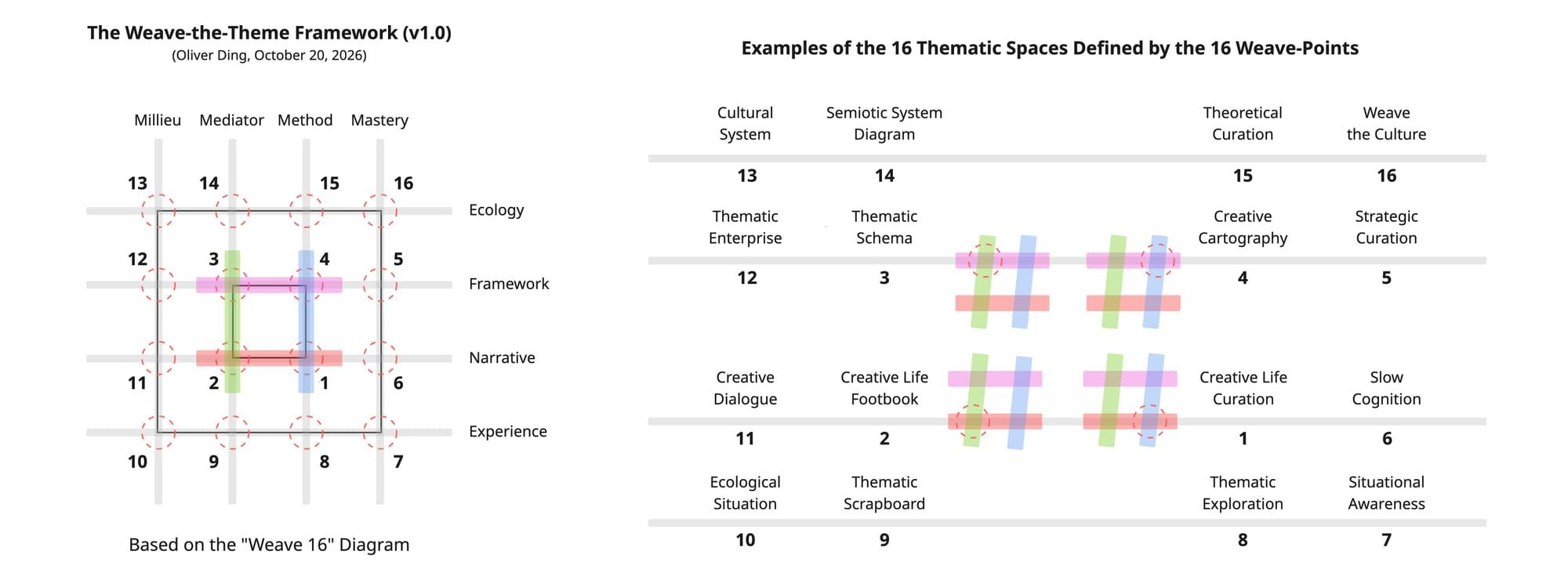
The numbering begins at "Method × Narrative" (#1, Creative Life Curation), moves left and then clockwise in a spiral, and concludes with "Mastery × Ecology" (#16, Weave the Culture). This numbering distinguishes an Inner Ring (the first four points: Creative Life Curation, Creative Life Footbook, Thematic Schema, Creative Cartography) from an Outer Ring (the broader contexts and expansions).
The framework was tested against two recent concepts, and neither fit a single weave-point. Thematic Supportance distributed across the entire Experience row; Thematic Focus crossed four coordinates. The framework did not break. It demanded new names: Capturing Thematic Supportance and Mastering Focus Dynamics were coined in the act of mapping. This was the moment the framework proved itself an open map rather than a classification system.
1.2 The Thematic Engagement Toolkit (v2.0)
The Thematic Engagement Toolkit (v2.0) rebuilds Thematic Engagement as a formal theoretical concept with four layers: Thematic Cognition, Thematic Activity, Thematic Situation, and Thematic Enterprise.
The reconstruction was driven by a paradox. Thematic Engagement had hosted a rich theoretical enterprise—TALE, the Theme-Concept-Framework transformation, a whole series of book drafts—yet it had never been elevated to the level of a formal concept. It remained "a theme," an object of inquiry and a project name, but never a concept that could organize work across domains.
The solution was methodological. Linear extraction—defining a concept step by step from a theme—does not work. The solution was to use the Weave-the-Theory model, considering principles and concepts simultaneously. Four principles mapped onto four concepts:
- T as Theme → Thematic Cognition (the Invariant layer)
- S-T-O → Thematic Activity (the Quasi-invariant layer)
- Themes of Practice → Thematic Situation (the Variable layer)
- Evolving Concept System → Thematic Enterprise (the Invariant Set)
These four layers are organized according to Ecological Formism, ensuring structural isomorphism with other major frameworks like the World of Activity (FFCC). The concept was not extracted; it was woven.
The complete architecture is captured in the diagram "Mapping the Landscape of Thematic Engagement," which places the Weave-the-Theory model onto a spatial map.
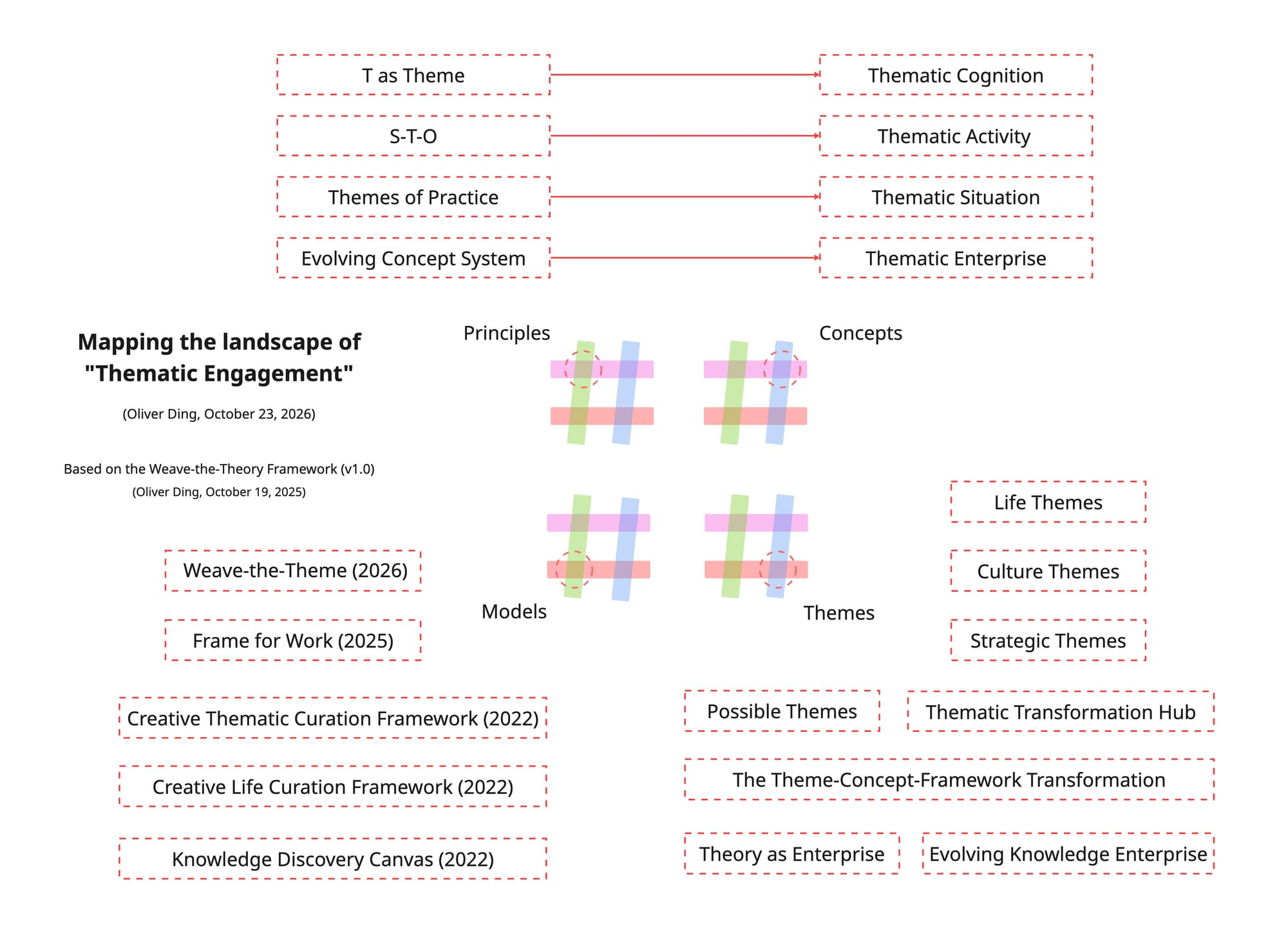
This diagram utilizes the four weave-points of the Weave-the-Theory framework. The upper half represents the Curativity Line, displaying the abstract dimensions: Principles and Concepts. The lower half represents the Creativity Line, which focuses on proliferation and concrete contexts. Specifically, the lower left displays the Models—the concrete frameworks developed over the years that operationalize the abstract principles. The lower right maps the Themes—the living context in which methodologies like the Thematic Transformation Hub and the Theme-Concept-Framework Transformation operate dynamically.
Part 2: How the RR Project Unfolded
The project began with a straightforward plan. Having just completed the Developmental Strategy manuscript on October 14, 2026, I wanted to apply the same meta-frameworks to the theme of "theme" itself, and integrate the results into Cognitive Hydrology, upgrading it to v2.0. The first three articles carried the prefix "Cognitive Hydrology" in their titles.
But the third article exposed a paradox. Thematic Engagement had hosted a rich theoretical enterprise, yet it had never been elevated to the level of a formal concept. This paradox changed the project. The question was no longer "how do we integrate these findings into Cognitive Hydrology?" It became "why did Thematic Engagement never become a concept, and what would it take to rebuild it as one?"
From there, the project unfolded in a series of moves that were not planned in advance.
2.1 From Local to Global
To resolve this paradox, I adopted the Weave-the-Theory model, aiming to interweave principles and concepts simultaneously. This intense, two-week period produced two primary artifacts: The Weave-the-Theme Framework (v1.0, 2026) and The Thematic Engagement Toolkit (v2.0, 2026).
These artifacts were the result of an expansion from the local mechanics of a theme to the global architecture of the GO Theory platform, unfolding through eight interlocking steps:
Step 1: I revisited the Flow-Story-Model framework and other related models, developed a brand new structure: the Experience–Narrative–Framework–Ecology (ENFE) schema.
Step 2: I combined the ENFE schema with the 4M (Milieu–Mediator–Method–Mastery) schema. Using the "Weave 16" meta-diagram, I developed the Weave-the-Theme Framework (v1.0), and then used this new grid to curate years of scattered thematic outputs.
Step 3: I zoomed out using the broader Weave-the-Theory model to organize my theoretical outputs according to its four weave-points, which resulted in the Landscape of Thematic Engagement diagram.
Step 4: Focusing on the Curativity line of this landscape, I revisited my earlier work and proposed four concepts corresponding to four principles, anchoring the Weave-the-Theme Framework as Thematic Cognition.
Step 5: I organized these four concepts according to Ecological Formism into four distinct layers, officially completing the Thematic Engagement Toolkit (v2.0).
Step 6: I stepped back from pure theory, applying the Creative Life Curation method to my own past to identify 15 Creative Journeys and conduct a detailed narrative and analysis of each.
Step 7: I brought these findings back to the GO Theory platform, comparing them with the Developmental Strategy, ACS, and SDP manuscripts, which led to the naming of a new knowledge ecology: Developmental Theme.
Step 8: Finally, from the vantage point of the platform, I formulated the Genesis of the Concept System, positioning this entire RR project as a developmental Episode within the evolution of GO Theory.
Looking back, these eight steps seem perfectly interlocking, as if they were mapped out in advance. But the truth is far less linear. I did not start with a master blueprint. I simply responded to the specific problem and the emerging outcome at each stage, borrowing external knowledge frameworks as my temporary compass. This expansion from the local mechanics to the global architecture unfolded naturally. Today, I view this entire local-to-global process as a journey guided by spatial heuristics—a way of navigating the thematic space until the structure reveals itself.
2.2 Approaching New Registers
While the eight steps outlined above provide a clear structural map of the project, the actual process also brought the work into several new registers. As the project unfolded, certain elements naturally expanded or deepened the initial scope:
The Weave-the-Theme Framework demonstrated its capacity as an open map. When tested against recent concepts like Thematic Supportance and Thematic Focus, neither fit a single weave-point. The framework did not break; instead, it accommodated them by demanding new names (Capturing Thematic Supportance, Mastering Focus Dynamics).
The Typology of Theme brought the project into a strategic dimension. Placing the Benchmark by Origin under Thematic Enterprise rather than Thematic Situation was a deliberate interpretive choice. Once the selection of themes depends on the stage of an enterprise, the typology extends beyond a mere classification into a strategy. The postscript added a further methodological reflection: Themes of Practice belongs to the Creativity Line, but the RR project itself represents a shift from the Creativity Line to the Curativity Line—an act of deliberate unification.
The Art of Alignment reflected on this process, distinguishing three levels: simple sorting, meta-framework alignment, and the illusion of spatial alignment. The final lesson—knowing when to stop aligning—served as a methodological capstone.
The two-part article, When Themes of Practice Meet Project Engagement, returned to the fifteen creative journeys and applied five lenses: Developmental Functionalism, Master Theme, Evolving Concept System, Platform Ecology, Self-referential Activity. The term Master Theme was deliberately established here, against the more common "central theme" or "overarching theme," because the theoretical system needed a dedicated term.
An interesting observation is that the RR project itself was advanced by using my own creative outcomes regarding "theme." For instance, one of the four weave-points in the Weave-the-Theory model is Theme itself. Moreover, the narrative and analysis of the 15 creative journeys were guided by the Creative Life Curation method, which is exactly the thematic element anchored at point #1 in the Weave-the-Theme framework. This entire process serves as a living case of Self-referential Activity.
By this point, the prefix "Cognitive Hydrology" had disappeared from the titles. The series tag had shifted to "Weave the Theme". The postscript made the reversal explicit: the original plan was to upgrade one theory; the actual outcome was to name a new knowledge ecology and to discover that Cognitive Hydrology was a Program on that ecology, not its umbrella.
Looking back at these shifts, this was not a mechanical execution of a project plan. The project itself was a very distinctive experience. It was like a journey, though it did not take place in a physical geography.
Now, as I am editing this book manuscript, I notice a strong similarity between this RR journey and my 2025 thematic trip to Fuzhou. Both unfolded with a similar rhythm: an initial return to past materials, a period of intense present-moment engagement, and finally an opening toward future possibilities. (For the full narrative of that earlier journey, see The Path of Creative Life in a Trip.)
Part 3: Thematic Engagement as the Genesis of Concept System
3.1 The Task for GO Theory
In late 2025, the Meta-frameworks book manuscript introduced the Six Faces of the Concept System:
- Knowledge Frameworks
- Mental Platforms
- Strategic Frameworks
- Cultural Frameworks
- Institutional Frameworks
- Spiritual Frameworks
These six faces were mapped to the five systems of the HLS framework: Mental Platforms to the Mental System, Strategic Frameworks to the Behavioral System, Cultural Frameworks to the Cultural System, Institutional Frameworks to the Historical System. Knowledge Frameworks and Spiritual Frameworks stand as the anticipatory horizon, pushing the Cultural System beyond its present limits.
The Six Faces described what a concept system is. It offered a taxonomy of concept systems in their social context. But it did not describe how a concept system develop. It had no account of genesis.
The answer was implicit in a different line of work: the Theme-Concept-Framework transformation, developed in 2023 through the TALE project. The Strategic Thematic Exploration framework mapped a linear, six-stage process: from a possible theme without a clue, to a possible theme with a clue, to a primary theme, to a primary theme with its network, to a knowledge concept with a working definition, and finally to a knowledge framework with a set of interrelated concepts.
This framework identified three types of transformation: the "Possible-Primary" Transformation (discovering the strategic intent), the "Theme-Concept" Transformation (turning raw themes into conceptual forms), and the "Concept-Framework" Transformation (curating concepts into a coherent whole). From 2023 to 2025, this model guided a series of projects and book drafts, moving from Meaning Discovery (clues) and Thematic Exploration (themes) to Grasping the Concept (concepts) and Frame for Work (frameworks). By the end of 2025, with the publication of Meta-frameworks, the entire Knowledge System layer was complete.
But the Strategic Thematic Exploration stopped at the Framework stage. It did not account for what happens when the framework is placed into a knowledge ecology. It was a one-way street for building a framework, but it did not describe the full arc of a concept system's genesis.
3.2 The Missing Piece: Ecology
The RR project supplied the missing piece. The Experience–Narrative–Framework–Ecology schema extends the Theme-Concept-Framework transformation into a fourth space: Ecology. It completes the picture by adding the stage at which a framework finds its ecological niche.
The connection is direct. Strategic Thematic Exploration Stages 1–2 map to Experience. Stages 3–4 map to Narrative. Stages 5–6 map to Framework. The endpoint of Strategic Thematic Exploration is only Space 3 of the new schema. The Experience–Narrative–Framework–Ecology schema completes the picture by adding Space 4: Ecology.
This extension is not merely a logical deduction. It is rooted in a practical realization: a Framework does not exist in isolation.
It is important to clarify the specific meaning of "Ecology" here, as it differs from my earlier usage in Weave the Theory (May 2026). In that book, the case studies were centered on public theoretical traditions such as Activity Theory, so "knowledge ecology" referred specifically to a public knowledge ecosystem. But in the Experience–Narrative–Framework–Ecology schema, Ecology is defined as a higher-level unit of analysis above a single knowledge framework or a single knowledge system. This unit is not exclusively personal or exclusively public; it can be applied to both. A Knowledge Ecology is formed when multiple knowledge frameworks gather around a central theme, and this configuration can operate at the scale of an individual creator or a collective tradition.
Space 4 represents the moment when an individual's constructed Framework enters this larger configuration. It is about how that system finds its ecological niche, interacts with other enterprises, and contributes to the ongoing evolution of a knowledge landscape. The journey from Experience to Ecology is the journey of how a distinct thematic insight finds its place within a structured ecology of meaning.
3.3 A Chain of Genesis: A Preliminary Sketch
If the four layers of the Thematic Engagement Toolkit describe the architecture of genesis, we still need a more concrete picture of the sequence. What follows is an attempt at such a picture—a provisional chain, offered not as a finished model but as a heuristic for the reader to see how a concept system may come into being.
The chain runs as follows:
Body(Self) → Action/Project → Experience → Thematic Supportance → Thematic Exploration → Thematic Focus → Thematic Living Coordinate → Themes of Practice → Thematic Creation → Concept System → Thematic Enterprise → Thematic Attachance → Creative Life Curation → Thematic Identity Curation → History[Life(Self)]
A few notes on how to read this chain.
First, the chain is not a rigid sequence of stages. It is a sketch of dependency. Each link names a condition that makes the next link possible, but the actual movement may loop, skip, or return. Thematic Exploration may lead back to Experience; Creative Life Curation may reopen Thematic Focus. The chain shows the logic of genesis, not its empirical chronology.
Second, some links use the word "thematic" in a narrow sense. Themes of Practice here does not refer to the broad 2019 concept that bridges individual life themes and collective cultural themes. It refers specifically to the thematic network that forms around a Creative Center through the operation of Developmental Projects. Similarly, Thematic Attachance here does not refer to the general mechanism of attaching and detaching mental focus, but specifically to the movement of thematic elements between multiple Thematic Enterprises.
Third, the chain is anchored at both ends by the HLS framework. It begins with Body(Self)—the embodied individual, the starting point of subjectivity—and ends with History[Life(Self)]—the self as situated within historical and cultural contexts. The middle links describe the transformations through which a lived experience becomes a concept system, and a concept system becomes a life history.
Fourth, the chain is offered as an attempt, not a conclusion. The genesis of a concept system is a complex phenomenon, and any single chain risks over-simplifying it. The value of this sketch lies not in its completeness but in its visibility: it allows the reader to see, at a glance, how the concepts developed across the eight articles of this collection might relate to one another. It is a thread to be tested, revised, and perhaps replaced.
What the chain does suggest, however, is that the genesis of a concept system is not a single event but a long chain of transformations—from embodiment to experience, from experience to theme, from theme to center, from center to system, from system to enterprise, and from enterprise to history. The RR project, in this sense, did not merely name a new knowledge ecology. It traced a chain along which any concept system might come to be.
3.4 The RR Project as an Episode
From the perspective of Platform Ecology, the RR project itself can be understood as a Developmental Episode in the evolution of the GO Theory platform.
A Developmental Episode is a special type of Project—one that makes a distinctive contribution to the Center-Platform development process. It restructures the foundational logic and leaves a lasting mark on what the enterprise ultimately is.
The RR project fits this definition. It did not merely produce new articles. It:
- Named a new knowledge ecology (Developmental Theme).
- Rebuilt Thematic Engagement from a theme into a formal concept with four layers.
- Completed the genesis account for the Six Faces of the Concept System by adding the Ecology layer.
- Clarified the relationship between Developmental Theme (Platform) and Cognitive Hydrology (Program).
- Demonstrated the Weave-the-Theme Framework as an open map through two test cases.
- Reduced five analytical lenses to four spatial dimensions.
These are not incremental additions. They restructure the foundational logic of the platform. The GO Theory platform now has a named ecology for theme inquiries, a concept that describes how themes become concept systems, and a methodology for building such concepts without falling into linear extraction.
v1.0 - October 30, 2026 - 3,277 words