
Revisiting-and-Rebuilding Knowledge Strategy Through the Gejunction Lens
From Ecological Strategic Cognition to Gejunction
by Oliver Ding
September 30, 2026
This article is part of a new thematic collection: The Gejunction of Knowledge Engagement.
This collection is a record of a Revisiting-and-Rebuilding.
The Knowledge Strategy trilogy was completed in June 2025. What I now call the Knowledge Strategy series extends that timeline: later manuscripts carry it through the second half of 2025 and up to SDP. Earlier this year, I had deliberately stepped away from Knowledge Engagement and redirected my creative attention toward Cultural Innovation — a journey that unfolded through ACS (Anticipatory Cultural Sociology), SDP (Strategic Developmental Psychology), and GO Theory. In the first half of 2026, I produced several new book drafts and a series of knowledge frameworks. Among them, the Gejunction framework led me back.
The return began with a specific question. Castle and Forest (2025) left largely untouched what happens when two knowledge creators meet. The answer I gave then was thin. With new tools, I revisited that part and wrote The Relationfield of Knowledge Engagement. It introduces a formula — RelationField = Subject–Subject (Subject–Object) — and uses it to finish what Castle and Forest left undone. After finishing that article, I realized Gejunction could be used to reflect on the entire trilogy from last year. The RR series widened from there.
Contents
1. A Watershed in June 2025
2. What the Trilogy Stood On, and Where Each Book Fell Short
3. What 2026 Put Underneath
4. Knowledge Strategy, Rethought
5. How the Revisit Was Done
6. What Carries Over
1. A Watershed in June 2025
Until June 2025, I thought of my work as "3+1." I was following three theoretical traditions, and each had led me to a theoretical enterprise of its own. Knowledge engagement was the extra one, the "+1": a line of work that sat beside the three enterprises rather than inside one of them.
The Knowledge Strategy trilogy was written inside that arrangement, and it carries its limits. Knowledge Strategy (January 2025) built the Ecological Strategic Cognition framework (ESC) and introduced the first Toolkit. Castle and Forest (February 2025) mapped the landscape of concept-related knowledge engagement. Wonder and Wander (completed June 2025) tested the Evolving Knowledge Enterprise model through case studies. All of it was the work of the "+1". The Toolkit I derived from ESC in early 2025 drew its content and resources almost entirely from a single series of maps and cases.
June 2025 was the watershed. From July to December I went through what I now call a generative confluence: the separate lines of work began to flow into one another. Out of it I developed the World of Life (World of Activity) Approach. In 2026 I named it the GO Theory platform, and it includes a set of meta-frameworks. Three projects carried the work through the first half of 2026: ACS (Anticipatory Cultural Sociology), SDP (Strategic Developmental Psychology), and GO Theory itself.
So the contrast between 2025 and 2026 is not a matter of more material. It is a change of footing. Before, there were three enterprises and an extra one. After, there is one platform, and knowledge engagement is one domain that can be read on it.
2. What the Trilogy Stood On, and Where Each Book Fell Short
It is easy to say the trilogy was limited. It is more useful to say how, book by book.
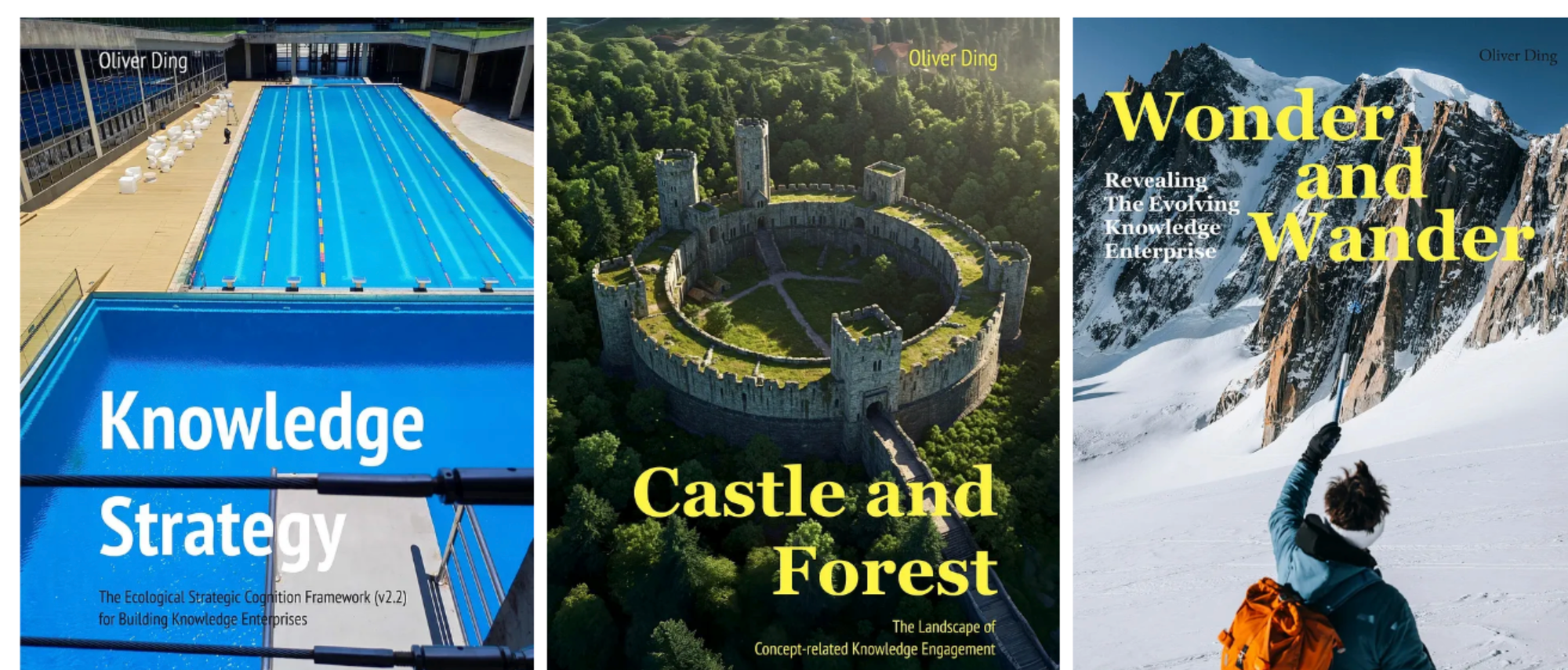
Book 1: Knowledge Strategy. ESC had been developing for years, and I had always hoped it would carry the Ecological Practice Approach into strategy. But in early 2025 I relied too heavily on Thematic Space Theory (TST) to push it forward. ESC ended up with nine spaces (Maps, Moves, Paths, Strategic Themes, Objects and Operations, Subjects, Mind, Meets, and Meaning), each filled with a concept from TST, and the Toolkit it led to had strategic themes as its core concept. That was a real contribution to the ESC topic. It also limited the topic's development.
Chapter 6 of the collection calls TST's position double-edged. It is a methodological theory, portable and useful to researchers and thinkers in general, but it had no theory of subjects of its own and left the social and strategic sides of cognition to other theories. The traces are visible in ESC. The Subjects slot held Ecological Relevance as a stand-in. The Meets slot was filled by Thematic Zones, which, as Chapter 5 of the collection shows, could describe only the condition in which two creators have not yet formed anything shared.
Book 2: Castle and Forest. The core basis of this book is the Knowledge Discovery Canvas (KDC). Using its four thematic areas, the book explores the concept-centered knowledge ecology and identifies twelve strategic themes in it, three for each area. Its contribution is a simple heuristic tool for understanding a complex knowledge ecology. Its flaw is that it depends too heavily on KDC.
I was not yet using the term "knowledge ecology" then. In 2026 it became a prominent term, and it points to an important prototype for knowledge strategy: creative self, knowledge center, and knowledge ecology, that is, how an individual creates and develops a knowledge center in a complex knowledge ecology. This model corresponds directly to the Center in today's FFCC model.
Book 3: Wonder and Wander. This book began as empirical research on the Evolving Knowledge Enterprise model, which I had started in 2023. The model begins from a knowledge center and expands into a knowledge enterprise of three dimensions. Eight case studies in the first half of 2025 brought rich insights, and I organized them into a multi-level Theory-as-Enterprise. In it, the original three-dimension model grew into a three-level center development model, which is a map. The framework for understanding that map is the Wonder and Wander framework, built directly on the Ecological Practice Approach.
Looking back, this framework deserves the name ESC v3.0. It returns the ESC topic to its original route, the application of the Ecological Practice Approach to strategy, which Book 1 had bent toward TST. Later I edited the Container Thinking manuscript and summarized the approach as v4.0, with four meta-frameworks: two belong to scientific explanation and two to strategic intervention. What the book could not supply was the ground beneath a center: how a center grows out of a lived coordinate, and how it connects to the social world as a whole. That is where the 2026 work begins.
So the contrast in this chapter is not between 2025 and 2026 as wholes. Book 3 already stood on the Ecological Practice Approach. The contrast is chiefly with the first two books, and with the idea that the Toolkit's strategic themes could carry a theory of strategy. In TST's own terms, which distinguish ontology, realism, and hermeneutics, those two books worked mostly at the hermeneutic level: maps, models, and heuristics for making sense of creative activity. That was a real strength. But the ontology beneath them was thin, essentially Theme as a container, and nothing in it connected the social world to the individual's action.
3. What 2026 Put Underneath
What changed in 2026 is the ground under the heuristics.
The ontological layer starts from the Living Coordinate. A coordinate is generated where Flow is cut by Focus, at the level of Body(Self). Lived out in social life, it becomes a Center at the level of Life(Self); and the Coordinate–Center–Gejunction framework describes how subjectivity unfolds across these nested layers. The FFCC model (Flow–Focus–Center–Circle) describes the individual's world of activity that these layers belong to.
On top of this sits the History{Life[Self(Body)]} framework (HLS, v3.0, December 2025). It crosses the Cultural and Historical systems with the Mental and Behavioral systems around Self(Body) at the center, yielding four regions of the social world, each animated by its own mechanism: Mental Moves toward Thematic Space, Generative Narrative toward Symbolic Universe, Social Moves toward Social Landscape, and Strategic Curation toward Social Territory.
Gejunction, named in early 2026, is the unit of synthesis that connects HLS to the individual. It has four aspects of one and the same unit: Thematic Spaces, RelationFields, Living Coordinates, and Weave-points. Thematic Space, the concept that organized so much of 2025, is now one aspect among four.
The table sets the two periods side by side.
| 2025 (ESC and the trilogy) | 2026 (GO Theory and Gejunction) | |
|---|---|---|
| Footing | TST's methodology; creative heuristics | Ontology and realism beneath the heuristics (Flow × Focus; Body, Life, History; HLS) |
| Unit | Thematic Space; the framework as a map | Gejunction: four aspects of one unit |
| Subjects | No theory of its own (Ecological Relevance as stand-in) | Self(Body), Living Coordinate, Center, Gejunction |
| Meets | Thematic Zones (describing only Outside) | RelationField: Subject–Subject (Subject–Object) |
| Strategy | Strategic themes as the Toolkit's core concept | Strategic Curation as a mechanism; a function of the enterprise and of the mental platform |
| Knowledge ecology | Explored through KDC, not yet named as such | A prototype: creative self, knowledge center, knowledge ecology, matching the Center in FFCC |
| Place of knowledge engagement | The "+1" beside three enterprises | One domain on a single platform |
| Tools | One Toolkit | A toolkit for each of the four aspects |
Read this way, the old topics of ESC do not disappear. They are read differently. Meets becomes RelationField. Subjects gets an actual account. Maps, Moves, and Paths keep their place in the Thematic Space aspect, with Mental Moves as its mechanism. The same words now rest on a different floor.
4. Knowledge Strategy, Rethought
The biggest consequence is for knowledge strategy itself. One relation anchors the rest: creative self, knowledge center, knowledge ecology. This is the prototype I drew from Book 2 in 1.2, and its three terms have different histories. Creative self and knowledge center were themes I kept developing after June 2025, while I was advancing Creative Life Theory (v3.0). Knowledge ecology was developed in 2026.
Read through GO Theory, the triad is the concrete form, within knowledge engagement, of what GO Theory calls the unfolding of subjectivity. It describes how an individual creates and develops a knowledge center in a complex knowledge ecology, and that is the question knowledge strategy now asks. Around this relation, the rethinking has a theory layer and a practice layer.
The theory layer. Three threads came together.
The first is the concept system and its faces. In the HLS framework, a concept system shows several faces at once, such as a cultural framework, a strategy framework, an institutional framework, and a mental platform. A major task of knowledge strategy then becomes coordinating these faces, for example translating between a mental platform and a strategic framework. If what an individual delivers to the outside is itself a knowledge system or a cultural system, cultural and institutional frameworks have to be handled as well. This is far more complex than choosing among strategic themes.
The second is the anticipatory thread. HLS is, in effect, an enlarged version of the Anticipatory Activity System (AAS), which I had used in Advanced Life Strategy since 2022. I left it alone in the 2025 ESC because the task then was to finish exploring ESC's own topic. In 2026 it led directly to the ACS project, and with it an ontological sequence of thematic creations.
The third is the subject. The Coordinate–Center–Gejunction framework shows how a subject's subjectivity unfolds in the social world, and the triad above is its concrete form in knowledge engagement. On one side stands that unfolding; on the other, the ontological sequence of thematic creations; beneath both, the FFCC model of the individual's activity world. Together they give life strategy and knowledge strategy a much stronger theoretical base than 2025 had.
The practice layer. Three things changed here too.
Knowledge ecology, developed in 2026 as a theme of its own and well beyond the range of the 2025 canvases, completed the triad. It gave knowledge strategy a new place to stand, and a freer one (Chapter 8 includes the Knowledge Ecology Square), with the triad tied to the Center of FFCC.
The maturing of the FFCC model, together with the sub-squares developed from GO Square, made the Coordinate–Center–Gejunction framework operational. Each of the four aspects now has its own tools: the RelationField Framework; the Weave-the-Strategy Toolkit for Thematic Spaces; the Living Coordinate model and FFCC; and the Weave Knowledge System with the GO Square series of maps. Thematic Space performs its own function, in step with the other three aspects.
And strategy changed its standing. It is now one of the six functions of a thematic enterprise, and equally one of the six functions of a mental platform in operation. These are the same thing seen from two sides, which echoes the 2025 observation, from the Container Thinking case, that a theory and the mental platform behind it are the same thing viewed from two angles. Wonder and Wander listed five functions of center development: strategy, narrative, curation, support, and design. The sixth is discovery. My Discovery trilogy covers knowledge discovery, life discovery, and meaning discovery. Its three manuscripts rest on three canvases developed from a single meta-canvas, the Thematic Matrix, and the trilogy is itself an application case of TST.
Put together, strategy now connects a chain of concepts: anticipatory activity, concept system, mental platform, strategic framework, and the Weave-the-Mind framework that carries meaning toward decision.
5. How the Revisit Was Done
As the introduction says, the RR began with a thin part of Castle and Forest, and the series widened from there, one aspect of Gejunction at a time. Each article took a leftover question or an unexpanded detail from the earlier work. Chapter 5, on RelationFields, finished what Part 5 of Castle and Forest had left undone. Chapter 6, on Thematic Spaces, fills a stretch of time rather than a gap in the books: the manuscripts written after June 2025, which carry the Knowledge Strategy trilogy on toward SDP and are now gathered as the Knowledge Strategy series. Chapter 7, on Living Coordinates, works through a case to ask how a coordinate becomes a center, a mechanism earlier work had only roughed out; it also reopens genidentity, which in Wonder and Wander was the kernel of the system and now divides into theme and identity. Chapter 8 turns to Weave-points through the GO Square series of maps.
The gaps were of different kinds: a thin chapter, a missing stretch of time, a mechanism left unspecified. I think that is what a Revisit-and-Rebuild looks like in practice. I did not plan a systematic rewrite. I let a live project show where the earlier work was weakest, and patched that place with the tool that fitted it.
Two habits of method ran through the articles. One is reading a path Episode by Episode rather than as a single arrow, which brought out how unevenly any area holds activity. The other is the thematic map, from TST, which lets a framework be drawn and a person's moves traced on it. I kept the big-picture contrast out of the individual articles so that each could stay with its own question. This chapter is where it is stated.
6. What Carries Over
The Revisit does not correct the trilogy so much as put a floor under it. Several things survive intact. The Map–Moves–Models architecture still organizes how I read any activity. The Enter–Event–Exit schema and the idea of Theory as Enterprise still do work, especially in the Container Thinking material. Episode analysis has become a regular way of reading. KDC kept growing through 2025 and 2026, and what was a dependence in Book 2 has become an asset: it still serves as the Map in Chapters 5 and 6 of the collection; the general form behind it, that any Move admits a Map of its own structure, turned out to reach well beyond knowledge engagement.
What changed is what stands under these tools and around them. In 2025 they were a set of heuristics for a single line of work. In 2026 they are instruments on a platform, each tied to a region of the social world and to the individual's own activity.
Chapter 2 of the collection maps the Knowledge Strategy series, so that the articles in Part 2 have a clear object to return to. The Epilogue returns to the question of method, which this chapter has deliberately left open. As with the rest of the collection, what is offered here is a personal record of one more loop in a longer weave.
v1.0 - September 30, 2026 - 2,802 words