
Epilogue: Subjectivity and Strategy
by Oliver Ding
October 14, 2026
This article is part of a possible book: Developmental Strategy: Strategic Actor and the Weave-the-Strategy Toolkit.
As I was completing this book, a pattern that had remained implicit across several recent projects gradually became visible. What initially appeared to be separate lines of inquiry—Strategic Agency, Strategic Mind, and Subjectivity—could now be understood as interconnected dimensions of a larger theoretical structure.
The concept of Strategic Agency and the concept of Strategic Mind belong together, but they address different questions. Strategic Agency concerns patterns of action: how a person exercises agency across social worlds, how agency cascades through different levels, how it resonates with other actors and environments, where it encounters thresholds, and what frontiers it opens. Strategic Mind concerns the cognitive structures through which strategic thought is organized: the nine aspects of strategic mind, mental platforms, strategic frameworks, and the practices of mental curation.
The distinction is not between action and thought as two independent processes. Rather, it allows us to examine two dimensions of the same actor: how a person acts in the world and how that person organizes the thinking that informs, interprets, and transforms action.
This distinction led me to recognize a third dimension: Subjectivity. In the World of Activity approach, subjectivity unfolds through Body(Self), Life(Self), and History[Life(Self)]. It is not simply an inner state or a fixed personal identity. It concerns the constitution of the actor through embodied existence, lived activity, and the historical development of a life.
When these three concepts are considered together, a larger pattern emerges:
Subjectivity — Agency — Mind
This pattern can be understood through the Self–Life–Mind schema, developed within my broader work on Creative Life Theory and subsequently incorporated into the Strategic Developmental Psychology (SDP) project.
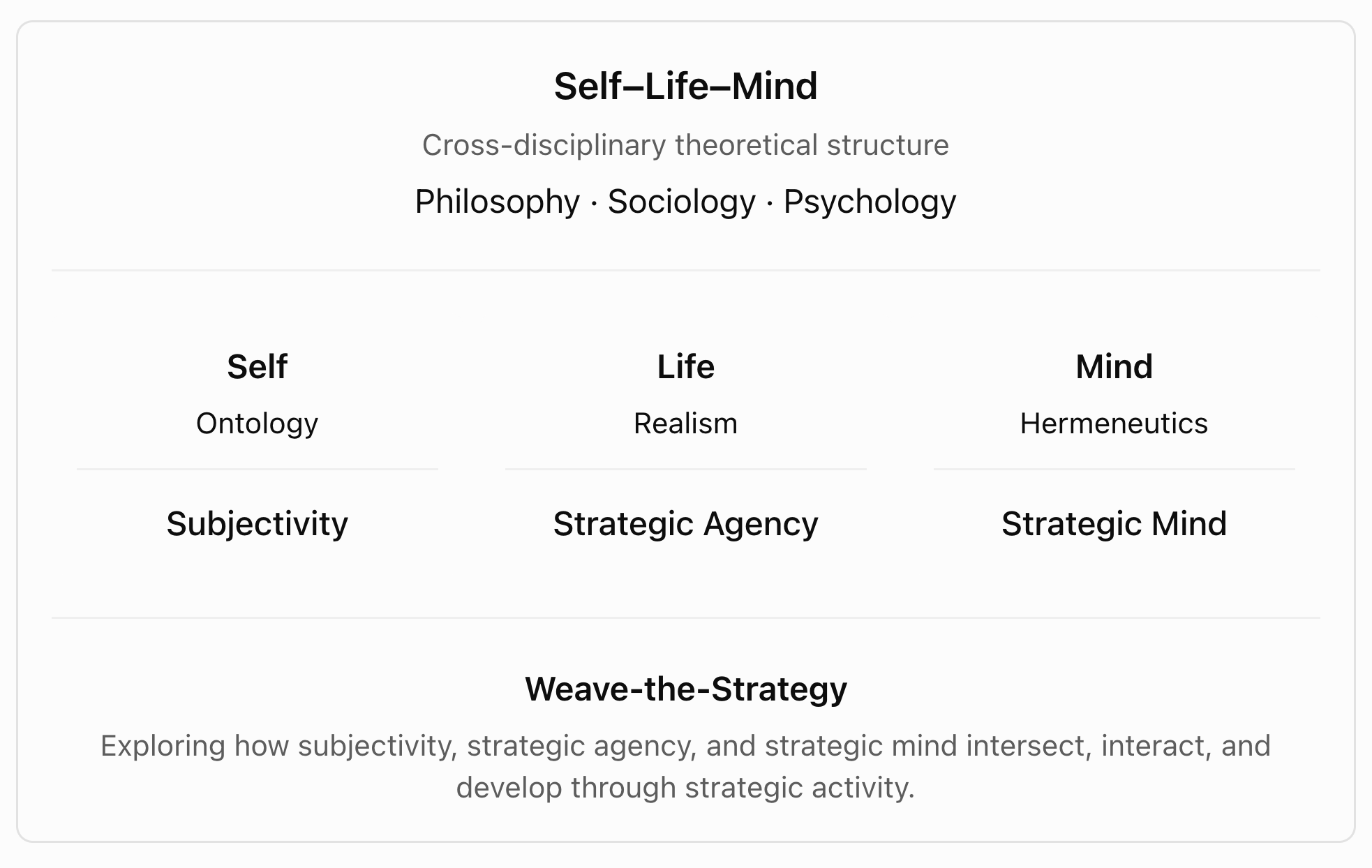
The schema brings three analytical dimensions into relation:
- Self — Ontology — Philosophy. This dimension concerns the constitution of the subject: who the actor is, how the actor's existence is constituted, and what makes the actor a subject of action.
- Life — Realism — Sociology. This dimension concerns the actor's engagement with social reality: what the actor does, how action unfolds across social worlds, and how patterns of agency develop through relationships, projects, and social environments.
- Mind — Hermeneutics — Psychology. This dimension concerns the cognitive organization of experience and action: how the actor interprets situations, develops mental structures, organizes knowledge, and constructs strategic possibilities.
The three dimensions do not represent three isolated academic territories. Nor do they imply that philosophy studies only the Self, sociology studies only Life, or psychology studies only Mind. Rather, Philosophy, Sociology, and Psychology offer different intellectual perspectives through which the interconnected constitution of a person, the unfolding of a life, and the organization of thought can be investigated.
The Self–Life–Mind schema provides a way to hold these perspectives together without reducing one to another. Ontological questions about the subject cannot be resolved solely through an account of observable behavior. The social development of agency cannot be understood solely through individual cognition. And the organization of strategic thought cannot be adequately examined without considering the subject who thinks and the social worlds in which that thinking becomes consequential.
Viewed from this cross-disciplinary perspective, Subjectivity, Agency, and Mind are three analytical aspects of the same unfolding process. Subjectivity concerns the constitution of the actor; Agency concerns the actor's practical engagement with the world; and Mind concerns the cognitive organization through which that engagement is interpreted and developed. Each aspect opens a different line of inquiry, while their relationships make a more comprehensive investigation possible.
This is also where the Weave-the-Strategy Framework acquires a broader significance. Its four weave-points can be examined as specific intersections among the dimensions of subjectivity, agency, and mind. Rather than treating strategic development as a linear sequence from thought to action, the framework makes it possible to investigate how different aspects of a person's strategic life become connected, reinforce one another, and sometimes generate new configurations.
The Weave-the-Strategy Toolkit v2.0 can therefore be understood as more than a practical toolkit for strategic work. It provides an entry point into a broader investigation of how a person becomes and develops as an actor: how subjectivity unfolds through lived experience, how agency takes shape through engagement with social environments, and how mind organizes and reorganizes the possibilities of action.
The relationship is recursive. A person's subjectivity informs what that person recognizes as possible and worthwhile. Engagement with the social world develops new patterns of agency, which can challenge existing understandings of the self. Strategic thought helps interpret these experiences and organize subsequent action, while the consequences of action reshape both the actor's understanding and the cognitive structures available for future decisions. Through this ongoing movement, subjectivity, agency, and mind continually transform one another.
This brings me to a central proposition: Subjectivity and Strategy are mutually constitutive.
Without a subject, strategy has no actor whose purposes, commitments, and circumstances give it meaning. It risks becoming a matter of calculation detached from the life it is supposed to serve. Without strategic activity, subjectivity cannot be fully understood through its actual development in the world. A person's capacities, commitments, and possible identities take shape not only through reflection but also through action, engagement, and the historical consequences of living.
Subjectivity provides the ontological ground of strategy: the question of who acts and how that actor is constituted. Strategy provides a practical and methodological pathway through which subjectivity is expressed, tested, and developed in the world. Their relationship is neither exclusively linear nor purely circular. It is a continuing process in which the actor's constitution, patterns of action, and organization of thought evolve together.
In this sense, the relationship also exemplifies Self-referential Activity in the domain of strategy. The actor engages with the world while simultaneously participating in the development of the very subject who acts. Strategy is not simply something a person possesses and applies; it is also part of the activity through which that person becomes different.
The significance of this structure extends beyond the present toolkit. By bringing Subjectivity, Agency, and Mind into a shared analytical space, the Self–Life–Mind schema opens a path toward connecting ontological inquiry in philosophy, the study of social action in sociology, and the investigation of cognition in psychology. It also provides a conceptual foundation for Strategic Developmental Psychology, where the development of agency and the strategic organization of a life become central theoretical concerns.
The present work establishes one configuration within this larger landscape. The Weave-the-Strategy Toolkit offers a way to examine how the dimensions of strategic life intersect; the Self–Life–Mind schema situates those intersections within a broader account of the person as an unfolding subject. Subsequent work will investigate these relationships further, exploring how strategic agency develops, how strategic mind is organized, and how both participate in the ongoing formation of subjectivity.
The inquiry thus returns to its starting point with a wider perspective. To study strategy is not merely to study how people make plans or pursue objectives. It is to investigate how subjects act, think, and develop through their engagement with the world—and how, through that engagement, they continually participate in shaping the lives they lead.
v1.0 - October 14, 2026 - 1,225 words