
The Weave-the-Possibility Framework (v1.0, 2026)
Four Weave-points for Exploring Possibilities
by Oliver Ding
October 15, 2026
This article began with a friend's two-year creative journey. From Life Garden to Possibility Philosophy and Consciousness Coordinates, his exploration shows how personal experiences, slow cognition, and creative moves can gradually form a Mental Platform for developing new projects. As I prepare for a conversation with him next week, I have been revisiting his journey and considering how to understand it through my own theoretical work.
Yesterday, I completed editing a new manuscript, Developmental Strategy: Strategic Actor and the Weave-the-Strategy Toolkit. This morning, I stepped out of that specific project context and returned to the Weave knowledge system itself. Using the Weave Basic Form to think about possibility, I developed a new framework: Weave-the-Possibility. This article first introduces my friend's creative journey, then examines it through the Weave-the-Strategy Toolkit, before explaining the origin and four weave-points of the new framework.
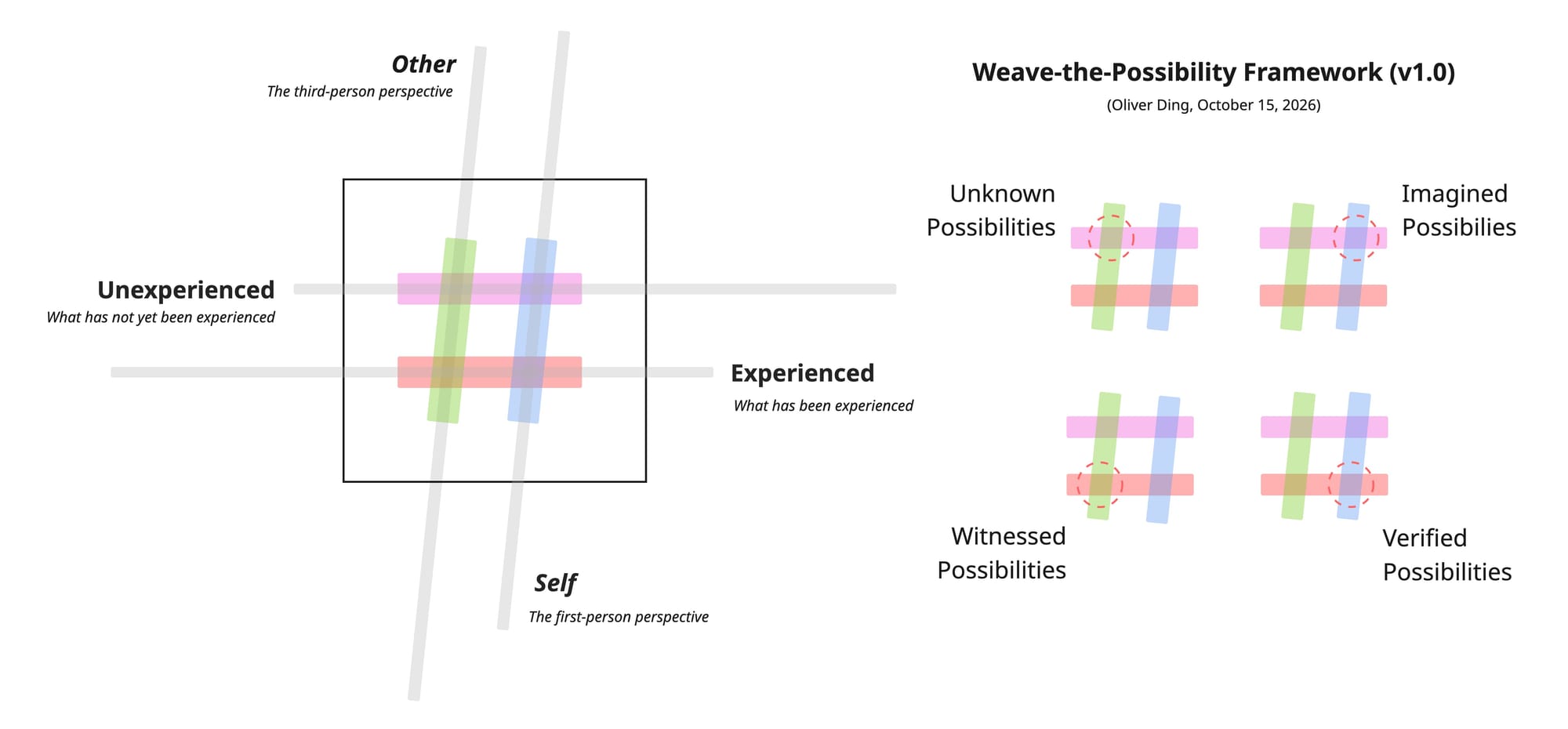
1. A Friend’s Two-Year Creative Journey
I have known this friend for more than ten years. He has continued to live in China, and his creative work has consistently been published in Chinese through his social media accounts. My account of his creative journey here is based on a Chinese-language article he shared publicly a few days ago. It offers a retrospective of his creative exploration over the past two years.
In July 2024, he suffered a traffic accident that broke his right hand. After surgery in August, he returned to Enping, a city in Guangdong Province in southern China, to recover. The unexpected interruption gave him time to reconsider his worldview, lifestyle, and multiple identities.
During the second half of 2024, he began developing the idea of Life Garden (生命花园). He no longer saw his identities—as a life explorer, educational innovator, entrepreneur, writer, poet, minimalist, knowledge seeker, and designer—as competing roles. Instead, he understood them as parts of an ecosystem in which different identities could nourish one another. Life did not have to revolve around a single professional identity. Yet this opening also raised a new question: when life offers many possible ways of being, where should one go next?
In September 2025, a trip to western Sichuan brought another turning point. Sitting under a tree beside a river, he asked himself: If the Buddha lived in the age of AI, what new teaching would he offer us? This question shifted his attention from personal life design toward a broader historical condition. As AI makes knowledge, information, tools, and capabilities increasingly accessible, people may face not only scarcity but also an abundance of choices and opportunities.
Later, in Dali, the concept of possibility emerged as a way to approach this condition. Possibility Philosophy began to take shape. Rather than focusing exclusively on suffering, problems, or predetermined goals, this orientation asks what is emerging, what remains unseen, and what might become possible.
By early 2026, possibility had expanded across domains including knowledge, money, relationships, careers, products, education, and organizations. It was becoming not simply a topic of inquiry but a meta-method for approaching different topics. He distinguished three orientations:
- A problem-oriented approach asks, What is wrong, and how can it be fixed?
- A goal-oriented approach asks, Where do I want to go, and how can I get there?
- A possibility-oriented approach asks, What is emerging, and what remains unseen?
The possibility-oriented approach does not eliminate problems or goals. Instead, it questions the frames and assumptions that determine which problems are noticed, which goals are pursued, and which alternatives remain outside the field of attention.
The next development was Consciousness Coordinates, a practical framework for exploring and generating possibilities through three dimensions:
- Time: from the immediate present to the distant future.
- Space: from the self to family, organizations, society, and humanity.
- Depth: from visible actions and surface conditions to underlying needs, beliefs, and life intentions.
These coordinates offer a way to examine how a person's field of awareness might expand. Awareness can reveal boundaries that were previously invisible, while creation can bring a person into contact with boundaries not yet understood. The framework thus becomes more than an analytical instrument: it can function as a generative grammar for exploring what might become possible.
This development also changed how he understood Life Garden. His different identities were no longer merely a collection of roles; they could be understood as different ways of entering and exploring consciousness coordinates. Life Garden became a life structure through which he could expand his awareness and engage with possibilities. As his account suggests, the garden becomes richer, and the gardener freer.
His relationship with Enping also changed. In 2024, he returned there because circumstances forced him to stop. By 2026, staying in Enping had become a choice—a deliberate home base from which to continue exploring. Looking back, he described a progression from stopping, to opening, to moving, and finally to connecting.
His journey remains open-ended. Do possibilities necessarily increase as history advances? Could Consciousness Coordinates themselves become a cage? Is a wider scope always better? When should a person let go of an identity? And how does consciousness actually expand through embodied experience, relationships, practice, and time?
These questions show that his creative journey is not simply the development of a series of concepts. It is an ongoing inquiry in which life experience, reflection, and conceptual construction continually shape one another. His exploration is also beginning to move beyond individual life design toward collective co-creation and organizations.
2. Reading the Journey through Weave-the-Strategy Toolkit
Over the past two weeks, I have been paying close attention to my friend's creative journey, partly in preparation for our upcoming conversation. During this period, I also completed the editing of Developmental Strategy: Strategic Actor and the Weave-the-Strategy Toolkit (Book, 2026). This work provided a theoretical perspective through which I could examine the relationship between his evolving ideas and his practical moves.
Two weave-points in the Weave-the-Strategy framework are particularly relevant to understanding his creative journey: Slow Cognition and Strategic Moves. The diagram below presents these two weave-points within the framework. Together, they offer a way to examine how reflective cognitive processes and practical moves intertwine over time.
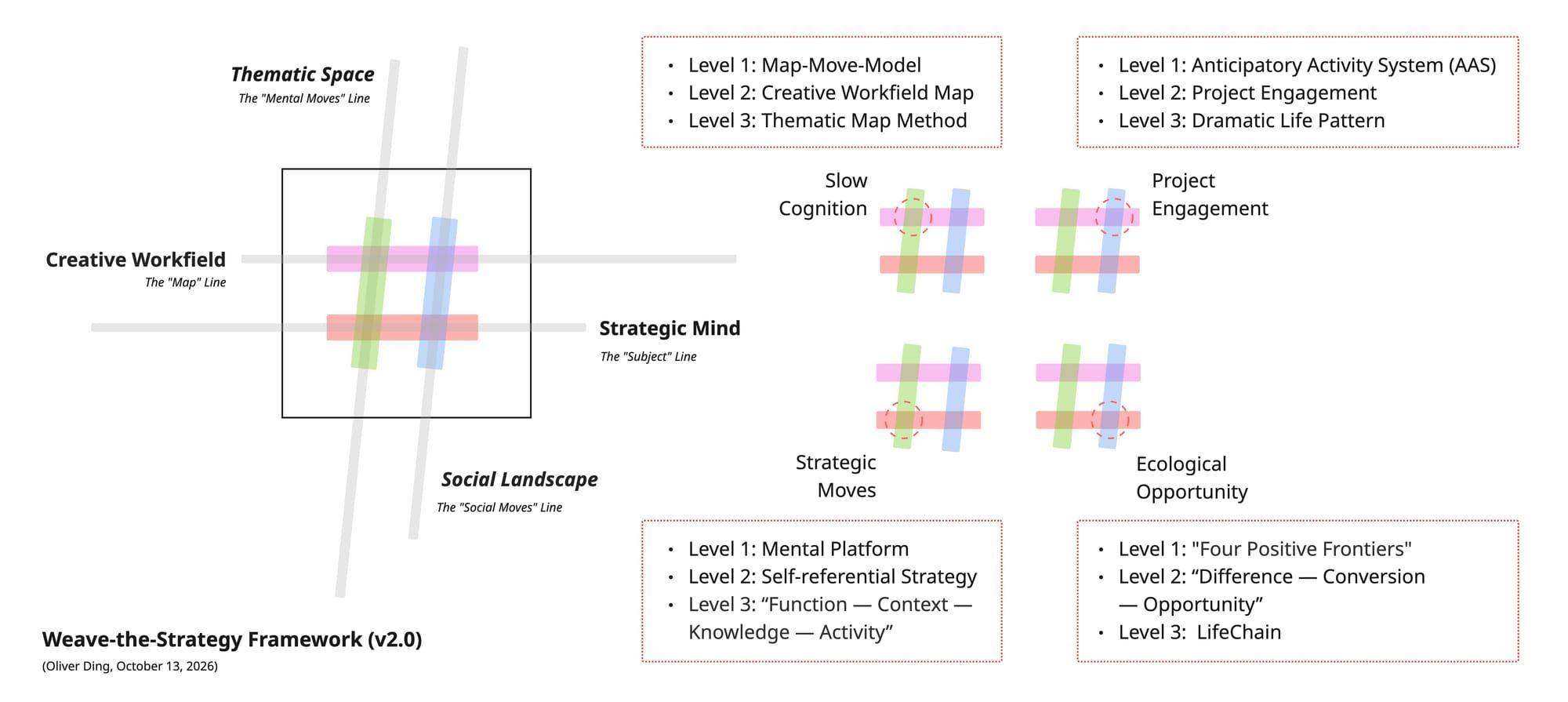
One important feature of his journey is the interplay between Slow Cognition and Strategic Moves. His concepts did not appear as isolated insights, nor did they emerge from a fully specified plan. The accident created a pause for reflection. Life Garden helped him reorganize his understanding of identity. The question about the Buddha and AI shifted the scale of inquiry. Possibility Philosophy reframed how he approached an increasingly abundant world. Consciousness Coordinates then gave this exploration a more operational structure.
Each conceptual development changed how he could approach the next question. At the same time, changing circumstances and choices provided new material for reflection. His journey can therefore be understood as an ongoing weave between a slower cognitive process that develops and reorganizes understanding and a sequence of strategic moves through which that evolving understanding takes shape in life and creative work.
His conceptual work also appears to be forming a personal Mental Platform. Life Garden, Possibility Philosophy, and Consciousness Coordinates are not simply three independent ideas. Together, they offer a developing structure through which he interprets experience, explores directions, and generates further projects. From the perspective of the Weave-the-Strategy Toolkit, this Mental Platform can be examined as a Strategic Framework guiding project development.
The above is a preliminary reading of his creative journey through the lens of my framework. I have not conducted a rigorous case analysis by systematically applying the conceptual structure of the Weave-the-Strategy Toolkit. Rather, I use the framework as an initial lens to explore how Slow Cognition and Strategic Moves may be intertwined in his creative journey.
3. Returning to the Weave Knowledge System
This morning, after completing the manuscript, I stepped out of the specific context of the Weave-the-Strategy project and returned to the Weave knowledge system itself.
Thinking about my upcoming conversation with my friend, I began to explore the concept of possibility through the Weave Basic Form. Rather than extending the strategy toolkit directly, I returned to the basic form to examine how different perspectives and experiences shape our access to possibilities.
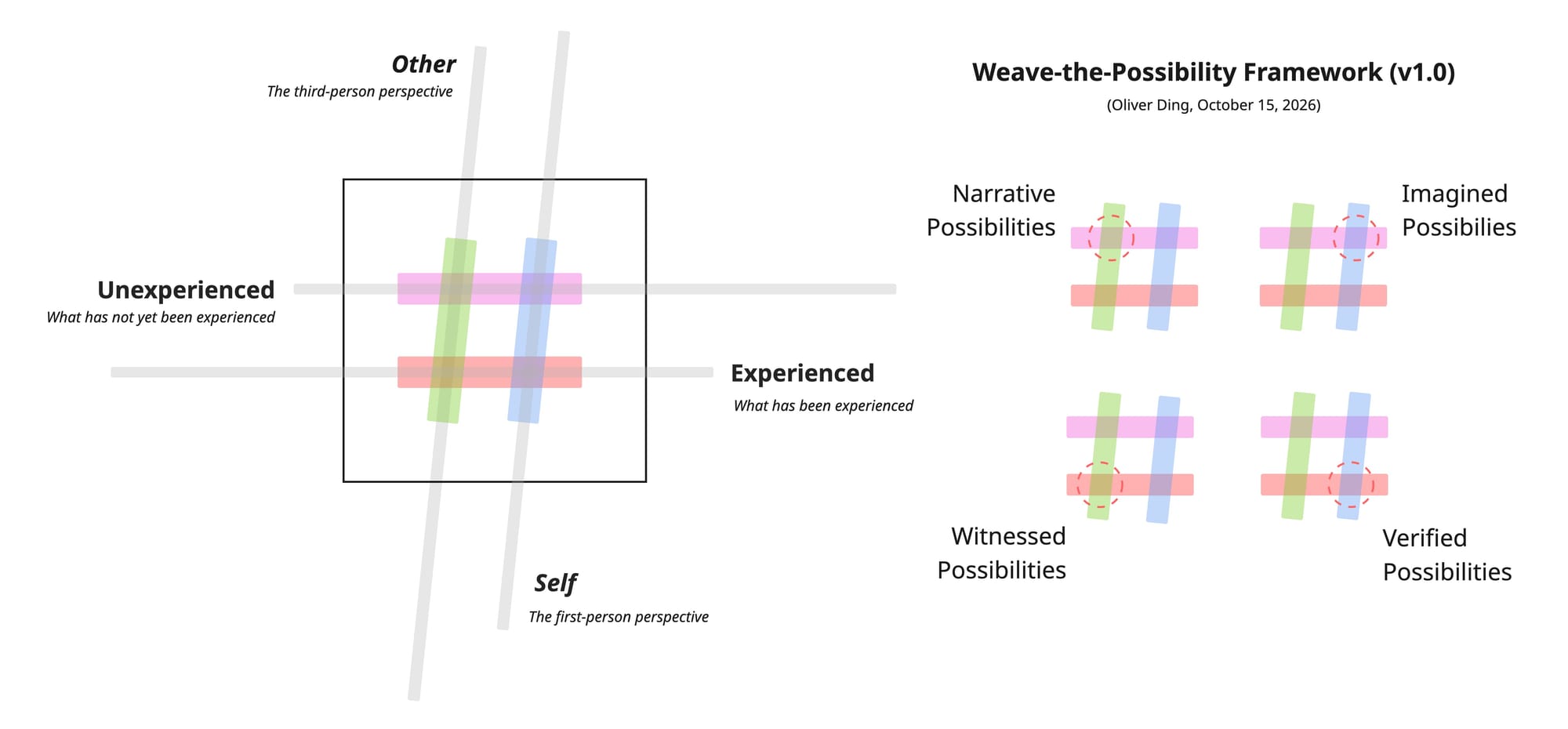
The Weave Basic Form brings together two diachronic dimensions and two synchronic dimensions. The distinction between Experienced and Unexperienced constitutes the diachronic axis because it concerns time: whether a possibility has entered a person's experience or remains outside it.
The distinction between Self (the first-person perspective) and Other (the third-person perspective) constitutes the synchronic dimension because it concerns social space. The Self perspective approaches possibilities from one's own position, while the Other perspective approaches them through observing other people.
The Other perspective, however, can involve two different modes of access. In a second-person relationship, another person communicates directly with us about their experiences, thoughts, or imagined possibilities. In a third-person relationship, we learn about others through observation or witnessing, without direct communication with them about those possibilities. I exclude the second-person perspective from the diagram because this framework focuses on the contrast between first-person experience and third-person observation, rather than direct interpersonal communication. Accordingly, Other in the diagram specifically refers to the third-person perspective.
These two axes provide different but complementary ways of examining possibilities. The diachronic dimensions distinguish possibilities in relation to experience over time. The synchronic dimensions distinguish perspectives in relation to the social space in which people encounter and observe one another.
Intersecting these dimensions produces four weave-points. I call this new framework Weave-the-Possibility. It offers a basic form for exploring how possibilities are experienced, imagined, witnessed, or remain unknown from different positions.
4. The Four Weave-points
The four weave-points emerge from the intersection of the diachronic axis—Experienced / Unexperienced—and the synchronic axis—Self (First-person) / Other (Third-person). Each combination identifies a distinct way of relating to possibilities.
4.1 Self (First-person) × Experienced: Verified Possibilities
Verified Possibilities are possibilities encountered through one's own experience.
From a first-person perspective, a person draws on their own lived experience to recognize that something can happen or can be done. Experience gives a possibility a concrete basis that imagination alone cannot provide.
In this framework, an actual occurrence provides primary verification: even a single instance demonstrates that the possibility is not merely imaginary but can happen under at least some conditions.
However, primary verification does not establish that the possibility can be reliably reproduced or that it will fulfill a particular purpose. These further judgments involve secondary verification, which evaluates the possibility against specific purposes and the criteria derived from them. A possibility may therefore be primarily verified through actual experience while remaining unverified, or only partially verified, in relation to particular intended purposes.
4.2 Self (First-person) × Unexperienced: Imagined Possibilities
Imagined Possibilities are possibilities that a person can envision but has not yet experienced.
Because this category combines the first-person perspective with the unexperienced dimension, it concerns possibilities that extend beyond one's own lived experience while remaining accessible to one's imagination. A person may envision a different way of living, a new kind of project, or a future that has not yet become part of their life. Such possibilities can guide exploration and strategic action even when their feasibility remains uncertain.
The movement between Verified Possibilities and Imagined Possibilities is closely connected to doing and learning. Without doing, imagined possibilities may remain confined to thinking, never entering lived experience and becoming candidates for verification. Conversely, without an open learning mindset, verified possibilities may remain fixed as what is already known, rather than prompting us to imagine what else might be possible. Doing brings imagined possibilities into experience, while learning from experience opens up new possibilities for imagination. The two categories thus form a dynamic relationship: we act on what we can imagine, and learn from what we experience to imagine beyond it.
4.3 Other (Third-person) × Experienced: Witnessed Possibilities
Witnessed Possibilities are possibilities encountered by observing the experiences and actions of others, without direct communication with them about those possibilities.
The third-person perspective places the observer in a social position outside the other person's first-person account. Through observation and witnessing, we may recognize possibilities that we have not personally experienced. Other people's lives, practices, and projects can reveal alternative ways of living, creating, and organizing activities.
The distinction from second-person engagement is essential here. If another person directly tells us about a possibility they have experienced or imagined, our access to that possibility involves direct communication. Third-person witnessing, by contrast, retains observation as the mode of access while excluding such direct communication about the possibility.
Because people occupy different positions in social space and have different experiences, resources, and circumstances, Witnessed Possibilities have a distinctive heuristic value for creative exploration. What has been verified for another person is not necessarily verified for us, and what has not worked for them may still be possible for us. Individual differences can change the conditions under which a possibility is realized. By observing others, we can therefore discover possibilities that have not yet been verified in our own lives, including possibilities that might become viable precisely because our circumstances differ from theirs.
4.4 Other (Third-person) × Unexperienced: Narrative Possibilities
Narrative Possibilities are possibilities we encounter through other people's accounts of experiences, practices, or futures, rather than through direct observation or personal experience.
Narratives allow possibilities to travel beyond the situations in which they originally emerged. Through stories, reflections, and descriptions, others can introduce us to ways of living, creating, and organizing activities that we have never witnessed firsthand. They can also communicate possibilities that remain unrealized, including imagined futures and projects that have yet to take shape.
The distinction between Witnessed and Narrative Possibilities concerns how we gain access to another person's world. Witnessed Possibilities emerge through observing others' experiences and actions, whereas Narrative Possibilities reach us through their accounts. A narrative does not automatically verify the possibility it describes; instead, it makes that possibility available for our own interpretation, imagination, and potential exploration. In this way, narratives expand the range of possibilities we can consider beyond what we have personally experienced or directly witnessed.
5. A Basic Form for Exploring Possibilities
The four weave-points offer a basic form for exploring possibilities from two complementary dimensions: the relationship between the self and others in social space, and the relationship between what has been experienced and what remains unexperienced. Together, they help us examine not only what is possible, but also how possibilities become accessible to us.
Each weave-point provides a different entry point for exploration. Verified Possibilities draw on our own lived experience, while Imagined Possibilities extend beyond what we have experienced. Witnessed Possibilities reveal what others have demonstrated through their actions and practices, while Narrative Possibilities introduce possibilities through what others tell us. These are not isolated categories. They form a connected field in which experience, imagination, observation, and narration can inform one another.
This basic form also highlights several ways in which possibilities can expand. Through doing, imagined possibilities can enter lived experience and become candidates for verification. Through learning, verified experiences can generate new questions and inspire further imagination. Through witnessing, we encounter possibilities realized under conditions different from our own, which may prompt us to reconsider what we regard as feasible. Through narratives, we gain access to experiences and imagined futures beyond what we can directly observe.
The four weave-points therefore serve as a heuristic for opening up possibilities rather than a rigid classification scheme. When exploring a life, project, or strategic direction, we can ask: What has my own experience verified? What can I imagine beyond it? What possibilities can I discover by observing others? And what new possibilities might I encounter through their stories? These questions help us move beyond the limits of current experience without losing contact with the practices, people, and learning through which possibilities can be explored.
v1.0 - October 15, 2026 - 2,722 words