
Weave the Theme: When Themes of Practice Meet Project Engagement (Part A)
A six-year exploration of the theme of theme
by Oliver Ding
October 28, 2026
This article is part of a possible book: Developmental Theme: The Weave-the-Theme Framework and Thematic Engagement (Book, 2026).
This article is part of the Revisiting-and-Rebuilding Thematic Engagement series. Part A presents the Introduction, Part 1, and Part 2 of the article.
Read Part B here: https://www.activityanalysis.net/theme-of-theme-b/
Introduction
For several years I have been working on the theme of theme. Most of that work took the form of projects: a book draft here, a framework there, a case study, a canvas, a diagram. Each project had its own question, its own year, and often its own knowledge center. Looking back, what these projects brought out can be sorted into two kinds of things: models and themes.
This article is the last one in the Revisiting-and-Rebuilding Thematic Engagement series. The earlier articles built frameworks and drew maps. This one goes back to what I actually did. I will tell the stories of fifteen creative journeys, each a chain of four or more projects, and show how a theme moved from one project to the next and which models came out along the way.
In the Weave-the-Theory model, models and themes sit on the creativity line. That line is the main thread of the article. I read the theme–model line as the principle of Themes of Practice at work. But the article is not only a narrative. After the stories, I will step back and reflect, and in doing so I will connect the Themes of Practice principle with the Weave-the-Theory model. I will also connect thematic engagement with project engagement. The basic model of the project engagement approach is the Developmental Project model, and its two core elements are theme and identity. Following that connection, we will see how the two kinds of engagement meet in the same projects.
For several years I have been working on the theme of theme. Most of that work took the form of projects. Looking back, I have identified approximately fifteen creative journeys. By my method, a chain of four or more interconnected projects constitutes a creative journey. These fifteen journeys span seven years and are organized around three distinct developmental stages of my knowledge enterprise:
- The "Container" Stage (2019–2020): Where the foundational concepts were born.
- The "Network" Stage (2020–2025): Where multiple knowledge centers formed a Value Circle, generating a highly diverse range of thematic explorations.
- The "Platform" Stage (2025–2026): Where the GO Theory platform emerged to support and integrate the earlier enterprises.
In Part 1, I will set the background. In Part 2, I will present the full landscape of these fifteen journeys. Each journey will be introduced with its own title, showing how a theme moved from one project to the next and which models came out along the way.
Contents
Introduction
Part 1: Background
1.1 The Revisiting-and-Rebuilding Thematic Engagement Project
1.2 The Landscape of Thematic Engagement
1.3 Exploring the "Theme" Weave-point
Part 2: The Landscape of Fifteen Creative Journeys
2.1 Overview of the 15 Creative Journeys
2.2 Early Stage: The "Container" Stage
- The "Themes of Practice" Journey (2017-2021)
- The "Theme-Activity Creative Dialogue" Journey (2019-2022)
2.3 Middle Stage: The "Network" Stage
2.4 The "Ecological Practice" Thread
- The "Thematic Space" Journey (2022-)
- The "Thematic Matrix Canvas" Journey (2022-2023)
- The "Thematic Supportance" Journey (2020-2026)
2.5 The "Life as Activity" Thread
- The "Shared Themes" Journey (2021-2023)
- The "Thematic Enterprise" Journey (2020/21-2026)
- The "Thematic Identity Curation" Journey (2021-2025)
2.6 The "Creative Life Theory" Thread
- The "Career Themes" Journey (2021)
- The "Creative Life Curation" Journey (2022-2023)
2.7 TALE: Theme-Concept-Framework Transformation
- The "Thematic Exploration" Journey (2023)
- The "Thematic Attachance" Journey (2023)
2.8 Latest Stage: The GO Theory Platform
- The "Strategic Themes" Journey (2024-2026)
- The "Thematic Focus" Journey (2025)
- The "Thematic Creation" Journey (2025-2026)
Part 3: Five Lenses for Interpreting the Creative Journey
3.1 The Developmental Functionalism Lens
3.2 The Master Theme Lens
3.3 The Evolving Concept System Lens
3.4 The Platform Ecology Lens
3.5 The Self-referential Activity Lens
Part 4: The Dialogue Between Themes of Practice and Project Engagement
4.1 The "Theme" Weave-point and Creative Journeys
4.2 The "Practice" Side of Themes of Practice
4.3 Theme, Identity, and Project Engagement
Postscript
From Cognitive Hydrology to Developmental Theme
Part 1: Background
1.1 The Revisiting-and-Rebuilding Thematic Engagement Project
The series began with the Experience–Narrative–Framework–Ecology schema. It continued with the Weave-the-Theme Framework (v1.0), then with Revisiting and Rebuilding the Thematic Engagement Toolkit, and most recently with Weave the Theme: The Typology of Theme and Beyond. This article closes the series.
1.2 The Landscape of Thematic Engagement
In the previous article I used the Weave-the-Theory framework to arrange thematic engagement as a landscape with a set of weave-points.
As I explored in my recent Weave-the-Theory book draft through multiple case studies (such as the development of the Anticipatory Activity System), theoretical knowledge does not grow as a linear progression. It grows through a weaving process organized around four interweaving points: Themes, Models, Concepts, and Principles.
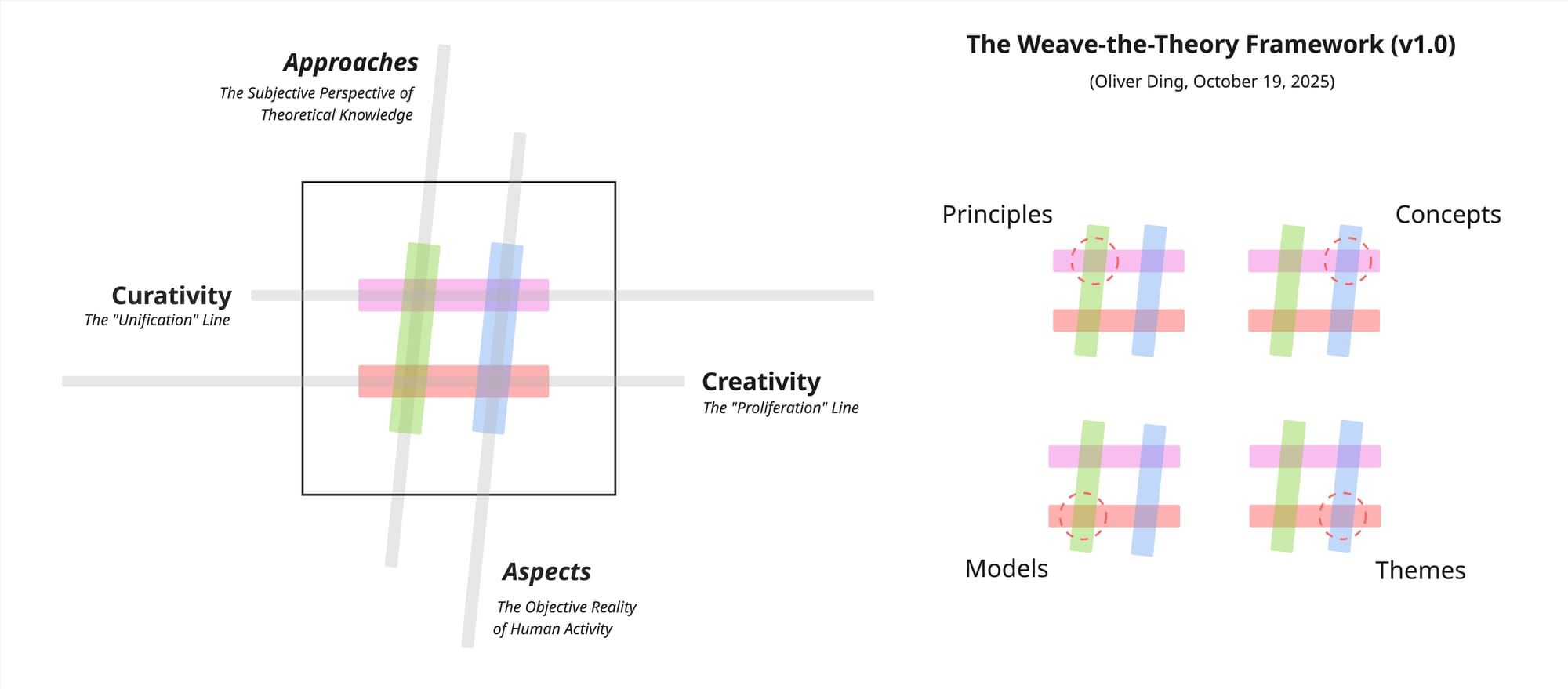
Applying this model to Thematic Engagement, the solution is to consider "principles" and "concepts" simultaneously. Based on years of inquiry, I have summarized four governing principles. They do not stand alone; rather, they map directly onto the four parts of Thematic Engagement as a theoretical concept:
- T as Theme. It concerns the theme itself and its crystallization. Its corresponding concept is Thematic Cognition (the Invariant layer).
- S-T-O. It adds S (subjectification) and O (objectification) to T, embedding the theme in concrete activity. Its corresponding concept is Thematic Activity (the Quasi-invariant layer).
- Themes of Practice. It adds the social situation in which the activity takes place. Its corresponding concept is Thematic Situation (the Variable layer).
- Evolving Concept System. It describes how concepts develop and scale into broader enterprises over time. Its corresponding concept is Thematic Enterprise (the Invariant Set).
The complete architecture of the v2.0 toolkit is visually captured in the diagram Mapping the landscape of "Thematic Engagement". By placing the Weave-the-Theory model onto a spatial map, the diagram reveals how the four weave-points interact to form a coherent knowledge enterprise.
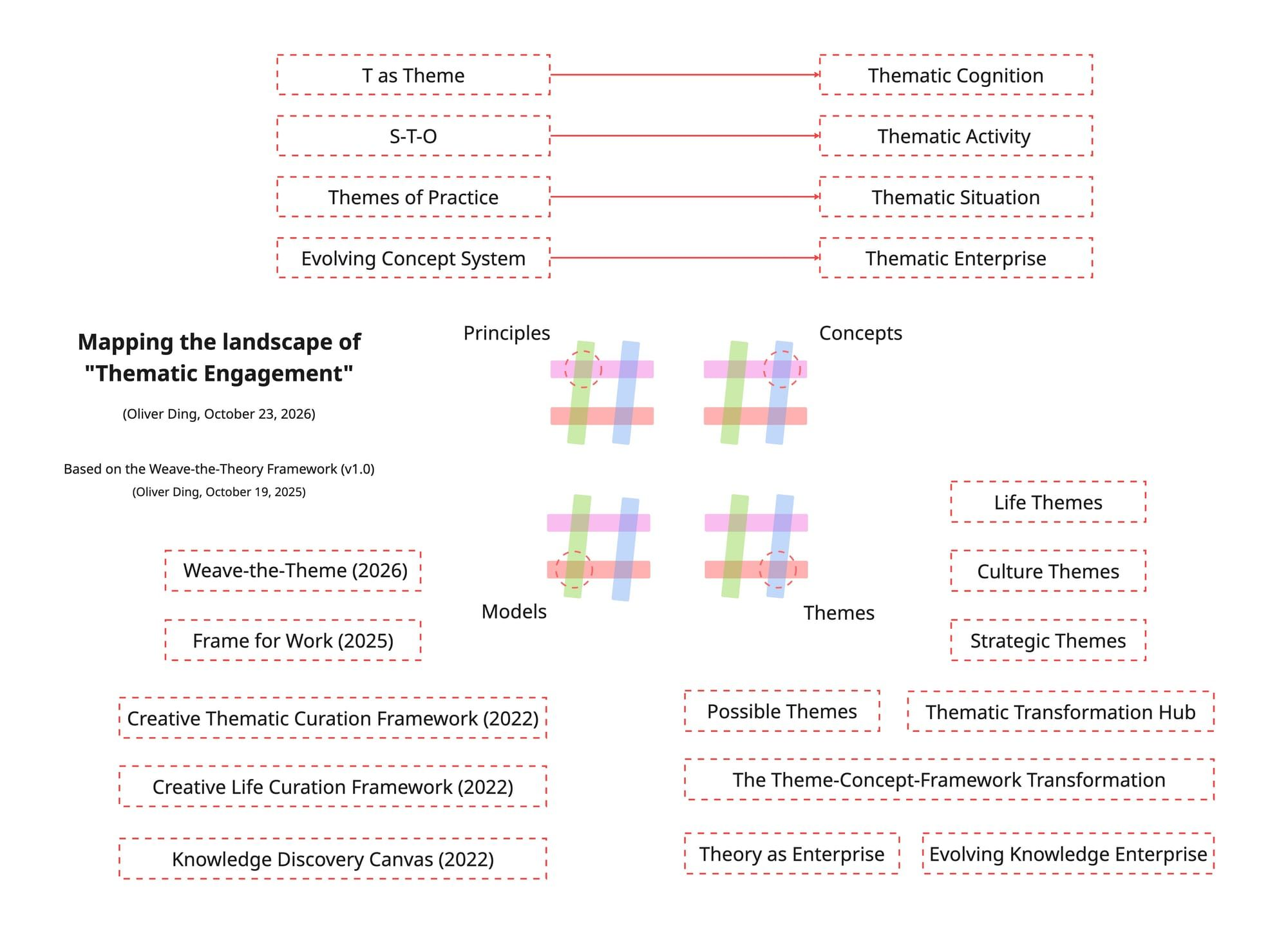
The upper half represents the Curativity Line, displaying the abstract dimensions: Principles and Concepts. The four principles (T as Theme, S-T-O, Themes of Practice, and Evolving Concept System) are mapped directly onto the four concepts (Thematic Cognition, Thematic Activity, Thematic Situation, and Thematic Enterprise). These form the fixed, conceptual skeleton of the toolkit.
The lower half represents the Creativity Line, which focuses on proliferation and concrete contexts. Specifically, the lower left displays the Models—the concrete frameworks developed over the years that operationalize the abstract principles. For instance, the Weave-the-Theme Framework (2026) and Frame for Work (2025) serve as models for Thematic Cognition, while the Creative Thematic Curation Framework (2022) and Knowledge Discovery Canvas (2022) exemplify Thematic Activity and Thematic Situation. Because models are illustrative examples, they remain open to revision as the work develops.
1.3 Exploring the “Theme” Weave-point
The lower right side of the diagram maps the Themes. If principles and models provide the structural logic, themes provide the living context. The landscape includes specific thematic domains such as Life Themes, Culture Themes, Strategic Themes, and Possible Themes. It is here that methodologies like the Thematic Transformation Hub and the Theme-Concept-Framework Transformation operate dynamically.
Those examples are only a few of the stories that the “theme” weave-point points to. The thematic space behind it holds many more, collected over many years. The purpose of this article is to go back through my exploration of the theme of theme and see what stories the journey contains.
Part 2: The Landscape of Fifteen Creative Journeys
After two days or of sorting, I identified about fifteen creative journeys, using the method of Creative Life Curation. By the method, a chain of four or more projects is called a creative journey. Each journey can yield one theme, and the journey is named after it: the “xxxx” journey.
A project has a theme too, according to the Developmental Project model. For research purposes, though, how to choose a project’s theme takes some care. The analysis at the journey level and the analysis at the project level do not choose themes in the same way. Sometimes a member project’s theme, taken alone, is not its main theme. But for the analysis of the journey, that side theme may be the one that matters. I call this the “main–side” dramatic life pattern.
2.1 Overview of the 15 Creative Journeys
The table lists the fifteen journeys. The numbering follows my working notes, and the titles are working titles taken from the theme each journey carries.
| # | Journey (working title) | Theme and … | Span | Told in |
|---|---|---|---|---|
| 1 | The “Themes of Practice” Journey | Curation | 2017–2021 | 2.2 |
| 2 | The “Theme–Activity Creative Dialogue” Journey | Activity | 2019–2022 | 2.2 |
| 3 | The “Shared Themes” Journey | Interpersonal Communication | 2021–2023 | 2.5 |
| 4 | The “Thematic Enterprise” Journey | Subjectivity | 2020/21–2026 | 2.5 |
| 5 | The “Thematic Identity Curation” Journey | Identity | 2021–2025 | 2.5 |
| 6 | The “Career Themes” Journey | Adult Development | 2021 | 2.6 |
| 7 | The “Thematic Space” Journey | Cognition | 2022– | 2.4 |
| 8 | The “Thematic Matrix Canvas” Journey | Diagram | 2022–2023 | 2.4 |
| 9 | The “Creative Life Curation” Journey | Creative Life | 2022–2023 | 2.6 |
| 10 | The “Thematic Exploration” Journey | Discovery | 2023 | 2.7 |
| 11 | The “Thematic Attachance” Journey | Enterprise | 2023 | 2.7 |
| 12 | The “Strategic Themes” Journey | Strategy | 2024–2026 | 2.8 |
| 13 | The “Thematic Focus” Journey | Subjectivity | 2025– | 2.8 |
| 14 | The “Thematic Creation” Journey | Culture | 2025–2026 | 2.8 |
| 15 | The “Thematic Supportance” Journey | Opportunity | 2020–2026 | 2.4 |
These journeys cover several years and many projects. How can the stories be understood as a meaningful whole? I first need to describe the larger context in which they happened. The stories themselves do not carry it; I know it from the inside. I described the broader picture in “A GAP Project and a Generative Confluence Journey” (February 2026), and here I give only its outline.
From 2019 to 2020, I set up CALL, the Creative Action Learning Lab. It was the first publication I set up on Medium, and it became the prototype of my later knowledge centers. It started with explorations of creative action and case studies. In 2020 I began to apply Curativity Theory to the field of knowledge curation, and that was the Activity U project, which ran for three years, from 2020 to 2022.
From 2020 to 2025, I grew a series of knowledge centers out of CALL. Each center carried one or two theoretical enterprises. They were independent of one another, but they also held creative dialogues. Together they formed a network, which I call the value circle.
From June to December 2025, I went through the generative confluence stage. Out of it I developed a theoretical platform, GO Theory: the World of Life (World of Activity) approach. It runs in parallel with the three earlier theoretical enterprises, which gives a 3+1 pattern.
I represent this structure with a container–network–platform model. From 2019 to 2020, CALL was a container. From 2020 to 2025, the value circle of several knowledge centers was a network. From 2025 to 2026, GO Theory became a platform. [Note to self: confirm whether the container–network–platform model has a published source.]
My work on the theme of theme was carried out inside this background, and the background explains much of the story: why the directions of exploration differ so much, and why some of them appear when they do. TALE, the Thematic Analysis Learning Engagement, is an example. I set it up in early 2023 as a new knowledge center, and its appearance was itself a step in the dynamics of the value circle.
The next sections tell the fifteen journeys within this context. The period sections come first (2.2 and 2.3). Then three threads run through the network period (2.4 to 2.6), then TALE (2.7), and then the latest stage, the GO Theory platform (2.8).
2.2 Early Stage: The “Container” Stage
The container stage covers 2019 and 2020. Two journeys begin here. In both, the interest is how a theme develops and which models came out.
The “Themes of Practice” Journey (2017–2021)
The journey starts with a project in 2017, the personal epistemology project, which brought out the concept of Life Themes. The main project came next. From October 2018 to March 2019 I worked on the Curativity Theory project and wrote a 615-page book draft, Curativity: The Ecological Approach to General Curation Practice. The draft was completed in March 2019. In it, Themes of Practice is one of five concepts, and each concept answers a basic question about curation. Curatorial Affordances asks why curation happens. Containers asks where. Themes of Practice asks how to coordinate individual experience and collective culture, since curation is both an individual action and a social practice. Curatorial Configuration asks how we understand meaningful wholes. Curatorial Crafting asks what the competence of curation is. Themes of Practice describes the transformation between individual life themes and collective cultural themes.
In 2019, the Cultural Curation project produced the “When Culture Meets Experience” framework, and the General Curation Framework was made in the same year. The Themes of Practice Framework followed in 2020.
Curativity Theory is a meta-theory. From March 2019 I used it across various knowledge projects, and I did not apply every concept to every project. Instead, I developed a series of models as knowledge frameworks and applied one model to each project as needed. In 2021, one case study applied the complete theory. In April 2021, friends hosted a two-month online program about the Whole Earth Catalog, using Milanote, WeChat, and video meetings. I was invited to join as a researcher. I first planned to use the Platform-for-Development framework, then realized that Ecological Curativity Theory fitted this program better. That became the Creative Curation project, and its case study is Creative Curation: The Whole Earth Catalog and the BACK TO W.E.C. Program.
The “Theme–Activity Creative Dialogue” Journey (2019–2022)
The second journey begins in the same book. In 2019, the Curativity book project included a hierarchy of cultural themes, built on the anthropologist Morris Opler’s concept of themes: a theme has expressions, and an expression has instances.
In 2020 I was working on the Activity U project and reviewing the hierarchy in Activity Theory. I compared the topics discussed by activity theorists and other scholars, and drew a general hierarchy of human activity. In the chart, Theme sits at the top as level 7. Below it come Activity network (level 6), Activity as an activity system (level 5), Projects as tasks and engagement (level 4), Actions (level 3), Operations (level 2), Function blocks (level 1), and Affordances (level 0). Leontiev’s “activity” and Schatzki’s “practice” correspond roughly to “expression” in Opler’s framework, so a theme is at a higher level of abstraction than an activity. I published this in “Activity U (VI): The Hierarchy of Human Activity and Social Practice” on September 29, 2020.
The chart also solved a problem I had had. I could not fit “Try Something New for 30 Days” into Activity Theory. In the chart, it is a theme, and a concrete project that follows it is an activity. In 2020 I used the theme to create a project of my own, Meet Muse for 30 Days, in which people looked for a free academic chapter or book on the Project MUSE website for 30 days.
The insight had a long effect on my later work. It started a creative dialogue between two systems of ideas: Themes of Practice, which belongs to the Curativity direction, and project engagement, which belongs to the Activity Theory direction. In 2022 the dialogue continued in two more projects: the Thematic Controversy project and the Thematic Engagement Toolkit (v1.0) project, whose case study was to discover the theme of Thematic Engagement. More material is in “Slow Cognition: The Echoes of A Thematic Dialogue.”
2.3 Middle Stage: The “Network” Stage
From 2020 to 2025 the work was spread over several knowledge centers. This is the period of the value circle. The centers I can name from my notes are CALL, the Curativity Center (launched in 2022 as a meta-center to support other centers), the Activity Analysis Center, TALE (set up in January 2023), and the Life Strategy Center, among others. The table gives a first account of what each carries. The assignment of journeys to centers is provisional.
| Knowledge center | Set up | Carries | Journeys [to confirm] |
|---|---|---|---|
| CALL | 2019 | Creative action; the container from which the others grew | 1, 2 |
| Curativity Center | 2022 | Curativity Theory and the ecological practice approach; a meta-center for other centers | 7, 8, 15 |
| Activity Analysis Center | [year] | Activity Analysis, Project Engagement, World of Activity | 4, 5 |
| TALE | January 2023 | Thematic engagement | 10, 11 |
| Life Strategy Center | [year] | [to fill] | [to fill] |
Many journeys belong to this period, so I tell them along the 3+1 pattern. The first three threads are the three earlier theoretical enterprises: the ecological practice thread (2.4), the life-as-activity thread (2.5), and the creative life theory thread (2.6). TALE has a section of its own (2.7). The “+1”, the GO Theory platform, comes last (2.8).
2.4 The “Ecological Practice” Thread
This thread runs through Curativity Theory and the Ecological Practice Approach. Themes of Practice, told in 2.2, belongs here. Three more journeys are told in this section: Thematic Space, the Thematic Matrix Canvas, and Thematic Supportance. The concept of Supportance, and Thematic Supportance with it, belongs to this thread.
The “Thematic Space” Journey (2022–2026)
Thematic Space started in early 2022 as an operational concept. I was working on the Developing Tacit Knowledge project and designed a Thematic Space Canvas; the diagram is dated March 10, 2022. I soon saw the theoretical value of the term, so I renamed the canvas the Knowledge Discovery Canvas and developed “thematic space” as an independent theoretical concept, to be used together with Attachance.
In 2023 and 2024 I developed several projects around Attachance, and the concept of thematic space developed fully in the same years. On October 9, 2024 I published “Mapping Strategic Moves #13: The Journey of Building Thematic Space Theory.” In 2025 I developed Thematic Space Theory as an independent theoretical enterprise. On February 26, 2025 I published “Thematic Space Theory: A Toolkit as a Specific Theory,” which was used in the ESC project, and on March 5, 2025 “Thematic Space Theory: An Ecological Approach to Social Cognition,” a stage summary of the theory.
In June 2025 I found the “Theorizing Creative Life” theme in my journey between 2014 and 2025, and on June 2, 2025 I made the “Theorizing Creative Life” landscape with the Self–Life–Mind schema. I selected three core concepts in it: World of Activity [Ontology | Self | Philosophy], Creative Center [Realism | Life | Sociology], and Thematic Space [Hermeneutics | Mind | Psychology]. The pattern in the landscape was a 3+1 structure, which I had not noticed before.
In the second half of 2025, Thematic Space Theory took the function of the Mind section in the Self–Life–Mind model of Creative Life Theory (v3.0). The book draft The Curativity of Mind: Mental Curation, Mental Platforms, and Mental Moves (v1.0) followed on December 13, 2025.
One diagram in this journey is worth keeping in view: the Basic Model of Thematic Space (October 31, 2023), a three-layer model. The layer of life experiences holds a Creative Life Story, the subjective aspect of knowledge holds a Creative Theme, and the objective aspect of knowledge holds a Knowledge Model.
The “Thematic Matrix Canvas” Journey (2022–2023)
The Thematic Matrix Canvas was originally the Thematic Space Canvas. When thematic spaces became a primary theoretical concept, I renamed it. It is a meta-canvas for Developing Tacit Knowledge, an abstract canvas that does not tie to any domain. Its purpose is to show one spatial structure from which domain-specific canvases can be designed. The structure has four significant areas, four dimensions, two subspaces (inner space and outer space), eight pairs of blocks, and a primary theme, 16 blocks in all. It adopts the perspective of Activity Theory and treats the whole process of using the canvas as an activity; inner space and outer space represent the internalization–externalization principle.
The meta-canvas led to six canvases: the Knowledge Discovery Canvas, the Spark Space Canvas, the Statue Space Canvas, the Life Discovery Canvas, the Optimal Context Canvas, and the Lifesystem Development Canvas. On October 26, 2023 I published “Situational Note-taking: The Thematic Matrix Canvas and Meaning Discovery Canvas,” which carried the canvas into note-taking.
The “Thematic Supportance” Journey (2020–2026)
This journey is the longest one in the thread, and it starts in 2020. That year I inspired by Gibson’s affordance theory, and I watched my sons’ creative play, and I perceived the potential for a new concept, Supportance. The 3i Model of Creative Action was developed in the same year. In 2021 I published an article that introduced the Actualization of Supportances model, which has three phases through which a Supportance moves from potential to actual: Perception, the transformation between Potential and Actual; Action, the transformation between Challenge and Response; and Curation, the transformation between Individual and Collective. Supportance Theory then developed over the next six years.
In 2026, while expanding the RelationField framework (v3.0), I analyzed how a material object, a chair in the former residence of the scholar Yan Fu, becomes a thematic object that carries meaning across time. Thematic Supportance was a by-product of that analysis. I published it on June 24, 2026, in “Thematic Supportance: Curation, Narrative, and Meaning.” It is a subtype of Supportance: the potential action possibility of symbolizing lived experience into a Creative Theme. The article grounds it in three cases from different ecological conditions: Yan Fu’s chair, Aria’s curation of her own experience, and Viktor Frankl.
In June 2026, Aria’s curation showed me what had been missing from my understanding of Supportance and led me to restructure the whole framework. On June 29, 2026, I launched the book Supportance: Self, Other, and Possible Support (v1, 2026), in which Thematic Supportance is Part 6. On July 3, 2026 I published “The Actualization of Thematic Supportance as a Creative Action,” where I used the 3i Model, made in 2020, to look at how Supportance Theory itself developed through a sequence of Creative Actions.
The June 24 article presents a master theme of my multi-year creative journey: How does individual life experience transform into collective cultural meaning? It connects Thematic Supportance with Creative Life Curation (2022), Strategic Life Narrative (2025), and GO Theory (2026).
In October 2026, I tested the concept on the 4×4 Weave-the-Theme framework. It did not fit one point: it was distributed across the Experience row, at Method × Experience, Mediator × Experience, and Milieu × Experience. The map asked for a new name for something that had always been there, my method of extracting Thematic Supportance, and I called it Capturing Thematic Supportance. The test also produced the concept of the Thematic Object, and RelationField appeared at Milieu × Experience.
2.5 The “Life as Activity” Thread
This thread runs through project engagement, the Cultural Projection Model, the Developmental Project model, the Anticipatory Activity System, and the idea of activity as the formation of concept. The Theme–Activity journey, told in 2.2, belongs here too. Three more are told in this section.
The “Shared Themes” Journey (2021–2023)
The journey starts in July 2021 with an empirical study, “Themes of Practice, Social Media, and Interpersonal Communication,” and a 56-page report. I introduced eight sub-concepts in it: Self-perceived Themes, Other-perceived Themes, Shared Themes, Authorship of Themes, Mentionship of Themes, Followship of Themes, Pervasive Mentionship, and Proximal Mentionship. The report was collected in a volume I edited in 2021, Themes of Practice: The Information Architecture of Social Life. On June 28, 2021 I designed a picture for a possible book with “The Information Architecture of Social Life” as its subtitle, which is also the title of the first epilogue of Curativity.
In September 2022 I developed the ARCH framework, “A Visual Language of Interpersonal Interactions and Collaborative Project Engagement.” It is a five-stage model, and its third stage is Think Together: Shared Theme, with the keyword Relevance. The stage uses ideas from the 2021 study: Primary Theme, Existing Themes and Emerging Themes, Interpretation, and Mentionship. Relevance Theory is part of its theoretical background.
In February 2023, in “Slow Talk: The ARCH of Thematic Engagement,” I expanded the unit of analysis from a single theme to a theme network. I added three terms: Initial Theme, a meaningful keyword that triggers a conversation; Focus, a person’s Situational Theme Network; and Landscape, a person’s Relevant Theme Network. A deep thematic conversation needs two moves: from My Focus to Your Focus, and from Focus to Landscape. On that basis two people can build mentionship, which means mentioning each other relevantly and accurately.
The journey closed in 2023 with two projects. The Slow Talk project developed the Mapping Thematic Conversation method, and the Thematic Conversation project ran a series of case studies on strategic exploration, social affordance, intellectual experience, note-taking and knowledge engagement, and persona. The series became Part 3 of the book Thematic Exploration, told in 2.7. The models are the ARCH Framework (2022), the Slow Talk Framework (2023), and the Thematic Conversation Model (2023).
The “Thematic Enterprise” Journey (2020/21–2026)
In 2021 I started from Andy Blunden’s idea of the project as a unit of activity and developed the project engagement framework, which went through several versions over the following years. I found that Blunden’s claim that activity is the formation of concept ran parallel to the Themes of Practice I had proposed, and I set theme as one of the two core elements of the Developmental Project model. The model came from the Activity U project (2020/2021), which produced two book drafts. One of them was Project-oriented Activity Theory, introducing the project engagement approach (v1.0).
The connection had a long effect. It made me think about the relation between theme and concept, and I developed the ontological setting of theme (concept). That brought Themes of Practice and concept creation together, and the 2023 book draft Grasping the Concept reflects it; the Introduction was published on November 29, 2023. The Evolving Concept System Model followed in 2024.
In mid-2025, on the basis of the evolving concept system, I proposed thematic enterprise as a theme and gave it a systematic framework. The Wonder and Wander project produced a book draft with a series of case studies on the Evolving Knowledge Enterprise model (2025) and introduced the Theory-as-Enterprise framework. Later in 2025, while writing the Developmental Projects book, I made a new version of the Cultural Projection Model (v2). It pairs enterprise with activity: enterprise stresses subjective experience, and activity stresses objective description. They are one thing seen from two angles, and projecting links them. Enterprise is the subjective side. My activity is my enterprise, and someone else’s activity is not my enterprise.
In 2026 I formally brought the concept of enterprise into the life-as-activity knowledge system, and the whole system rose to version 4.0 in Weave the Life: The Life-as-Activity Approach (v4.0, August 9, 2026). It sums up all my creative results in the direction of activity theory. The models of this journey are the Developmental Project Model (2021), the Evolving Concept System Model (2024), the Evolving Knowledge Enterprise Model (2025), and the Cultural Projection Model (v2, 2025).
The “Thematic Identity Curation” Journey (2021–2025)
The journey is about the relation between theme and identity. I gave it the name of a framework I made in 2024, Thematic Identity Curation, but the thread is older, and it starts in 2021, when the Developmental Project model set the two concepts as its core elements. The model came out of the Activity U project, where I started from Andy Blunden’s idea of the project as a unit of activity. Theme came in from the side of Themes of Practice, and identity was the other element. The next two projects each took up one of the pair.
In 2022 the Creative Life Curation project produced a framework for how experience turns into theme. The diagram is dated October 19, 2022, and a book draft followed in November. The framework was first called the Creative Life Curation framework; later I detached it from the method and renamed it Creative Thematic Curation (also known as the hourglass model). It looks at the Themes of Practice side of a journey of projects.
In 2023 the Creative Identity Engagement project took the other element. The framework, dated December 11, 2023, belongs to the Project Engagement approach and connects to the Developmental Project model through identity. It describes identity development from the perspective of the project in three phases: Internalization, Alignment of Identity, and Externalization.
In May 2024, in the Strategic Life Development project, I connected thematic curation with identity building and developed the Thematic Identity Curation framework. The diagram, Thematic Curation as Identity Building, is dated May 9, 2024. The framework follows how the two change together as projects unfold, through five moments: Thematic Echo, Thematic Blend, Thematic Integration, Creative Projects, and Identity Development, each paired with a knowledge framework.
From late 2024 until the manuscript was completed on June 18, 2025, I worked on the GO Theory (v1.0) project, named after the book GO Theory: Genidentity, Opportunity, and World of Activity. Genidentity became the key concept, and it connected with the dynamic change between theme and identity. The manuscript also includes the Thematic Identity Curation framework and several other identity frameworks. On May 20, 2025, I made the diagram Time Curation, Space Curation, and Life Coordinate, which links the Developmental Project model with the Life Coordinate model: theme to life focus, which corresponds to time curation, and identity to life flow, which corresponds to space curation. The pair set in 2021 now sits on the two axes of one diagram.
The Activity U project appears in two other journeys here, the Theme–Activity Creative Dialogue and the Thematic Enterprise journeys, where it is told for a different theme. The models of this journey are the Developmental Project Model (2021), the Creative Thematic Curation Framework (2022), the Creative Identity Engagement Framework (2023), and the Thematic Identity Curation Framework (2024).
2.6 The “Creative Life Theory” Thread
This thread runs through Creative Life Curation, Thematic Exploration, and Thematic Enterprise. The last two are told in 2.7 and 2.5. Two journeys are told here.
The “Career Themes” Journey (2021)
The Career Curation project of 2021 asked what themes mean in adult development. I made a framework for personal innovation, inspired by an earlier article, “Platform Innovation as Concept-fit,” and named it Career-fit. It has four keywords, Experience > Themes > Projects > Opportunities, and roughly five steps: reflect on career experience, discover pairs of opposite themes, fit all pairs of opposite themes, join or initiate relevant projects, and fit career themes with career opportunity. Three pairs of opposite themes came from my own career: China versus America, Theory versus Practice, and Concept versus Diagram.
The core of Career-fit is the structure and dynamics of career themes. Pairs of Opposite Themes refers to significant differences between career themes, and I take it as the best starting point for personal innovation, since it leads to structural tensions such as boundary, distance, difference, heterogeneity, contradiction, and complementation. If one or more of these tensions can be turned into creative opportunities, there is a way to personal innovation. Meta-themes refers to using one high-level theme to curate similar career themes. Development of Themes refers to the transformation of career themes. I treated career themes as a special type of life themes and cultural themes, and Themes of Practice served as the bridge between the two. The framework was published as “Personal Innovation as Career-fit.” [Three or more projects still to be added to make this a journey of four.]
The “Creative Life Curation” Journey (2022–2023)
In 2022, I developed a series of analysis models and levels to dig creative themes out of individual experiences and life courses, then to move on to creative projects and develop creative achievements. The journey has one principle, S–T–O, and two frameworks, the Creative Thematic Curation model and the Creative Life Curation framework. The principle describes three stages: S is subjectification, turning the world into personal experience; T is thematic crystallization, where a creator finds a match between individual life themes and collective cultural themes; O is objectification, turning that experience into shareable artifacts.
In October 2022, I made the Creative Life Curation Framework as a large semiotic diagram, and in November I wrote the book draft Creative Life Curation: Turning Experiences into Meaningful Achievements. S–T–O was applied to establish five analysis units of a creative life, in order: Creative Actions, Creative Projects, Creative Journey, Creative Landscape, and Creative Lifescope. The diagram is three by five. The T element runs along the Symbolic line under Objectification: Name, Concept, Life Themes, Emerging Themes, Cultural Themes. It is read from the top left, where experience lies, to the bottom right, where cultural themes lie. The same year I made a set of analysis models and terms: Mapping Thematic Landscape, Mapping Thematic Dialogue, and Mapping Thematic Journey. Creative Life Theory (v1.0) also produced four book drafts, collectively titled Aspects of Creative Life, one for each of Creative Actions, Creative Projects, Creative Journeys, and Creative Life.
The journey also set an important theme, Thematic Engagement, and brought out a new knowledge center. In January 2023 I set up TALE to push the development of this theme.
In 2023 I worked on Creative Life Theory (v2.0), a meta-framework to support those units of analysis. Its core is the Creative Course Framework (April 18, 2023), which I developed from Ping-keung Lui’s Subjectivist Structuralism. I raised S–T–O to the most basic principle of the theory. The sign of version 2.0, introduced in April 2023, has three elements: the square, the circle, and the sandglass, with the sandglass standing for S–T–O. In October 2023 I used the sign as a situational model to edit the book draft Creative Life Theory (v2): Building a Knowledge Enterprise, which has five parts: Introduction, The Sandglass, The Circle, The Square, and The Engagement. The 2023 book also introduced The Hermeneutics of Creative Life, a diamond with four poles, Theme (top), Practice (bottom), Knowledge (left), and Creator (right). It has two sequences, a textual one (Work → Text → Copy → Meta-text) and an actional one (Project → Action → Experience → Life Course), with a spiral of creative work at the center.
2.7 TALE: Theme–Concept–Framework Transformation
TALE, the Thematic Analysis Learning Engagement, was set up in January 2023 as a knowledge center for the theme of Thematic Engagement. Two journeys of 2023 belong to it.
The “Thematic Exploration” Journey (2023)
From January to June 2023, I worked on a series of sub-projects at TALE, with tools such as Possible Themes, thematic cards, and the Thematic Brief, and with the Strategic Thematic Exploration framework. In the end I found an emerging theme in these projects: the Thematic Creativity and Thematic Curativity of Early Discovery. On June 23, 2023, I decided to edit a possible book, Thematic Exploration: The Early Discovery of Knowledge Engagement, and published version 1.0 of its table of contents.
The diagram in that post places Thematic Engagement at the top. It consists of Knowledge Engagement, with Knowledge Themes, and Cultural Engagement, with Cultural Themes. Both flow into Creativity and Curativity, within Activity as project engagement. The book has six parts: Strategic Thematic Exploration; Possible Themes, with a typology of themes; Slow Talk, the thematic conversations from 2.5; Possible Frameworks, six methods each with an example; Spontaneous Concept System, where Theme (Concept) leads through the spontaneous, defined, and scientific concept systems; and a Toolkit. [Further projects of this journey to be added from the notes.]
The “Thematic Attachance” Journey (2023)
After TALE had run for a while, it played a special role in the network of my knowledge centers. I call this special function of TALE the Thematic Transformation Hub. The hub looks for Thematic Attachances between different knowledge centers and different knowledge frameworks. It detaches a single theme from its original framework and attaches it to a new one. The method also works for transferring thematic elements between knowledge centers.
This was a journey of several continuous projects. From March to August 2023, in the Mental Moves project, I used the terms creative attachance and mental elements. On March 24, 2023 I made a list of articles about Attachance and drew the diagram of the “Mental Moves” knowledge project, and on March 27 I described three aspects of mental elements: name, content, and form. On July 13, 2023 I published “Mental Moves #8: The Hierarchy of Knowledge Centers,” where I saw that the life containers in the project, knowledge models, knowledge projects, and knowledge centers, form a nested structure, Centers [Projects (Models)], and that mental elements move between its levels. On August 1 I edited the Mental Moves book draft, Mental Moves: The Attachance Approach to Ecological Creative Cognition. In September, in the analysis of TALE’s Thematic Transformation Hub, I used the terms Thematic Attachances and Knowledge Elements. The two sets of terms mean the same thing. The earlier project gave a systematic research insight, and the later one showed one concrete application.
That later project is “Value Circle #3: TALE as a Thematic Transformation Hub” (September 1, 2023). As a hub, TALE uses the Strategic Thematic Exploration framework and takes four actions: it transforms experiences into situational themes, connects situational themes with creative themes, transforms creative themes into knowledge elements, and curates knowledge elements into knowledge frameworks. The idea of the hub started from a series of mental moves between TALE and other centers, which I had first called “Collaborations.” I traced the path through four examples in March 2023: on March 11, “TalkThree,” from CALL through the Curativity Center to TALE; on March 22, “Knowledge Center,” by the same route; on March 24, “Mental Moves,” from CALL through the Activity Analysis Center to TALE; and on March 29, “Expansive Activity Analysis,” from the Activity Analysis Center to TALE.
One of the moves is the clearest story of a theme and a model changing places. “Life Coordinate” began as a concept inside CALL’s Lifesystem Framework (v1.0). It was detached from that framework and attached to TALE as an independent theme, where it was developed into version 2.0. Then it was detached from TALE and attached again to CALL as a concept of the Lifesystem Framework (v2.0). The main goal was to turn “Life Coordinate” from a concept into a theme, so that TALE’s audience could use it without taking on the Lifesystem Framework. The models of this journey are the Mental Moves framework and the Thematic Transformation Hub.
2.8 Latest Stage: The GO Theory Platform
After the generative confluence of June to December 2025, I established GO Theory as the platform of my theoretical enterprises, and the projects since January 2026 have been supported by it. At the end of 2025 the center of my creative work shifted from Knowledge Engagement to Cultural Development, and GO Theory became the developmental platform for several enterprises, among them Anticipatory Cultural Sociology, Cognitive Hydrology, Strategic Developmental Psychology, and Platform Ecology. Three journeys are told here. The ends of several earlier journeys also lie in this stage: the Thematic Identity Curation journey (2.5), the Thematic Enterprise journey (2.5), and the Thematic Supportance journey (2.4).
The “Strategic Themes” Journey (2024–2026)
Strategic themes formally appeared in the Ecological Strategic Cognition (ESC) project of 2025, but their seeds were in 2024. That year the Creative Diagramming project explored knowledge frameworks and cognitive representation; see “Diagram Explained: Kinds of Cognitive Representation and The Fifth Way of Knowing.” Also in 2024, the Strategic Moves project used the House of Project Engagement as a map for case studies and analysis. It produced the Mapping Strategic Moves method, and some of its terms were defined as strategic themes. That was the earliest empirical case of strategic themes. The Mapping Strategic Moves Method (v1, 2024) was published on October 16, 2024.
In the ESC project of 2025 I formally used the term strategic theme as a core part of the ESC framework. On one side I used it as the cognitive representation of strategy, an idea inspired by the Creative Diagramming project. On the other side I gave it three sub-elements, object, objective, and operations, inspired by the Mapping Strategic Moves method. In the ESC 2.0 series I gave strategic themes a criterion: a theme that describes all three, or that includes the objective, is classified as a strategic theme.
In 2026, in the Developmental Strategy project, I connected strategic themes to the strategic framework: strategic themes are the foundational elements of a framework, and a strategic framework is essentially a concept system whose origin can be traced to a set of interrelated strategic themes.
The “Thematic Focus” Journey (2025–2026)
The idea of Thematic Focus started in the first half of 2025, when I published the World of Activity Toolkit (v1.0) and the FFCC model, Flow–Focus–Center–Circle. In that model, two transitions matter, from flow to focus and from focus to center, and Thematic Focus is the key to both, because it is where embodied experience gets a name and a linguistic form.
On April 26, 2025, I published the Footbook draft Scalable Focus: Primary Theme and Other Strategic Objects (v1, 2025). On May 20 I made the diagram Time Curation, Space Curation, and Life Coordinate, connecting the Developmental Project model with the Life Coordinate model. On May 25 I developed The World of Activity Model: Flow, Focus, Center, and Circle (v1.0, 2025), which organizes flow, focus, center, and circle by the four-layer structure of Ecological Formism. By then the tight link between theme and focus was in place. In October 2025 I made the five-stage Enterprise Development Framework, released as a tiny paper, The Bloom of Enterprise: Creative Theme → Scalable Focus → Center Development → Value Circle → Developmental Platform.
The diagram of May 20 and the FFCC model, made five days apart, do not map onto each other one to one. In the diagram, theme connects to life focus, which corresponds to time curation, and identity connects to life flow, which corresponds to space curation. In FFCC, flow is diachronic development, the original and undifferentiated state of life experience. Attention cuts it: a moment of experience is noticed and separates from the flow, and a focus appears, and with it a spatial pattern. The interweaving of flow and focus is the living coordinate. The living coordinate is the basis, or prototype, of a creative center: a focus that keeps drawing attention and action turns into a center. Once the center has formed, its cross becomes theme and identity. Theme is the continuation of the center’s own thematic focus, which is time curation. Identity is the difference between this center and other centers, which is space curation.
The relation took more than a year to state. On September 8, 2026, I designed the House of Focus Dynamics diagram and proposed Thematic Focus for the first time. Focus has three stages: Attention Focus, Thematic Focus, and Scalable Focus. The key transition is from Attention Focus to Thematic Focus, which is naming. On September 14, 2026, I published “The Unfolding of Subjectivity: The Coordinate–Center–Gejunction Framework,” which proposes that flow and focus constitute the living coordinate, while theme and identity co-reside in the creative center, and that theme is the key concept for understanding subjectivity.
In October 2026, while creating the 4×4 Weave-the-Theme framework, I tested the concept on it. Thematic Focus did not fit one point. It spread across Milieu × Experience, Mediator × Narrative, Method × Narrative, and Method × Framework. The test produced a new name, Mastering Focus Dynamics, and it connected the FFCC model to the map for the first time.
The “Thematic Creation” Journey (2025–2026)
The Thematic Creation journey began with a notes document written during a trip in 2025. The notes led to the book draft Homecoming: A Thematic Trip and the World of Activity Approach. I called my trip to Fuzhou a thematic trip, the objects I met on it thematic objects, and some of the places thematic places. During the trip I was rereading the autobiography I wrote in 2015, and I met again the objects and places of my past life. The book draft also brought out the term tiny culture.
In early 2026 I was working on the ACS project, Anticipatory Cultural Sociology, and I proposed an ontological framework of thematic creation. It is developed in Chapter 3 of the possible book Anticipatory Cultural Sociology: Creation, Projection, and Agency (2026). The articles in that chapter name three modes of existence for thematic creations: Mindentity (January 26, 2026), the first principle of thematic creation, which belongs to the Self; Worldentity (February 13, 2026), the cultural givenness of a creation that has become a given structure in the World of Life, which inspires Awe; and Folkentity (February 21, 2026), the status of creations that have entered collective life as active objects of Cultural Projection, which belongs to Us. Together they form the spectrum Self–Us–Awe. The article “Culture as Anticipatory Activity” (February 21, 2026) explains the foundations of the spectrum and shows how it unfolds through the Agency Cascade model. It deepens the “Culture as Thematic Enterprise” framework, from an operational description of cultural development to an ontological account of what thematic creations are.
This concludes Part A of the article. We have traced the fifteen creative journeys across the container, network, and platform stages, showing how a theme moved from one project to the next. But after telling these stories, a deeper question remains: What overall patterns and theoretical insights emerge from these seven years of exploration?
In Part B, we will step back from the chronological narrative and apply five synchronic lenses to re-interpret these fifteen journeys. We will then conclude with a broader theoretical dialogue between Themes of Practice and Project Engagement.
Continue reading Part B here: https://www.activityanalysis.net/theme-of-theme-b/
v1.0 - October 29, 2026 - 7,921 words