
Agentic Project Engagement: AI-Supportive Annual Reflection (Collection, 2026)
A small experiment of GO with AI
by Oliver Ding
November 23, 2026
An annual reflection is an opportunity to look back on our experiences, recognize patterns, and understand how our personal, professional, or intellectual development has unfolded. People describe this kind of activity in different ways—annual reflection, annual review, year in review, recap, or retrospective. I prefer annual reflection because it emphasizes understanding and discovery rather than evaluation. I sometimes also use annual review, especially when referring to a particular yearly review project or document.
With the support of AI, this familiar activity can become a collaborative project. Instead of simply asking AI to write an annual summary, we can engage with it in a process of reconstructing and interpreting our development.
I call this type of project AI-supportive Annual Reflection. It is one possible form of Agentic Project Engagement, in which a person initiates and directs a project while working with AI as a supporting partner.
A New Collection
Why do I need to work on this topic and edit this collection?
The answer sits at the intersection of my long-term creative practice and the recent development of GO Theory. On August 17, 2026, I spent an afternoon reflecting on the context of the Activity Analysis Center and mapping the creative landscape for what I later named GO Theory Phase III (Gejunction and AI). During that mapping and reflection, I placed my recent creative themes onto the World of Life diagram. It became clear that the theoretical platform is shifting toward practical application and case-based exploration.
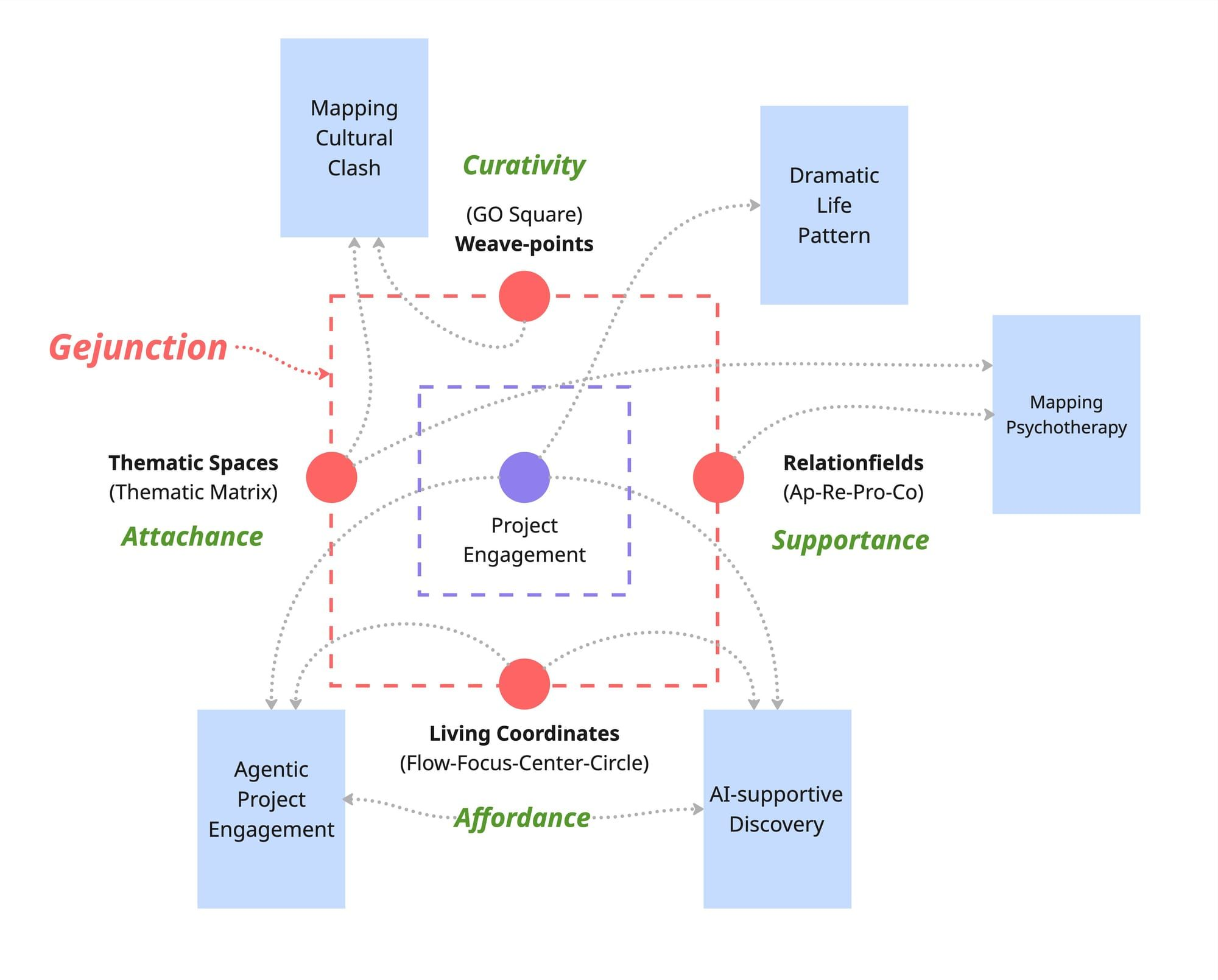
That realization on August 17 is exactly why I am editing this collection. This collection is a direct response to that shift. It is not just a personal annual reflection; it is a methodological case study of how human and AI can collaborate to make sense of a life journey. It connects directly to two specific creative themes mapped that day:
- Agentic Project Engagement
- AI-supportive Discovery
First, this project serves as a concrete case for Agentic Project Engagement—a theme applying the Project Engagement approach to understand AI agents and human-in-the-loop. An annual reflection is traditionally a solitary cognitive activity. However, by treating AI as a supporting partner, I am initiating and directing a project where the AI acts as a co-interpreter. The A/B test presented in this collection—comparing an AI-generated version based purely on accumulated memory (Version A) against a version refined through continuous human feedback (Version B)—perfectly illustrates the dynamics of human-in-the-loop. It shows how an actor perceives, directs, and acts on the possibilities generated by an AI agent.
Second, this collection is a direct manifestation of AI-supportive Discovery—a theme exploring AI tools as part of a supportive environment for human discovery. This theme grew directly out of my own experience using AI tools for creative life discovery projects. In this collection, AI serves exactly as this supportive environment. While Part 3 will explore the broader framework of "Annual Reflection as Life Discovery," this collection acts as its initial, practical demonstration.
Annual reflection is a broad and universal activity, yet the specific practices vary significantly from person to person. Even in my own work over the years, I have not strictly followed a single, fixed method. Consequently, AI-supportive annual reflection is inherently diverse—there is no single "correct" way to do it.
Editing this collection is intended as a modest starting point to initiate this exploration. It serves as a demonstration of how one might approach this theme, rather than a definitive template. I warmly invite readers to join this project, experiment with your own variations, and help push this topic further.
Featured Article
- GO Theory (Phase III): Gejunction and AI - August 17, 2026
Part 1: Before AI
Before 2022, I followed a familiar practice shared by many people: around the end of the year or the beginning of a new one, I would write a long post reflecting on the past year. It was a way to look back on my experiences, review what I had done, and share some thoughts about my personal and professional development.
In 2022, I wrote a book draft titled Creative Life Curation: Turning Experiences into Meaningful Achievements. Since then, I have treated the Annual Review as a special Creative Life Curation project. Rather than writing a single post to summarize the year's experiences, I approach it as a process of collecting, organizing, and curating materials from my creative life, followed by reflection on what they reveal. Over the years, I have experimented with different ways of conducting this process, depending on the materials available and the questions I wanted to explore.
My annual reviews have taken different forms. Sometimes, I begin with a thematic map, as I did when mapping my intellectual development in 2019. In my review of 2023, I organized a curated series of articles around the theme of Early Discovery, bringing together different aspects of my creative activities, including the curation of 26 possible books and twelve creative moments. In 2024, I explored two complementary approaches: Project Engagement, through which I examined the relationships among projects, sub-projects, and meta-projects; and Themes of Practice, through which I identified 17 creative themes and explored their broader connections. These approaches offered different ways to reconstruct the development of my creative activities.
Another recurring approach is to curate around specific creative objects and then reflect on them. These objects may include thematic maps, diagrams, book drafts, conceptual decks, articles, or collections of creative outputs. Rather than relying solely on my memory or general impressions, I revisit these concrete materials, examine their origins and relationships, and consider what they reveal about my experiences and intellectual development. The objects serve as entry points for reflection, while the process of curation helps me discover connections and patterns that might otherwise remain unnoticed.
Despite their differences, these annual reviews share a common orientation: curation comes before reflection. I do not simply look back and describe what happened during the year. I first select and organize meaningful materials, whether through projects, themes, or specific creative objects, and then use the curated collection as a basis for further interpretation and discovery.
Each approach offers a different perspective on my creative life, but they all turn annual reflection into an active creative project. In this sense, my Annual Review is not merely a retrospective account of a year; it is an opportunity to rediscover the development of my creative life through the materials I have produced and the relationships I establish among them.
Featured Article
1.1 A Thematic Map of My Intellectual Development in 2019
On November 22, 2026, while browsing through some old photos, I unexpectedly came across a diagram (see below). I created it at the end of 2019 as a thematic map of my intellectual development that year.
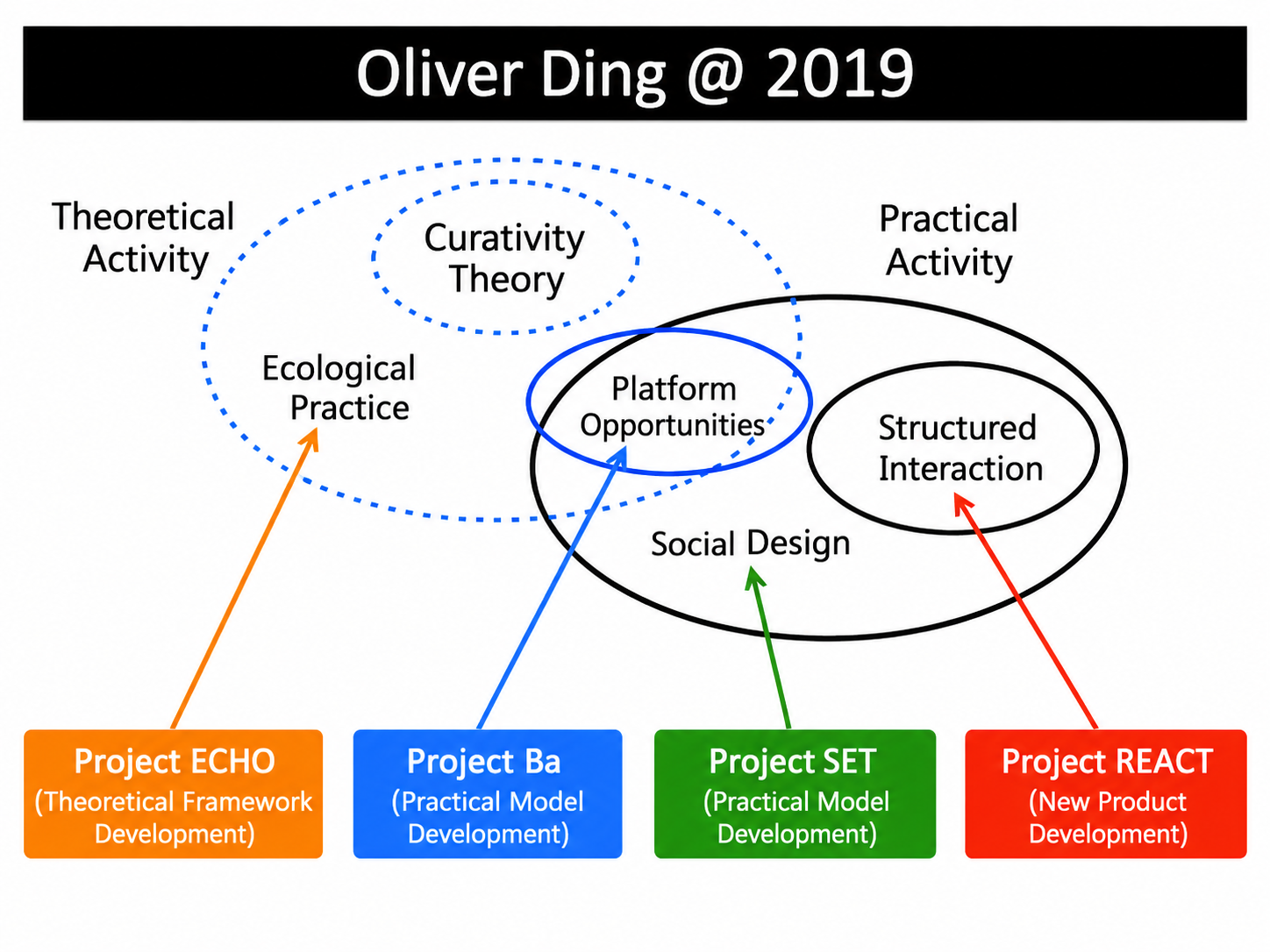
Looking at it again, I can see how it captured several thematic focuses that were taking shape through my projects and everyday work. The map distinguishes two areas of development: theoretical development, represented by dotted lines, and practical development, represented by solid lines. It also shows several projects through which these themes were explored.
At that time, I was still working at a startup, involved in digital product development and design. This professional context was an important part of my practical work, particularly my interest in Social Design.
Interestingly, although I was already mapping the themes behind my work in 2019, I had not yet formally adopted the term or method of Annual Themes. That came later, in 2023, when I began using annual themes to reflect on and organize my creative work more systematically.
- A Thematic Map of My Intellectual Development in 2019 - Nov 22, 2026
1.2 My 2023 Annual Review: Aspects of Early Discovery
In early 2024, I conducted my 2023 annual review. Unlike a single retrospective post, this review was developed as a curated series of articles and diagrams, which were later collected into Part 6 of the book draft Meaning Discovery: Capture Significant Insights in Everyday Life (2024).
The central theme that framed my creative journey in 2023 was "Early Discovery." I organized the review into a multi-chapter structure to capture different dimensions of this journey:
- Continuous Curation of Second-order Experience: Reflecting on how I processed and curated my own creative outputs.
- Aspects of Early Discovery: Tracing the development of frameworks like "Frame for Work" and the transition from spontaneous to scientific concept systems.
- Curating 26 Possible Books: A massive synthesis of my knowledge engagement projects, reviewing the book drafts developed across the Developmental Project Model, the Ecological Practice Approach, and other theoretical enterprises.
- Creative Moments: Highlighting twelve specific creative milestones and the art of early discovery.
This 2023 review demonstrates a "project-based curation" method. Instead of just listing what happened, I grouped the year's output into a cohesive thematic structure, turning a year of scattered knowledge exploration into a systematic archive of "possible books" and significant insights.
Featured articles:
- 2023: Aspects of Early Discovery (Series) and Beyond - January 1, 2024
- Oliver Ding: My Twelve Creative Moments of 2023 - January 8, 2024
1.3 Oliver Ding's Project Engagement in 2024
In my 2024 annual review, I examined my creative activities through the lens of Project Engagement, using three levels of analysis: Projects, Sub-projects, and Meta-projects. I began by mapping the major projects I had engaged in throughout the year, connecting them with their related book drafts, theoretical frameworks, and creative diagrams. This helped me reconstruct the landscape of my creative enterprise and identify several major project networks rather than viewing each project as an isolated undertaking.
I then selected several major projects for closer examination, including Creative Diagramming, Creative Life Curation, the Project Engagement Approach (v3.1), and Strategic Life Development. For each project, I traced its development, examined its relationship with other projects, and identified the frameworks and outcomes that emerged along the way. I also paid attention to the relationship between larger projects and their sub-projects, recognizing that activities such as developing a knowledge map, writing an article, or curating a possible book could serve as smaller projects within a broader creative endeavor.
Beyond individual projects, I identified several Meta-projects that revealed deeper structures in my creative journey. Two particularly significant examples were the reflection on my five-year creative journey through two GAP projects, and the development of the Self–Life–Mind schema as a meta-framework. These meta-projects were not simply larger projects; they emerged through reflection on relationships among existing projects and opened up new directions for subsequent development. I also examined unfinished projects and possible projects to capture work that had not yet reached completion or had not fully developed into actual projects.
Finally, I used this review to understand the broader transformation of my creative enterprise. By tracing the relationships among projects, sub-projects, and meta-projects, I recognized how several years of work on Knowledge Engagement and Individual Life Development were gradually giving way to a new focus on Cultural Life Development. The review also helped me see how the Creative Life Curation method itself had evolved into the Strategic Life Narrative method. Thus, my 2024 annual review was not merely an inventory of completed projects, but a reconstruction of my project engagement, its evolving structures, and the strategic shifts emerging from my creative journey.
Featured Article
- Oliver Ding's Project Engagement in 2024 - January 15, 2025
1.4 Oliver Ding’s Seventeen Creative Themes of 2024
Alongside reviewing my project engagement in 2024, I also examined my creative activities through the lens of Themes of Practice. While the project-based review helped me reconstruct how my creative work was organized and developed, this thematic review focused on identifying the broader themes that connected different projects. I identified 17 creative themes that had emerged throughout the year, beginning with two initial themes: Evolving Concept System, carried forward from my previous creative practice, and Creative Diagramming, as a new exploration. As the year unfolded, additional themes emerged from my ongoing activities.
I then examined the origins and development of these 17 themes, paying attention to how they were connected to different projects and how some themes evolved into new ones. I organized them into three thematic groups: a group centered on Evolving Concept System, a group developing around Creative Diagramming, and a third group containing other emerging themes. This grouping helped me see different trajectories in my creative practice rather than treating all themes as independent topics.
Going further, I looked for broader patterns within these groups and identified two higher-level organizing frameworks. The first was Past–Present–Future, which connected themes related to reflection, emergence and performance, and anticipation. The second was Theory–Practice, which brought together themes concerning project engagement, meta-frameworks, by-products, practical application, and theoretical curation. These frameworks helped me understand the deeper relationships among the themes and the different dimensions of my creative development.
Finally, I used the thematic landscape to recognize a significant shift in my creative direction. By the end of 2024, I had begun moving from Individual Life Development toward Cultural Life Development, represented by the emerging theme of Cultural Grounding / Cultural Growing. Looking back, the annual review became more than a retrospective account of completed projects: it allowed me to reconstruct how my creative themes emerged, developed, intersected, and eventually revealed new directions for my future work.
Featured Article
- Oliver Ding’s Seventeen Creative Themes of 2024 - January 14, 2025
Part 2: GO with AI
My Two Versions of the 2026 Annual Review
I recently conducted a small experiment using ChatGPT to produce two versions of my 2026 intellectual development review.
Version A: AI-Based Reconstruction from Accumulated Memory
The first version was generated by AI based on the accumulated information and memories available to it about my intellectual development and ongoing projects. It identified major theoretical frameworks, research directions, and creative works, and organized them into an annual development narrative.
Version B: Reconstruction through Human Feedback
For the second version, I provided additional information and feedback to clarify important relationships that were not sufficiently visible in the first version. For example, I explained how my work on World of Activity provided a foundation for Developmental Science, how Developmental Theme and Developmental Strategy formed its two complementary directions, and how my exploration of Prestructurism addressed a philosophical dimension of GO Theory.
This feedback did more than add missing details. It changed the overall interpretation of the year: from a collection of projects and publications to a developmental trajectory connecting disciplinary dialogue, Cross-Disciplinary Developmental Science, and philosophical foundations.
The comparison offers an interesting analogy to two aspects of AI development: learning from large-scale data and improving through human feedback. Of course, this is only an analogy, not a reproduction of the technical processes involved in training AI models.
I plan to publish both versions on my website and include them in an AI research project. The comparison will offer an opportunity to examine what AI can reconstruct from accumulated memory and how human feedback can reshape that reconstruction.
An Invitation to Participate
I would like to invite readers to conduct their own AI-Supportive Annual Reflection.
You can begin by asking an AI assistant to review your development over the past year, based on the information and conversation history available to it. Then provide additional feedback, correct misunderstandings, and explain connections that the initial review may have missed. Finally, ask it to produce a revised version.
If you are interested in participating in this exploration, I would welcome the original materials from your process, such as:
- Your initial prompt
- The first AI-generated annual review
- Your feedback and additional information
- The revised AI-generated review
- Your own final reflections on the process
You can decide what to share and remove any private or sensitive information before submitting your materials.
By collecting and comparing different cases, we can explore how people engage with AI to reflect on their development—and how human feedback contributes to the process.
An annual reflection can become more than a review of the past year. It can become a project of discovering how one's development has unfolded, with AI as a collaborative partner.
v1.0 - November 24, 2026 - 2,744 words