
Spatial Heuristics: Engaging with the Path of Creative Life
by Oliver Ding
November 6, 2026
This article is part of a collection: The Spatial Heuristic Sprint: A Case Study of a Two-Week Revisiting-and-Rebuilding Project.
Introduction
The two-week Revisiting-and-Rebuilding (RR) project on theme ended in the editing of a book, Developmental Theme. As I edited it, I noticed a strong similarity between the project and my 2025 thematic trip to Fuzhou. The project was a very distinctive experience. It was like a journey, though it did not take place in a physical geography. Both moved in a similar rhythm: first a return to past materials, then a period of intense engagement with the present, and finally an opening toward future possibilities.
This case has four parts. Part 1 describes the 2025 trip and the Path of Creative Life, which the preface of Homecoming used to narrate it. Part 2 explains why the book is organized differently, and how the three presents of Augustine's time structure relate to the Path of Creative Life model. Part 3 reads the two-week RR project through the same positions. Part 4 sets the project beside the trip and tests the idea of the Path of Creative Life model as a whole.
This case starts from that resonance. It asks whether the Path of Creative Life model can read the project, and what happens when the model is put into the work of editing a book. It also asks what the spatial heuristic does when the space is not a model's thematic space, but a route I have walked in the body.
Part 1: The Fuzhou Trip and the Path of Creative Life Model
1.1 The 2025 Trip
In the summer of 2025 I went back to China for a family visit, and I spent most of my time in Fuzhou. I had lived there for nearly twenty years before I moved to the United States. The trip was a re-engagement with familiar places, old friends and the memories that had shaped my earlier life.
Inspired by ecological psychology, activity theory, and phenomenological sociology, I approach Mind from an ecological perspective, integrating thinking with doing. This trip involved mental movements across multilayered spatial trajectories and temporal dimensions — reflecting, interpreting, and connecting life experiences across different scales of time and space.
I wrote about it in the preface of Homecoming, The Path of Creative Life in a Trip, and the preface is the source of the account below.
1.2 The Path of Creative Life Model
In August 2021, I created a diagram called "The Path of Creative Life." It emerged from a constellation of concepts:
- Individual actions — Activity — Collective culture
- Theme — Experience
- Reflection — Emergence — Anticipation
- Exploitation — Exploration
- Review — Orient
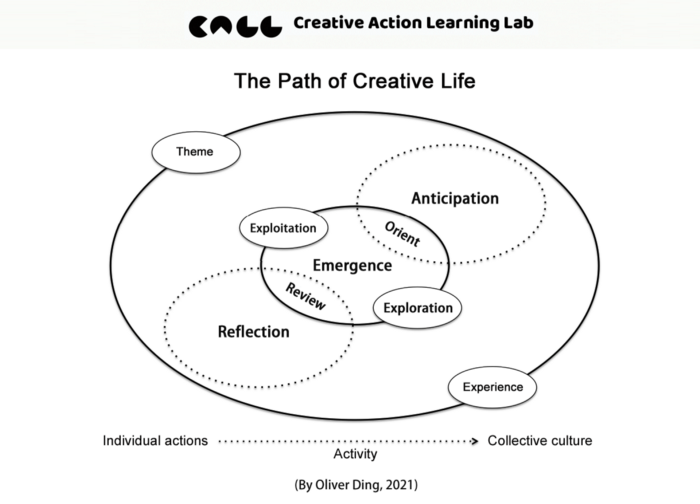
I didn't pay much attention to this diagram in 2021 because I was immersed in developing the Life-as-Project approach, which operates within the field of Activity Theory. However, in 2022, I rediscovered its theoretical value and adopted it as the foundational model for Creative Life Theory (v1.0), which I developed that year.
On July 26, 2025, as my trip in Fuzhou drew to a close, I had a striking realization: the entire trip had organically followed this model. The trip's arc — from initial themes and experiences through reflection and emergence to new anticipations — mirrored the creative life path I had theorized years earlier. That day, I spent time reviewing the trip through this analytical lens, uncovering patterns I hadn't consciously planned but had intuitively enacted.
1.3 The Trip along the Path of Creative Life Model
The preface narrates the trip through seven sections. The full text is available at The Path of Creative Life in a Trip. The summary below follows its structure.
Reviewing the Past. On June 23 I returned to China with my family. We went to Wuyi Mountain, and on the way I recalled my 2015 autobiography, A Freesoul, and the childhood experiences in it. I wrote spontaneous notes in a WeChat group, and in Fuzhou I went back to the chapters of the autobiography that dealt with my early career.
Serendipitous Emergence. On July 5 I accidentally deleted the WeChat group from my phone. A friend recovered the posts, and I moved them to a community on Knowledge Planet, where I organized them over the following days. From that work came a new project, The World of Activity of a Freesoul, and a working plan dated July 12.
Self-Referential Exploitation. I used the World of Activity approach to read my own autobiography, treating it as case material. Through several cases I derived the forms of the World of Activity that marked different stages of my life. The approach was a form of strategic self-reference that I had used repeatedly in recent years.
Immersing the Present. I spent days with old classmates and with a friend from Beijing, exploring the city together. A friend from afar mailed me his portfolio. These present-moment conversations moved between past, present and future, and they gave me new material for the daily notes.
Improvised Exploration. Some ideas came without a plan. I often carried small objects when I met friends, and these objects became anchors for conversations. This led me from the Theory as Enterprise framework to the more general Thematic Enterprise framework, and from the case of the Internet to the notion of Significant Social Forms.
Orienting to the Future. A friend from Beijing and I visited the historic district of Sanfang Qixiang and the former residence of Yan Fu. Later I recorded the episodes of my creative life after 2013, especially the emergence of my most recent projects.
An End as a Beginning. The trip ended, and the preface ends with the book that the trip made possible. The English book, Homecoming: A Thematic Trip and the World of Activity Approach, was written after I returned to the United States. The Chinese draft was about 217,665 words in its latest version.
Part 2: The Book and the Compromise
Editing a book is not the same as writing a preface. In the 2025 preface, the Path of Creative Life model gave the trip its whole structure, and seven sections were enough for a single trip. The book is different. It gathers many articles, and applying all seven positions to it would have turned its body into an account of the model. That would have been too intricate for organizing an edited book, and it would not have helped the reader see the articles.
So I took a compromise. The main part of the book is organized by Saint Augustine's temporal structure: the present of the past, the present of the present, and the present of the future.
The link between the two is not new. In 2022 I wrote Slow Cognition: Three Paths of Creative Life and A Semiotic System, and there I set out how the Path of Creative Life connects with Augustine's time structure through the ontology of action of the theoretical sociologist Ping-keung Lui. Lui's starting point is the statement that "the body is in action, action is in the fleeting moment, the fleeting moment is in the body." In his account the fleeting moment comprises the present of the past, the present of the present, and the present of the future. The actor remembers in the first, pays attention in the second, and expects in the third.
Read against the Path of Creative Life model, the correspondence is direct. Reflection is the remembering in the present of the past. Emergence is the attention in the present of the present. Anticipation is the expecting in the present of the future. The figure The fleeting moment shows the same three presents, with Theme and Experience around them.
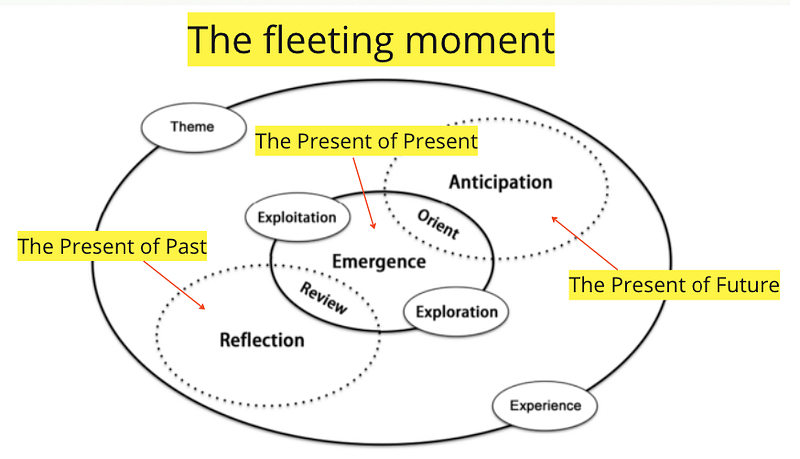
The connection changed how I thought about the Path of Creative Life model. It could serve as an ontology of a life strategy project, and Lui's approach could help me curate my frameworks into a meaningful whole. The Augustine structure is therefore not a different model. It is the three presents of the Path of Creative Life model, kept in the book without the rest of its positions.
The three main parts of the book follow these presents:
- The Present of the Past collects retrospective articles written over the past few years on several key themes and concepts. They are the articles I returned to most often during the RR project.
- The Present of the Present focuses on the rebuilding phase of the project, in which the Weave-the-Theme Framework and the Thematic Engagement Toolkit were brought forth. Its last chapter, Creating with Spatial Heuristics, records the spatial heuristics used in the process.
- The Present of the Future focuses on the new creative visions that emerged from the project. It uses Developmental Theme to frame the exploration of theme as a knowledge ecology, and it proposes an account of the genesis of the concept system within the GO Theory platform. Both visions are open for future development.
The other two parts of the book are extended reading. Part 4 gathers case studies that show how theme functions in four types of projects. Part 5 is a reading guide to the chain of genesis, with the articles arranged by the four layers of the Toolkit.
Part 3: The Two-Week RR Project
When the book was finished, I began to gather the spatial heuristic cases that the project had produced, for a new special collection. That was when I picked up an idea I had set aside. The book was not suitable for the Path of Creative Life model, but the RR journey fit the model so closely that it seemed a pity not to use it as a case of spatial heuristics. So I read the project through the seven positions of the model, in the order in which they occurred.
The RR project ran from October 15 to 31, 2026. Its record is the chat logs, private notes and articles of those days, and I use them as the source for each position below.
Reviewing the Past. On October 14 I had finished the Developmental Strategy manuscript. On the morning of October 16 I wrote to Claude about the Curativity of Mind model, version 3.0, which I had written a year earlier. I wanted to rename it, clarify its diagram and sidebars, and reflect on it within the GO Theory platform.
Serendipitous Emergence. On the morning of October 17 I compared the model with the S-T-O principle, and I found that the model did not consider the O of objectification. Then, in the third article, I found a paradox: Thematic Engagement had hosted a rich theoretical enterprise, but it had never been raised to a concept. The question of the project changed with it.
Self-Referential Exploitation. The frameworks I used to test the new concept were my own: the ENFE schema, the Weave-the-Theory model, and the 4M schema. I wrote the first articles of the series on them, and I drew the Weave 16 grid, the four-layer diagram and the Landscape of Thematic Engagement on Miro.
Immersing the Present. Between October 19 and 23 I wrote and published three articles, and each was tested against the diagrams. This was the period of intense engagement with the present.
Improvised Exploration. The name t-only came on October 19 from a comparison I made in the discussion. The name Developmental Theme appeared only later, while I was reviewing the fifteen creative journeys. On October 25 the typology of theme changed its aim from proposing a classification to curating earlier attempts.
Orienting to the Future. The project ended by pointing to what comes next. Two of its outcomes set new objectives. Developmental Theme gave the theme a future as a knowledge ecology, and the account of the genesis of the concept system gave me a question to pursue. The plan for Cognitive Hydrology 2.0 was set aside during the editing, but it did not disappear. It returned as a direction that remains open.
Part 4: Two Journeys in Three Layers
Once the project is read through the seven positions, I can put it beside the trip. Both are journeys that the model describes, and the question is what they share and where they part.
They share a form. In both, I returned to the past, was turned by something I had not planned, used my own tools, was absorbed in the present, improvised, and turned toward the future. I recognized the form in the body before I could state it in a text. In the trip I saw the arc only after it had ended, on July 26. In the RR project I saw the rhythm while the editing was still going on.
They also differ. The trip happened in places: Wuyi Mountain, the old city of Fuzhou, the former residence of Yan Fu in Sanfang Qixiang, and the friends I met there in person. The RR project had no such places. The turn in the trip came from an accident with a WeChat group. The turn in the project came from a paradox in my writing. The trip left daily notes in Chinese, and the project left chat logs, private documents and published articles. The trip ended with a preface and a book drafted in two languages. The project ended with a book, a framework, a toolkit and a concept, all within two weeks. The trip lasted weeks, and the project lasted fifteen days.
Ecological Formism is the structure I have used throughout this creative process, and it is also the structure that the other cases of the series rely on. It sorts any object of knowledge into four layers along one continuum.
- The Invariant is a stable basic form.
- The Quasi-invariant is a pattern that recurs across cases and adjusts to each of them.
- The Variant is a particular, situation-bound instance.
- The Invariant set is a group of invariants standing in a part-to-group relation.
The layer of an object depends on the scale at which it is seen. In the Thematic Engagement Toolkit, the four concepts occupy these four layers: Thematic Cognition is the invariant, Thematic Activity is the quasi-invariant, Thematic Situation is the variant, and Thematic Enterprise forms the invariant set. The same principle, applied at each scale, is what allowed the toolkit to be built.
Read in this way, the three elements of this case form three layers. The three presents of Augustine are the Invariant, the basic form of time that does not depend on any particular creative work. The Path of Creative Life model is the quasi-Invariant: its seven positions recur in the 2025 trip and in the two-week project, but each time they take a different shape. The variant layer is the situation in which the model is enacted. Here there are two cases. The 2025 trip was a thematic trip, a movement out of the house into places, among friends and memories. The 2026 project was a revisiting-and-rebuilding project, carried out at home rather than on a journey, at a desk with diagrams and chat logs. The difference between the two is therefore a difference of the variable layer, the way the same arc was lived in a different situation.
Conclusion
The spatial heuristic shows itself in this case in two ways.
The first is in the project itself. The seven positions of the Path of Creative Life model changed from one to the next, and each change was a movement between thematic spaces. These spaces are anchored by the three times of Augustine: the present of the past, the present of the present, and the present of the future. The project was not a line of stages. It was a movement among spaces of time, and the Path gave that movement its order.
The second is in the analysis itself. This case began with the two-week project, went back to the 2025 trip, and returned to the present. That movement is also a movement between thematic spaces, now anchored by the three layers of Ecological Formism: the invariant, the quasi-invariant and the variant. The analysis could only be carried out because each layer was a space that could be entered and left.
This case therefore shows that the spatial heuristic works in three kinds of space. It works in physical space, as in the Fuzhou trip, where places held memories. It works in the abstract space of a time structure, as in Augustine's three presents. And it works in the thematic spaces behind a knowledge model, as in the layers of Ecological Formism and the four layers of Thematic Engagement, each of which is a thematic space into which an analysis places something. The contribution of this case to the collection, and to the series as a whole, is that it makes the third kind visible. The spatial heuristic is not confined to a diagram or to a terrain. It operates in the thematic spaces that lie behind the models themselves.
v1.0 - November 6, 2026 - 2,866 words