
Spatial Heuristics: From Local to Global
A case study of revisiting-and-rebuilding the Curativity of Mind model
by Oliver Ding
October 18, 2026
This article is part of a collection: The Spatial Heuristic Sprint: A Case Study of a Two-Week Revisiting-and-Rebuilding Project.
Introduction
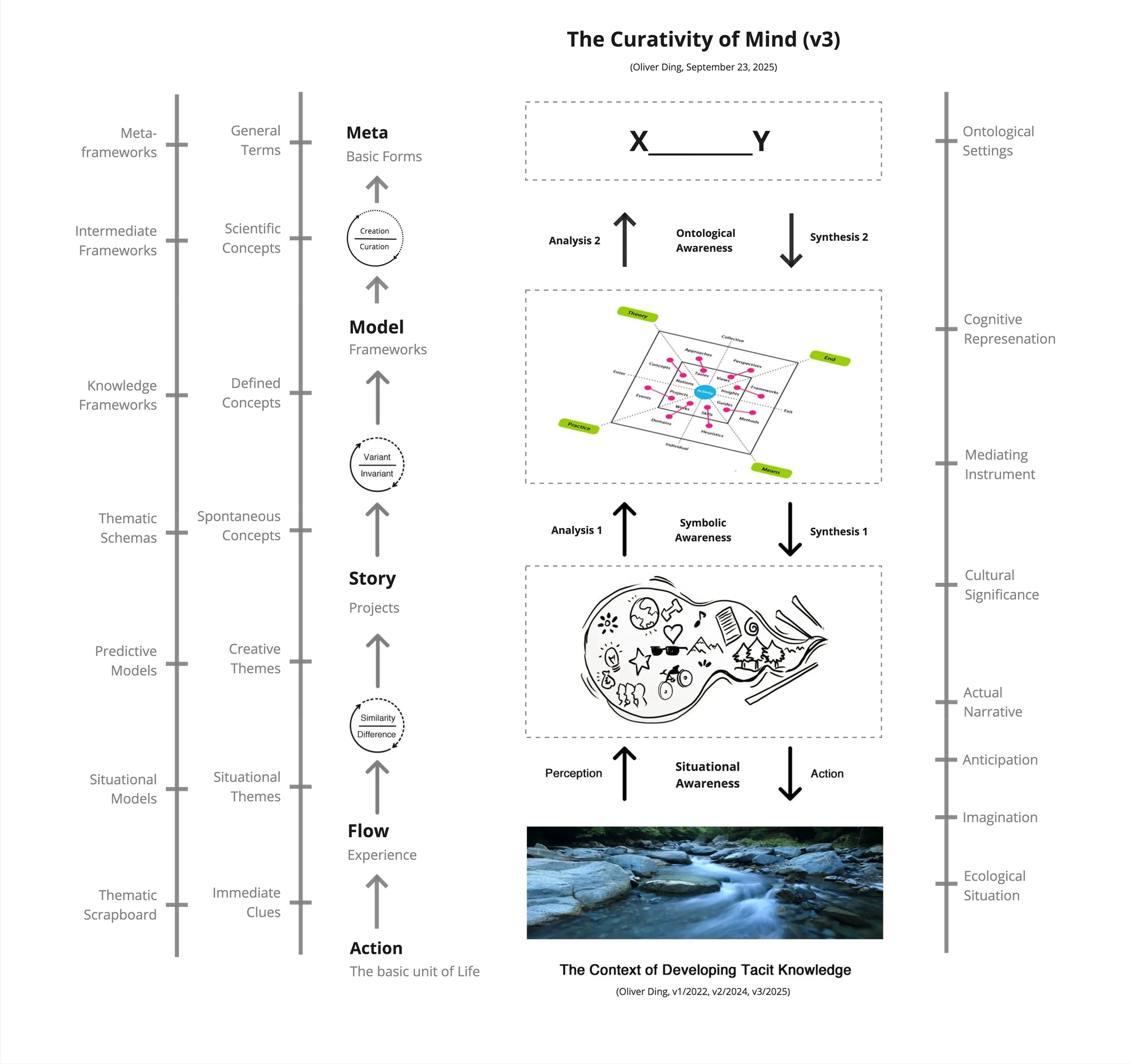
This case records my work on October 16 and 17, 2026. The times given for each part are approximate. The subject was the Curativity of Mind model. I first drew it in 2022 as a three-level schema, Flow–Story–Model. In 2024 I added a Meta level, and in 2025 I added three sidebars. Over the years I used it in several projects, and each use changed it a little.
In October I did not extend the model. I made it smaller, moved the smaller version into another framework, and then placed the result back onto the larger map it came from. I organize the case in four parts, and each part describes one spatial move:
- Part 1: From broad to narrow.
- Part 2: Detach and attach.
- Part 3: See local from global.
- Part 4: Expand from local to global.
Each part follows the same pattern: the situation at the time, the tools I used, the questions I was working on, the solution I reached, and the interim insight that came out of it.
Part 1: From Broad to Narrow
Approximate time: the afternoon of October 16, 2026.
This part covers the first move. I asked what the model is really for, compared its versions, and decided to narrow its scope. It is the starting point of the whole case, because every later step depends on what was chosen here.
1.1 The situation
I started from one question: what is the essence of this model? The model had lived through several versions, and I could no longer say with confidence what it was for. The name Curativity of Mind no longer fit the current version, and the current version had no name. The earliest version was called Context of Developing Tacit Knowledge, which described its original scope.
1.2 The tools
The core tool is the Concept Dynamics model, which I developed in 2020 and published with the Creative Action Learning Lab. It treats a concept as a system with three corners and three sides, set inside a context.
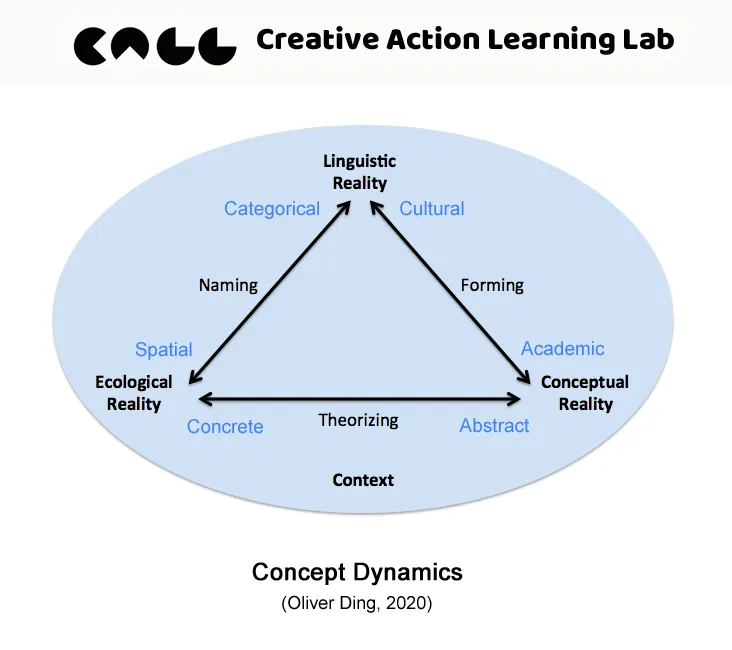
The three corners:
- Ecological reality: what a researcher actually experiences in the world. This corresponds to personal knowledge.
- Conceptual reality: the result of creative conceptualization. This corresponds to public knowledge.
- Linguistic reality: the form of expression, with its language and rhetorical effects. This corresponds to everyday language.
The three sides, each with two named ends:
- Naming, between ecological and linguistic reality. The ecological end is "spatial" and the linguistic end is "categorical."
- Forming, between linguistic and conceptual reality. The linguistic end is "cultural" and the conceptual end is "academic."
- Theorizing, between ecological and conceptual reality. The ecological end is "concrete" and the conceptual end is "abstract."
The context is the ellipse around the triangle. It is the changing background of a concept across periods of its development.
Three features of the model mattered for this work. The development is non-linear, so there is no fixed starting corner. An ideal concept has no internal contradiction among its three sides, and no outside contradiction between those sides and its context. And when a concept is moved into a new context, it is reconceptualized, which produces several meanings.
I also compared the versions side by side: the 2022 schema, the 2024 version with Meta, and the 2025 version with sidebars.
1.3 The focal questions
- What stays the same across versions, and what changes?
- Which side of the triangle does each version use most?
- Is the broad scope still useful, or should the model be narrower?
1.4 The solution
The triangle showed me a clear gap. The 2022 schema has no direct side from Flow to Model, which is theorizing: going from concrete experience straight to an abstract model. The 2024 version added Meta, which reads as the context in which concepts are kept as public knowledge. The 2025 sidebars are the lived-experience side of the triangle. Their fine levels came from my own creative projects, which I had summarized for years.
From this I chose to narrow the scope. The broad version covered the development of tacit knowledge in general. The narrow version covers the development of themes, concepts, and frameworks. I did not throw away the broad version. Each version has its own reason to exist, so the narrow one is a new version next to it.
1.5 The interim insight
The main structure held across versions. What changed was the scope, and the change of scope was a choice about what the model is for.
Part 2: Detach and Attach
Approximate time: the evening of October 16, 2026.
This part covers the second move. I took the narrow version out of the Curativity of Mind model, gave it a provisional name, and attached it to Cognitive Hydrology. The question was what the new version keeps from the old one, and what it adds.
2.1 The situation
With the narrow version chosen, I needed to take it out of the Curativity of Mind model. I gave it a provisional name, the T-only model, where T stands for theme. Then I attached it to Cognitive Hydrology, the theoretical enterprise that studies how themes and concepts develop in one person's creative life.
2.2 The tools
Three tools were used here.
The 2022 schema, Context of Developing Tacit Knowledge. It was influenced by James March's distinction among three kinds of wisdom: action, story, and model. At the time I paired these with Flow, Story, and Model. That pairing was later judged an error, because the word Story in the schema carries two meanings: raw material, which is experience already put into text, and a form of cognitive representation parallel to Model. The schema therefore could not be read as a direct match to March's three terms.
It combined two things. The first is a diachronic development of abstraction levels: Flow is experience, Story is experience already put into text, Model is a set of frameworks, and Meta is the level of basic forms. The levels were drawn as a single chain, Flow, Story, Model, Meta, but that was a mistake in the drawing. Flow can go directly to Story, and it can also go directly to Model, so the levels are linked by several paths, not one line. Each path has its own move: Flow to Story is similarity and difference; Story to Model is variant and invariant; Flow directly to Model is theorizing; Model to Meta is creation and curation.
The second is a synchronic canvas: the Thematic Space Canvas, later called the KDC, which lays out a configuration around a theme, like a city with entrances and exits. The Model level was an abstraction level, not the canvas itself.
The three awareness pairs, placed at the center of the diagram: Situational Awareness, Symbolic Awareness, and Ontological Awareness. Each pair has an upward arrow called Analysis and a downward arrow called Synthesis.
The six operations of Slow Cognition, from the Cognitive Hydrology documents: Thematic Exploration, Embodied Experience, Thematic Conversation, Conceptual Thinking, Strategic Curation, and Continuous Objectification.
I also used the five operations of the Thematic Space, from the 1.0 documents: separating name from reality, injection and outflow, juxtaposed presentation, gathering and refinement, and separation and displacement of use.
2.3 The focal questions
- What did the T-only model inherit from the Curativity of Mind model?
- What is new when it sits inside Cognitive Hydrology?
- Where does Story and Model fit, given that Cognitive Hydrology already has its own operations?
2.4 The solution
I sorted the parts into two lists.
What was inherited: the awareness pairs and the movement from concrete to abstract and back again. The idea that experience comes first also came with it. The Flow, Story, and Model levels did not come across as a fixed sequence; they were later read as spaces and as forms of representation.
What is new: the focus on how themes and concepts develop, the link to the six operations, and a clearer claim about Story and Model. In the Creative Diagramming article on kinds of cognitive representation, I found seven operational types of representation. I matched Story to metaphorical stories, a loose structure in words, and Model to knowledge diagrams, a structure in space. That match is still for me to confirm.
2.5 The interim insight
Detaching and attaching made the boundary clear. The T-only model now says what it covers. Cognitive Hydrology says what it adds. Story and Model are two parallel forms of representation, one in words and one in space, and that gives the T-only model a concrete form that the old model did not have.
Part 3: See Local from Global
Approximate time: the morning of October 17, 2026.
This part covers the third move. I looked at the narrow model from the larger map of the platform, using Ecological Formism. The aim was to see which layer the model belongs to, and what its surrounding structure looks like.
3.1 The situation
With the narrow model in place, I looked at it from the larger map of the platform. The platform's meta-frameworks include Ecological Formism, which I used because its key principle is that it can be applied at any scale.
3.2 The tools
Two tools, plus the model itself.
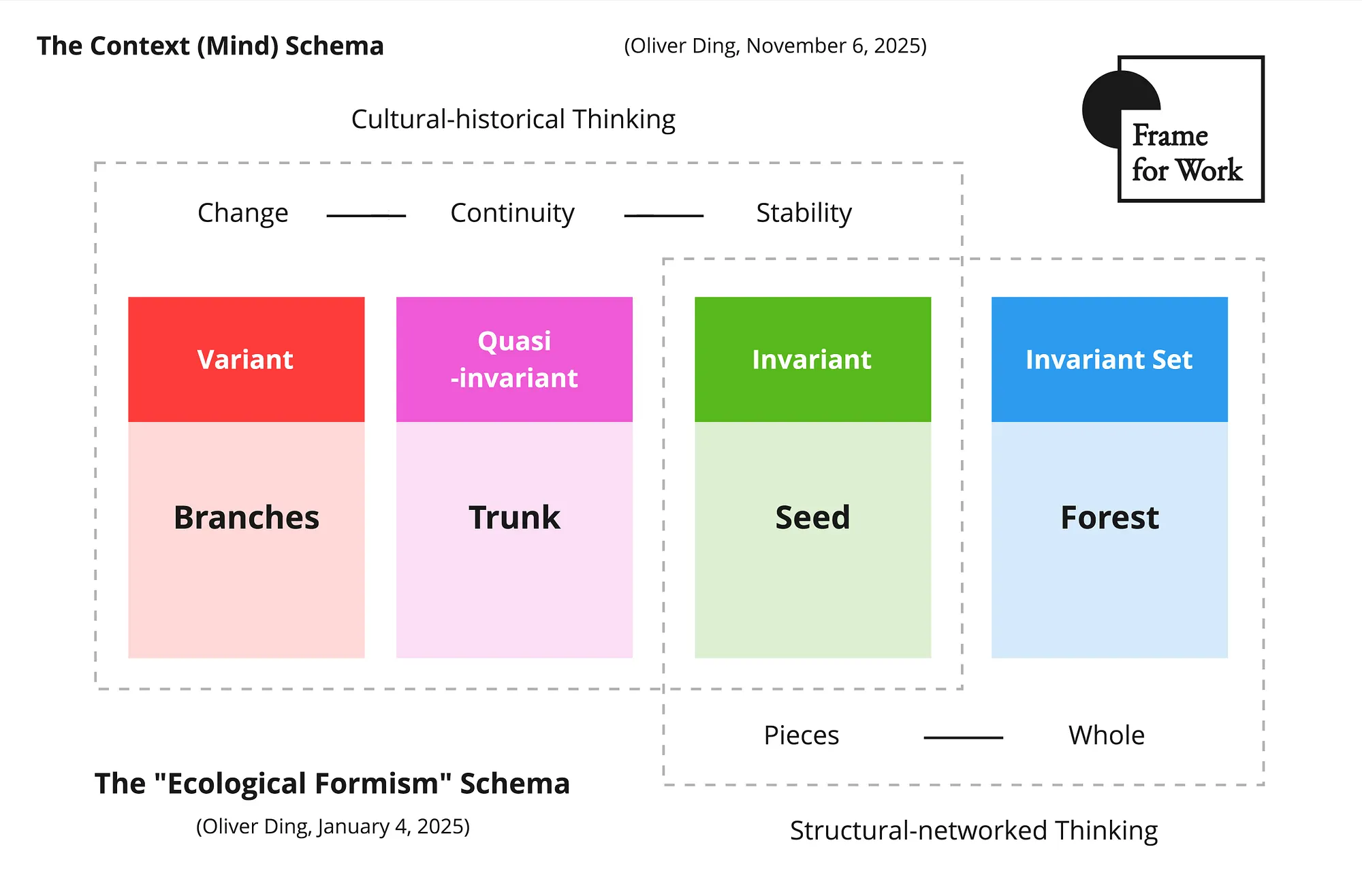
Ecological Formism. It sorts any object into four layers along one continuum: variant, quasi-invariant, invariant, and invariant set. A variant is a particular case. A quasi-invariant is a pattern that recurs across cases but adjusts to each. An invariant is a stable basic form. An invariant set is a group of invariants in a part-to-group relation. The principle is scale-free: the same object can sit in different layers at different scales.
The Creative Life Square. It is a sub-square of GO Square, an 8 × 8 grid with 64 weave-points. Its structure is S–T–O: subjectification (lived experience), thematic crystallization, and objectification (products). The vertical axis is the scale of experience, in three groups:
- Individual: TT, CDM, CLC.
- Two or more people: CON, SLD, SLN.
- Enterprises with several themes: CD, GC.
The horizontal axis is the kind of product, in eight types: TC, TM, TO, TE, PB, SP, AP, CC.
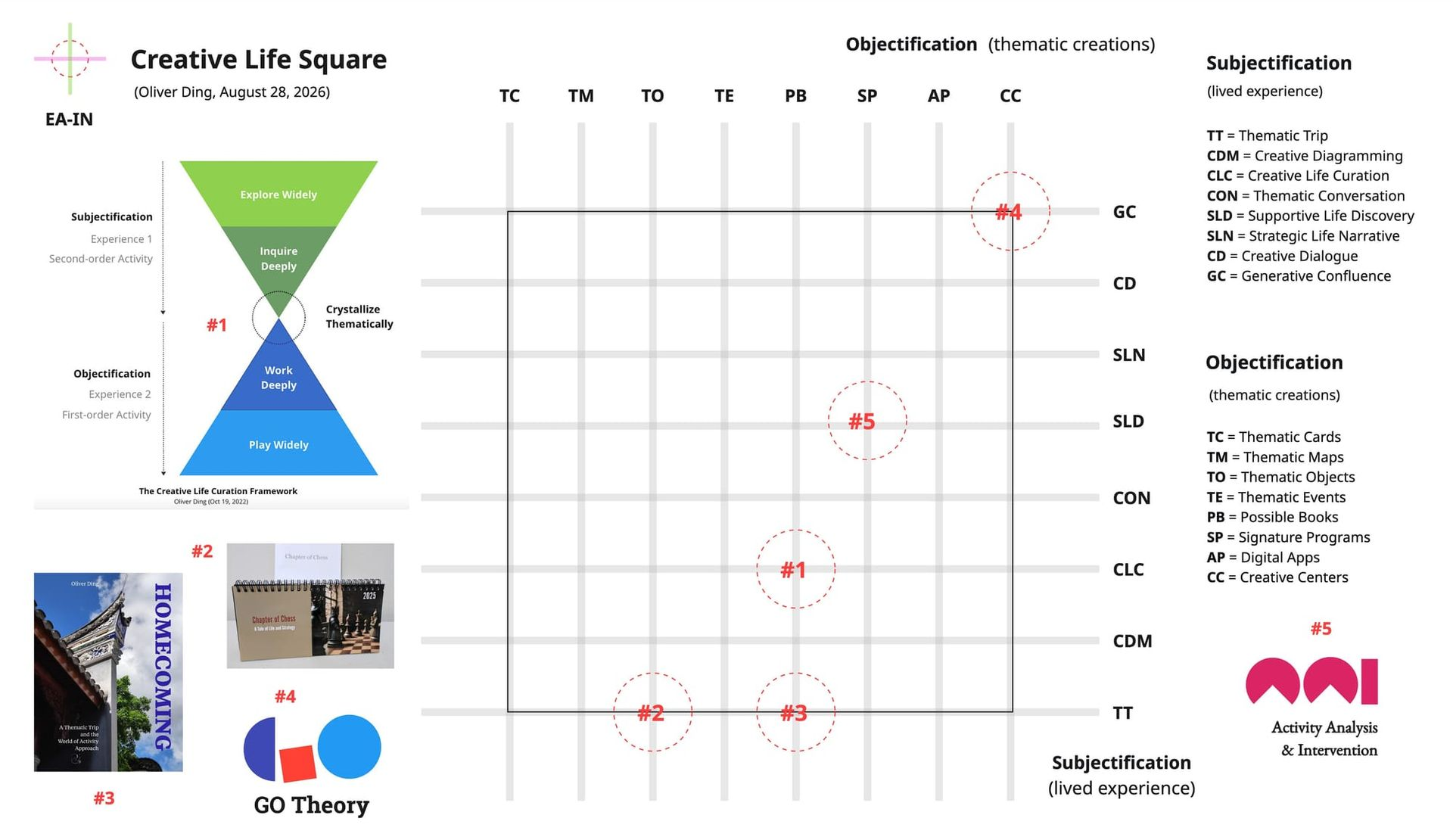
The T-only model itself: the invariant that describes how a theme moves through four thematic spaces, from concrete experience to abstract concept and back.
3.3 The focal questions
- Which layer does the T-only model belong to?
- What is the square, in relation to the model?
- What is a case, in relation to the layers?
3.4 The solution
I placed the results in three layers.
Invariant layer. The T-only model. It describes how a theme moves through four thematic spaces, from concrete experience to abstract concept and back. I take it to hold in every case.
Constant frame. The Creative Life Square. Its vertical axis is the scale of subjective experience: an individual, two or more people, or an enterprise with several themes. Its horizontal axis is the kind of product, from thematic creations to creative centers, with eight kinds in total. Each cell pairs one scale of experience with one kind of product.
Variable layer. The situations that enter the cells, and the concrete operations that develop inside each cell. Each case is one instance, not the layer itself. My Closure and Unfolding theme, which began with a photo taken at Pengdun, is one such instance.
I made a correction here. I had first put the square in the constant layer. I then saw that the square is quasi-constant. Its structure is stable, but its cells hold different content. I also saw that the constant layer is the same as the invariant layer.
3.5 The interim insight
The layer a thing belongs to depends on the scale at which I look at it. At the platform's scale, the T-only model is invariant. At its own scale, it is a continuum of four stages. The square sits between them and gives the cells a stable structure.
3.6 Detail: The Two Meanings of Meta
This detail belongs to the work of Part 3. It shows how one level of the model turned out to carry two meanings, and how I came to see the second one only after the first had been settled.
The situation. By the time I was looking at the three layers, the top of the main ladder, Meta, was still the least clear. Earlier I had written it as the fourth and highest rung: Flow, Story, Model, Meta, each more abstract than the last. In the Ecological Formism reading, I had aligned Meta with Invariant Set, but only approximately, because Invariant to Invariant Set is a part-to-group relation, not a further step of abstraction.
My first reading. I read Meta as one more rung. Model holds frameworks, and Meta holds general terms and basic forms. The tools I used were the main ladder and the Ecological Formism continuum. The question I was working on was whether Meta was a rung that could be placed on the same ladder as Model, or whether it needed a different place.
The correction. The author pointed out that Meta is not only a further abstraction of Model. It has a second dimension: it looks at the knowledge system and the knowledge ecology, and it decides which elements should be kept as public. In this reading, Meta is not the top of a ladder of abstraction. It is the level where a field decides what stays shared.
The author drew this from a teacher's work in theoretical sociology. That work analyzes several sociological theories and extracts more general meta-terms that can serve across them. The example is useful because it shows a level whose job is not to go higher, but to select and keep what a whole field can share.
The link to public and private. Once Meta was read as public retention, it connected to a distinction already in the framework. In the Frame-for-Work article, Knowledge Frameworks are public, while Mental Models are private. Meta, in this second meaning, is the level that moves an element from private to public. This gave the second meaning a concrete place in the model, not just a loose idea.
The check against the Invariant Set. The author then read Invariant to Invariant Set as the relation between a sociological theory and theoretical sociology. Under that reading, Invariant Set is the group of theories' invariants, gathered into general terms. This matched the public curation of Meta. The approximate alignment I had made earlier became a more exact one: Meta corresponds to Invariant Set in the sense of a shared group.
This also changed the label. The label "Basic Forms" fits a group of forms better than a single framework, so it sits more naturally with Invariant Set than with Invariant. The conflict I had seen between the two was therefore reduced.
What stayed open. Two questions were raised but not settled. The first was whether Meta could be read as the context in the Concept Dynamics ellipse, where public retention happens. The second was whether Meta sits at the top of the Concept side. The second was later corrected: Concept and Activity are one pair in the lower part of the Body System, so Meta cannot be the top end of a Concept side.
Interim insight. Meta has two meanings that belong to one level. The first is a step up in abstraction. The second is the act of keeping what a field can share. The second meaning is the one that explains why Meta is the furthest level the model reaches, and why the limit of meaning lies outside it. The first meaning is easier to see; the second needed a case from outside the model to become visible.
Part 4: Expand from Local to Global
Approximate time: the afternoon of October 17, 2026.
This part covers the fourth move. I put the result back onto the larger map. The HLS map shows Cognitive Hydrology across four regions, and the question was where its parts actually belong.
4.1 The situation
I put the result back onto the larger map. On the platform's map of March 16, 2026, Activity Analysis sits at the center, with four enterprises in four directions. I had placed Cognitive Hydrology at the top, under Creative Cognition, near the limit of meaning. I had made that placement because the map had to show five enterprises at once.
4.2 The tools
Four tools.
The platform map of March 16, 2026. Activity Analysis sits at the center, labeled Life as Activity or Project Engagement. Four enterprises sit in four directions: Strategic Development toward individuals on the left, Cultural Anticipation toward collectives on the right, Platform Ecology toward science at the bottom, and Cognitive Hydrology toward creative cognition at the top.
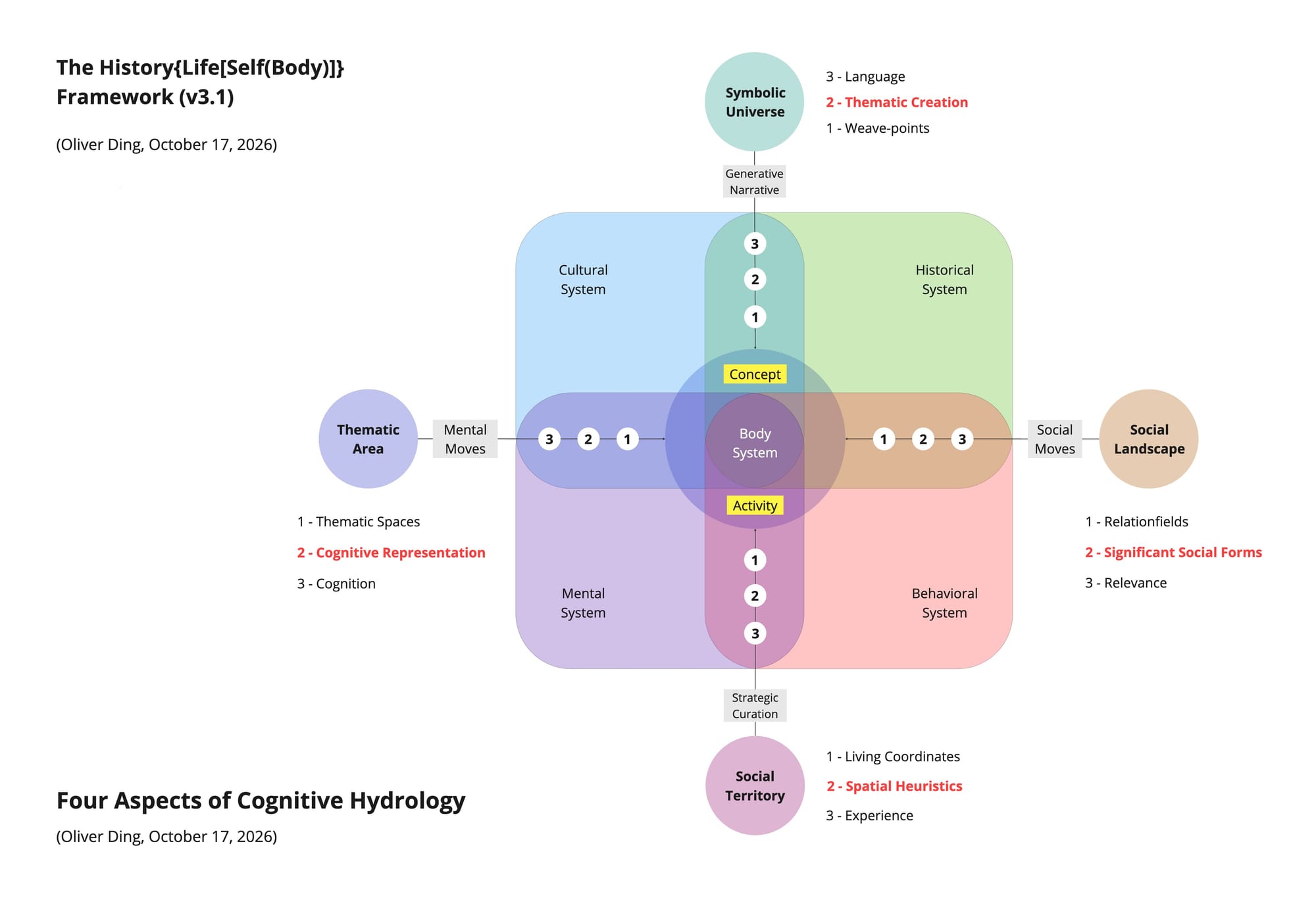
The HLS version 3.1 diagram of the four aspects of Cognitive Hydrology. The Body System sits at the center. Four regions surround it: Symbolic Universe at the top, Thematic Area on the left, Social Landscape on the right, and Social Territory at the bottom. The left axis carries Mental Moves, the right axis Social Moves, the top Generative Narrative, and the bottom Strategic Curation. On each axis, three numbered items count outward from the body: 1 the Gejunction aspect, 2 the Cognitive Hydrology part, and 3 the dimension.
The Creative Diagramming typology. It lists seven operational external representations: thematic lists, metaphorical stories, thought experiments, conceptual tables, knowledge diagrams, mathematical formulas, and computer simulations. It compares them on three aspects: linguistic, spatial, and computational.
The Concept–Activity pair at the Body System, which corresponds to Theme–Project. It sits in the lower part of the Body System, near Activity.
4.3 The focal questions
- If Cognitive Hydrology is placed at the top only because of the layout, where does it really belong?
- Which parts of each HLS region already belong to Cognitive Hydrology?
- Where does the Concept–Activity pair sit?
4.4 The solution
I expanded Cognitive Hydrology across all four HLS regions. Each region now has three numbered items, counted outward from the Body System.
- Number 1 is the Gejunction aspect: Weave-points in the Symbolic Universe, Thematic Spaces in the Thematic Area, Relationfields in the Social Landscape, and Living Coordinates in the Social Territory.
- Number 2 is the Cognitive Hydrology part: Thematic Creation, Cognitive Representation, Significant Social Forms, and Spatial Heuristics.
- Number 3 is the dimension: Language, Cognition, Relevance, and Experience.
Each Cognitive Hydrology part has a source in my own earlier work: Thematic Creation from ACS, Cognitive Representation from Creative Diagramming, Significant Social Forms from the Social Landscape work, and Spatial Heuristics from this series. The Thematic Space that the T-only model describes is the Thematic Area, and its working form is Cognitive Representation.
The Concept–Activity pair, which corresponds to Theme–Project, sits in the lower part of the Body System, near Activity. Following Andy Blunden's idea that activity is concept formation, I read Concept and Activity as one process seen from two sides. I considered Identity as a possible third element, and set it aside: theme and identity belong to GO Theory version 1.0, which is already complete.
Two corrections came up in this part. First, I had placed Cognitive Hydrology only in the Symbolic Universe, but version 1.0 is grounded in individual experience, so the placement was a choice for the map and not a limit on the theory. Second, I had placed Meta at the concept end of the axis; the correct reading puts it in the lower part of the Body System, with Concept and Activity as one pair.
4.5 The interim insight
Cognitive Hydrology is not a theory of one region. It runs through all four. The first placement was a layout choice. The HLS map shows its full shape, with a module in each region.
Part 5: A New Framework and Toolkit
This part presents what came out of the four moves as a framework the reader can use. It has four sections: the model itself, the toolkit that goes with it, the split of Meta into two words, and the development of the word ecology.
The T-only model draws on three primary sources:
- The Curativity of Mind model. It is the origin of the model. Its structure, its sidebars, and its concept-dynamics reading were carried into the narrower version.
- The theme–concept–framework schema. It sets the four thematic spaces. It is described in the April 2026 article "The Theme–Concept–Framework Transformation (2023–2026)," which traces the sequence from clues and themes to concepts, frameworks, and meta-frameworks.
- The recent work on knowledge ecology. It is the source of the word ecology, which appeared in several book drafts after April 2026 and marked the point where the top of the sequence moved from meta-frameworks to ecology.
5.1 The T-only model
The T-only model describes how one person's theme develops. T stands for theme. Its essence depends on context. The same structure can describe a theme's growth from experience to concept, the building of a concept system, or a field's orientation toward shared value. The model therefore has no single fixed meaning; its meaning is set by the context in which it is used.
The current context is the theme–concept–framework–ecology schema. A schema is described in language and can be detached from any diagram. A model, by contrast, has a concrete diagram. The T-only model is drawn as a diagram, and the schema is the sequence within which it works. The four thematic spaces of the T-only model are set by the theme–concept–framework–ecology schema. Their meanings are as follows:
Space 1: From action to experience, from experience to theme. Creative inspiration develops from a pre-linguistic stage to a stage of linguistic naming. A theme first appears as something felt in action and experience, before it has a name.
Space 2: From theme to concept. Thinking moves from vague stirrings and inspiration to formed thought. It produces a simple structure: one theme and one concept. The result is expressed as a story, a model, or another cognitive representation.
Space 3: From concept to structure. Simple structures become compound structures. Several themes form a theme network, and several concepts form a concept system. The results are again expressed as stories, models, or other representations.
Space 4: Deepening, and attention to the knowledge ecology. Theme, concept, and framework develop at a higher level: meta-frameworks, meta-terms, and meta-diagrams. This space also attends to the whole knowledge ecology, so that the development of themes, concepts, and frameworks is considered in light of the progress of the field as a whole.
The four spaces run from concrete to abstract, and the sequence ends in the field. Across the four spaces, a theme can return to experience to be checked. This return is the test of having actually seen it. So the model is a loop from concrete to abstract and back to concrete, not a one-way ladder.
In the larger map, the T-only model sits in three places at once. It is the middle letter of S–T–O, with subjectification on one side and objectification on the other. It is the Thematic Area of HLS, whose working form is Cognitive Representation. And it is the lower part of the Body System, where Concept and Activity form one pair, corresponding to Theme and Project.
The four spaces form the main of the model. From the main, several dimensions can be drawn out, and each dimension crosses all four spaces, with a value in each one. The structure is the same as the strategy used in World of Activity v2.0: the four FFCC positions define the thematic spaces, and seven dimensions then cross those four spaces, each giving a value to every position. In the T-only model, the four spaces play the role that FFCC plays there. The four spaces give the development over time, which is diachronic. The dimensions give the pattern at each moment, which is synchronic. The 2022 schema combined the same two kinds of structure: the development of abstraction levels, and the canvas of a configuration.
For the T-only model, the four dimensions are given by the Milieu–Mediator–Method–Mastery schema. Each dimension is one row of the grid, and each row gives a value for each of the four spaces.
| Dimension | Space 1 | Space 2 | Space 3 | Space 4 |
|---|---|---|---|---|
| Milieu | to be filled | to be filled | to be filled | to be filled |
| Mediator | to be filled | to be filled | to be filled | to be filled |
| Method | to be filled | to be filled | to be filled | to be filled |
| Mastery | to be filled | to be filled | to be filled | to be filled |
In the current mapping, Mastery is the main movement itself, Mediator is carried by the concept units in the two left sidebars, and Milieu and Method are carried by the right sidebar. How the right-sidebar items divide between Milieu and Method is still to be decided. The grid is a template to be filled, not a set of results already reached.
The four spaces also align with the four FFCC positions: Space 1 with Flow, Space 2 with Focus, Space 3 with Center, and Space 4 with Circle. This alignment is not a coincidence. Both the World of Activity and the T-only model are applications of the same basic principle of Ecological Formism, applied at two different objects: the whole life and the theme. The principle yields a four-position structure in each case, and each application fills that structure with its own content.
5.2 The toolkit
The toolkit has six tools. Each is a way of moving through the model.
- Concept Dynamics. Use it to read a concept as a triangle with three corners (lived experience, public concept, everyday language), three sides (naming, forming, theorizing), and a surrounding context. Use it when a concept seems to be missing a side, or when its meaning has shifted in a new context.
- Story and Model as forms of representation. They are parallel, not steps in a sequence. Story is a representation form carried in words, corresponding to metaphorical stories among the seven operational kinds of representation. Model is a representation form in space, corresponding to knowledge diagrams. Both are used across Spaces 2 and 3. The word Story also has an earlier sense, as raw material: experience already written into text. That earlier sense belongs to Space 1, while the representation sense belongs to Spaces 2 and 3. In the 2022 schema, the Model level was an abstraction level in a diachronic development, while the canvas, the KDC, was the synchronic pattern. The two should not be confused.
- The awareness pairs. Three pairs sit at the center: situational, symbolic, and ontological awareness. Each pair runs upward as analysis and downward as synthesis.
- The six operations of Slow Cognition. Thematic Exploration, Embodied Experience, Thematic Conversation, Conceptual Thinking, Strategic Curation, and Continuous Objectification.
- The five operations of the Thematic Space. Separating name from reality, injection and outflow, juxtaposed presentation, gathering and refinement, and separation and displacement of use.
To use the toolkit on a theme, place the theme on the four spaces, check its sides with Concept Dynamics, choose the representation that fits its stage, and run the operations that match the move needed.
5.3 Meta and ecology
The earlier version of the model used one word, Meta, for the top of the ladder. That word now carries two meanings, and I split it into two words.
- Meta is the purely cognitive sense: moving up in abstraction, toward general terms and basic forms.
- Ecology is the value sense: an orientation toward what a field keeps as shared, what remains in common use, and what counts as public value.
The two words are not two levels. They are two readings of the same top of the model. Meta is the direction of thought; ecology is the direction of value. Both belong to Space 4 of the sequence: Meta is the cognitive side of that space, and ecology is its value side, the attention to the knowledge ecology.
This split comes close to the multi-perspective character of the four KDC areas. Each area can be read as a cognitive position and as a value position, which is what the four HLS dimensions were meant to organize.
5.4 How the word ecology developed
The word ecology did not appear all at once. It developed through the sequence of my own work.
The article "The Theme–Concept–Framework Transformation (2023–2026)", dated April 13, 2026, still described the sequence as ending in meta-frameworks. The sequence ran from Clues to Themes, Concepts, Frameworks, and Meta-frameworks. Ecological Formism, published in November 2025, was the single meta-framework at the top, and Meta-frameworks, released on December 31, 2025, collected thirty-eight meta-frameworks. In April, the top of the sequence was still a collection of frameworks.
In the months after that article, as several books were edited, the theme words ecology and knowledge ecology began to appear. Read against the sequence, this means the top moved again. The sequence advanced from meta-frameworks, a collection of frameworks, to ecology, the field that keeps them alive and decides what they share.
So the word ecology marks a change in where the sequence ends. It is not only a new title for a book. It is the point at which the top of the sequence changed from a set of tools into a value orientation.
Part 6: Reflection on the Whole Case
Written after the four moves, on October 17, 2026.
This part steps back from the four moves. It looks at three things: the conversation with Claude, which was the main activity of the work; the way the platform now refers back to itself; and the Thematic Conversation that the whole process became.
6.1 The conversation as AI-supportive Life Discovery
For these two days, the main activity was a conversation with Claude. This makes the case an example of AI-supportive Life Discovery: the discovery happened in dialogue, and the AI supported it.
Several insights from the record matter here.
- The division of labor was clear. I brought the theme and the experience: the model's history, its sidebars, and the reasons for each change. Claude brought frameworks and textual evidence, and kept the structure in view.
- The AI made mistakes, and I had to correct them. It placed Cognitive Hydrology in one region only. It read Ecological Formism as static. It put the Knowledge Discovery Canvas in the wrong layer. It placed Meta at the wrong end of the axis. The corrections were part of the work. Each one made the structure more accurate.
- The AI tended to align things: matching counts, matching labels, drawing one-to-one lines. I often had to stop this and ask for separate objects, and for the relations between them.
- The AI asked too many questions, and some of them assumed a fixed scope. A better conversation asks fewer questions and checks more directly against the texts.
- Claims were most useful when they were tied to a text. Where the AI pointed to a passage, I could accept or reject it quickly. Where it spoke from general knowledge, it was often wrong.
- The final decisions stayed with me. The AI could propose a layer, a name, or a scope, but the choice was mine.
These points describe the supportive role. The AI helped keep the threads and the references in view, and helped me see where a structure had been stated too loosely. It did not replace the judgment of the person whose life and work the theme belongs to.
6.2 The platform's self-reference
The platform now holds a set of meta-frameworks, and they are linked to a number of knowledge systems. At this level, self-reference happens more often than before.
In this case, Ecological Formism was used to organize the output of Cognitive Hydrology, and it appeared again and again. It produced the three-layer toolbox. It was then applied to the layers themselves, which made each layer relative to scale. Ecological Formism also underlies FFCC, which was itself one of the frameworks that gave the case its structure. So a framework was used to reorganize results that it had helped produce.
HLS shows the same pattern. HLS gave the map on which Cognitive Hydrology was placed, and the placement showed that Cognitive Hydrology is part of HLS's own structure: its four modules sit in the four regions of HLS. Each use of a meta-framework returns to the meta-framework with new content.
The insight is that self-reference is not a flaw here. It is how the platform grows. Each case tests the frameworks against their own output, and the frameworks become more precise. The risk is that the loop closes too tightly and stops testing against experience. The check against lived experience, the test of whether one has actually seen it, is the guard against that risk.
6.3 The Thematic Conversation
The whole process is itself a Thematic Conversation. Two streams met. One was my theme: the name, the content, the ecological reality, and the context of the Curativity of Mind model and of Cognitive Hydrology. The other was the set of frameworks and textual evidence brought to bear on it.
The meeting produced turbulence. My claims, the AI's claims, and the corrections clashed, and the clashes set the direction. The result was a new version: Cognitive Hydrology moved from version 1.0 to version 2.0.
Two observations follow.
First, the version 1.0 documents already contained dialogue. Their origin cases, "Anchoring the Center" and "Generative Center," came out of an email exchange. Dialogue was not new in version 2.0. What version 2.0 added was an explicit place for interaction in the theory.
Second, the Thematic Conversation at the individual level remains the scope. A conversation can change a person's theme, but the theme stays the person's own. Group development, in which several people build one shared concept, belongs to other enterprises.
Closing: Interim Results
The four moves produced four results.
- A narrower model, the T-only model, with a clear scope: how one person develops themes and concepts.
- Three layers: an invariant model, a quasi-constant square of 64 cells, and variable situations that fill the cells.
- Cognitive Hydrology placed across the four HLS regions, with four modules and four dimensions.
- A four-dimension reading of the Knowledge Discovery Canvas areas, which turns an intuition from the 2023 Mindset project into a grid to fill.
Open tasks
Three tasks remain. The first is a sub-square of 64 evergreen themes for social interaction, to be built later as a GO Square sub-square. The second is the full grid for the Knowledge Discovery Canvas areas. The third is the social side: Significant Social Forms is the current name for it, and I plan to develop it toward ecological social forms.
All three stay within what one person can develop. Questions of collective development belong to other enterprises on the Collectives side of the map.
v1.0 - October 18, 2026 - 5,964 words