
Spatial Heuristics: GO Theory and Four Aspects of Cognitive Hydrology
by Oliver Ding
November 6, 2026
This article is part of a collection: The Spatial Heuristic Sprint: A Case Study of a Two-Week Revisiting-and-Rebuilding Project.
On March 11, 2026 I published the second case of the Spatial Heuristics series, Spatial Heuristics: From the Margins to the Center. It used the four boundaries of the World of Life as a spatial heuristic: Spirituality above, Science below, Individuals on the left, Collectives on the right. A concept anchored to one of these margins, and oriented toward the center, finds its place and its relation to the others. The case showed the operation at work in the development of Anticipatory Cultural Sociology from v1.0 to v1.1.
The World of Life Framework was part of a large knowledge enterprise: GO Theory, which refers to the World of Life (World of Activity) Approach. Since GO Theory provides a set of meta-frameworks such as the HLS map of the social world, it is also claimed as a developmental platform for supporting several theoretical enterprises.
This article asks where Cognitive Hydrology stands, and it answers the question on two maps. The first is the World of Life framework, within which the enterprise is one of several. The second is the HLS map of the social world – which is the ontological setting of the GO Theory – on which the enterprise appears as four aspects. The article gives the platform context briefly, from the platform map of March 16, 2026, and then turns to the four aspects, with the spatial heuristic treated in detail, because it is now one of those aspects.
From the Margins to the Center
The second case of the series, Spatial Heuristics: From the Margins to the Center (March 11, 2026), began on a Saturday in early February, in a library. I had been revisiting the Knowledge Engagement Framework, version 4.0, a tool developed in 2023 and organized across six sections and eighteen binary dimensions. While working on it with an AI tool, I recognized that its structure was not specific to knowledge. It described the characteristic tendency through which a person meets an object at the level of action, and that tendency came before any project was organized. A project is a structured series of actions; the framework named the pattern that animates the actions themselves.
That recognition gave the concept a place. If the framework operates at the level of action, the concept belongs near the lower boundary of the World of Life, near Science, the limit of material patterns and natural laws. It is an ecological quasi-invariant, a tendency that is relatively stable across situations. A new word was needed, and by evening the concept had a name, Posture.
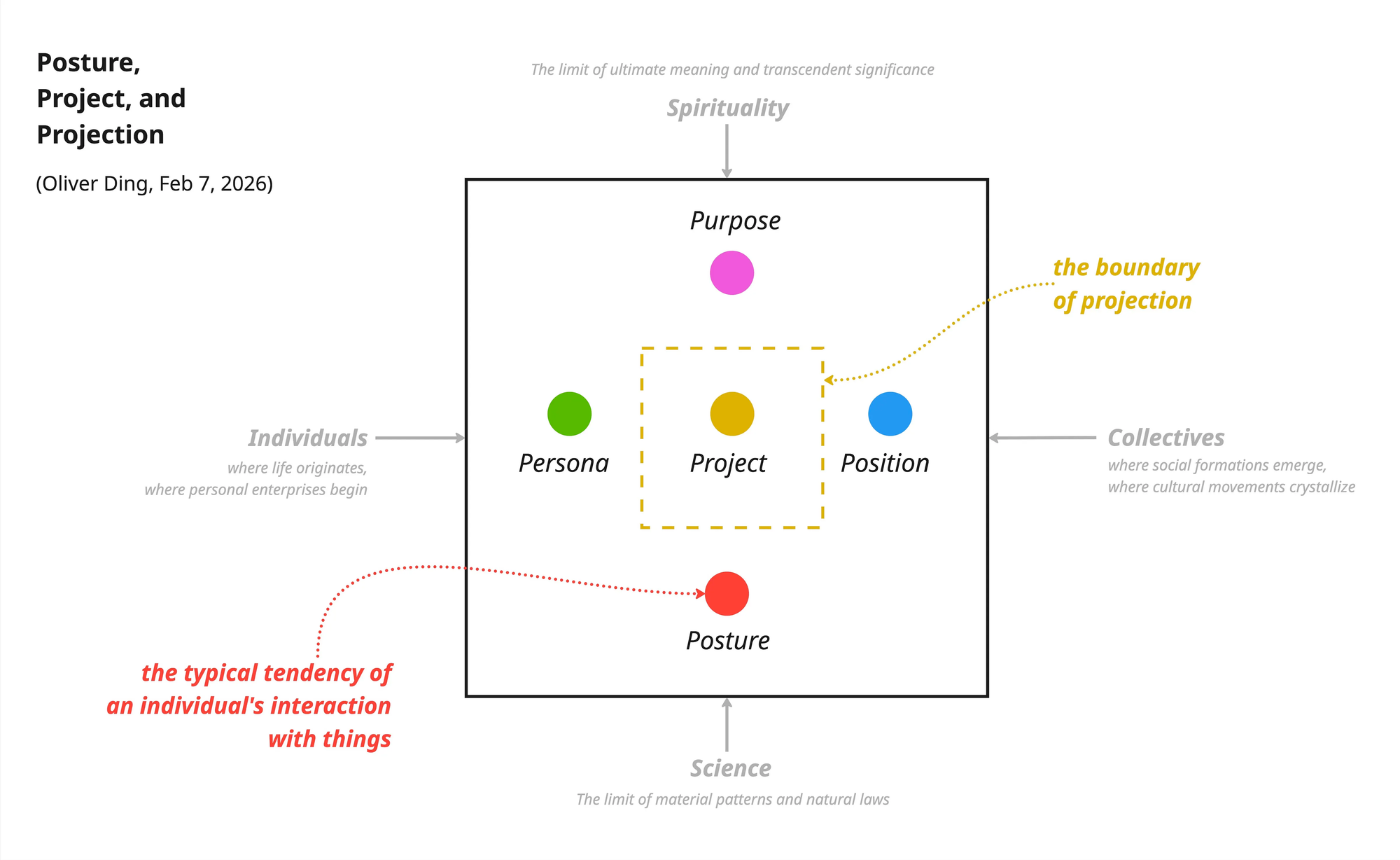
The diagram that produced the name is the generative center of the case. It has an outer square for the World of Life, with its four boundaries, and an inner square labeled Project. Four concepts sit in the intermediate space, each near one boundary and each oriented toward the project: Purpose near Spirituality, Posture near Science, Persona near Individuals, and Position near Collectives. The four boundaries served as a spatial heuristic. Each one specified the kind of concept that should occupy its position, so the empty positions called for concepts, and the concepts found their relation to the center and to each other.
The same operation repeated over the following weeks. It produced the cognitive container of cultural projection, and then the four parallel frameworks of ACS v1.1. The case also named the three techniques of Spatial Heuristics, Spatial Curation, Structural Encounter and Analogical Extension, and identified the constructive mechanism beneath them. The creator perceives the graphic affordances of an existing diagram, constructs a situational model by adding or removing spatial elements, and turns that model into a template that can be reused.
For the present argument, the point is this. A structure with defined margins does more than hold content. It generates positions, and each position asks what belongs there. The March case examined this function on the World of Life diagram. The rest of this article examines the same function on the HLS map.
The Platform Context
The platform map that frames this article was published on March 16, 2026, and it appears in the article From GO Theory to ACS and Beyond (March 30, 2026). It is titled GO Theory: An Interdisciplinary Theoretical Platform, and it presents the platform in its second phase, as a map with moves and models.
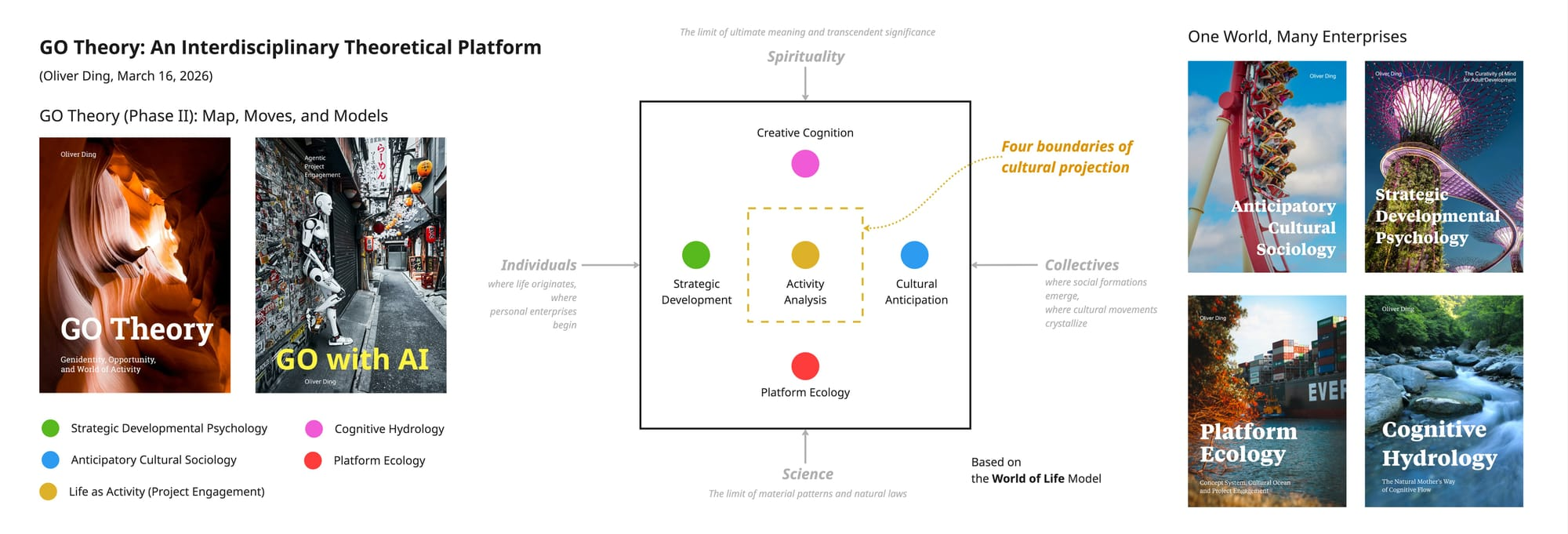
On this platform, five theoretical enterprises operate, each occupying a distinct position within the World of Life:
- Life as Activity (including the Project Engagement Approach) — at the center, attending to the structure of activity itself, the operational language shared by all the other enterprises
- Anticipatory Cultural Sociology — at the Collectives boundary, attending to cultural development at the collective scale
- Strategic Developmental Psychology — at the Individuals boundary, attending to individual life development at the personal scale
- Cognitive Hydrology — at the Spirituality boundary, attending to the flow of ideas and meaning in creative life
- Platform Ecology — at the Science boundary, attending to the ecological and structural conditions of platform development
On this map the enterprise occupies a direction, not a boundary. Its direction is toward the top, toward creative cognition, and the boundary above it names the limit that the direction points toward. The map therefore gives the platform context for the rest of this article.
A Blank Map for Cognitive Hydrology
When I began the review of Cognitive Hydrology 1.0 in October, the enterprise stood on the platform map among five theoretical enterprises, in the position the platform gave it. That position was relative. It told the enterprise apart from the others, and it did not say what the enterprise could become.
I detached Cognitive Hydrology from that group of five. Its position was no longer a place among the others, and the question became what the enterprise could be on its own. I then attached it to a blank HLS map. On October 17, in the afternoon, I drew that map with its four regions empty. Each region asked what would occupy it, and the question was no longer about the other enterprises but about this one.
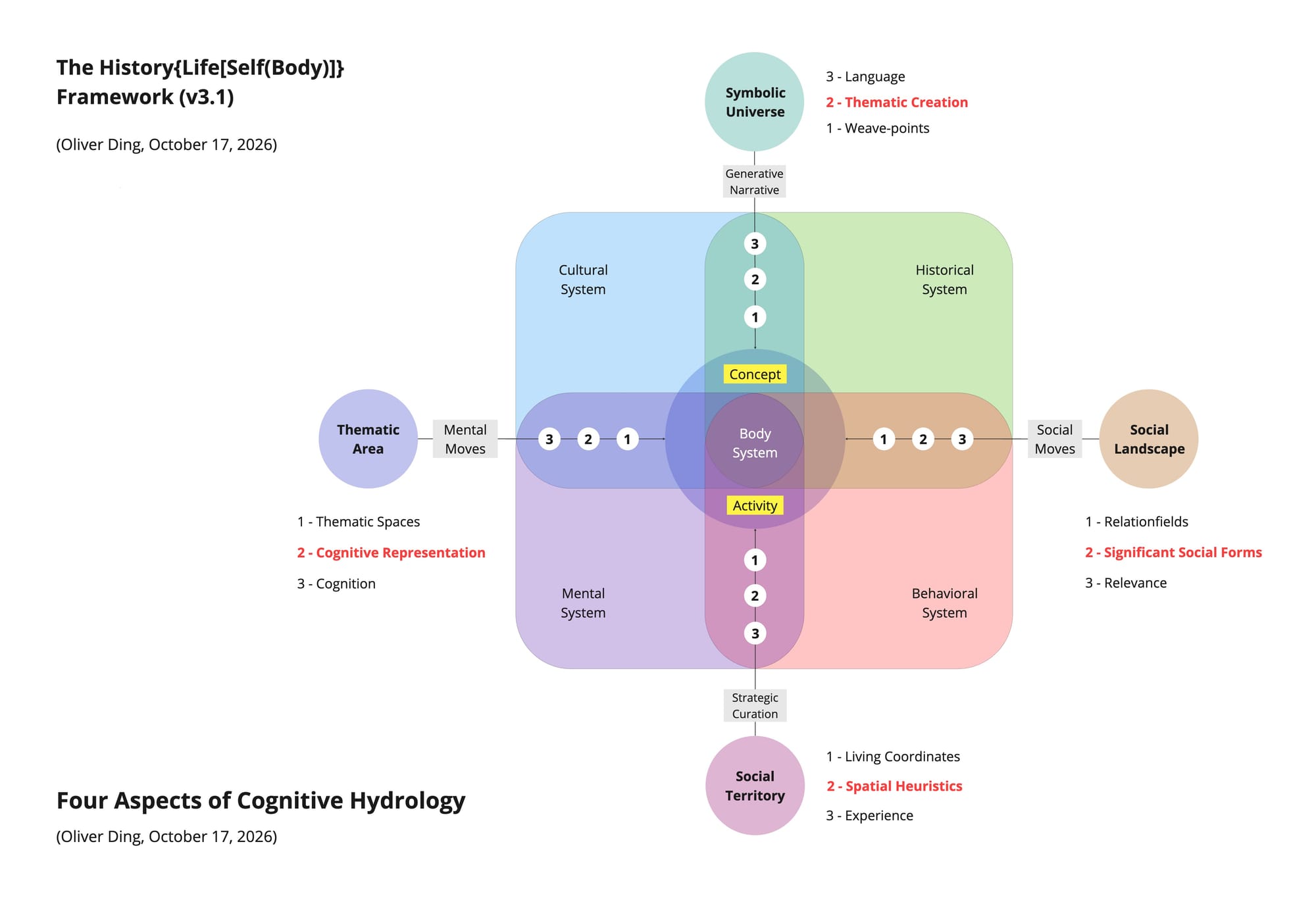
The attachment is where the spatial heuristic began to work again. The empty regions did what the four boundaries of the World of Life had done in February: each region asked what belonged there. Cognitive Hydrology 1.0 is strongly grounded in the individual's subjective experience, and it is not a floating discussion of language or meaning. Every theoretical enterprise relates to all four regions of the HLS map, so an enterprise discussed alone must be expanded across them. The four aspects below are the answer the map produced.
On October 19 the positioning of the enterprise was stated as "the ecological approach to thematic cognition," which described its place in cognitive science. The phrase "ecological approach" is a technical term in my theory, meaning the anti-dualist orientation of ecological psychology, activity theory and phenomenology. By the end of October the enterprise had been placed within Developmental Theme as one of its programs. The ecology is not an umbrella over the enterprise; the enterprise is one way of working within it.
Four Directions as Creative Guides
The HLS map, History{Life[Self(Body)]} in its version 3.0 of December 19, 2025, is the ontology of the social world in the GO Theory platform. The Body System sits at the center, the starting point of subjectivity. Four regions are generated by crossing the Cultural and Historical systems with the Mental and Behavioral systems. The Symbolic Universe, the Social Territory, the Thematic Space and the Social Landscape each have a mechanism that reaches it from the body: Generative Narrative, Strategic Curation, Mental Moves and Social Moves, respectively.
Read as a spatial structure, the map does more than locate an enterprise. It tells the creator where to look, because each of its four directions asks for content. The numbering in the diagram Four Aspects of Cognitive Hydrology, drawn on the morning of October 17, follows the same logic. Each region carries three numbered items, increasing outward from the Body System.
- Number 1 is the Gejunction aspect of the region
- Number 2 is a module of Cognitive Hydrology
- Number 3 is a dimension.
The dimensions I named for the regions are experience, relevance, cognition and language. They are one way of reading the regions, not the only one, because each region is multidimensional.
Gejunction shows that this structure guides creation, since Gejunction was built the same way.
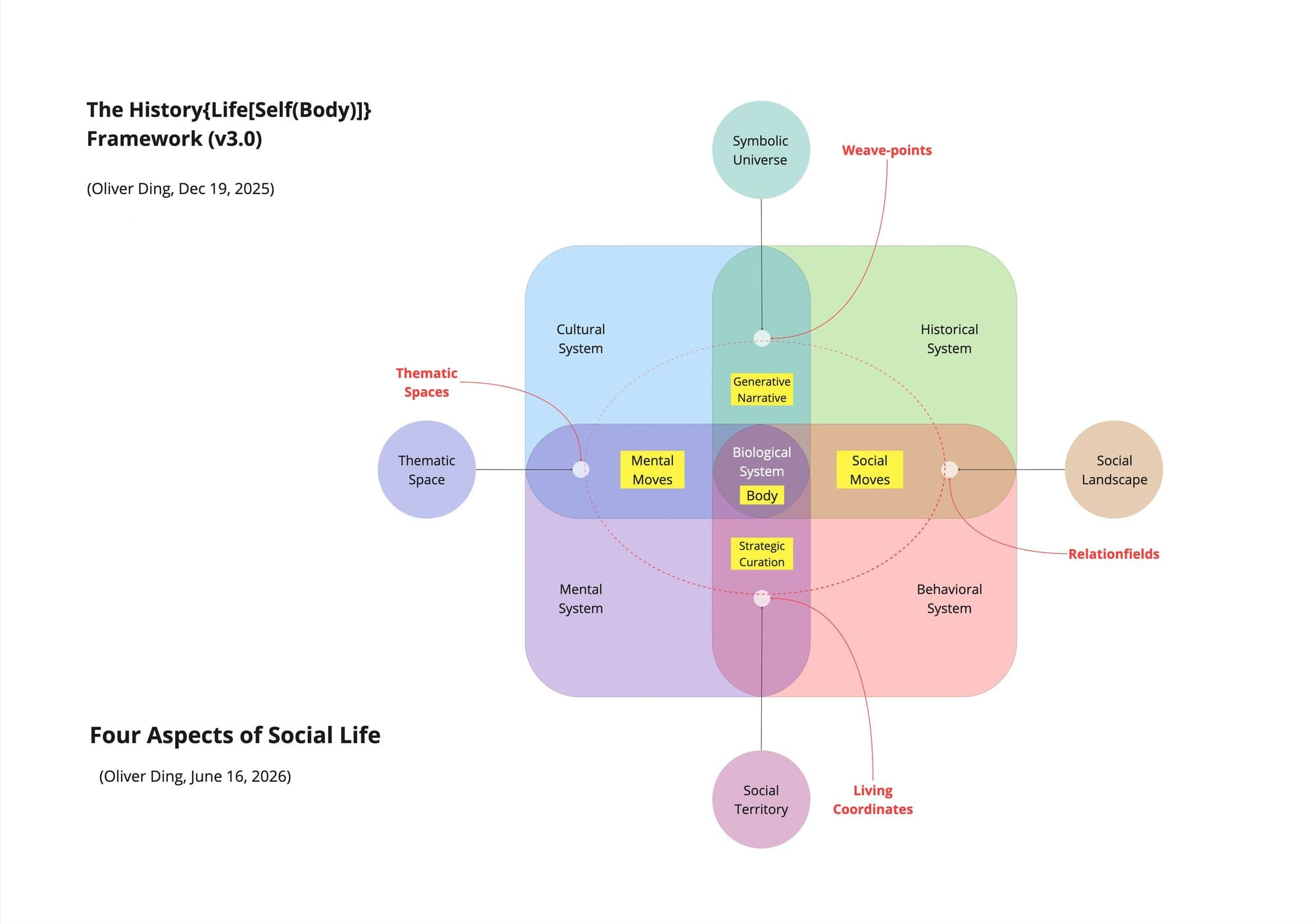
Its four aspects were placed into the four regions of the HLS map: the weave-point in the Symbolic Universe, the living coordinate in the Social Territory, the relationfield in the Social Landscape, and the thematic space in the Thematic Space. Each region asked what belonged in it, and each aspect answered for its direction. The four aspects are four analytical perspectives on one social unit, and none is reducible to the others.
Cognitive Hydrology follows the same construction. Its four modules are the answers that the four directions of the HLS map asked for.
The Four Aspects
Cognitive Hydrology appears in four modules, one in each region. Each is an aspect of the enterprise, and together they make up the whole of it on the map.
Thematic Creation, in the Symbolic Universe. This is the aspect in which a theme becomes a shared cultural form that others can recognize and carry. It corresponds to the cultural and historical intersection, and to the Generative Narrative mechanism. In the ACS framework a thematic creation is first a Mindentity, anchored in the creator's psychological ownership, and then moves toward a Folkentity and a Worldentity. This aspect is where the creative act reaches the symbolic world.
Cognitive Representation, in the Thematic Area. This is the aspect in which thinking about a theme takes an external form: a story, a diagram, a list, a table, a formula. It corresponds to the intersection of the Cultural and the Mental, and to the Mental Moves mechanism. The Story and the Model of the t-only model are two of the representation types that belong here. Whether the full set of types should be listed in the same place is a question I have not yet settled.
Significant Social Forms, in the Social Landscape. This is the aspect in which a theme acquires recognized social forms, the institutions, roles and practices through which other people carry it. It corresponds to the historical and behavioral intersection, and to the Social Moves mechanism. It is the least developed of the four in the present work, and it will need its own articles.
Spatial Heuristics, in the Social Territory. This is the aspect the series has been developing, and it needs the most careful description.
In the series, Spatial Heuristics is an operation: the spatial structure of an existing knowledge framework guides creative work, and insight arrives through the recognition of a structure rather than through logical derivation. The series names three techniques of this operation. Spatial Curation uses an existing map as a container and places concepts into it. Structural Encounter draws an insight from a newly formed spatial configuration. Analogical Extension tests a spatial logic proven in one domain against an adjacent one. Beneath the three techniques the series identified a constructive mechanism: one perceives the graphic affordances of an existing diagram, constructs a situational model by adding or removing spatial elements, and turns that model into a template that can be reused in other domains.
On the HLS map the spatial heuristic sits in the Social Territory, where the Strategic Curation mechanism operates. That placement is what makes the operation part of Cognitive Hydrology and not only a method of the series. It falls under the dimension of experience, because the operation begins from the creator's own recognition of a structure, and it is trained by use. A newcomer who sees the same diagram finds nothing in it, as I wrote in the first case of the series.
This aspect is the only one of the four that is a method rather than a content. The other three name what a theme becomes in the enterprise. The spatial heuristic names how a creator moves through a theme. For this reason the sprint collection is a case of this aspect, and the aspect explains why the collection could be organized as a sprint over known terrain.
Conclusion
The four aspects are not independent. The book Developmental Theme states that thematic cognition runs through all of them. It gives each aspect its theme, so that thematic creation, cognitive representation, significant social forms, and spatial heuristics are four ways in which one theme is held and acted on. Read this way, the four aspects are four places where thematic cognition takes concrete shape on the HLS map.
The spatial heuristic has worked in this case in the same way it worked in the March case. On the platform, the five theoretical enterprises stood in five positions on one map, and Cognitive Hydrology occupied one direction among them. That placement was relative. When I revisited Cognitive Hydrology 1.0, I detached it from the group of five and attached it to a blank HLS map. The empty regions of the map then did what the four boundaries of the World of Life had done in February: they asked what belonged in each position. The four aspects of Cognitive Hydrology were the answer. The HLS map and the World of Life square are both spatial structures of the GO Theory platform, and each can exercise the spatial heuristic on the enterprise that is placed within it.
Placing the spatial heuristic within one of the four aspects raises a further question about the relation between the two. Until now Cognitive Hydrology has been one of the three dimensions of the spatial heuristic's coordinate, the stream that gave the operation its object and its orientation. Once the spatial heuristic becomes one of the aspects of Cognitive Hydrology, that relation has to be reconsidered. The operation can no longer be read only as the enterprise's environment. It is now part of the enterprise, and the enterprise is the place in which the operation is studied and developed further.
v1.0 - November 6, 2026 - 2,398 words