
Spatial Heuristics: The Unfolding of Structural Symmetry
by Oliver Ding
November 6, 2026
This article is part of a collection: The Spatial Heuristic Sprint: A Case Study of a Two-Week Revisiting-and-Rebuilding Project.
On March 7, 2026 I published the first case study of the Spatial Heuristics series, Developing a Pedagogy for Cognitive Hydrology. Its opening section tells how the series began. In January, while writing the final chapter of Lake 42, I noticed a mirror symmetry between two enterprises I had just established: Anticipatory Cultural Sociology (ACS), which attends to cultural life development at the collective scale, and Strategic Developmental Psychology (SDP), which attends to individual life development at the personal scale. The two share one fundamental pattern under different disciplinary clothing.
I took that consistency as a signal. If the pattern held this closely, some method must be operating beneath it. That question led to the operation I later named Spatial Heuristics. This article follows the symmetry from that first recognition to the second pair that appeared in October, and it asks what the symmetry does as a spatial heuristic, not only what it looks like.
The First Pair: ACS and SDP
The first pair developed in parallel through the first half of 2026. ACS took the collective side of anticipation, and its landscape places cultural development as a continuous anticipatory activity of creating and curating concept systems. SDP took the individual side, starting from a question psychology had never answered: why it has no proper concept of strategy with the standing of emotion or cognition.
The symmetry did more than describe the two enterprises. It worked as a spatial structure in which one enterprise could find a gap and the other could fill it. The clearest case came on 18 March 2026. Reflecting on the relation between the LARGE Method and the ACS v1.2 actor model, I saw that the Self–Other dimension was missing from ACS's three-dimensional structure.
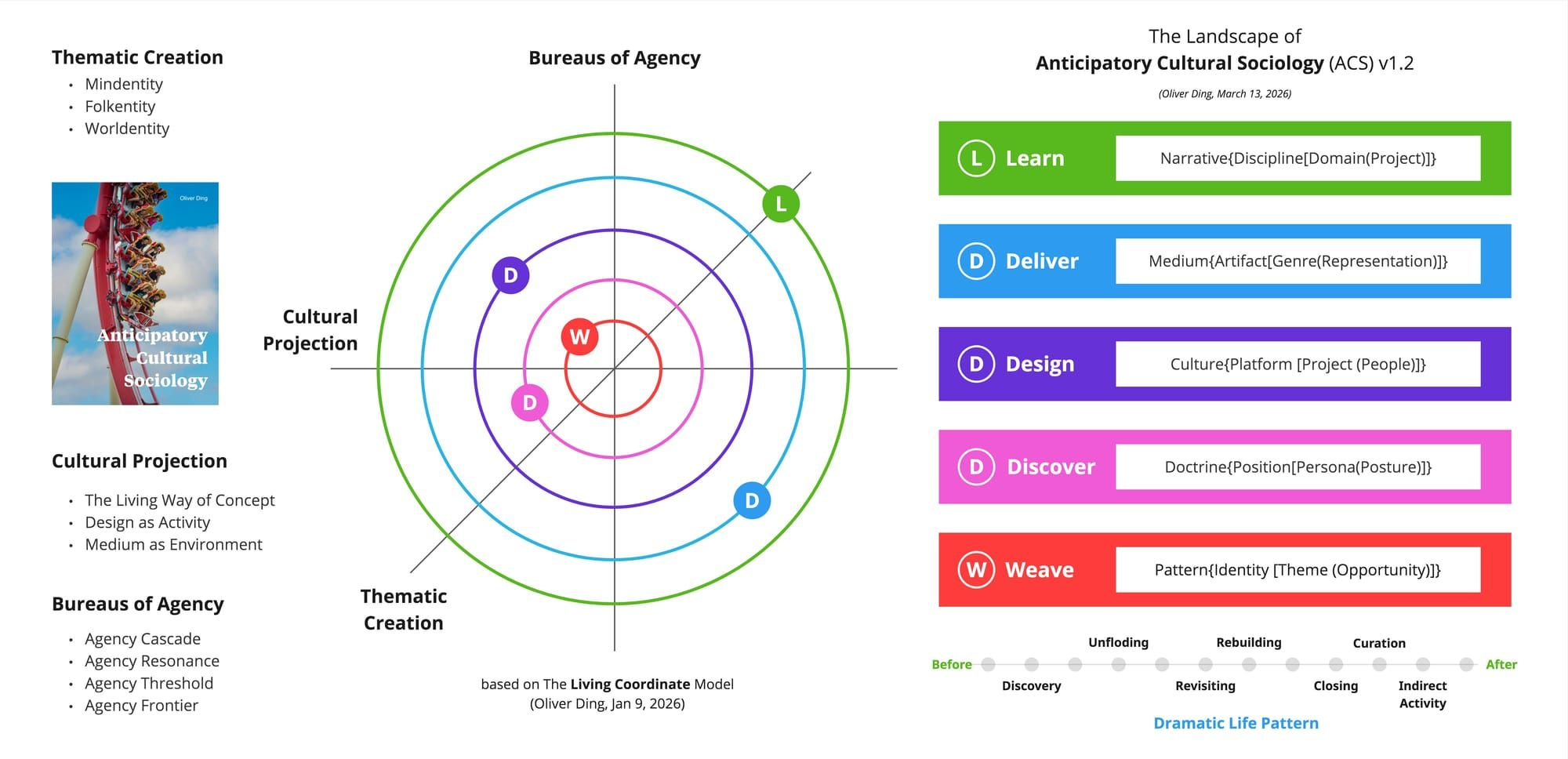
There were two ways to respond. One was to expand ACS to four dimensions. The other was to keep ACS as a three-dimensional model and move the Self–Other dimension to SDP, where it more naturally belongs, under the axis of Supportive Life Discovery. I chose the second. The dimension was not invented for SDP. It was a dimension of the same spatial foundation, the World of Life, that had been placed in the wrong enterprise.
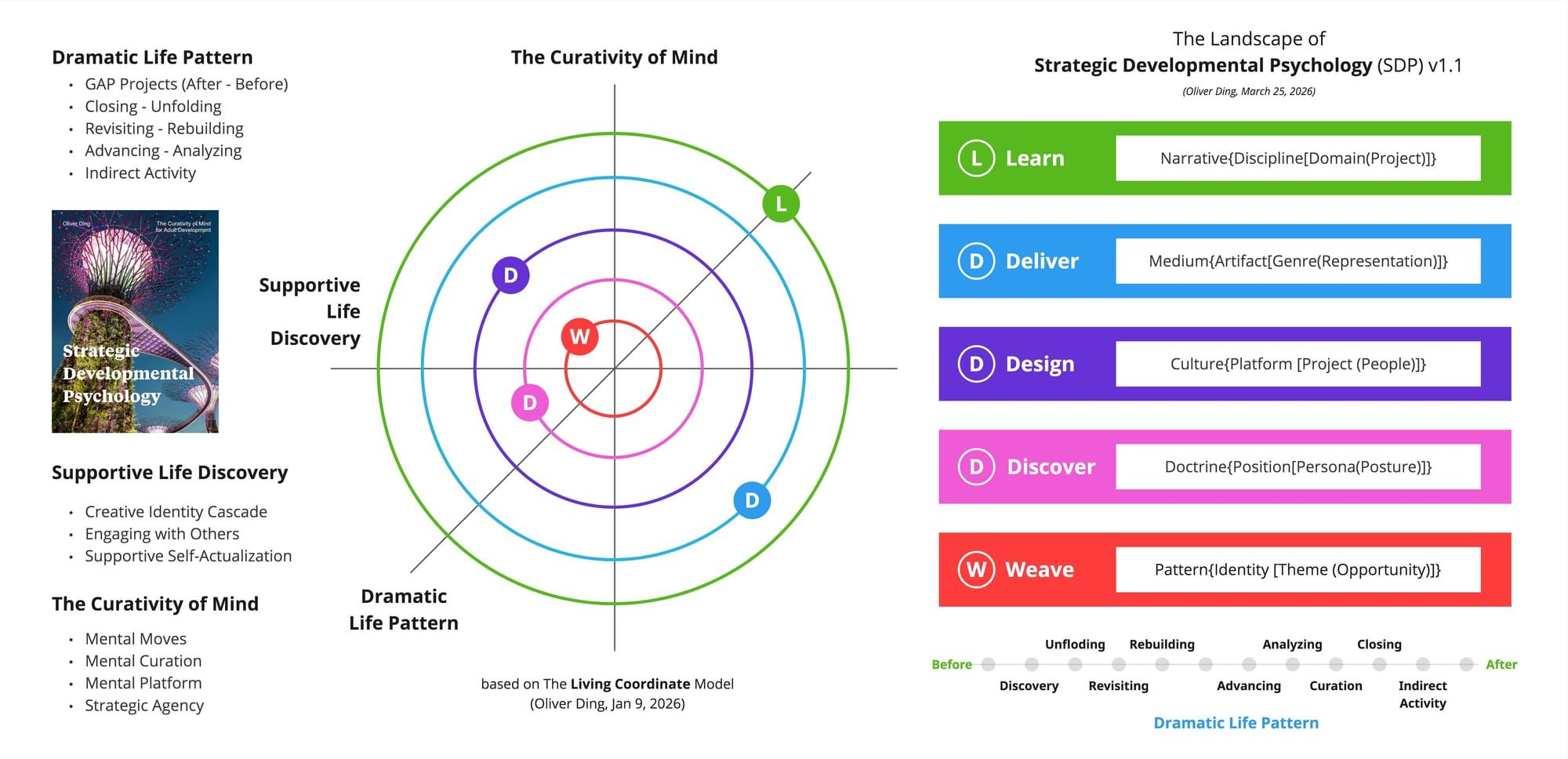
This is the operation of a spatial heuristic. The structure of ACS made the missing dimension visible, because the three dimensions had a shape and the fourth had no place in it.
The symmetry between the two enterprises told me where the dimension could go. The migration from ACS to SDP was a move through the shared structure, not a logical deduction from either enterprise alone.
The Second Pair: Developmental Strategy and Developmental Theme
The second pair was formed in October. Developmental Strategy was completed on October 14, and Developmental Theme followed on October 30. Its introduction calls it a sister volume, and it says the pair follows the same logic as the first. Developmental Strategy addresses how a strategic actor navigates the unfolding of their life and enterprise. Developmental Theme addresses the conceptual and thematic foundations on which that navigation takes place.
Three features make the two books alike, and each is a point where the symmetry operates.
First, both use a Weave knowledge system for curation. Developmental Strategy reorganized the strategy theme through the Weave-the-Strategy Toolkit, and Developmental Theme curates years of exploration through the Weave-the-Theme Framework. The same curation tool is applied to two different objects.
Second, both use Developmental Functionalism to frame a new knowledge ecology. Instead of asking what a concept is in essence, both ask what a concept does in human and enterprise development. This functional lens draws the boundary that separates the new ecologies from traditional academic inquiry.
Third, both position themselves explicitly on the GO Theory platform. Neither is an isolated theoretical project. Each is a localized structural component within a broader ontological and epistemological architecture.
These three features show where the second pair matches the first. In the first pair, ACS and SDP are symmetric enterprises. In the second, the two books belong to one enterprise and are symmetric in their method. Theme corresponds to culture, the collective side, while strategy corresponds directly to the actor, the individual side. The shape of the first pair is kept, but it now applies to two books and to one shared method.
Developmental Strategy as the Context Project
Developmental Strategy therefore serves as the context project of Developmental Theme, and the context role works at two stages.
The first stage is the symmetry between ACS and SDP. The two enterprises keep their disciplinary boundaries. ACS belongs to sociology, SDP to psychology, and the symmetry is a way of seeing one pattern through two disciplines without merging them.
The second stage is the pair of books. Developmental Strategy and Developmental Theme do not keep the boundary between disciplines in the same way. Their common orientation is a developmental science that crosses disciplines. The reorientation began with the article Knowledge for Development, written on 26 August 2026. It repurposed an earlier Knowledge Discovery Canvas and placed developmental science in the End zone, with philosophy, sociology and psychology in the Theory zone. The article's insight was that my transdisciplinary approach, moving across philosophy, sociology and psychology, could be oriented toward developmental science as a unifying direction. That reorientation resolved a long-standing tension between sociology and psychology in my own identity.
So the second stage is an extension of the first. The first kept the disciplines apart and showed one pattern through them. The second brings the disciplines together under the principle of knowledge for development, and it looks at the same movement, from theme and strategy to concept system, from the viewpoint of a developmental science that crosses boundaries.
The Unfolding
Seen across these steps, the symmetry is not a fixed resemblance. It is a spatial heuristic that has unfolded at two stages. In the first stage, a gap in one enterprise was filled by a dimension moved from the other, and the two disciplines were kept apart. In the second stage, the pattern of two books on one platform was used to bring the disciplines under one developmental science. Developmental Strategy is the reference against which Developmental Theme can be checked, and the path between them runs through Knowledge for Development.
For this collection, the lesson is that the structure described in March has been repeated at several scales and in several forms. The same symmetry that once linked two enterprises now links two books, and it now carries a principle that neither discipline could carry alone.
v1.0 - November 6, 2026 - 1,132 words