
Weave 16: From Weave the Life to Weave the Theme
A case study of Spatial Heuristics
by Oliver Ding
This article is part of a collection: The Spatial Heuristic Sprint: A Case Study of a Two-Week Revisiting-and-Rebuilding Project.
Two major outcomes of the two-week Revisiting-and-Rebuilding project are both based on knowledge frameworks from the Weave knowledge system. This case study focus on one of such framework: the "Weave 16" diagram, which was used to develop the Weave-the-Theme framework (v1, 2026).
The Weave 16 diagram, a 4×4 grid, is the turning point of what I call Weave 2.0. Until April 2026 the Weave knowledge system was built on a 2×2 basic form. The 4×4 grid marked its first expansion, and it is the reason the system could hold more than a few concepts at once. Since the Weave knowledge system is one of three dimensions of the "Spatial Heuristic" thematic coordinate, the "Weave 2.0" development indicates the dynamic evolving of the dimensions.
This article follows the development of the Weave knowledge system in four steps. It asks how the grid came about, how it was first used in Weave the Life, how it was used a second time for theme, and what the two uses show together. The last step matters, because it shows that the coordinate was not fixed at the beginning of the year. The Weave dimension, which had been a frame, changed while the spatial heuristic was being used, and the change was part of the development.
Contents
Part 1. The Development of Weave Knowledge System
1.1 The 2×2 basic form
1.2 The Expansion: From 2×2 to 4×4 and 8×8
1.3 The Five-Day Exploration: The 8×8 Edition
1.4 The Complete System
Part 2. Building the Weave-the-Life Framework (v3.0)
2.1 Early versions: v1.0 and v2.0
2.2 The 4×4 Edition: v3.0
2.3 An Open Knowledge Map: Linking Weave-points and Thematic Space
Part 3. Building the Weave-the-Theme Framework (v1, 2026)
3.1 Early Discovery: The T-only Model
3.2 The 4x4 Edition: Weave-the-Theme (v1.0)
3.3 An Open Knowledge Map: Curating Thematic Elements
Part 4. One Meta-diagram, Two Situational Models
4.1 Creative Process
4.2 Sixteen Weave-points
4.3 Inner Ring and Outer Ring
4.4 Numbering
Conclusion
Part 1. The Development of Weave Knowledge System
The original Weave Basic Form was a 2×2 model, introduced in October 2025. It was the synthesis of two diachronic dimensions and two synchronic dimensions, yielding four Weave Points. It conceived the World of Activity as such a synthesis, and it was used to develop a series of diagrams for various knowledge projects.
April and May 2026 were the key period of Weave 2.0. In those two months the Weave knowledge system grew from the 2×2 basic form, through the 4×4 Weave 16 grid, to the 8×8 edition of GO Square. Each step extended the one before it, and the three together form a complete knowledge system, with its own unit of analysis and its own set of positions. This section follows the three steps in order, and it gives the most detail to the third, which came from a five-day exploration in mid-April.
1.1 The 2×2 Basic Form
The Weave Basic form is a super-simple diagram that frames the activity within the World of Activity as the synthesis of two diachronical dimensions and two synchronical dimensions. The model consists of four Weave-points (S1D1, S1D2, S2D1, S2D2), each representing a structural nexus where one synchrony dimension intersects with one diachrony dimension.
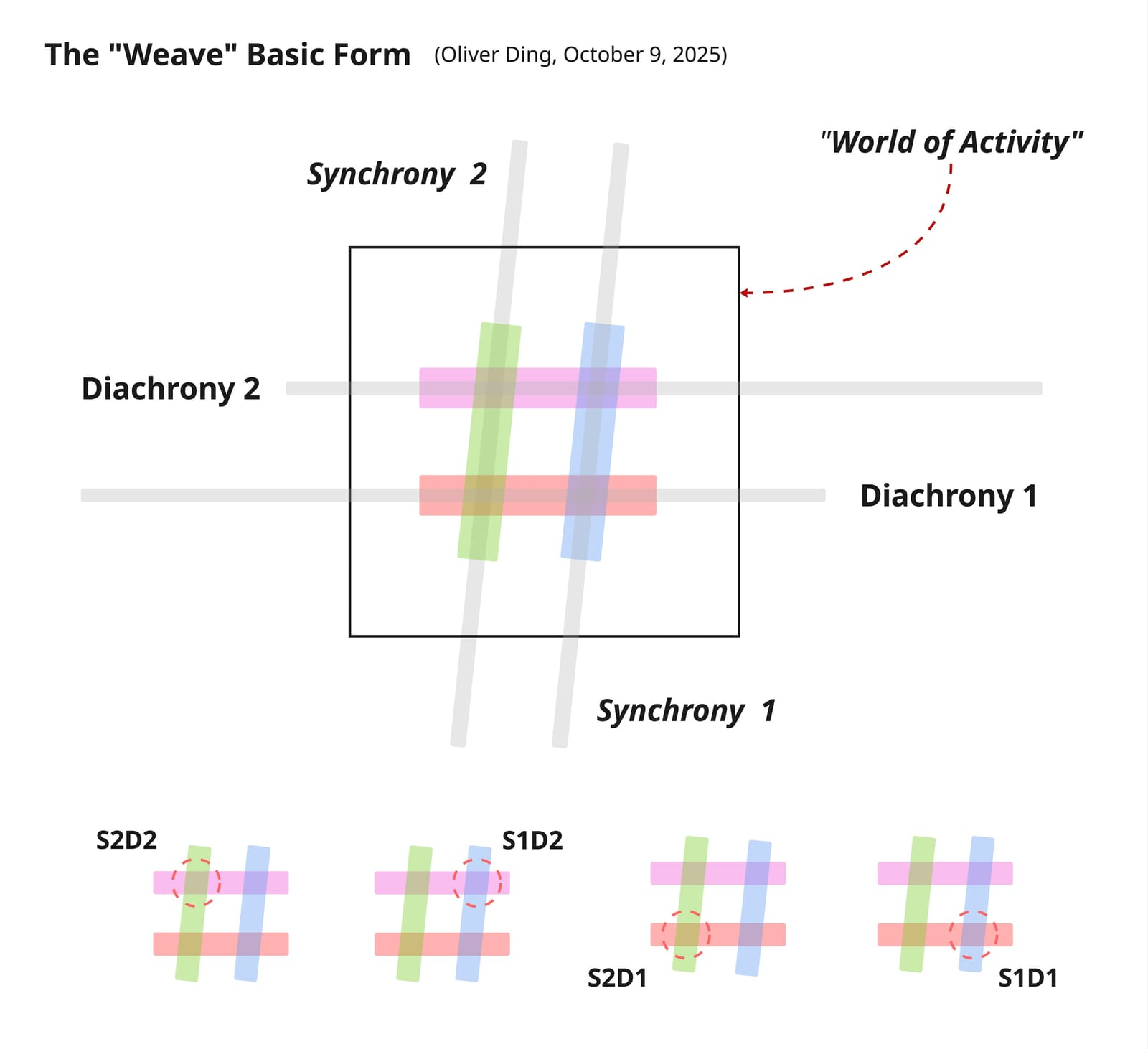
As an abstract model, the “Weave” basic form serves as the foundation for generating derived forms and situational frameworks. More details can be found in [Meta-framework] The “Weave” Basic Form.
The Basic Form was applied to a series of knowledge projects — Weave-the-Theory, Weave-the-Life, Weave-the-Enterprise, Weave-the-Culture — each a derived framework applying the same structural logic to a different domain. This proliferation was not arbitrary; it demonstrated that the Basic Form was genuinely generative: the same four-point structure produced analytically useful results across domains as different as theoretical activity, life development, enterprise analysis, and cultural development.
In March 2026, I release a collection titled Weave 42: Building Knowledge Ecologies Across Scales (March 2026), which produced the first systematic account of the full Weave knowledge system: its Basic Form, its derived frameworks, their relationships, and their shared structural logic. Weave 42 marked the end of the first wave — the moment when the framework had been used enough to be documented as a system and communicated beyond the creator.
1.2 The Expansion: From 2×2 to 4×4 and 8×8
In April 2026, working on the Weave 42 project, this structure was expanded to a 4×4 edition: the Weave 16 diagram, with sixteen weave-points.
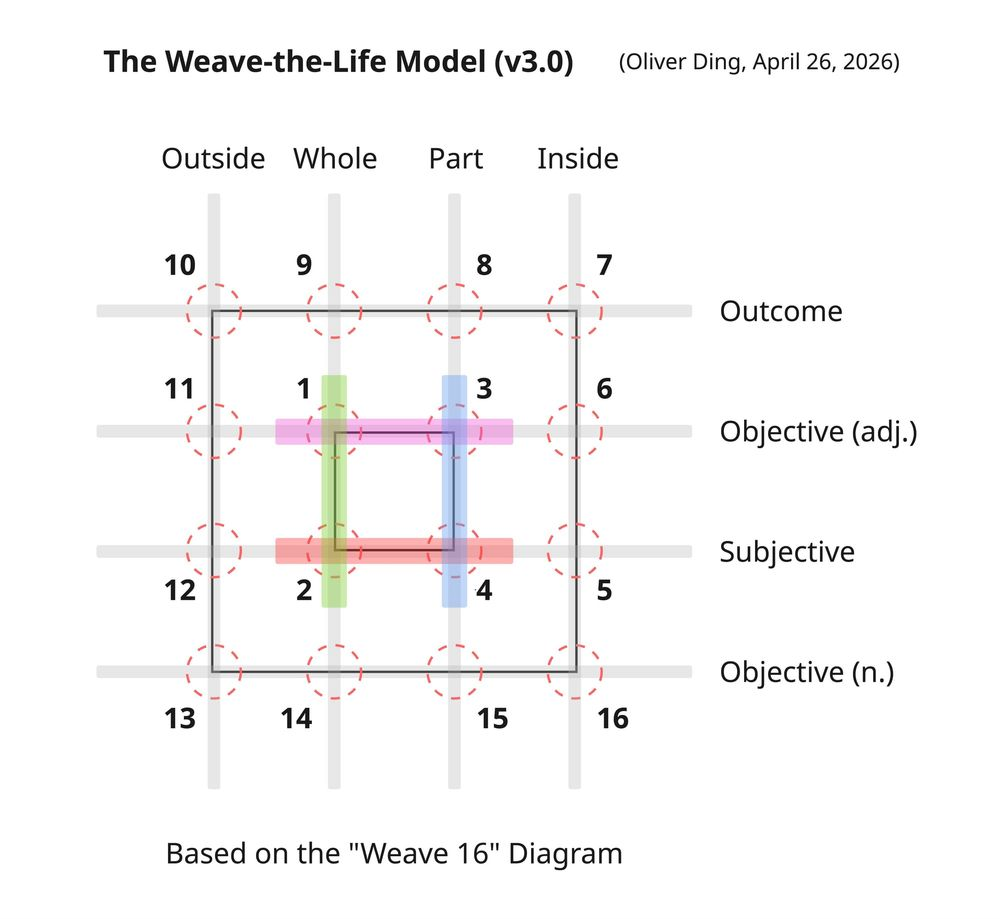
On April 26, 2026, based on the 4×4 edition, I developed the Weave-the-Life model (v3.0). The original v2.0 structure remains intact at the center, and the whole model has grown outward into a larger Weave Diagram. Its four diachronic dimensions and four synchronic dimensions draw inspiration from four pairs of concepts: Whole–Part, Inside–Outside, Objective (n.)–Outcome, and Subjective–Objective (adj.). Some of these are rooted in traditional Activity Theory, and others come from my own explorations.
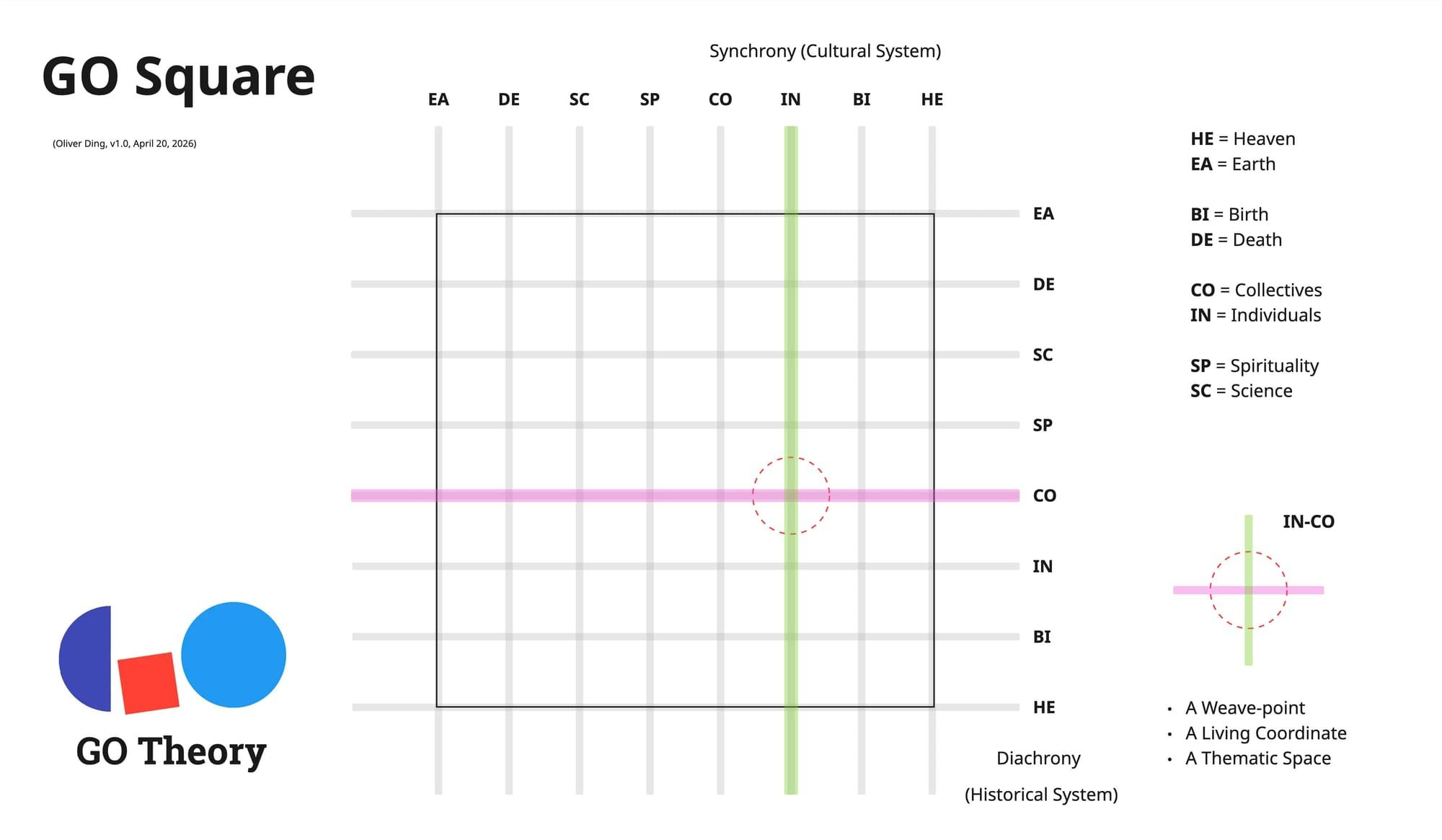
The same logic was then extended to an 8×8 edition — the Go Square — producing sixty-four coordinates for mapping concept systems within the GO Theory framework.
This expansion from 2×2 to 4×4 and 8×8 is what I called Weave 2.0.
Details about the 4×4 expansion will be unpacked in part 2. The next section focuses on the 8×8 expansion.
1.3 The Five-Day Exploration: The 8×8 Edition
The 8×8 edition came out of a practical exploration. After sending the previous issue of the Activity Analysis Network newsletter, I started a Creative Life Discovery project to explore the Weave knowledge system and the Yinyang-Bagua knowledge system. It was a GAP project, an informal activity that takes place between formal projects, and it lasted five days in mid-April 2026.
The exploration was a structural comparison, not an appropriation. I did not treat the Yinyang-Bagua as a theoretical resource, and I did not translate its cosmology into modern terms. The Yinyang-Bagua has a formal logic in which Taiji generates Liangyi (Yin and Yang), Liangyi generates Sixiang (the Four Images), the Four Images generate Bagua (the Eight Trigrams), and the Eight Trigrams combine into sixty-four hexagrams. Each hexagram is a distinct situational configuration. The structure is a finite set of fundamental elements that combine into a larger set of structurally distinct positions. The Weave knowledge system had a parallel logic. Its synchronic dimensions represent positions that coexist, and its diachronic dimensions represent processes that unfold across time. Their intersection generates weave-points, which are structural nexuses where processes and structures meet.
The question that emerged was what eight fundamental elements, derived from the ontology of GO Theory, could serve as the basis of such a matrix. The answer was already in my earlier materials. The World of Activity defines four boundaries: Heaven, Earth, Birth and Death. These form the outer square, which defines the four boundaries of natural existence. The World of Life defines four more: Collectives, Individuals, Spirituality and Science. These form the inner square, which defines the four boundaries of cultural existence. Together the eight boundaries are the structural limits within which human meaning-making unfolds. They became the Eight Units of GO Square, and each of the sixty-four ordered pairs of Units defines a thematic space. The sixty-four pairs form the 8×8 matrix.
The correspondence between the Eight Units and the Eight Trigrams was not planned. I found that the two systems were isomorphic at the level of combinatorial structure, and I set a one-to-one correspondence in the order of the Primordial Eight Trigrams. Earth corresponds to Kun, Death to Gen, Science to Kan, Spirituality to Xun, Collectives to Zhen, Individuals to Li, Birth to Dui, and Heaven to Qian. The alignment follows the generative logic of the Four Images, from the most material and passive pole, through the Object axis and the Subject axis, to the most creative and formless pole. Each of the sixty-four ordered pairs of Units therefore maps onto one hexagram. I did not take this logic from the Bagua. It is a parallel discovery of the same formal logic by two systems developed independently, one in ancient Chinese cosmology and one in contemporary social theory.
1.4 The Complete System
On May 26, 2026, I published an article titled Weave 2.0: Synchronic Line, Diachronic Line, and Living Coordinate, reflected on the development of the Weave knowledge system.
The three editions together make the Weave knowledge system complete. The 2×2 basic form gave the system its first two diachronic and two synchronic dimensions. The 4×4 Weave 16 grid, developed in April 2026 within the Weave 42 project, gave it sixteen weave-points. The 8×8 edition, from the five-day exploration, gave it sixty-four GO coordinates for mapping concept systems within GO Theory. The expansion from 2×2 to 4×4 and 8×8 was named Weave 2.0. It was not only a change of scale. It was the point at which the system found the unit of analysis that its earlier forms had only implied.
The unit of analysis is the intersection of one diachronic line and one synchronic line, which gives a Living Coordinate.
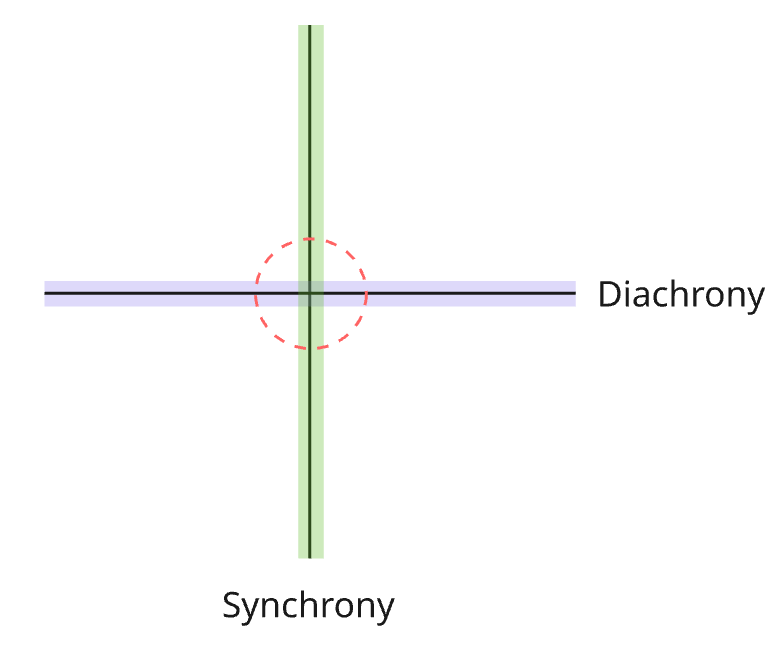
Each coordinate opens onto a thematic space. The three creative elements of Weave 2.0, weave-points, living coordinates and thematic spaces, come from three knowledge systems: the Weave knowledge system, the World of Activity Approach, and Thematic Space Theory.
Moreover, the connection among Weave-point, Living Coordinate, and Thematic Space does more than establish a unit of synthesis within the Weave knowledge system. It creates a structural bond between the Weave knowledge system and two other knowledge systems — the World of Activity Approach and Thematic Space Theory — that had previously developed in parallel. Each system now supports and amplifies the others: the Weave knowledge system provides the structural architecture; the World of Activity Approach provides the actor's inhabitation of that architecture; Thematic Space Theory provides the populated territory that gives each position its analytical depth. This is not integration by absorption — each system retains its own identity and developmental logic — but synergy: the three systems together can do what none could do alone. This is the external expansion of Weave 2.0.
Part 2. Building the Weave-the-Life Framework (v3.0)
The Weave-the-Life Framework (v3.0) did not emerge in isolation. It grew out of a series of prior developments — a basic form, two earlier framework versions, an approach, and a personal intellectual journey.
2.1 Early versions: v1.0 and v2.0
During the development of the Weave Basic Form, I experimented with several cases that incorporated activity-inspired principles as key elements. After the basic model stabilized, I applied it to systematically design the Weave-the-Life framework – a series of operational diagrams that translate the abstract dimensions into a life-design grammar.
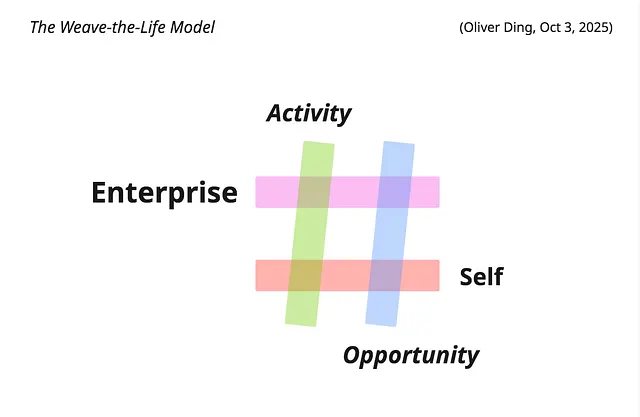
On October 3, 2025, I added the Weave-the-Life model (v1.0) to the Life-as-Activity approach (see the diagram below). This model aims to bridge the "Activity as Project Engagement" level and the "Life-History Topology" level, explaining how the former unfolds into the latter.
On October 13, 2025, I revisited the Weave-the-Life model and developed a series of frameworks that together form the Weave-the-Life Framework Family:
- Weave-the-System
- Weave-the-Project
- Weave-the-Case
These three frameworks create a nested structure, providing a scalable way to connect meso-level and micro-level analysis. Further details are available in Life-as-Activity: The Weave-the-Life Framework (v2.0).
On November 11, 2025, I designed a new abstract diagram to represent the deep structure of the Weave-the-Life Framework.
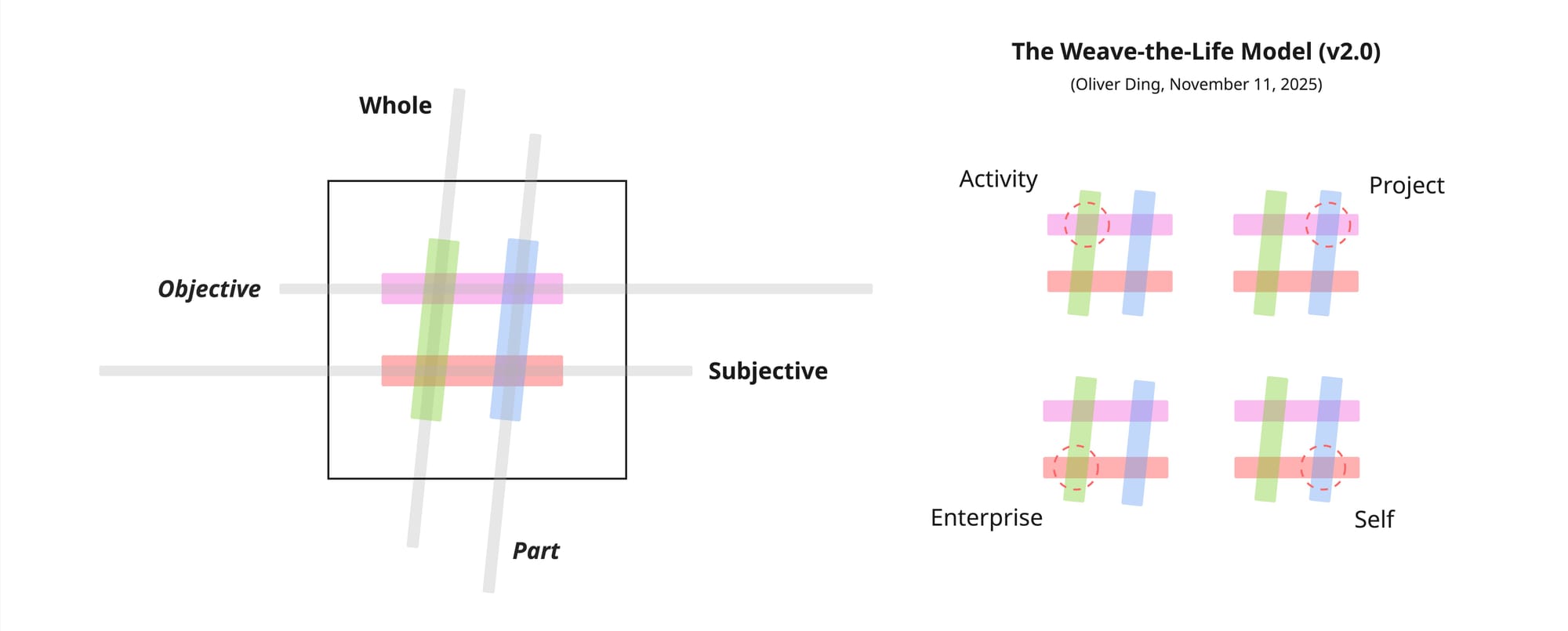
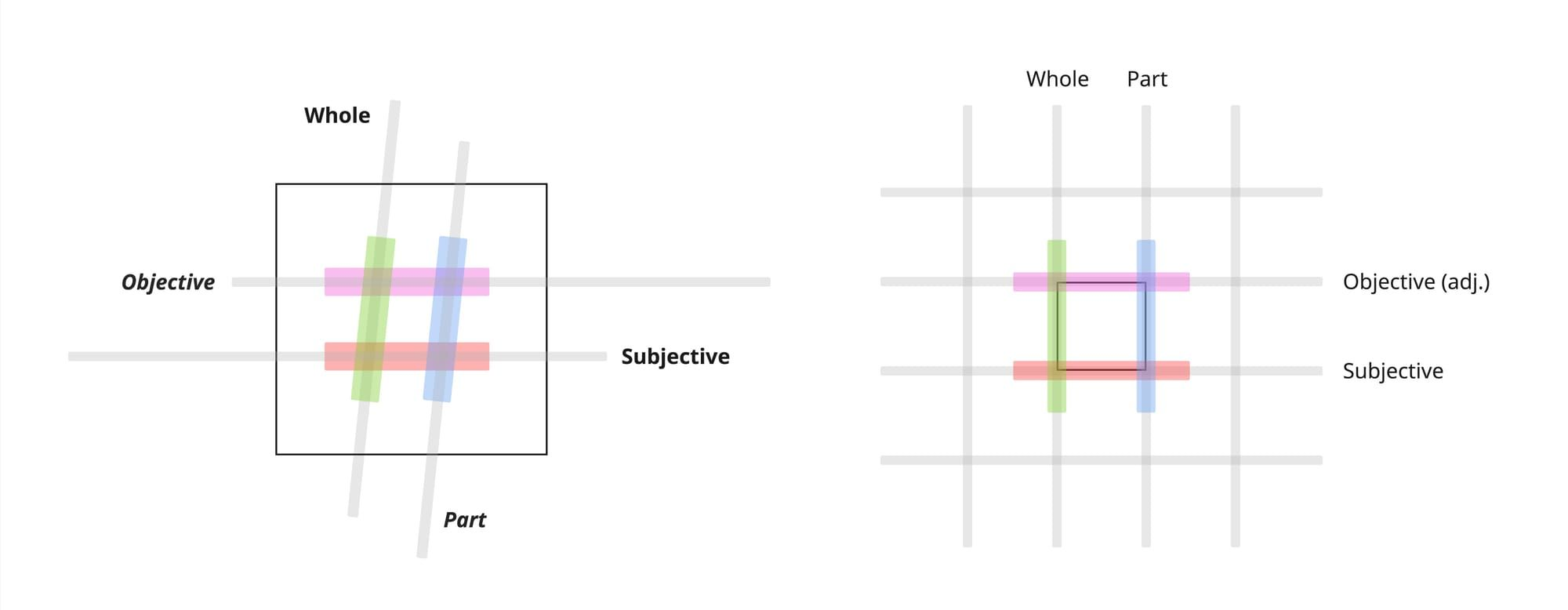
The new model integrates four dimensions: Subjective, Objective, Part, and Whole. The Subjective–Objective dimensions capture diachronic aspects of life, while the Part–Whole dimensions capture synchronic aspects. Together, these dimensions weave individual and collective life within an evolving structural, cultural, and historical landscape.
The model defines four Weave-Points, where one synchronic dimension intersects with one diachronic dimension. Concepts from v1.0 are positioned at these points: Self, Enterprise, Project, and Activity.
- At the Part dimension, the Self–Project connection represents "Project Engagement," where an individual participates in a specific project.
- At the Whole dimension, Activity refers to the aggregation of individual projects, while Enterprise encompasses a series of self-directed actions that extend beyond immediate projects.
The distinction between Subjective and Objective reflects the dual aspects of life: individual experience versus collective existence. The Part–Whole distinction reflects the structural depth of life. These four dimensions are continuously interwoven in lived experience, forming the fabric of both personal biography and social reality.
The framework operates bidirectionally. In the forward direction, individual actions crystallize into enterprises that transcend personal will. In the reverse direction, social structures and historical events enter individual life through activities and projects. This bidirectional dynamic illuminates both individual agency and structural constraints, demonstrating how otherness—aspects of social reality beyond immediate intersubjective negotiation—becomes incorporated into personal life.
By incorporating the concept of Enterprise, the Weave-the-Life Framework emphasizes the subjective dimension of social life: a long-term, self-determined trajectory of actions.
2.2 The 4×4 Edition: v3.0
The 4×4 edition expands both axes from two to four, increasing the Weave Points from four to sixteen.
The diagram below presents the Weave-the-Life Model (v3.0) in full. The original v2.0 structure remains intact at the center; the entire model has grown outward into a larger Weave Diagram.
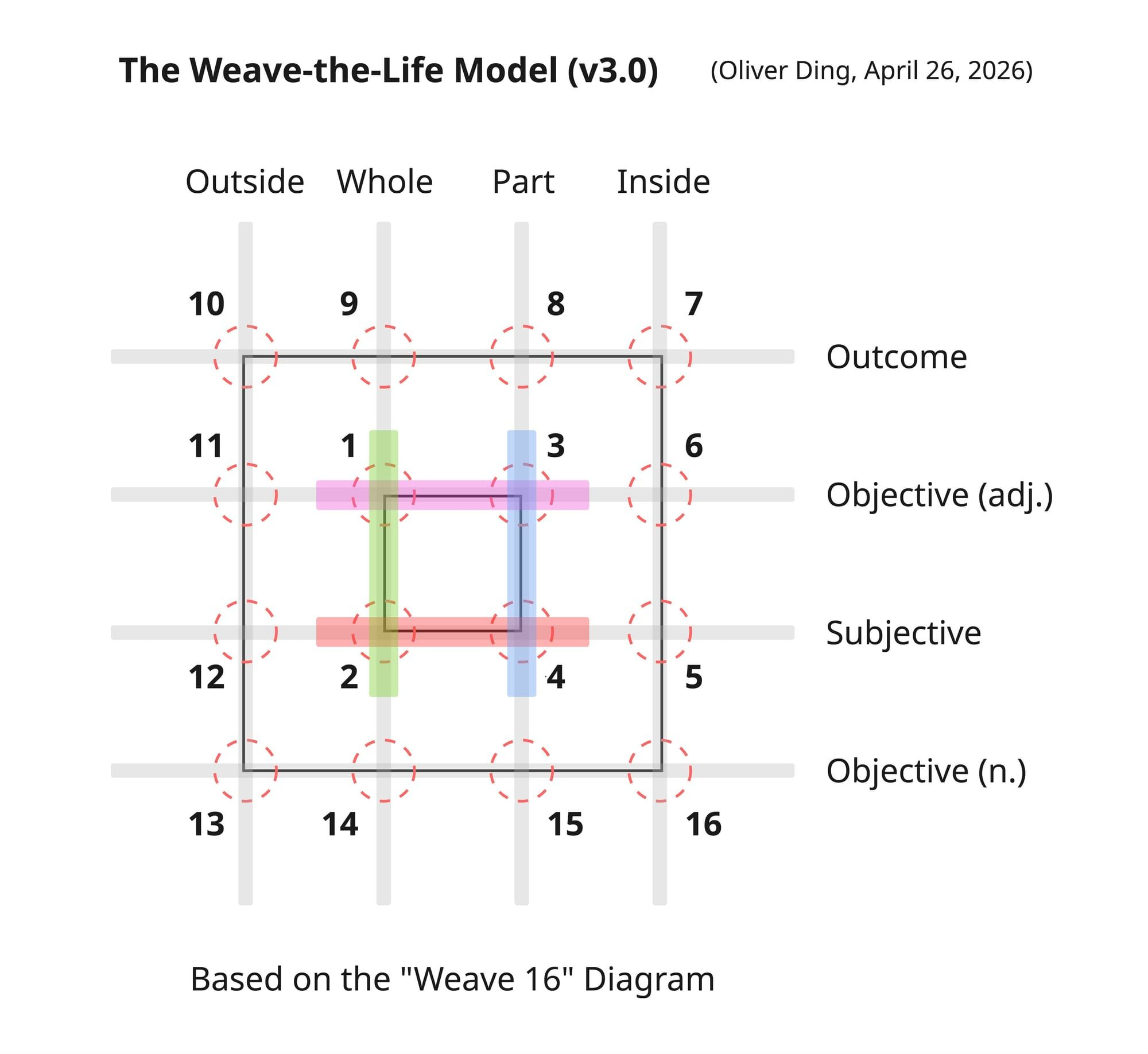
The four diachronic dimensions and four synchronic dimensions draw inspiration from four pairs of concepts — some rooted in traditional Activity Theory, others emerging from my own explorations.
- Whole - Part: Although traditional Activity Theory does not foreground this pair explicitly, it surfaces in many of its models — the hierarchical structure of Operation-Action-Activity, the Activity System model, and others.
- Inside - Outside: The principle of internalization–externalization is central to Activity Theory. Building on it, the “Activity as Project Engagement” principle introduces the “Outside — Projecting — Inside” triad — a basic ecological form that describes how people engage with social environments through a cyclical movement between person and project. These social moves echo the mental moves of internalization–externalization, linking changes in social action with changes in psychological process.
- Objective (n.) - Outcome: The concept of “Object” and the Object-Orientedness Principle are foundations of Activity Theory. In 2021, while developing the Anticipatory Activity System (AAS) framework, I began distinguishing Objective (what is motive about, oriented toward the future) from Object (what is acted on, anchored in the present). This distinction receives its own structural space in the new diagram.
- Subjective - Objective (adj.): Introduced in the the Weave-the-Life model (v2.0), this pair captures diachronic aspects of life — individual experience and Enterprise versus collective existence and Activity. It re-centers the actor's own perspective, restoring subjective experience to the person living it.
Based on these conceptual resources, the vertical axis of the v3.0 model is labeled Outcome, Objective (adj.), Subjective, and Objective (n.). The double use of “Objective” is theoretically deliberate. Objective (adj.) refers to observable activity processes and the social landscape, while Objective (n.) points to the future-oriented, motive-laden dimension of activity — the anticipatory horizon. The horizontal axis is labeled Outside, Whole, Part, and Inside. Together, these four columns trace a continuum from macro-level social objects to micro-level individual subjects:
- Outside corresponds to the Life-History Topology level, encompassing culture and history.
- Whole corresponds to the Anticipatory Activity System level, encompassing enterprise and activity.
- Part corresponds to the Project Engagement level, encompassing project and event.
- Inside corresponds to the subject — the individual’s psychology and immediate situation.
A subtle but significant transformation occurs here. Traditional Activity Theory’s subject–object relation is reconfigured as a self–world continuum, anchored at the two extremes of Inside and Outside.
2.3 An Open Knowledge Map: Linking Weave-points and Thematic Space
The first use also addressed a problem of the earlier knowledge map. The map displayed the territory of the Life-as-Activity Approach, gathering framework diagrams, book covers and tools, but it lacked a coordinating mechanism. The frameworks sat side by side, and their relations were implied rather than articulated.
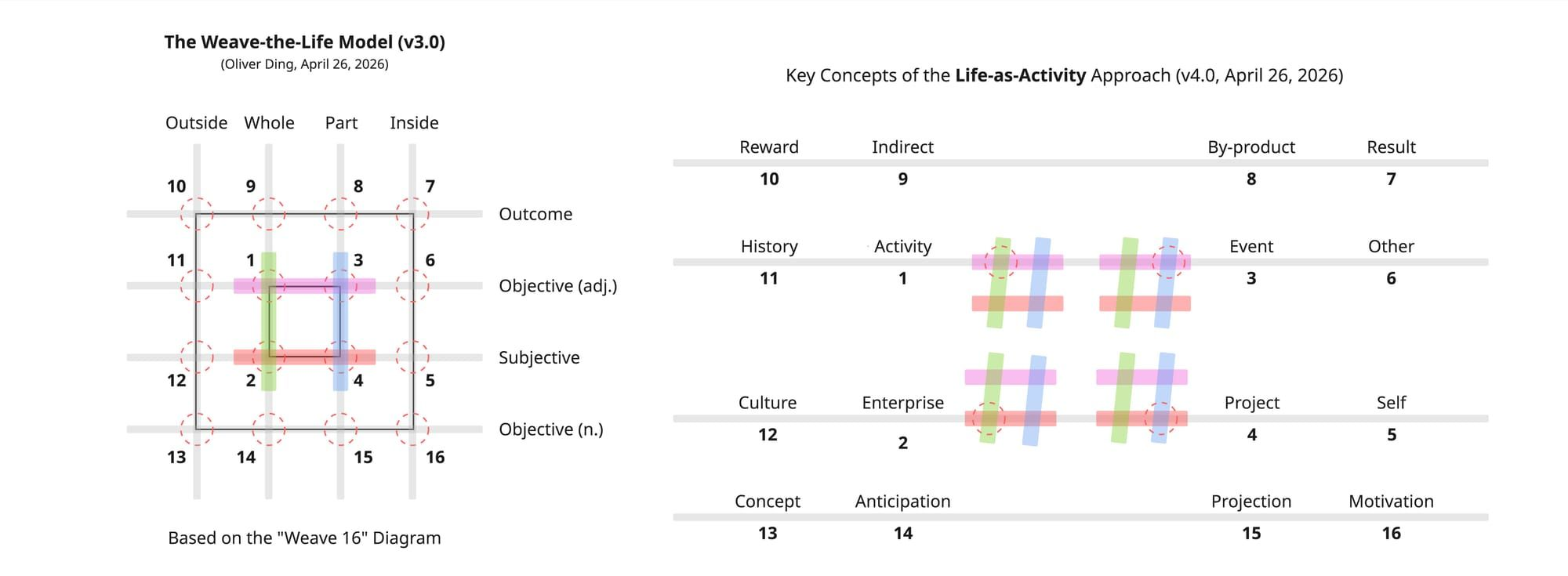
The Weave-the-Life framework answered this through a formal innovation drawn from the logic of Thematic Space. Each cell in the 4×4 Weave diagram is at once a Weave-point, a Coordinate and a Thematic Space: a structural intersection, a positional address and a living cognitive container. This nesting meant that frameworks previously distributed across separate diagrams could be organized within one spatial argument.
16 key concepts are selected to name the 16 weave-points of the diagram.The concept placed there — Self, Project, Projection, Enterprise — names the container and marks its location on the map. But what lives inside that container is far more than a single term. A thematic space may hold multiple frameworks, a series of diagrams, documented case studies, connections to other traditions of thought, and the personal history of how the concept developed over years of work.
This is why the Weave 16 diagram is not a classification system. It is a curatorial map. The 16 Weave Points organize the territory; the thematic spaces populate it.
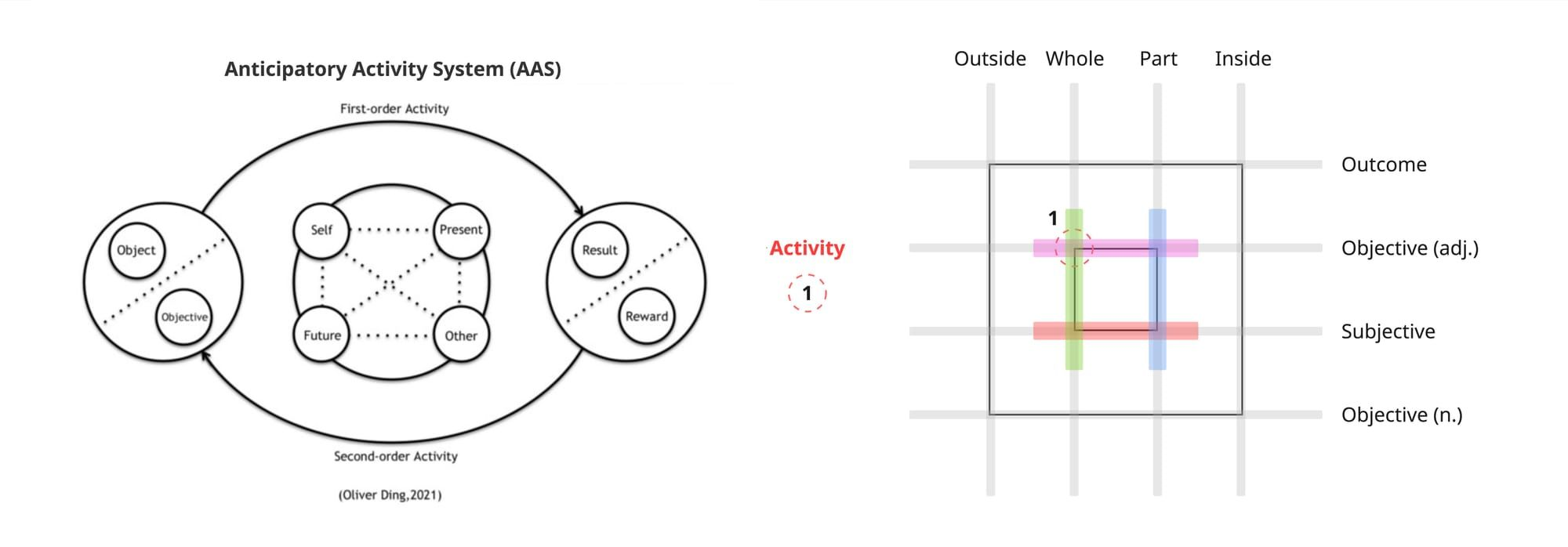
In Life-as-Activity: The Weave-the-Life Framework (v3.0), I demonstrate three ways these containers are activated. An individual concept opens its own thematic space. A pair of concepts, brought together, generates a new container that neither could hold alone. A group — several concepts gathered by thematic affinity rather than geometric proximity — forms a larger container with its own integrative logic. In each case, a specific diagram accompanies the demonstration, showing the thematic space in visual form.
Part 3. Building the Weave-the-Theme Framework (v1, 2026)
The second use of the Weave 16 diagram came in October 2026, during a two-week Revisiting-and-Rebuilding (RR) project.
Both uses of the Weave 16 grid address the same fundamental challenge: how to effectively curate the rich outcomes of a long-term creative journey—a vast landscape of a knowledge ecology—into a coherent whole.
The first use, Weave-the-Life, organized the accumulated outcomes of my years of exploration in the Activity Theory tradition, which I collectively call the Life-as-Activity approach. The second use, Weave-the-Theme, addressed a different landscape. It was designed to curate my years of exploration on theme and concept, bringing together the creative outcomes that presented in the "Theme-Concept-Framework Transformation" series book drafts.
3.1 Early Discovery: The T-only Model
Before the 4x4 grid could be applied to "theme," two conceptual shifts had to occur. The first was the detachment of the T-only model. As discussed in Spatial Heuristics: Detaching T from S-T-O, the T-only model was extracted from the Curativity of Mind model to focus exclusively on "T" (Thematic Crystallization) within the S-T-O principle. It needed a new structure to hold its four distinct phases.
However, a detached concept still needs a structure to hold its distinct phases. The T-only model could not remain an isolated fragment; it required an internal architecture to describe how a theme actually develops. This need drove the emergence of the Experience-Narrative-Framework-Ecology (ENFE) Schema on October 19, 2026.
The ENFE Schema is the direct spatial elaboration of the T-only model. It defines the vertical architecture of thematic development—the diachronic evolution of a theme. It names four distinct epistemological states that a theme travels through: from a pre-linguistic Experience, to a Narrative where it gains linguistic existence, to a Framework where it becomes a composite structure, and finally to an Ecology where it finds its niche in a larger knowledge landscape.
In this sense, the ENFE Schema is the static skeleton of the T-only model. It tells us where a theme goes in its developmental journey. But it does not yet tell us how that journey is interwoven with the concrete conditions of practice. That dynamic, operational dimension would require a second axis—which leads to the next step.
3.2 The 4x4 Edition: Weave-the-Theme (v1.0)
The ENFE Schema provided the vertical, diachronic architecture—the evolutionary timeline of a theme. But at this early stage of the two-week RR project, my primary goal was to build toward Cognitive Hydrology v2.0. The core mission of Cognitive Hydrology is not merely to describe themes, but to cultivate an individual's capacity for thematic development and concept creation.
To achieve this developmental goal, a diachronic timeline alone was insufficient. I needed a horizontal, synchronic axis that could provide a fine-grained breakdown of the concrete conditions under which thematic development actually takes place.
I chose the Milieu-Mediator-Method-Mastery (4M) Schema for this axis because it offered exactly that level of precision. I had developed the 4M Schema in 2025 while designing the Frame-for-Work Canvas (inspired by Clay Spinuzzi’s sociology of translation). By replacing "Empirical Focus" with the broader "Milieu" and adding "Method," the schema became a highly refined lens for analyzing practice. It dissects any creative activity into four precise dimensions: the surrounding environment (Milieu), the tools and mediums (Mediator), the cognitive operations (Method), and the achieved state (Mastery). Extending the ENFE Schema with 4M allowed me to map not just where a theme is in its lifecycle, but how it is actively being cultivated at that specific moment.
On October 20, 2026, the Weave-the-Theme Framework (v1.0) was born by crossing these two schemas. The sixteen intersections became sixteen thematic spaces, each providing a precise coordinate for a specific stage of thematic cultivation.
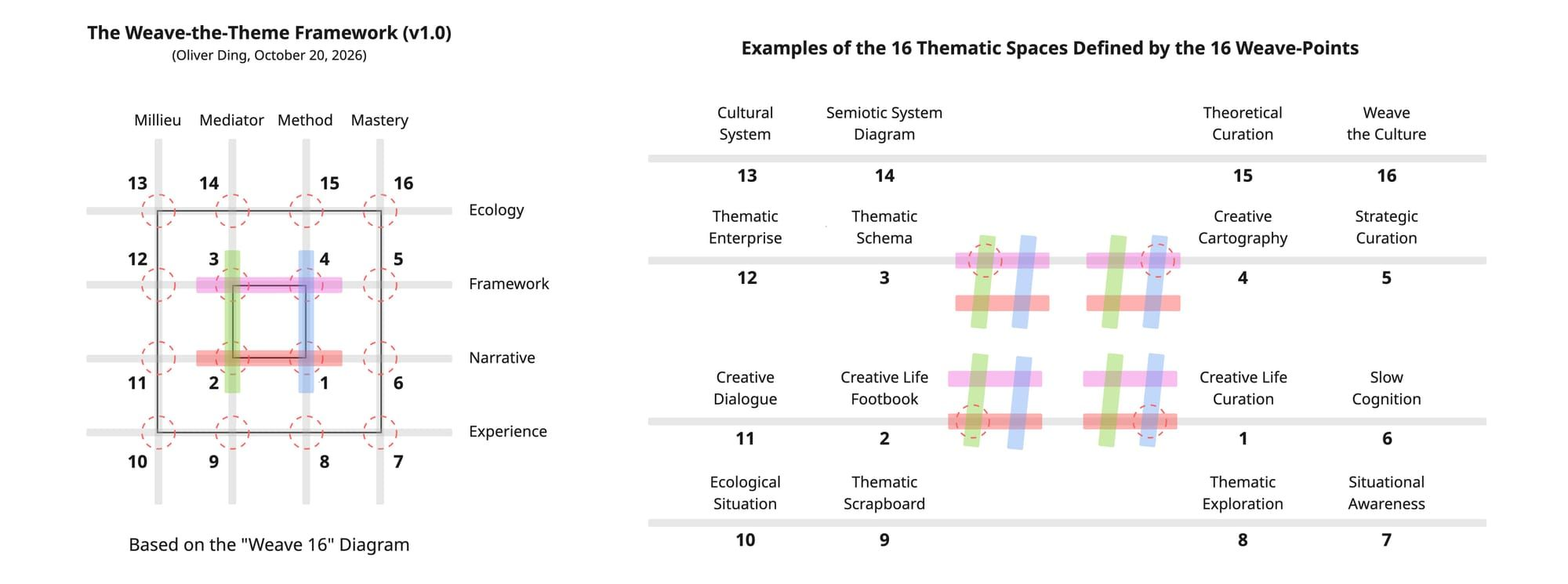
Building the grid was only the first step. The real value of the framework lay in its application as a knowledge curation tool. Over the years, I had produced a vast landscape of creative outcomes on the theme of "theme"—frameworks, diagrams, articles, and book drafts. But these outcomes had always lived in separate knowledge systems. They were connected in my practice, but they had never been gathered into a single view.
The 4x4 grid changed that. To populate the sixteen thematic spaces, I went back through my archives and selected specific creative outcomes as representative examples for each weave-point. This was not a mechanical filing process. It was an active curation. As I placed the elements into the grid, I had to constantly check them against the structure. Some examples were moved to different points because the diagram revealed that they did not fit the intended coordinates. For instance, placing "Situational Awareness" at #7 (Mastery × Experience) forced me to clarify exactly what kind of mastery is achieved at the pre-linguistic stage.
For the first time, a simple diagram allowed me to curate these scattered outcomes into a new configuration. Ideas that had developed in different contexts suddenly became adjacent, and their structural relationships became visible. The sixteen representative elements are not a closed taxonomy, but the first threads woven into the fabric of a larger knowledge ecology.
3.3 An Open Knowledge Map: Curating Thematic Elements
The Weave-the-Theme framework solved the problem of curating years of scattered thematic outputs. But the grid is not a rigid classification system; it is an open curatorial map.
Each of the 16 weave-points is a portal that activates a Thematic Space—a living cognitive container. Inside each space resides a multitude of Thematic Elements: frameworks, diagrams, case studies, book drafts, and lived experience. The sixteen representative elements (such as "Ecological Situation" at #10 or "Thematic Enterprise" at #12) are merely the first threads woven into the fabric.
The true test of this open map came from two recent concepts that were not designed with this diagram in mind:
- Thematic Supportance: When mapped, this concept did not fit into just one box. It distributed itself across the Experience row: the milieu of the encounter (Milieu × Experience), the physical object as a mediator (Mediator × Experience), and the act of capturing it (Method × Experience). The map even demanded the creation of a new name—"Capturing Thematic Supportance"—to fully articulate the method.
- Thematic Focus: This concept similarly crossed boundaries. It began at Milieu × Experience (emerging from the flow of experience), operated at Method × Narrative (the act of naming), and was captured at Mediator × Narrative (becoming a linguistic container).
These cases reveal a deeper principle: a concept system does not simply correspond to a single weave-point. Its multiple concepts can be concentrated at one point, or distributed across several spaces. When a large concept system connects to the Weave diagram, it is divided into smaller thematic spaces—a mediation produced when the Weave diagram provides the coordinates, and the concept system provides the content. The map remains open, ready to be stretched and re-drawn as new themes emerge.
Part 4. One Meta-diagram, Two Situational Models
Read together, the two uses of the Weave 16 structure address the same fundamental challenge: how to effectively curate the rich outcomes of a long-term creative journey—a vast landscape of a knowledge ecology—into a coherent whole.
However, the Weave 16 is not a fixed classification system; it is a meta-diagram. It provides only a pure spatial structure—sixteen coordinates—without prescribing what must live inside them. Because the meta-diagram itself is content-agnostic, how it is applied depends entirely on the specific situation. Therefore, each application generates a different knowledge framework, even though they share the same underlying structure. I call these specific, context-driven outcomes situational models. Weave-the-Life (v3.0) and Weave-the-Theme (v1.0) are two such situational models, derived from the same meta-diagram but shaped by entirely different contexts.
This distinction explains why the two situational models manifest profound differences across four key dimensions: Creative Process, Weave-points, Inner Ring and Outer Ring, and Numbering.
4.1 Creative Process
The two situational models emerged from drastically different rhythms and developmental logics. Weave-the-Life was a long-term slow cognition process spanning several months, whereas Weave-the-Theme was a concentrated fast sprint completed within a two-week Revisiting-and-Rebuilding project (with the actual construction taking about four days).
This difference in pace is rooted in where their structural dimensions came from. For Weave-the-Life, the two axes of the 4×4 grid were endogenous. They were the result of years of accumulated exploration within the Activity Theory tradition—an organic crystallization of my continuous inquiries into the life-as-activity approach. In contrast, the dimensions for Weave-the-Theme were a temporary synthesis. The vertical axis (ENFE) was born directly out of the RR process of the Flow-Story-Model framework, while the horizontal axis (4M) was brought in externally to complement it.
Most importantly, the creative process of Weave-the-Life was itself the very process through which the 4×4 meta-diagram was born. Initially, the 2×2 basic form was insufficient; driven by practical needs, the structure naturally expanded to a 4×4 grid—a classic case of practice driving theoretical development. Because Weave-the-Life came first, it not only gave birth to this meta-diagram but also equipped me with the tool and the operational fluency to use it. Therefore, applying it to Weave-the-Theme was a natural transfer. The fast sprint of Weave-the-Theme was only possible because it was firmly grounded in the slow cognition that preceded it.
4.2 Sixteen Weave-points
There are multiple ways to describe the sixteen weave-points. The simplest is purely numerical (e.g., #1 to #16, which will be discussed in the numbering section). A second way is to use the combination of the two axes (e.g., "Method × Narrative"). However, both methods remain highly abstract. To bring these spaces to life, we need a concrete method that is deeply tied to the process of knowledge curation.
In the Weave-the-Life case, I curated 16 Key Concepts. These represented the foundational pillars of the life-as-activity approach, synthesizing years of theoretical exploration into a coherent conceptual landscape. For example, the intersection of "Part" and "Subjective" was anchored by the concept of "Project", while "Whole" and "Objective" was anchored by "Enterprise".
In the Weave-the-Theme case, I took a different approach and used concrete examples instead of abstract key concepts. The reason lies in the nature of the 4M Schema. Unlike the abstract concepts of the Life-as-Activity approach, the 4M Schema (Milieu, Mediator, Method, Mastery) leans heavily toward the operational level of practice. Therefore, forcing an abstract concept onto a 4M intersection would feel disconnected. Instead, I curated concrete examples from years of scattered thematic outputs to anchor each space. For instance, the intersection of Method × Narrative (#1) was anchored by "Creative Life Curation", and Mastery × Experience (#7) was anchored by "Situational Awareness".
However, it is crucial to avoid a common misunderstanding: a knowledge framework does not have to be confined to a single weave-point or thematic space. The diagram is an open map, and a concept system can unfold, distribute, or cluster across multiple coordinates.
In the original Weave-the-Life article, I demonstrated three distinct ways to map concepts to thematic spaces:
- Single Concept, Single Space: An individual concept opens its own dedicated thematic space.
- Pairing Concepts: A pair of concepts, brought together, generates a new container that neither could hold alone.
- Thematic Clustering: A group of concepts, gathered by thematic affinity rather than geometric proximity, forms a larger container with its own integrative logic.
This distributed mapping is further validated by the two test cases in the Weave-the-Theme article. Thematic Supportance, for instance, did not fit into a single weave-point; its elements distributed themselves across the entire Experience row—from the encounter's context (Milieu × Experience) to the physical object as a mediator (Mediator × Experience), and the act of capturing it (Method × Experience). Similarly, Thematic Focus unfolded across weave-points: beginning at Milieu × Experience (emerging from the Flow), operating at Method × Narrative (the act of naming), and manifesting at Mediator × Narrative (the linguistic container).
This dynamic curation process meant that content was constantly checked against the structure. Some examples were moved when the meta-diagram revealed that they did not fit their intended coordinates. This proves that knowledge curation is not just about filling boxes; it is an active process of testing and refining the relationship between the abstract structure and the concrete output. A large concept system acts as a large thematic space itself; when it connects to the meta-diagram, it is divided into smaller spaces—a mediation produced when the meta-diagram provides the coordinates, and the concept system provides the content.
4.3 Inner Ring and Outer Ring
The relationship between the inner and outer rings reveals another fundamental difference between the two situational models: one is a product of deliberate design, while the other is a serendipitous discovery.
In Weave-the-Life, the inner ring and outer ring were developed intentionally. The inner ring is literally the historical 2×2 version of the framework. It holds the core concepts of the life-as-activity approach (Self, Project, Activity, Enterprise). As the theory matured, I deliberately expanded the two axes from two dimensions to four. This expansion added new dimensions like Outside, Inside, Outcome, and Objective (n.), which naturally grew outward to form the outer ring, capturing broader socio-historical contexts. Here, the 4×4 structure was a conscious architectural evolution—the inner ring was preserved as the foundation, and the outer ring was built around it.
In Weave-the-Theme, however, the situation was entirely different. When I was designing the 4×4 structure and curating the thematic outputs, I did not consider the concepts of an "inner ring" or "outer ring" at all. I was simply trying to map different elements into the grid. It was only after the framework was completed that I made an accidental discovery: the four points at the center (#1 to #4)—Creative Life Curation, Creative Life Footbook, Thematic Schema, and Creative Cartography—happened to perfectly correspond to the core methodologies and output forms of Cognitive Hydrology.
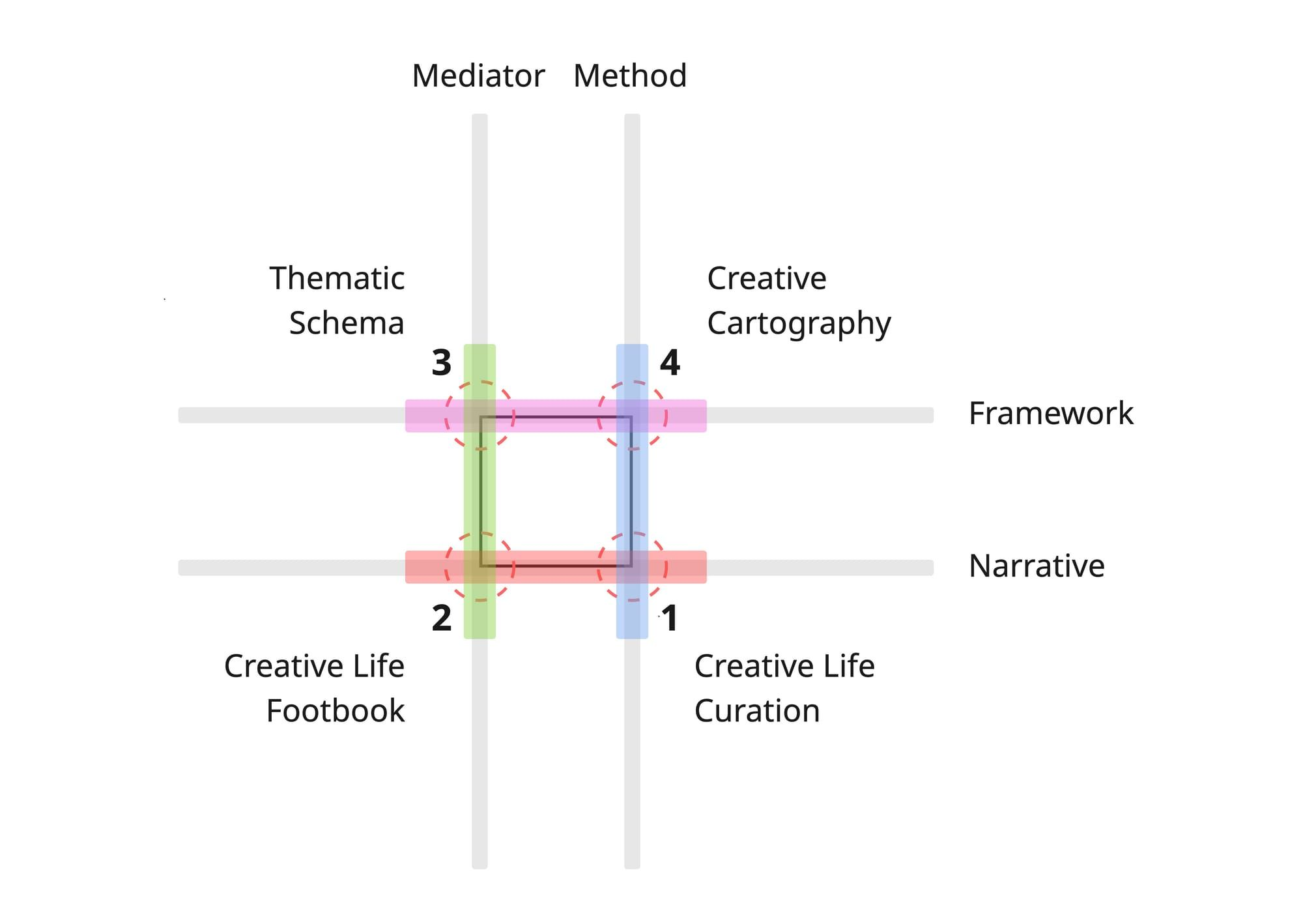
This was a pure coincidence, but a highly meaningful one. To visually and conceptually reinforce this unexpected alignment, I deliberately adopted a unique numbering sequence. This numbering strategy spatially distinguished the diagram into a core Inner Ring and a broader Outer Ring, turning an accidental discovery into a structural anchor for the framework. (The details of this numbering strategy will be explored in the next section.)
4.4 Numbering
The numbering methods of the two situational models share a deep structural affinity. Both are designed to start from the center and expand outward, reflecting the natural evolution from a 2×2 core to a 4×4 grid. When I numbered Weave-the-Theme, I was indeed influenced by the numbering logic of Weave-the-Life. However, there are subtle but meaningful differences in their specific outward paths.
In Weave-the-Life, the numbering strictly follows the historical architecture of the 2×2 basic form. The Inner Ring points (#1 to #4) are positioned exactly where the original 2×2 weave-points were: #1 in the top-left (Activity), #2 in the bottom-left (Enterprise), #3 in the top-right (Project), and #4 in the bottom-right (Self). From this core, the numbering moves outward to the Outer Ring (#5 to #16). The path traces the newly added dimensions (Outside, Inside, Outcome, Objective) in a specific sequence, preserving the spatial logic of how the life-as-activity approach organically expanded over time.
In Weave-the-Theme, although the numbering also starts from the center, the specific path and the choice of the starting point were deliberately adjusted. The sequence does not begin with the top-left coordinate. Instead, it begins specifically at #1 (Method × Narrative) located in the bottom-right, which represents Creative Life Curation—the core methodology of Cognitive Hydrology. From this point, the numbering spirals clockwise outward to #16 (Mastery × Ecology).
This slight modification in the path—anchoring the start at the core methodology rather than a historical geometric center—does not follow the organic growth of the framework. Instead, it was intentionally adopted to reinforce the accidental discovery of the Inner Ring (the operational engine) and the Outer Ring (the extended contexts). By tracing this specific clockwise spiral, the diagram visually prioritizes the core methodology of Cognitive Hydrology, turning a serendipitous structure into a functional navigational path.
Conclusion
The journey of Weave 16 reveals a core lesson of Spatial Heuristics: the same spatial structure can accommodate entirely different engagements. This difference is not merely reflected in the final outcomes, but is deeply embedded in the processes of how they were implemented.
Weave 16 is the pivotal point at which the Weave dimension of the spatial heuristic coordinate began to develop. It was born out of a shared fundamental challenge: how to effectively curate the rich outcomes of a long-term creative journey—a vast landscape of a knowledge ecology—into a coherent whole.
By treating Weave 16 as a meta-diagram, it provided a pure, content-agnostic structure. However, its true power was revealed through its application. Because the specific situations differed, each engagement generated a distinct situational model, differing in both process and result:
Weave-the-Life represents a slow, organic engagement. The process was a long-term slow cognition spanning months, evolving iteratively (v1.0 to v3.0). Its dimensions were endogenous, naturally expanding from a 2×2 core to a 4×4 structure as the theory matured. The outcome was a conceptual landscape populated by abstract key concepts.
In contrast, Weave-the-Theme represents a fast, synthetic engagement. The process was a concentrated sprint (about four days within a two-week RR project). Instead of organic growth, it relied on cross-schema synthesis—temporarily bringing together the ENFE and 4M schemas to build a 4×4 structure directly. The outcome was an operational map populated by concrete examples from past thematic outputs.
Crucially, these different processes and outcomes proved that the meta-diagram is an open map. A concept system does not have to be confined to a single box. Just as the test cases of Thematic Supportance and Thematic Focus revealed, a concept can distribute its elements across multiple weave-points, forming meaningful constellations within the matrix.
The ultimate lesson for the coordinate itself is that its dimensions are not fixed. The Weave dimension evolved from a 2×2 frame, to a 4×4 frame, and to an 8×8 frame. Each step was driven by a practical engagement in a new case. The coordinate learned from its own uses. The fast, synthetic sprint of Weave-the-Theme was only possible because it was firmly grounded in the slow, organic cognition of Weave-the-Life. The structure remains stable, but the processes, the engagements, and the outcomes multiply. The dimension grows through its uses, and this growth is part of the ongoing movement from a mere coordinate to a living center.
v1.0 - November 7, 2026 - 6,276 words