Interthyme: A Dramatic Life Pattern
Resonant rhyme in parallel across time
by Oliver Ding
April 24, 2026
A short note
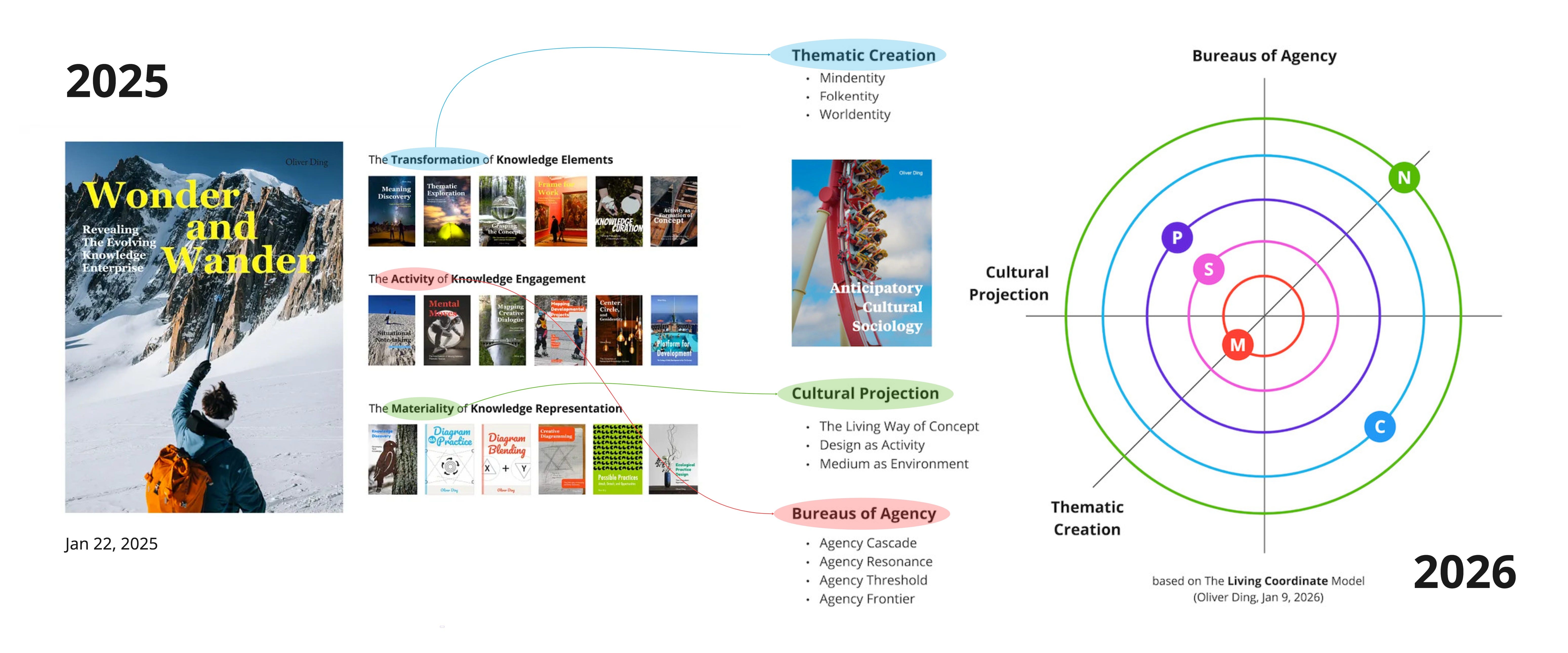
This morning, I revisited the Wonder and Wander book and found the diagram that represents three dimensions of knowledge enterprises. Immediately, I connected it with the diagram of the Anticipatory Cultural Sociology. See the diagram above.
Two diagrams were made at different times, one was in January 2025, while the other was made one year later. However, they have the same structure at the deep level.
- Transformation of … Elements → Thematic Creation
- Activity of … Engagement → Bureaus of Agency
- Materiality of … Representation → Cultural Projection
These two theoretical enterprises have different focuses, one is about Knowledge, and the other is about Culture. However, if we use “Cultural” to replace “Knowledge” in three dimensions in the 2025 diagram, we almost get the same ideas as the three dimensions of the 2026 diagram.
Over the past several years, my primary focus has been on the creative lives of knowledge creators, including their creative enterprises and life development.
However, in the last season of 2024, I saw some signs of the end of this journey. For example, I shifted my focus from knowledge engagement to cultural engagement in the Strategic Life Narrative project. In December 2024, I introduced GO Theory (The Genidentity — opportunity Approach), which emphasizes Social Life Development as its primary object.
During the 2024 Christmas holiday, I had a reflective conversation with a mentor, revisiting my work on HELLO THEORY, GO Theory, and the Strategic Life Narrative project. Through this reflection, I realized my newest focus had shifted toward Cultural Life Development, marking a detachment from Individual Life Development. This strategic move was encapsulated in the theme of “Cultural Grounding/Cultural Growing.”
This is both a good end and a good beginning.
On January 18, 2025, I made the diagram below to reflect on my creative journey from 2023 to 2024.
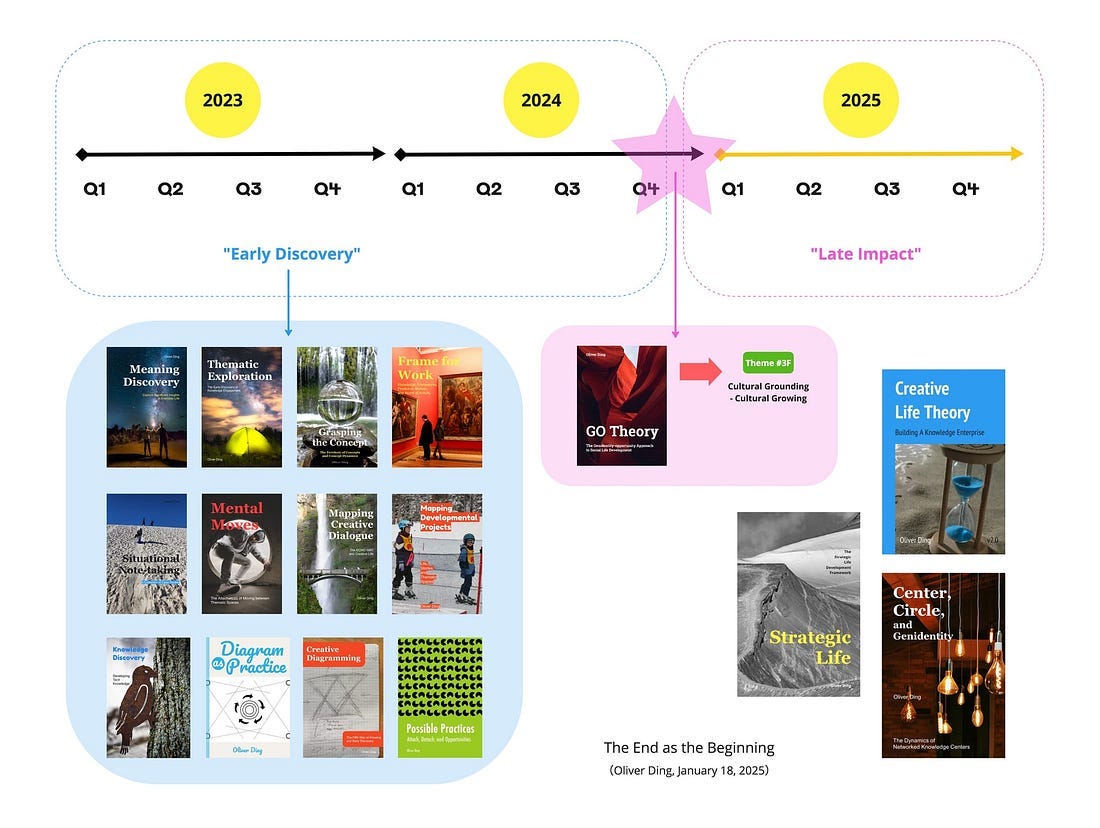
In 2023, I made four possible books focused on the Early Discovery of knowledge engagement, forming the series Aspects of Early Discovery.
By the end of 2024, the series had expanded to include 12 possible books, organized into three sub-series, focusing on three aspects:
- The transformation of knowledge elements
- The activity of knowledge engagement
- The materiality of knowledge representation
These three aspects form the foundation for building a knowledge enterprise, which was the central focus of Phase 1 of Creative Life Theory.
The diagram was named the End as the Beginning, highlighting my shift from individual life development to cultural life development.
To close a several-year journey of knowledge engagement, on January 22, 2025, I created the picture below, highlighting three aspects and the related book drafts I had written. The theme “Wonder and Wander” was born.
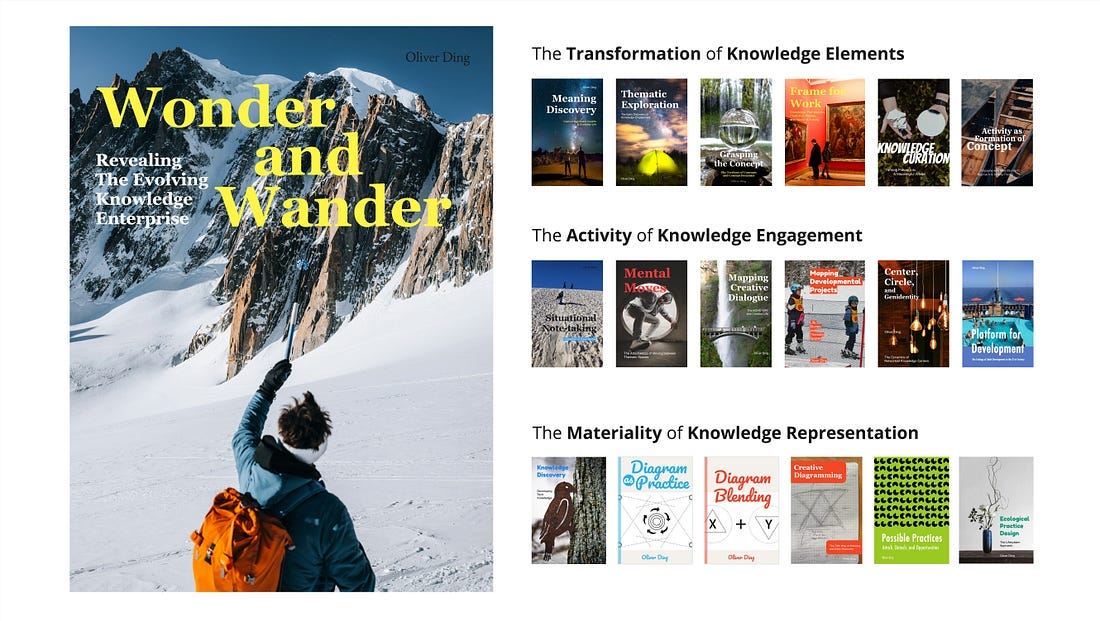
The three aspects echo three dimensions of the Evolving Knowledge Enterprise model I had been developing from 2023 to 2024. Therefore, I used “Revealing The Evolving Knowledge Enterprise” as a subtitle of the “Wonder and Wander” theme.
On March 1, 2025, I wrote a short note about the theme, kick-starting the project.
I have used different terms to describe these aspects in different frameworks. On March 26, 2025, I introduced the “Mental — Social — Material” Schema as a meta-framework to support these models.
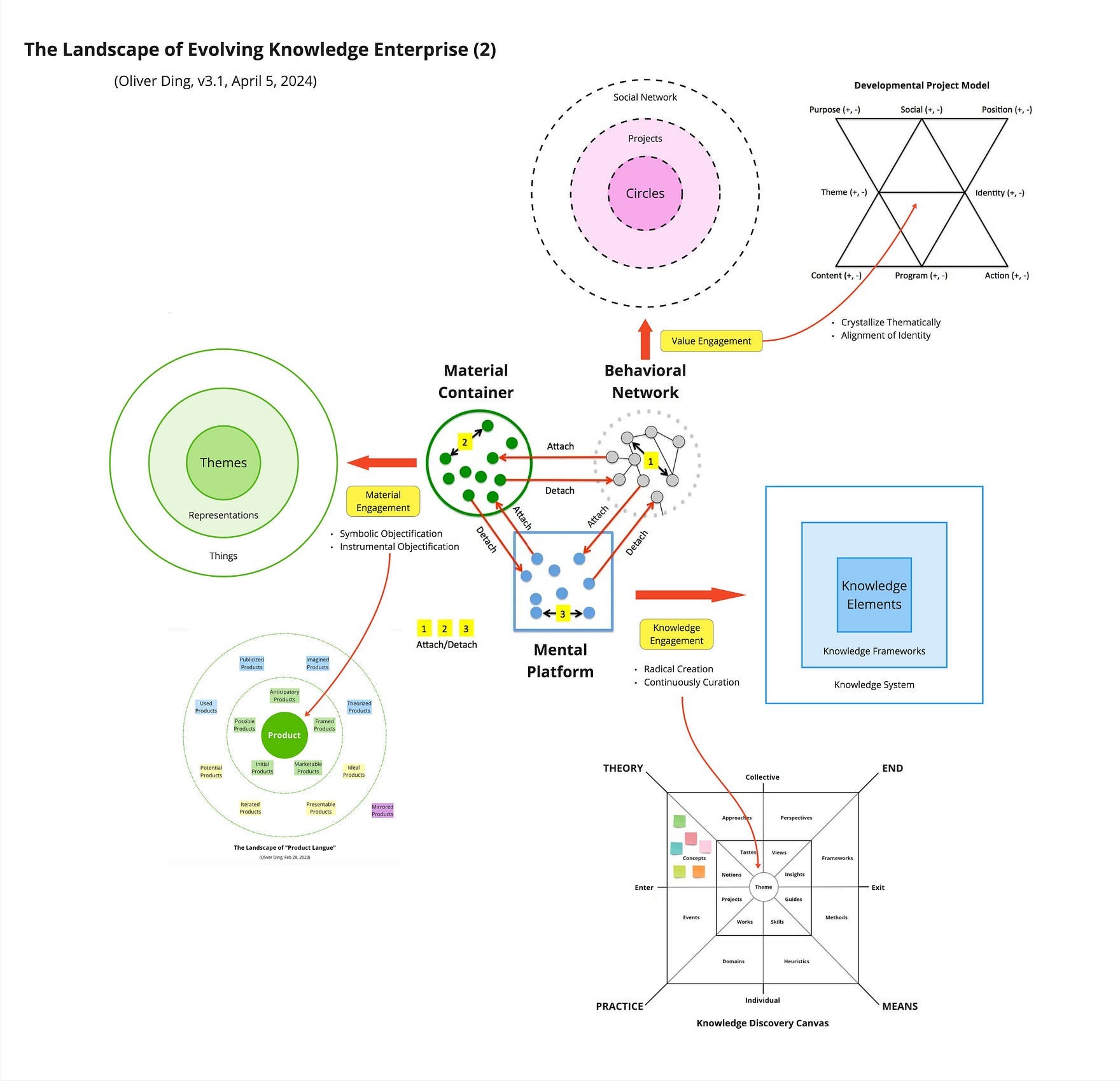
A fully developed model, called the Landscape of Evolving Knowledge Enterprise Model, was created in April 2024. It is a model with three dimensions and three hierarchical levels. The three dimensions involve not only thinking, but also other forms of engagement such as doing, saying, and making. This model emphasizes going beyond the mental dimension to include embodied, communicative, and material practices.
- Mental Platform: How do you think?
- Behavioral Network: How do you do?
- Material Container: What do you make?
In the case study titled The “Evolving Knowledge Enterprise” Journey (2020–2025), I traced the historical development from knowledge curation to knowledge engagement, and ultimately to knowledge enterprise, as follows:
- Single Point: “HERO U” (2020)
- Durable Category: “Knowledge Curation” (2020–2022)
- Cross-categorical/Trans-categorical: “Knowledge Engagement” (2022–2023)
- System/Complex: “Knowledge Enterprise” (2023–2024)
- Trans-system/Trans-complex: “Creative Enterprise” (2024–2025)
In January 2023, I launched TALE (Thematic Analysis Learning Engagement), a new knowledge center to host the Thematic Engagement project. This project emerged from a creative dialogue between Activity Theory and Curativity Theory, developed between 2020 and 2022.
As a knowledge center, TALE focuses on the “Person — Theme” relationship and its dynamics. However, this object of study is quite broad — there are many concrete activities and projects that fall under the abstract notion of Thematic Engagement.
To maintain focus, I developed the TALE model to frame its strategic intention. See the diagram below.
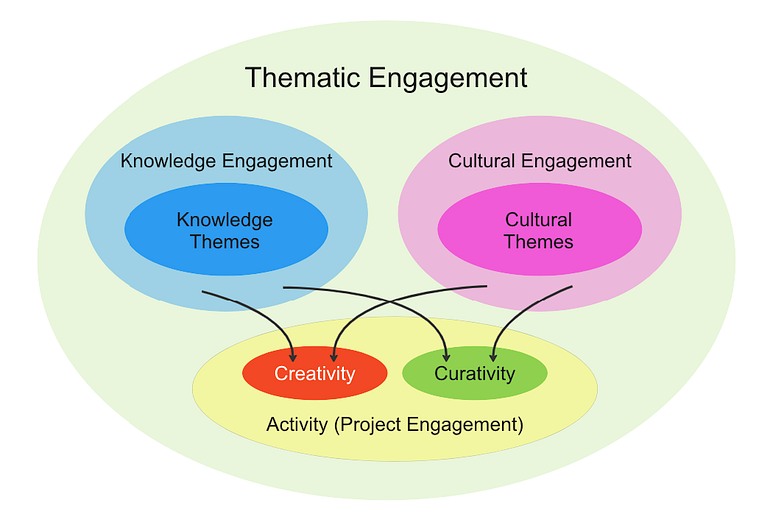
I divided Thematic Engagement into two types: Knowledge Engagement and Cultural Engagement. Drawing from the Project Engagement Approach, I redefined ‘Engagement’ and treated theme-based activities — such as projects — as its key working objects.
From 2020 to 2022, I explored knowledge engagement through a series of projects. In 2023, I decided to continue along this direction. Thus, I defined the first phase of TALE to focus specifically on Knowledge Themes, in order to stay aligned with my other knowledge-related initiatives.
Moreover, I positioned the exploration of “Themes/Concepts” as my primary focus. This strategic intention creates a pathway for evolving from knowledge engagement toward cultural engagement.
By the end of 2024, I began shifting from Knowledge Engagement to Cultural Engagement. Interestingly, the entire body of knowledge created under TALE in 2023–2024 turned out to be ready for this transition. I simply rephrased parts of my frameworks — changing terms like “knowledge X” to “creative X.”
In fact, I don’t see this as a shift but rather an expansion — because all creations about themes and concepts within the context of knowledge engagement can also be applied meaningfully to cultural engagement.
This strategic model has helped me navigate the balance between Performance (as present objects) and Anticipation (as future objectives). More details can be found in [Frame for Work] Case Study #2: The TALE Model (2023).
At first glance, a reader may understandably interpret this as a strategically planned developmental story — as if the overall trajectory had been mapped in advance, with the three-dimensional pathway already anticipated from the beginning.
However, this was not what actually happened.
Between January and March 2026, when I began developing the ACS project, from the initial naming of version 1.0 to the eventual 200,000-word manuscript of version 2.0, I was certainly aware that my broader focus was moving from knowledge toward culture. Yet at that specific moment, I was not consciously extending the earlier three-dimensional knowledge model in order to build the new theoretical framework.
At the same time, I was deeply engaged in writing Lake 42. In early January, while working on that manuscript, I developed the Living Coordinate model — a three-dimensional, three-ring structure that emerged from the immediate needs of that project.
Later, in February, when I began consolidating a series of ACS-related writings, I used this newly developed structure to organize the work into a three-dimensional coordinate and three-ring model (v1.1).
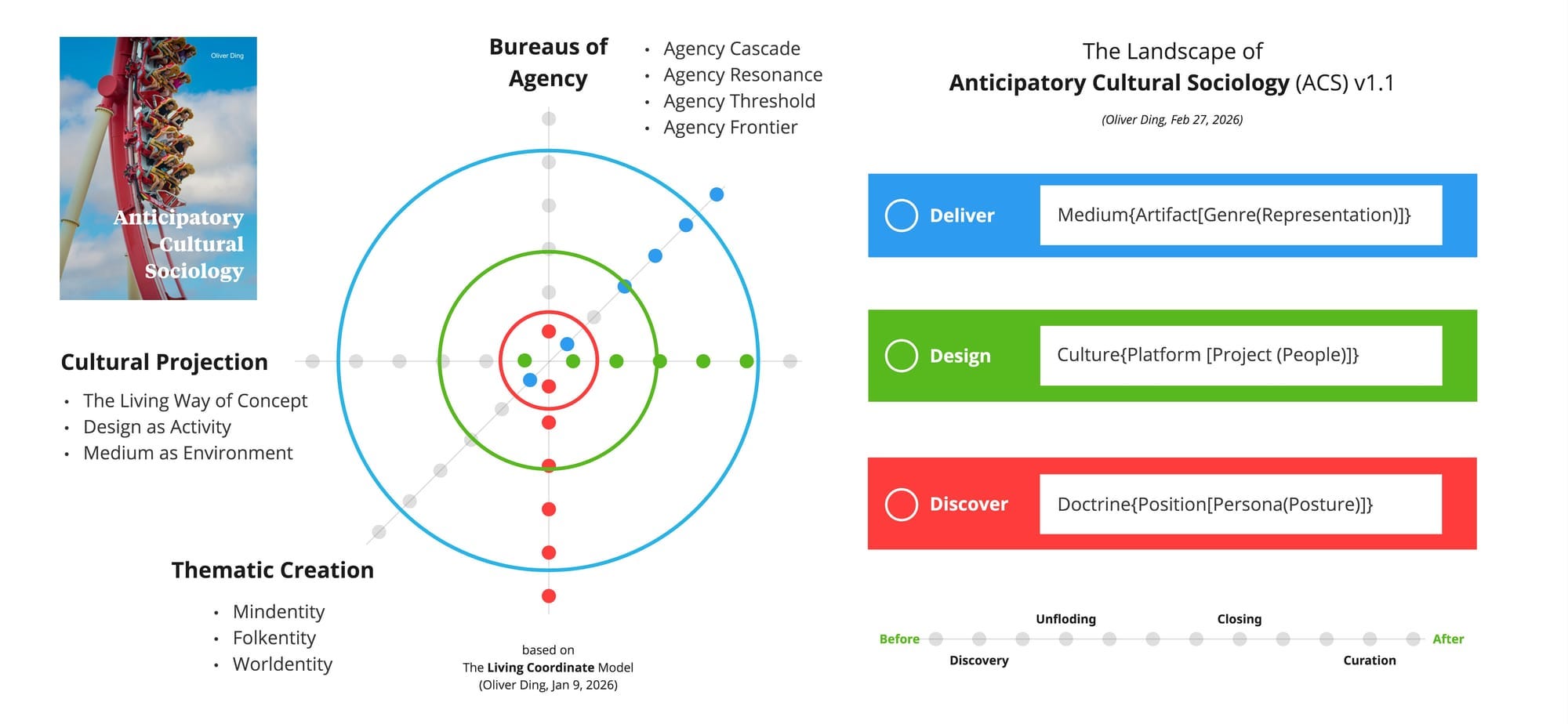
Importantly, the choice of dimensions at that stage was not drawn from the earlier knowledge framework. Instead, it was informed by several dimensions that had been developed within the LARGE Method.
The LARGE Method itself was also a product of the ACS project’s unfolding process. During that period, I had already begun to position it as my meta-method for theoretical and strategic development.
In other words, my attention at that time was fully occupied by the newly emerging tools and models. They became the immediate focus of my work.
I had, in fact, completely forgotten the earlier three dimensions developed within the knowledge framework.
Otherwise, I would most likely have directly reused the earlier terminology instead of arriving at a new set of terms for the three-dimensional coordinates.
This is precisely why the later recognition was so striking.
What I encountered was not the execution of a pre-existing plan, but the re-emergence of a deep structure under entirely different project conditions, through different conceptual pathways and different vocabularies.
The sense of interhyme emerged at the moment when I realized that these independently developed structures, despite their distinct terms and immediate purposes, shared the same deep rhythm.
This was not a case of deliberate repetition.
Rather, it was a case of structural reappearance.
Interestingly, I also experienced a similar sense of interhyme yesterday. See the figure below.
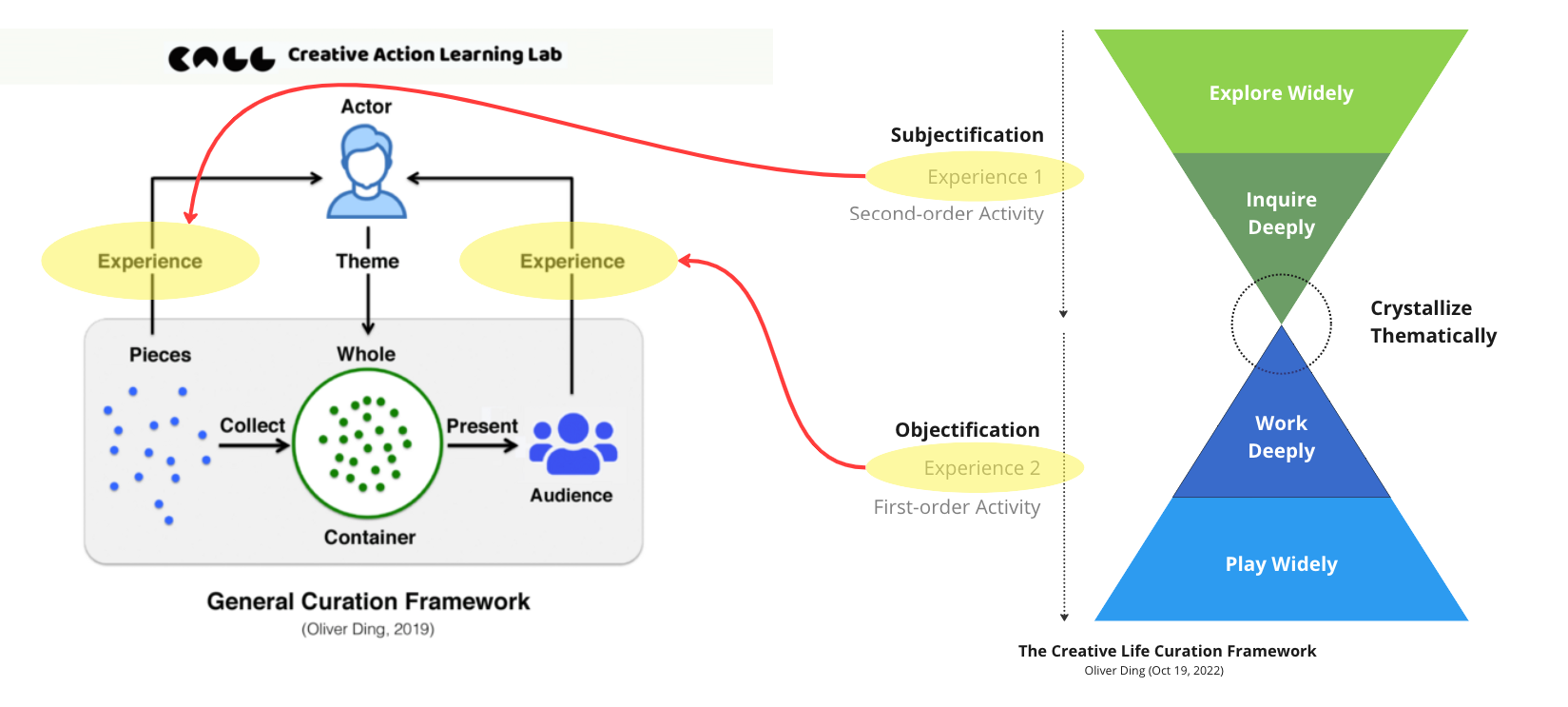
When I developed the Creative Life Curation model in October 2022 (right side of the figure), I was struck by how closely it aligned, in form, with the General Curation Framework I had created in 2019 (left side of the figure). The red connections indicate a pair of corresponding concepts between the two models:
- Subjectification ↔ Experience 1 (Actor — Pieces)
- Objectification ↔ Experience 2 (Audience — Actor)
This correspondence becomes clearer when viewed alongside a third framework: the AAS (Anticipatory Activity System), where the distinction between first-order activity and second-order activity provides an explicit articulation of the same structural differentiation.
Subjectification
- Experience 1: turning the world into a person’s experience.
- This echoes Second-order Activity.
Objectification
- Experience 2: turning the person’s experience into artifacts for the world.
- This echoes First-order Activity.
In this sense, the alignment is not limited to two models, but extends across three independently developed frameworks.
This case is different from the one discussed earlier today.
The example from this morning concerns a single theoretical enterprise, where the same deep structure re-emerged across different stages and projects without explicit reuse. By contrast, the 2022 case involves models from different theoretical enterprises, where a shared deep structure becomes visible across them.
What is common to both, however, is not the continuity of development, but the presence of a structural pattern that can appear across independently formed thematic spaces.
In Jaunary 2026, I coined a new term called “Interthyme” and designed a theamtic card. Now it is time to share it with readers.