
[Dramatic Life Pattern] The Weave-the-Gap Pattern
Expanding the GAP Projects into an Advanced Pattern
by Oliver Ding
November 17, 2026
This article is part of the Dramatic Life Pattern series.
Previous articles focused on individual patterns. In recent case studies, however, I found that these patterns do not occur in isolation; they often occur together. This article uses the weave basic diagram to expand the GAP Projects into an advanced pattern made up of four patterns.
The article is structured as follows. First, I introduce the GAP Projects pattern. I then explore two new patterns adjacent to it. Next, I introduce the weave basic form and use it to create a new framework for building an advanced pattern. Finally, I present concrete case studies to show how the framework can be used.
I developed this framework a year ago, when I called it “weave the pattern.” Today I am renaming it “weave the gap” and adding recent cases.
Contents
Part 1. The GAP Projects Pattern
1.1 What Is a GAP Project?
1.2 The Creative Life Curation Project (The "After" Project)
1.3 The Creative Life Discovery Project (The "Before" Project)
Part 2: Two Related Patterns
2.2 The 2S Pattern: Write after Talk
2.3 Beyond the Temporal Aspect
Part 3: Weave the Gap
3.1 The Weave Basic Form
3.2 The Weave-the-Gap Model
3.3 Creative Life Curation vs. Strategic Life Narrative
Part 4: Case Study: From Homecoming to Lake 42
4.1 1E (Curation as Closure): Closing the Homecoming Project
4.2 The GAP Project (After): Curation as Reflection
4.3 The GAP Project (Before): Narrative for Discovery
4.4 The 2S Pattern (Write after Talk)
4.5 Conclusion of the Case
Part 5: Examples of Four Thematic Spaces
5.1 The Value Circle Project (1E Pattern: Curation as Closure)
5.2 The Strategic Life Project (Curation as Reflection)
5.3 The Weave-the-Education Diagram (Narrative for Discovery)
5.4 Activity Analysis Network #9 (Write after Talk)
Part 6: Activity, Curativity, and Creativity
6.1 Activity Provides Materials
6.2 Curativity Organizes Them
6.3 Creativity Opens Possibilities
Conclusion
Part 1. The GAP Projects Pattern
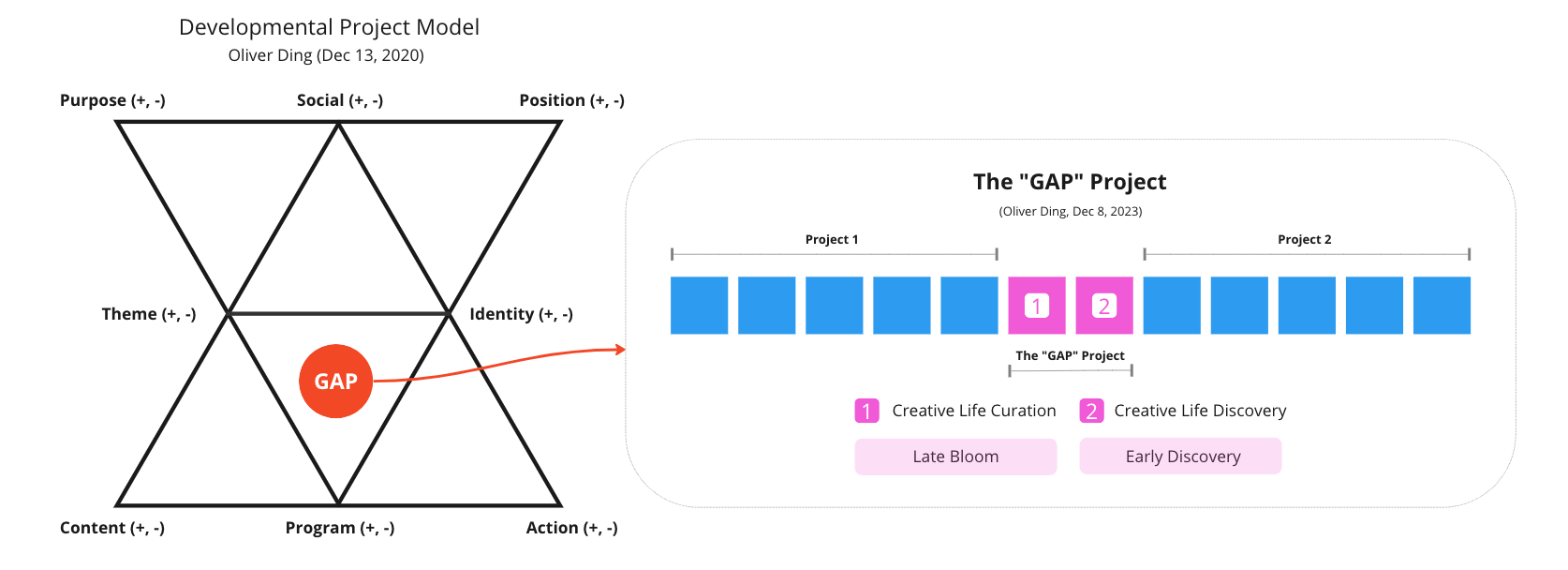
I use the term GAP Project to refer to an informal project that sits between two formal projects. The idea is inspired by the gap year—a period when students step away from formal study to travel, work, volunteer, or explore before moving on to the next stage of their lives.
1.1 What Is a GAP Project?
A GAP Project occupies the gap between one project and the next, much as a gap year occupies the space between stages of formal education. It is not a break from meaningful work; it is a developmental interval. It gives me room to reflect on what has just ended, explore what might come next, and turn that in-between time into something purposeful.
I use an “After | Before” structure to distinguish two types of GAP Projects:
- The “After” Project, such as Creative Life Curation
- The “Before” Project, such as Creative Life Discovery
In this article, I treat GAP Projects as one pattern within a larger weave rather than as an isolated habit. Let's look at the two types in detail, drawing on specific cases from my own creative journey.
1.2 The Creative Life Curation Project (The "After" Project)
A Creative Life Curation project is an “After” project. It takes place after a formal project has ended and uses that interval to reflect on the experience, curate its pieces, and turn them into a meaningful whole.
Creative Life Curation is a specific method that I introduced in a book manuscript of the same title, written in 2022. It refers to turning life experiences into developmental resources and meaningful achievements. For knowledge creators, I see it as a specific life strategy: instead of letting experience pass by as memory, we frame it, curate it, and give it a second-order meaning.
A clear case of this is the GAP project I ran in October 2022. Before this gap, I had just closed a 3-year formal project—the Knowledge Curation project (June 2020 to Oct 18, 2022). Instead of jumping straight into the next big thing, I ran an "After" project from Oct 20 to Oct 26. During this short interval, I reflected on the three journeys of the Knowledge Curation project and developed the Creative Life Curation Framework. I also created a curated framework for the Life Strategy project, connecting several different theoretical approaches.
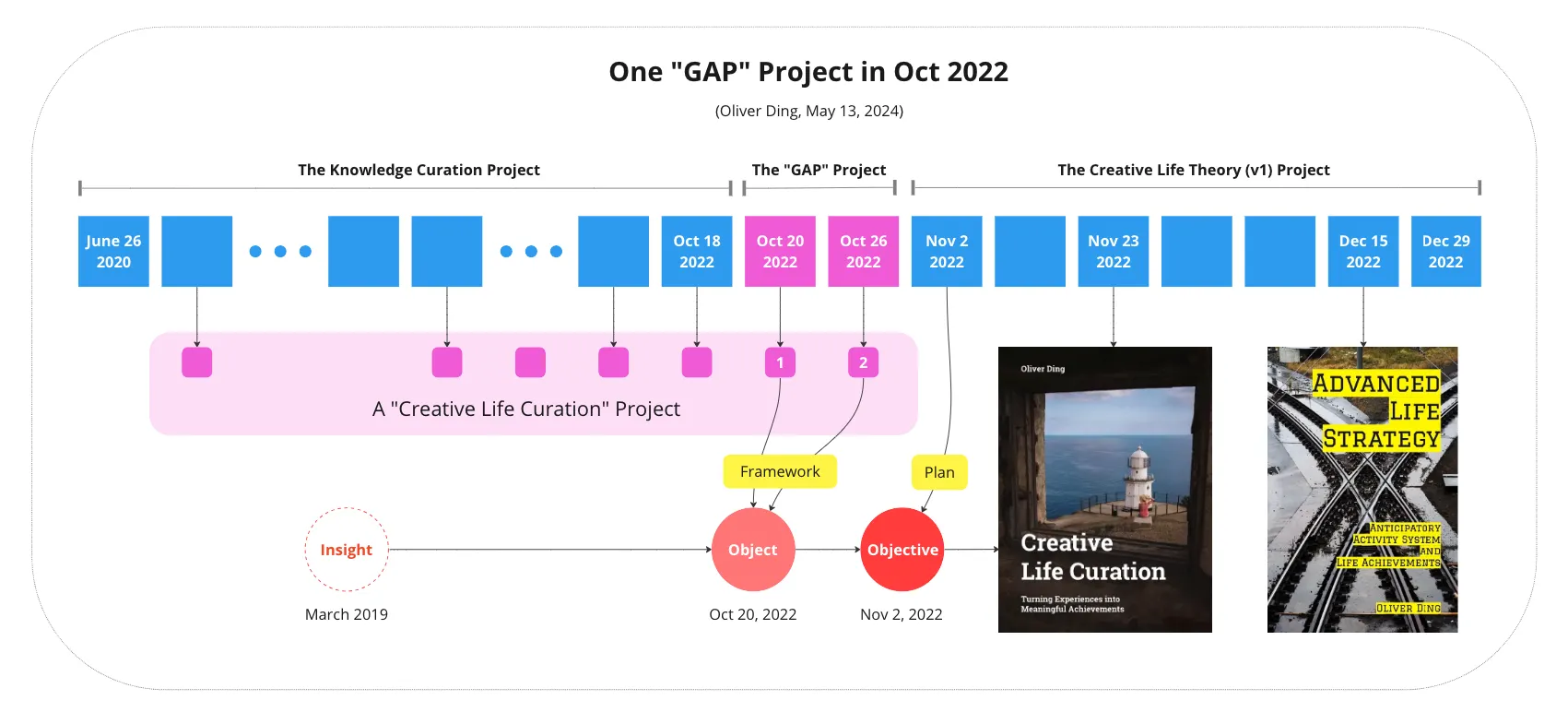
This GAP project had a massive impact. It laid the foundation for the Creative Life Theory (v1.0) project that followed. The outcome of this GAP project eventually became two book manuscripts: Creative Life Curation: Turning Experiences into Meaningful Achievements (edited on Nov 23, 2022) and Advanced Life Strategy (edited on Dec 15, 2022).
1.3 The Creative Life Discovery Project (The "Before" Project)
A Creative Life Discovery project is a “Before” project. It takes place before a formal project begins. It is a gap project of the “Before” type: a period for exploring possible directions, identifying themes, and discovering what the next formal project might become.
If Creative Life Curation looks backward and turns experience into meaning, Creative Life Discovery looks forward and turns uncertainty into a sense of possibility. It is less about closing a chapter than about opening one—testing ideas, following curiosities, and finding the seeds of a project that has not yet taken shape.
For example, in March 2024, I finished editing my 30th possible book, which marked the end of a 5-year creative journey that started in March 2019. In April 2024, I ran two GAP projects in parallel.
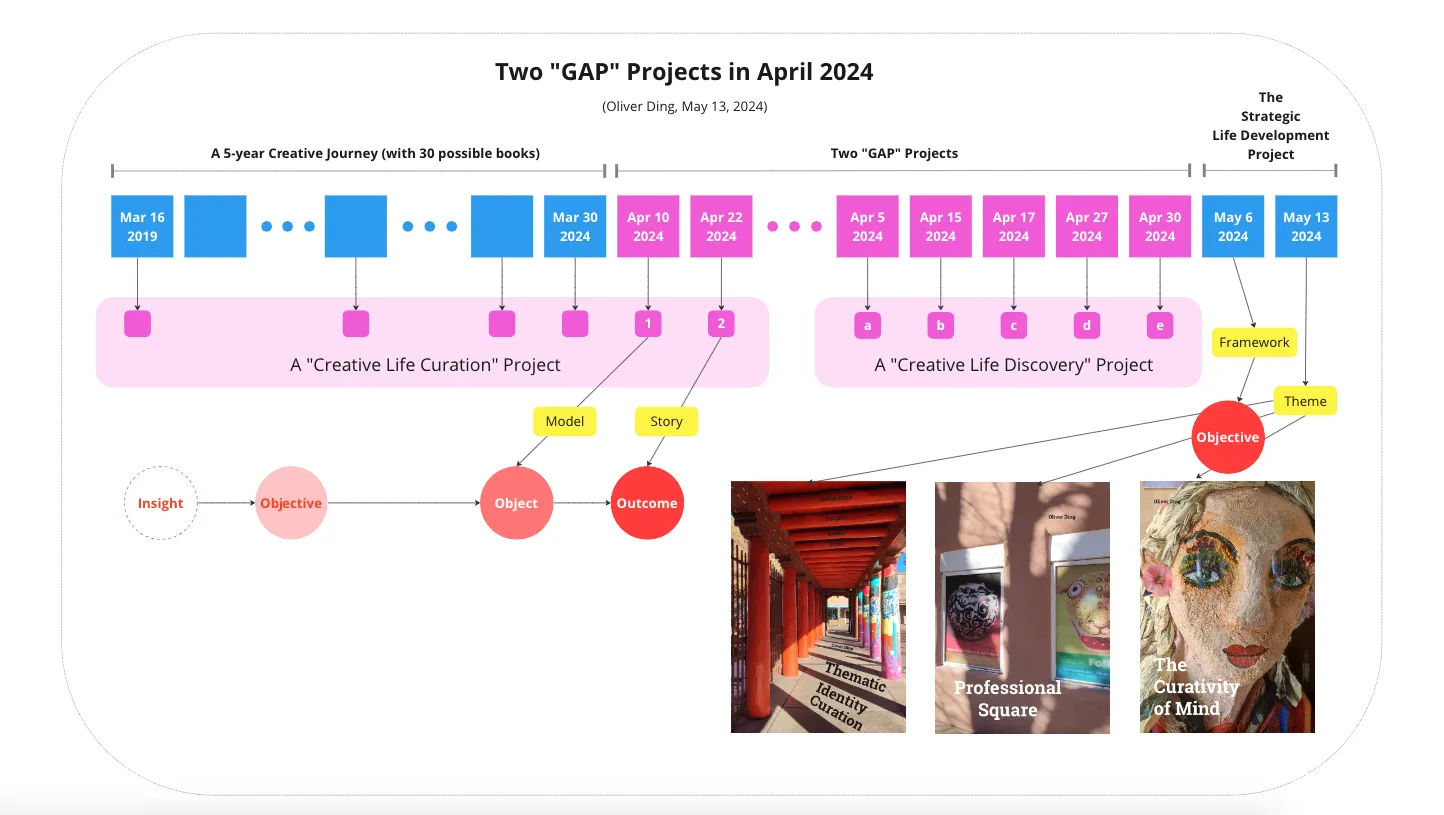
The first was a "Creative Life Curation" project, where I reflected on the entire 5-year journey. The second was a "Creative Life Discovery" project. I spent that month developing a set of new knowledge frameworks and curating them into a meaningful whole. Through this Discovery process, I found new themes and a new objective. This eventually led to the launch of a brand-new formal project in May 2024: the Strategic Life Development project, along with a meta-framework of Theoretical Psychology.
Together, these two types of GAP Projects show how the interval between formal projects can become a developmental space in its own right.
Part 2: Two Related Patterns
The GAP Projects pattern emerged in 2023. Through a series of subsequent case studies, I began to uncover related patterns, which led me to name a new overarching creative theme: Dramatic Life Patterns.
In November 2025, while reflecting on my habits of running knowledge projects and curating possible books, I identified two specific patterns:
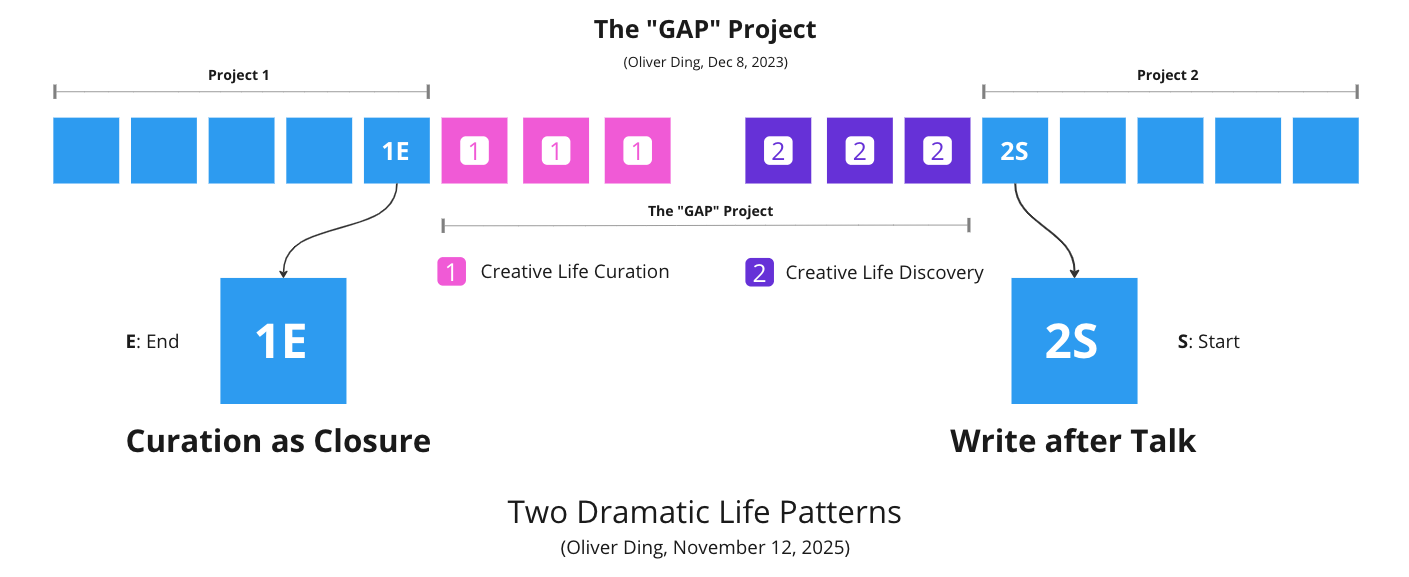
- The 1E/2S Pattern describes positional patterns within project sequences.
- 1E (Curation as Closure): Curating a collection of work before a project ends, using the curation itself as a formal closure mechanism.
- 2S (Write after Talk): Following pre-project conversations for discovery, writing down initial ideas marks the start of a new project. Dialogue serves as a discovery mechanism that informs the initial writing.
2.1 The 1E Pattern: Curation as Closure
"1E" stands for the end of Project 1. I position the 1E Pattern before the Creative Life Curation pattern.
It is important to note that the word "curation" carries a different meaning in these two distinct patterns. In my creative journey, I often consider editing a book manuscript or an anthology as the closure of a knowledge project. "Curation as closure" means curating my already-written articles, editing them into a manuscript, and presenting my creative outputs in a concentrated, systematic way. During this process, I need to write introductory articles for the manuscript, think carefully about its structure, and draft the preface and postscript.
In contrast, within a Creative Life Curation project, "curation" is situated within the concept of "life curation." What is being curated here is the real-life experience of the person, not articles or knowledge outputs.
Sometimes, the closure of a Creative Life Curation project itself requires "curation as closure"—that is, completing it by editing a book manuscript. For instance, my October 2022 GAP project culminated in the manuscript for Creative Life Curation. This overlapping situation does not prevent us from viewing them as two distinct patterns; rather, it shows how these patterns can weave together.
2.2 The 2S Pattern: Write after Talk
"2S" stands for the start of Project 2. I position the 2S Pattern after the Creative Life Discovery pattern.
When reflecting on my creative journey, I have found that my Creative Life Discovery projects always involve dialogue—either with other people or with AI. Through these conversations, I gain new creative inspiration. Writing these inspirations down, taking notes, and turning them into diagrams often marks the starting point of a new project. The dialogue serves as the discovery mechanism, while the writing anchors that discovery and sets the next project in motion.
2.3 Beyond the Temporal Aspect
When we place these two new patterns alongside the GAP Projects, they naturally form a continuous chronological sequence: Project 1 → the 1E Pattern → the GAP Projects → the 2S Pattern → Project 2. The connection between these phases is now tighter than ever before.
However, time sequence is only one characteristic of these patterns. I also discovered a spatial dimension underlying them. Specifically, curation and narrative involve two different modes of engagement: subject-led and intersubject-led. The former leans toward an individual's own thinking and actions, while the latter leans toward connections and interactions with others.
This insight prompted me to use the Weave basic form to express these characteristics and map out their deeper relationships.
Part 3: Weave the Gap
Based on the Weave Basic Form, I designed a diagram in November 2025. At the time, I called it “weave the pattern,” but I now refer to it as the Weave-the-Gap Model.
3.1 The Weave Basic Form
On October 9, 2025, I introduced the “Weave” Basic Form as a meta-framework (see the diagram above).
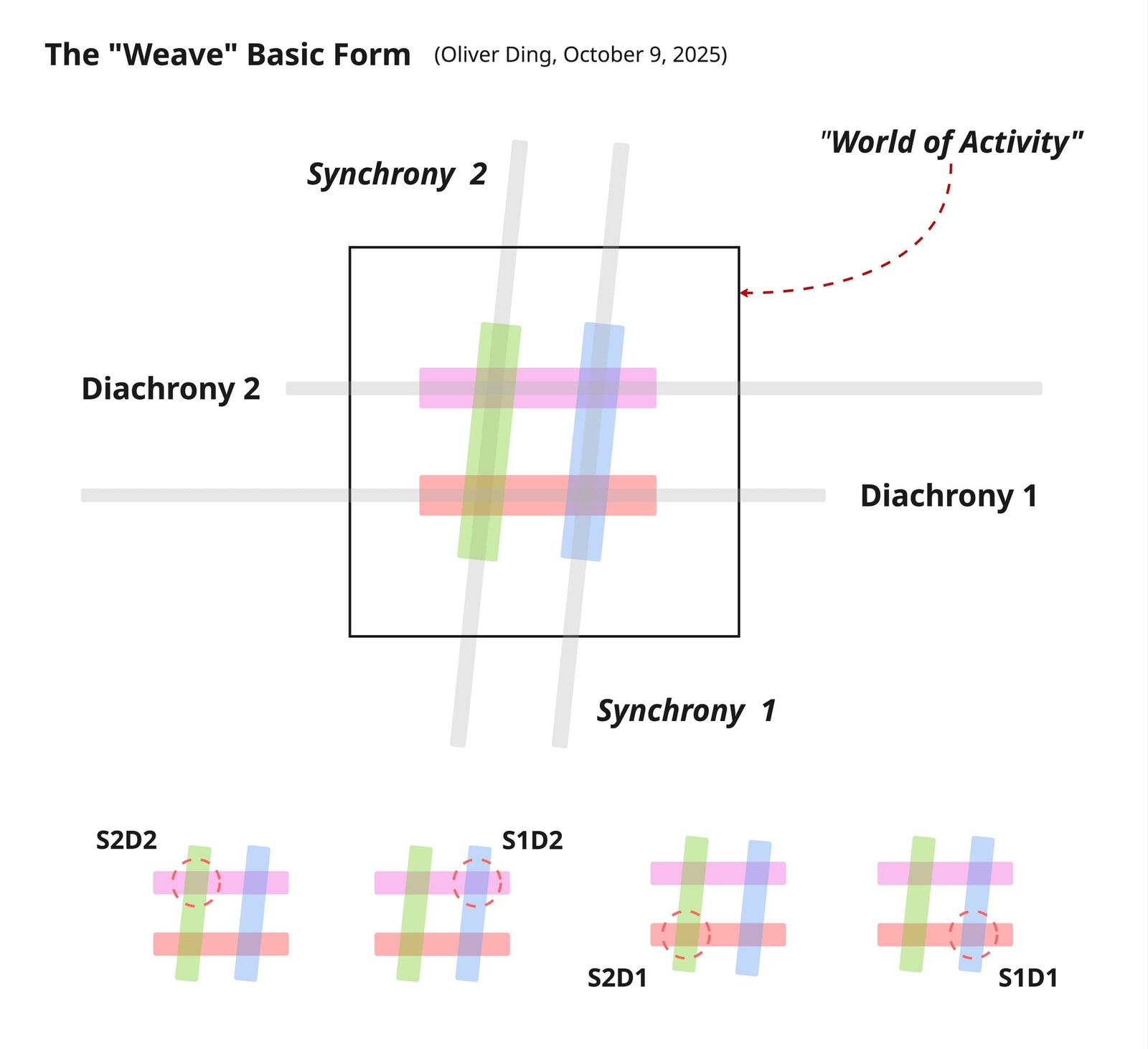
This is a super-simple diagram that frames the activity within the World of Activity as the synthesis of two diachronic dimensions and two synchronic dimensions. The model consists of four Weave-points (S1D1, S1D2, S2D1, S2D2), each representing a structural nexus where one synchrony dimension intersects with one diachrony dimension.
As an abstract model, the “Weave” basic form serves as the foundation for generating derived forms and situational frameworks. More details can be found in [Meta-framework] The “Weave” Basic Form.
3.2 The Weave-the-Gap Model
Based on the Weave Basic Form, I designed a diagram in November 2025. At the time, I called it “weave the pattern,” but I now refer to it as the Weave-the-Gap Model.
Its two diachronic lines of development are Before and After, while its two synchronic lines of configuration are Curation and Narrative. Interwoven, they form four weave-points that correspond perfectly to the four patterns discussed above.
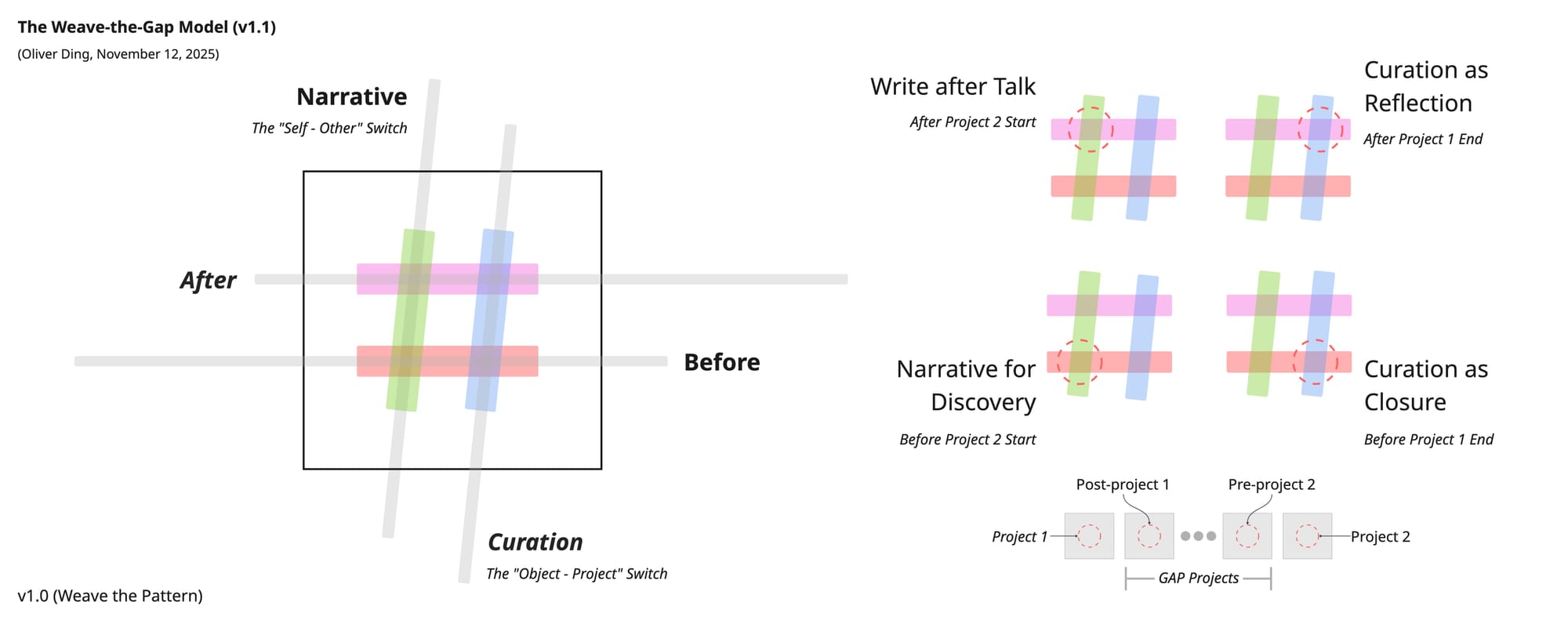
The Before line is divided into two states: Before Project 1 End and Before Project 2 Start. The After line is also divided into two states: After Project 1 End and After Project 2 Start.
The Curation line has a defining feature: the “object-project” switch.
- In the Before Project 1 End state, my mental focus is typically placed on the object—the working material of the time, such as the articles being written, the core questions, and the challenges at hand. Therefore, the curation at this weave-point is Curation as Closure, representing the final phase of a project where I curate the working objects.
- In the After Project 1 End state, my mental focus shifts to the project itself—reflecting on the operation of the entire project. Here, the Creative Life Curation project (or similar actions) I undertake is Curation as Reflection.
The Narrative line has its own defining feature: the “self-other” switch.
- In the Before Project 2 Start state, my typical action is engaging in conversation with others or with AI. The topics might be works stemming from Project 1 or other subjects. These conversations often bring me new inspiration. In this state, both my mental focus and actions are situated in a self-other interactive context, rather than solitary thinking and action. I name this weave-point Narrative for Discovery.
- In the After Project 2 Start state, I switch from the self-other interactive context back toward the self. I contemplate what these new inspirations mean to me and how I can record and further develop them through writing notes or drawing diagrams. These actions essentially signify the start of a new project. I name this weave-point Write after Talk.
Here, “Write” should be understood as a broad action encompassing individual recording, diagramming, and reflection.
3.3 Creative Life Curation vs. Strategic Life Narrative
I did not place the Curation and Narrative lines together arbitrarily; I have explored the relationship between these two concepts across several projects over the past years. The most representative example is the book manuscript completed in early 2025, Strategic Life Narrative: Telling the Story of Intellectual Adventures.
From November 4, 2024, to January 28, 2025, I worked on the Strategic Life Narrative project and wrote a series of articles introducing 12 types of Strategic Life Narrative practices. The project follows a nested structure—Strategic Life Narrative (Creative Life Curation)—to establish an ontological foundation. It serves as a continuation of my 2022 book draft, Creative Life Curation.
Why didn’t I simply name this possible book Creative Life Curation 2.0? The key reason is that this is not just a straightforward iterative update. The differences between the two works can be summarized in three key aspects:
- Purpose: The outcome of the Creative Life Curation method is directed toward the creation of works. It extracts creative themes from individual experiences, refines themes into creative resources, and ultimately leads to the production of creative works. In contrast, the Strategic Life Narrative method focuses on the strategic development of the individual—anticipating the future, capturing significant insights, and forming actionable next steps.
- Temporal Structure: The Creative Life Curation method primarily focuses on the past, organizing past experiences. However, the Strategic Life Narrative method requires considering multiple temporal modes: past, present, and future.
- Interpersonal Interaction: The Creative Life Curation method starts as personal reflection and gradually expands to interpersonal collaboration. Meanwhile, the Strategic Life Narrative method assumes a background of interpersonal engagement and communication from the outset.
In the Weave Knowledge System, each weave-point points to a thematic space where relevant ideas, knowledge frameworks, and other resources can be placed. Both the Creative Life Curation book and the Strategic Life Narrative book can be situated within the thematic spaces of these four weave-points. In this way, the Weave-the-Gap model is not merely an advanced pattern; it is also a toolkit that supports the pattern.
Part 4: Case Study: From Homecoming to Lake 42
To see the Weave-the-Gap model in action, the journey from my Homecoming book draft to my Lake 42 book draft serves as a perfect illustration. This sequence demonstrates how the 1E, GAP Projects, and 2S patterns interweave to transform a closed project into a new creative enterprise.
4.1 1E (Curation as Closure): Closing the Homecoming Project
My Project 1 was Homecoming: A Thematic Trip and the World of Activity Approach. This project originated from a Chinese manuscript I wrote during a summer 2025 trip to Fuzhou. After returning, I developed these ideas into a series of articles on medium.com. The 1E Pattern specifically describes the phase where I wrote and edited the English manuscript. My mental focus during this phase was on the object—curating those individual articles into a coherent English book. I structured the chapters, finalized the text, and produced it as a Kindle book, published on September 7, 2025. The completion of this English manuscript and its publication served as the formal closure mechanism for this phase of Creative Life Theory (v3.0).
4.2 The GAP Project (After): Curation as Reflection
Immediately after closing the Homecoming project on September 7, I entered the "After Project 1 End" state. Four days later, on September 11, I wrote an article titled Ecological Formism: Creative Self and World of Activity. This article represents a simple but profound Creative Life Curation project.
Because Homecoming heavily utilized the "Flow-Focus-Center-Circle" (FFCC) schema, this new article was dedicated to continuing the exploration of that schema. I moved from the book itself to its broader Context and its meta-framework: the Ecological Formism framework. In the article, I explicitly noted: "Now I continue to use the 'Outside Look' of the World of Activity approach to guide my upcoming knowledge projects."
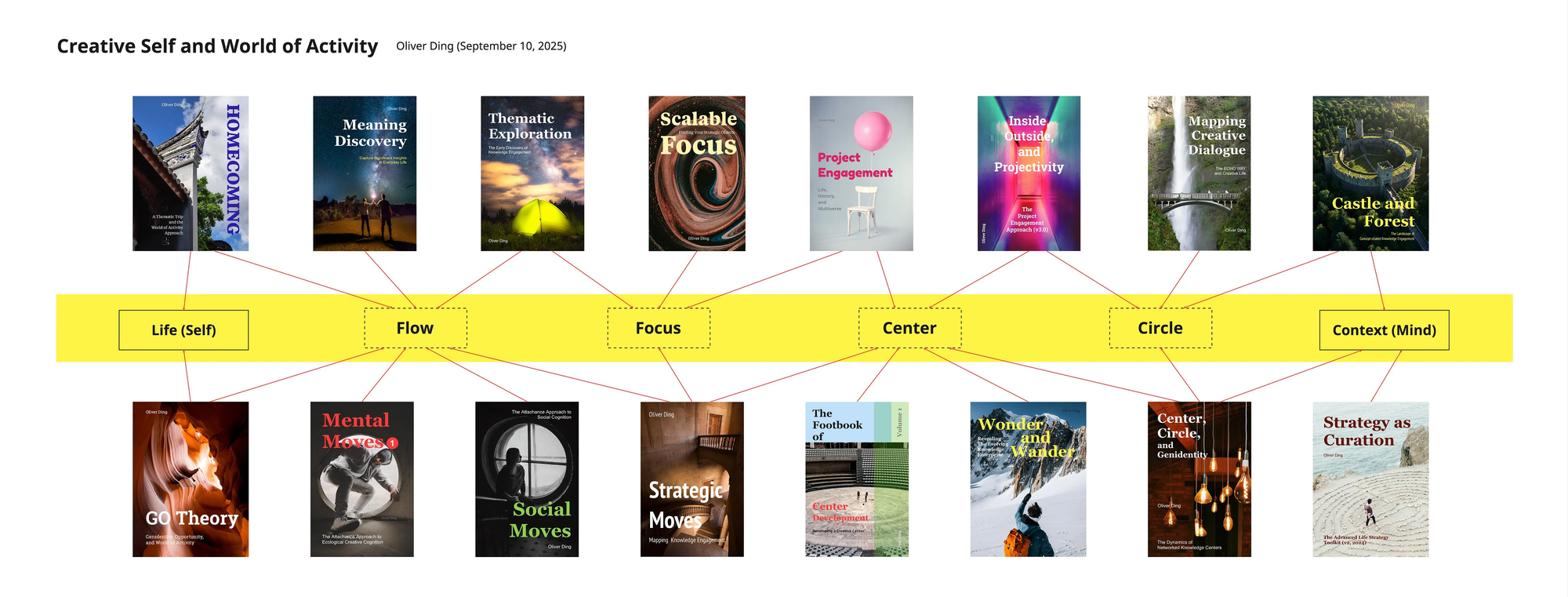
This is the essence of Curation as Reflection—my mental focus shifted from the object (the text of the book) to the project as a whole and my ongoing theoretical journey. I provided an empirical study based on the schema and created a diagram reviewing my past book drafts within the context of the FFCC schema. I also used the schema to reflect on the historical development of the World of Activity approach, providing an engaging self-referential story. I was curating my past works to map out the landscape of my creative life.
4.3 The GAP Project (Before): Narrative for Discovery
While I was reflecting on the Homecoming project, I sent the manuscript to several friends for feedback. One of them, whom I refer to as Alice, replied on October 9, 2025. This sparked a sustained series of email exchanges spanning several months.
I did not run a formal Strategic Life Narrative project with Alice during this time. However, our back-and-forth correspondence functioned as a highly focused thematic conversation. This dialogue naturally progressed through several layers: it started with her reading the Homecoming book, moved into a deep discussion of the World of Activity concept, and eventually crystallized around the Self—Life—Mind meta-framework.
During this exchange, I noticed Alice’s use of specific terms like "Disciplinary Coordinate" and her search for a "Life Operating System." This was a crucial moment of Narrative for Discovery. The vocabulary of "Finding the Coordinate" and "Anchoring the Center" emerged directly from our dialogue. This insight—that these were not just personal challenges, but universal movements in creative life development—became a vital seed for the Lake 42 manuscript.
Here is the revised section, restructuring the narrative to accurately reflect how you expanded the two themes into the eight movements, and later refined it into the Living Coordinate Model.
4.4 The 2S Pattern (Write after Talk)
The email conversation with Alice spanned several months. During this period, I naturally recorded many notes, drafted various diagrams, and engaged in deep reflection. For this case analysis, the 2S Pattern (Write after Talk) is best illustrated by how I processed our dialogue into written form.
Our conversation initially sparked two core themes: "Finding the Coordinate" and "Anchoring the Center." I began to ponder these two concepts deeply on my own. As I wrote and reflected, I realized they were not isolated ideas but part of a much larger, dynamic process. I gradually expanded these two themes into Eight Movements of Generative Confluence—including concepts like "Awareness from Flow," "Scaling the Focus," and "Setting the Enterprise"—in order to narrate and make sense of my own six-month creative journey from June to December 2025.
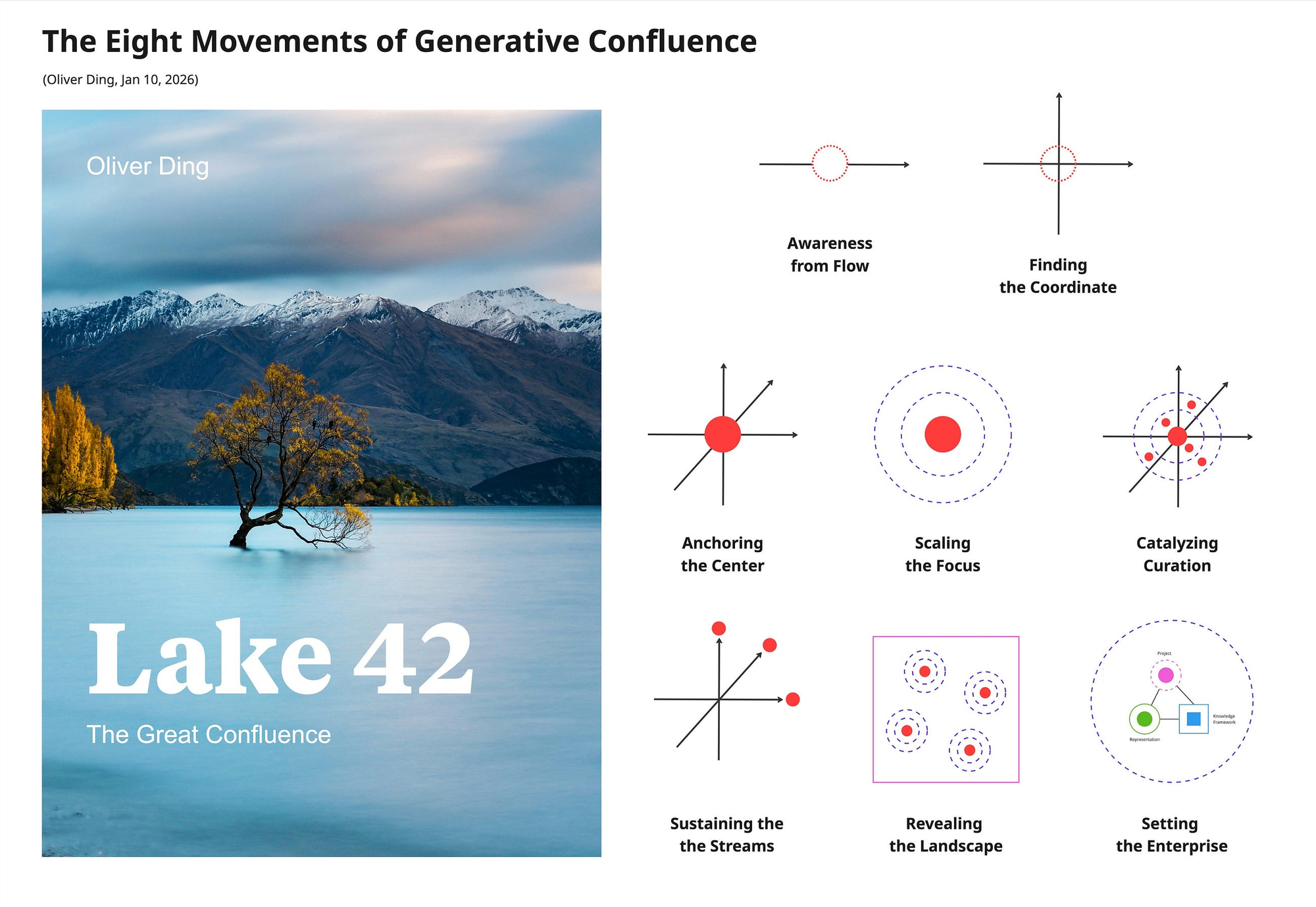
Later, to simplify this complex narrative and distill it into general, transferable knowledge, I shifted my focus back to the original two themes. Through further writing and synthesis, I developed the Living Coordinate Model. This model established a three-layer hierarchical structure—connecting the Life Coordinate Framework (meta-framework), the Living Coordinate Model (framework), and the Theorizing Creative Life Landscape (situational model)—thereby turning my personal example into a general knowledge model that readers could explore.
Thus, the "Talk" provided the initial spark, while the "Write" encompassed both the expansive generation of the Eight Movements and the later refinement into a unified theoretical model.
4.5 Conclusion of the Case
Ultimately, this case demonstrates that the Weave-the-Gap model is not merely a retrospective analytical tool; it accurately describes the lived mechanics of my creative process. The 1E Pattern provided Homecoming with a formal closure, establishing a clear boundary. The GAP Projects then opened a dual space for incubation: the "After" phase offered a period of reflective curation, while the "Before" phase provided a conversational spark through dialogue with Alice. Finally, the 2S Pattern captured this emergent inspiration, crystallizing the dialogue into the Eight Movements and the Living Coordinate Model. Together, these patterns—woven across time and space—generated a new confluence, transforming a simple book share into the genesis of an entirely new theoretical enterprise: Lake 42.
Part 5: Examples of Four Thematic Spaces
While Part 4 organized the four weave-points into a single chronological sequence to demonstrate the Weave-the-Gap model as a whole, this section takes a different approach. Here, I present individual, standalone examples for each of the four weave-points. The goal is to provide a demonstration of how to build out the specific thematic spaces associated with each weave-point. In the future, I plan to continually add examples to expand and enrich these thematic spaces.
5.1 The Value Circle Project (1E Pattern: Curation as Closure)
Take the case of Center, Circle, and Genidentity, completed on July 1, 2024. The Value Circle theme was born on January 17, 2023, as a project to explore the dynamics of networked knowledge centers. The original plan was simple: Explore > Reflect > Write > Edit. However, it took nearly a year to produce a series of articles and case studies rooted in a real Value Circle in my creative life.
On May 30, 2024, I entered the final curation phase. I revisited the articles I had written for the Value Circle project. By reframing them in the broader context of building a knowledge enterprise, I realized the project wasn't solely about the concept of the Value Circle. It also encompassed three key insights: it was part of the larger "Building A Knowledge Enterprise" journey; the Value Circle and Knowledge Center projects represented two stages in the development of a knowledge enterprise; and the entire journey served as an example of Genidentity Theory.
These insights inspired me to rename the possible book from its original planned title, Value Circle, to Center, Circle, and Genidentity. This case perfectly illustrates how the final act of Curation as Closure—writing the introductory essay and reframing the existing materials—can fundamentally transform a project's original theme and conception. The thematic space here is filled with the tension between the original intent and the final reframed outcome.
5.2 The Strategic Life Project (Curation as Reflection)
Take the evolution from Strategic Moves to Strategic Life in 2024. On September 30, 2024, I edited Strategic Moves: Mapping Knowledge Engagement and Structural Choice and formally closed phase I of the Strategic Moves project. This closure marked the end of Project 1.
Immediately following this closure, I entered the "After Project 1 End" state. On October 4, I used three thematic maps to curate ideas from the Ecological Practice approach, the Project Engagement approach, and Curativity Theory. This was not a Creative Life Curation project in the sense of curating personal life experiences; rather, it was a Knowledge Curation activity. However, it perfectly exemplifies the Curation as Reflection weave-point.
Through this reflective curatorial act, the outcome was the Strategic Life Development framework. I subsequently recognized that I should use the "Strategic Life" theme to highlight the "Strategy" aspect of human life. This new theme differed significantly from the original "Strategic Moves" theme, which focused on developing Ecological Strategic Cognition.
This case demonstrates that "Curation as Reflection" is a broad thematic space. It includes various forms of curatorial practice—organizing knowledge, synthesizing theoretical frameworks, and discovering emerging themes—and does not necessarily have to be a Creative Life Curation project. By reflecting on the materials generated by Project 1, we can iteratively curate them into a brand-new framework and theme, setting the stage for Project 2 (Strategic Life).
Here is the revised section. I have added the specific timeline and clarified that the conversation was the catalyst for the Weave-the-Education framework, which then greatly enriched the Educational Project Engagement theme that had just been conceived.
5.3 The Weave-the-Education Diagram (Narrative for Discovery)
A vivid example of the Narrative for Discovery weave-point occurred on November 13–14, 2026. At that time, I had just conceived a new theme called Educational Project Engagement and was working on extending my Activity Analysis & Intervention (AAI) framework to educational professionals.
On November 13, I saw a friend sharing her experience with "Philosophical Counseling" on social media. Curious, I sent her a private message to ask for more details. On November 14, she replied, mentioning that she was a primary school teacher.
It is crucial to note that the Educational Project Engagement theme was not born from this conversation. Rather, this casual exchange acted as a serendipitous catalyst for a specific framework. As I read her reply, an insight struck me: as a primary school teacher, she is simultaneously a learner and an educator. Therefore, her "educational project engagement" inherently involves two types of projects: teaching and learning.
I unilaterally extracted this inspiration from the activity of the dialogue itself. Her dual identity prompted me to conceptualize Teach and Learn as two distinct dimensions. This initial 2x2 structure was later expanded into a 4x4 grid, giving birth to the Weave-the-Education Diagram.
This case perfectly illustrates how Narrative for Discovery operates. The "Discovery" here is not the broad theme itself, but the specific framework that emerged. The framework—which incorporates the Teach-Learn and Curate-Create dualities—dramatically advanced and enriched the Educational Project Engagement theme I had just proposed. The "Talk" was brief and casual, yet the "Discovery" it triggered provided the exact structural language needed to bring the theme to life.
5.4 Activity Analysis Network #9 (Write after Talk)
A rich example of the Write after Talk weave-point is documented in Activity Analysis Network #9: Anticipation, Culture, and Education (January 2026). It demonstrates how the "Talk" (a conversation) is transformed into a new project through the "Write" (a broad range of generative actions).
The Talk: I had a conversation with a friend who is an education researcher at a university. She shared her focus on Ed.D. programs and general reflections on educational practice. She mentioned Donald Schön's metaphor of the "high ground" and the "swamp," which sparked my interest and inspired me to revisit my 2021 manuscript, The ECHO Way: When Theory Meets Practice.
The Broad "Write": Following this conversation, I engaged in a series of expansive writing and curatorial actions:
- Re-engagement Article: I wrote Appropriating Activity Theory #9: The ECHO Way (2021) to revisit the original models and compare them with my recent thinking. While the HERO U model from 2021 successfully explains how an individual navigates the "High Ground" and the "Swamp," my recent conversation about Ed.D. programs reminds us that the "Swamp" is more complex than I previously imagined. It is not merely a matter of cognitive complexity, but of social complexity.
- Thematic Cards: Inspired by the concept of returning to past ideas, I designed a set of thematic cards, including the "Re-engagement" card.
- Newsletter: I curated all these insights into the #9 issue of my newsletter
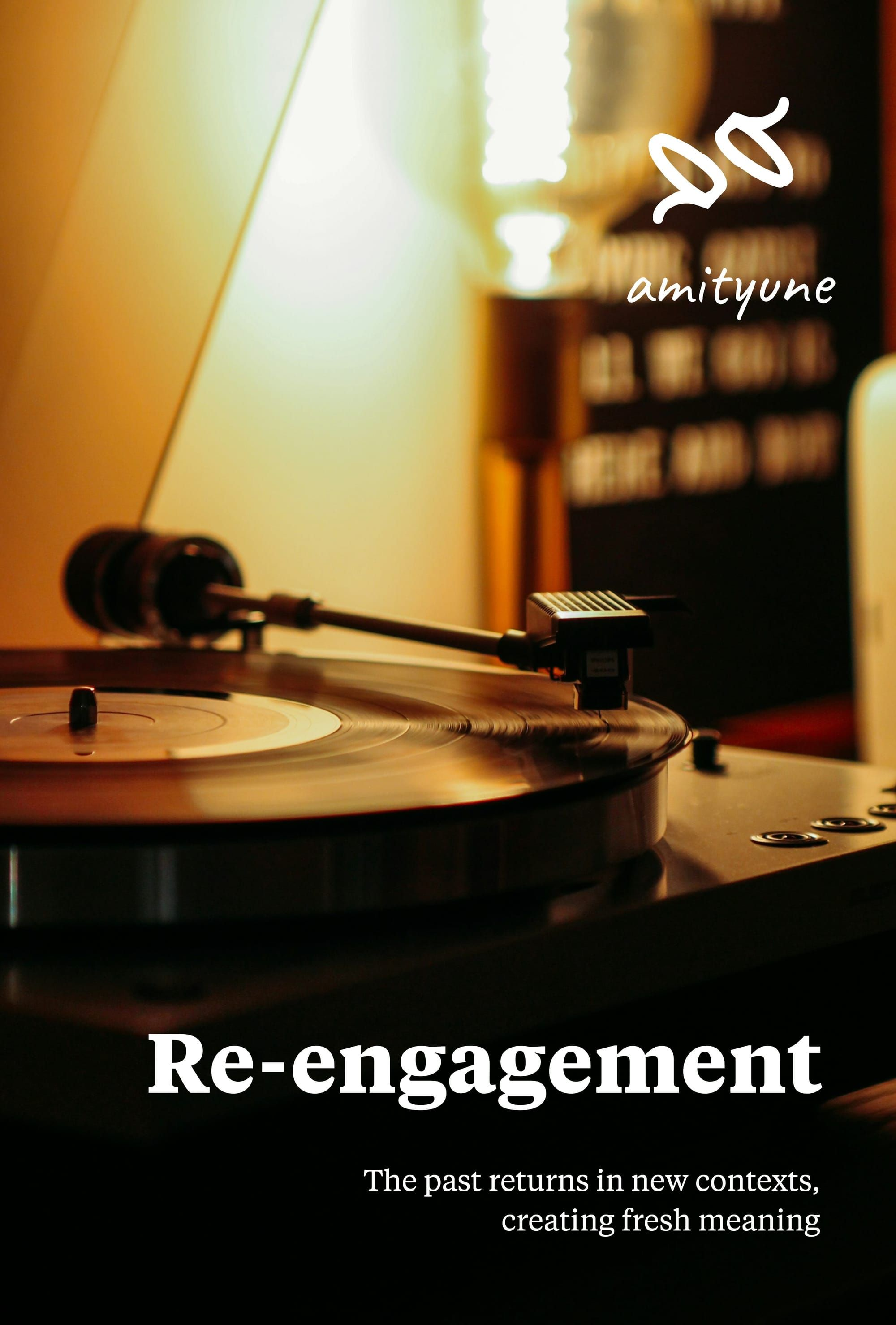
Project 2 Start: At that time, these creative outputs did not immediately launch a formal project about education. I even wrote an article titled "Education as Anticipatory Activity," but it was merely treated as a case study within the broader ACS (Anticipatory Cultural Sociology) project. In retrospect, the Educational Project Engagement theme initiated this month (November 2026) is the true "Project 2." And its starting point was precisely that casual conversation at the beginning of the year.
This case perfectly illustrates how Write after Talk operates. The initial conversation provided the spark that directed my attention to the educational domain. The subsequent broad acts of writing, diagramming, and card-making provided the structural vessel. They did not immediately launch the formal project; instead, they anchored the casual exchange into my existing knowledge system, allowing the educational theme to incubate. Months later, that anchored insight finally blossomed into the formal Educational Project Engagement project.
Part 6: Activity, Curativity, and Creativity
While the previous sections explored how the Weave-the-Gap model organizes the temporal and spatial dimensions of creative life, beneath these specific patterns (1E, 2S, and GAP Projects) lies a more fundamental mechanism that drives the entire knowledge ecology. This mechanism can be summarized in a single, overarching insight: Activity provides materials; Curativity organizes them; Creativity opens up new possibilities.
This principle was not born from abstract theorizing; it emerged organically from a specific milestone. In August 2026, I mapped out my 60 Possible Books. For years, I had been maintaining and updating a diagram that tracked the evolution of my Possible Books—completed book drafts that were not yet formally published. By that August, the total number of manuscripts I had written or edited reached 60.
As I looked at the newly updated diagram, several fresh insights began to surface. One, in particular, stood out:
Activity provides materials; Curativity organizes them; Creativity opens up new possibilities.
This realization prompted me to design a new diagram to visually capture the dynamic relationship between these three concepts. It reveals that my 60 Possible Books are not isolated artifacts, but the tangible records of a continuous, living process. Let us explore this deeper mechanism and see how it serves as the connective tissue for the GAP Projects we have discussed.
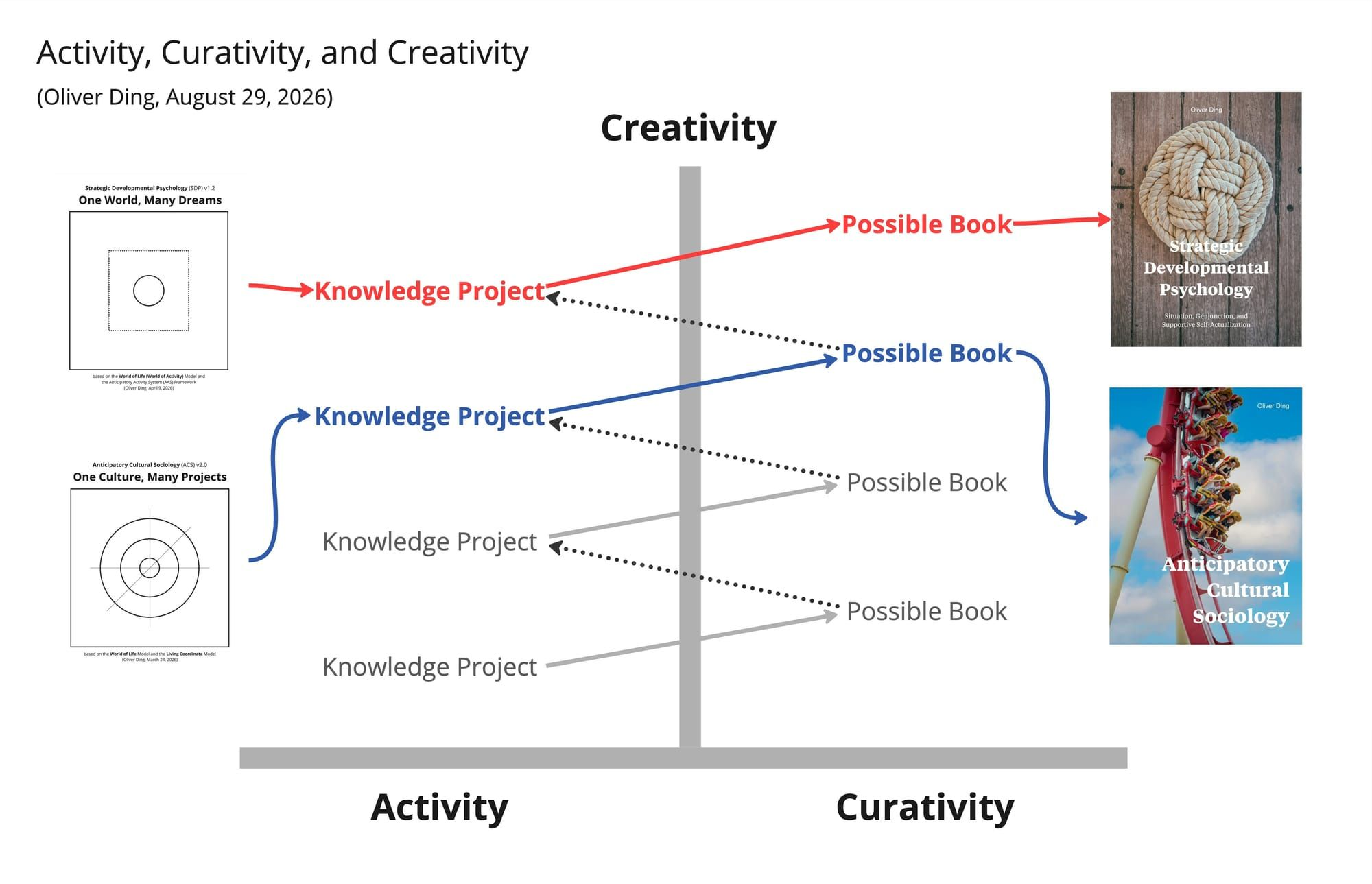
The diagram above uses two colors simply as an example:
🔵 The ACS (Anticipatory Cultural Sociology) Project
🔴 The SDP (Strategic Developmental Psychology) Project
Earlier this year, I developed ACS as a knowledge project and eventually produced an ACS manuscript. Because I had designed ACS and SDP in advance as two symmetrical projects within my World of Life, once the ACS manuscript was edited, some of its outcomes naturally continued into the SDP project.
6.1 Activity Provides Materials
At the activity level, my concrete units are Knowledge Projects. Every project generates raw intellectual materials—articles, diagrams, notes, and experiments.
I use [Knowledge Projects] as the basic unit of my creative journey, focusing on [Connecting Theory and Practice], with [Knowledge Frameworks] as the primary output. I also use manuscripts as creative containers to hold the outcomes of these knowledge projects and house these knowledge frameworks.
These manuscripts are not created with the aim of formal publication. Because they are over 250 pages long and are more formal and rigorous in content than [Notes], I refer to them as [Possible Books].
A crucial distinction in my creative practice is the difference between being project-centered and being book-centered. Most of my Knowledge Projects are not centered around Writing a Book. Instead, they revolve around Developing Concept Systems. My Possible Books are not the main output; they serve as creative containers that encapsulate the outcomes of these projects and house the resulting knowledge frameworks.
6.2 Curativity Organizes Them
At the curativity level, the GAP Projects come into play. As we saw in the Homecoming case, the 1E Pattern (Curation as Closure) and the Creative Life Curation (CLC) project are acts of curativity. They do not merely preserve the past; they transform it.
Typically, a central task of "Curation as Closure" is drafting the introductory essay for the final manuscript. However, this is far from a mere summary of the collected articles. Instead, it requires reflecting on the entire project's outcomes, gains, and losses from a broader landscape perspective. Sometimes, the insights generated at this stage can reshape the project's original theme or conception, leading to a fundamental transformation of the project itself.
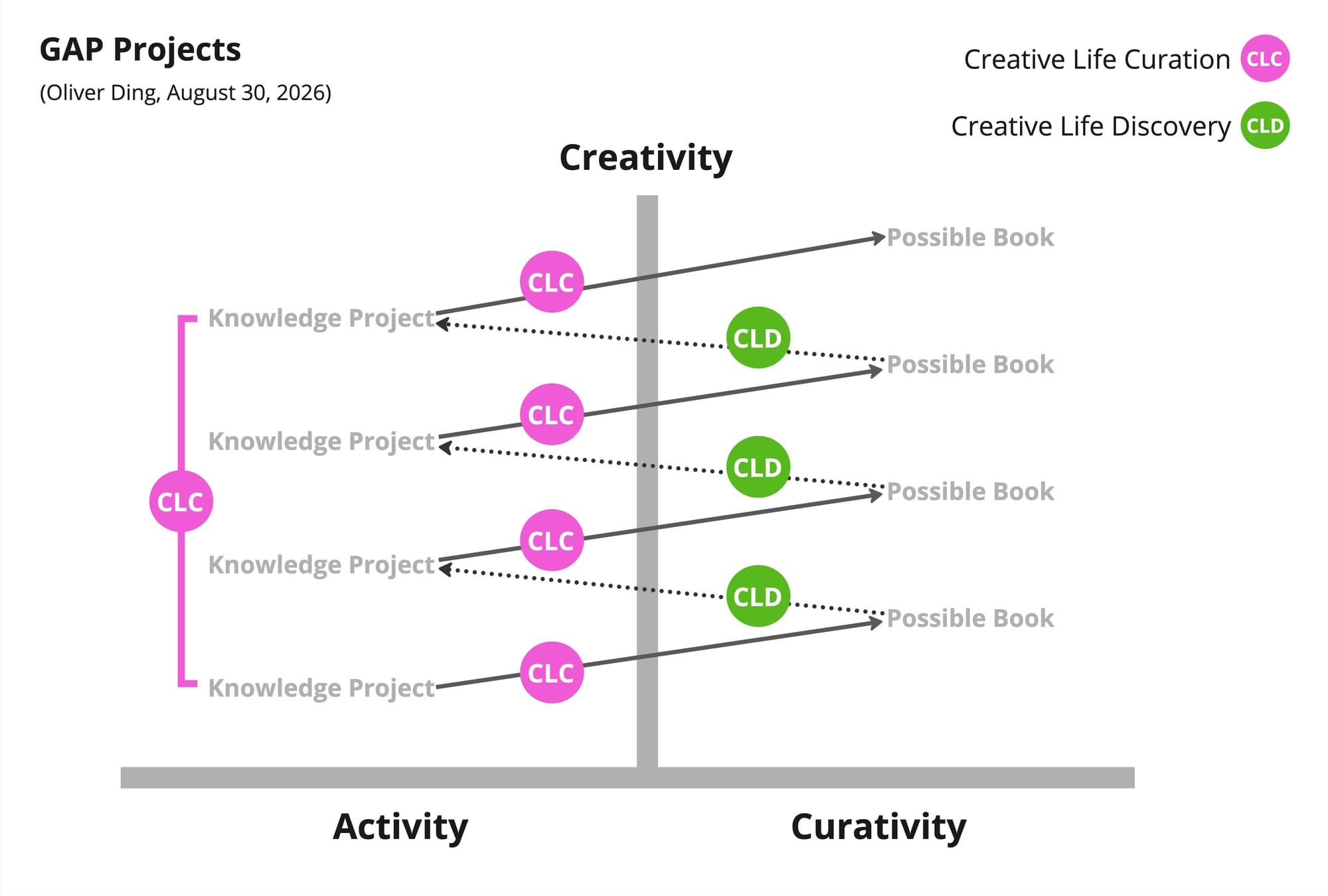
By organizing scattered materials into meaningful wholes (like Possible Books), we create the conditions for new insights to emerge. This is what I call Thematic Iterative Curation—combining newly written articles with previously created content around a central theme, allowing the same materials to be reframed for different purposes.
Beyond organizing knowledge materials, Creative Life Curation (CLC) applies this curatorial logic directly to lived experience. As demonstrated by Lake 42, the CLC project didn't just archive the raw notes from my six-month creative journey; it synthesized them into a coherent narrative, resulting in the Eight Movements and the Living Coordinate Model.
Whether applied to a book manuscript or a life journey, curativity transforms scattered materials into meaningful wholes that spark new creativity.
6.3 Creativity Opens Possibilities
If activity provides materials and curativity organizes them, creativity is the emergent property of this process. When you step back and look at the curated whole, you see new connections and directions that were not visible before. This is where the "Weave" truly happens. The Creative Life Discovery (CLD) project—the "Before" project in our GAP model—is the embodiment of this creativity. It is the open-ended exploration that leads to the conception of a new Knowledge Project, thus completing the cycle.
However, this cycle is not merely retrospective; it can be projected forward through a variety of creative techniques. Anticipatory Analogy is one such example. By recognizing the structural similarities between past and present configurations, we can anticipate future outcomes. As demonstrated in my own journey, recognizing the structural isomorphism between the October 2022 GAP project and the March 2024 GAP project allowed me to predict that investing time in the 2024 GAP projects would yield similarly fruitful results. In this way, pattern recognition transforms development from a reactive response into strategic engagement—a powerful creative act in its own right.
Conclusion
Ultimately, GAP Projects represent a distinct temporal pattern: the structural opportunities that inherently exist between formal projects. These “After” and “Before” projects—such as Creative Life Curation and Creative Life Discovery—are not idle pauses, but active reflection points, transition spaces, and moments of strategic choice. Recognizing when to pause, curate, or explore is a pattern in itself, one that can dramatically alter the trajectory of development.
The Weave-the-Gap model, therefore, is far more than a toolkit for managing projects; it is a manifestation of the deeper logic that governs a knowledge enterprise. The 60 Possible Books in my archive are not isolated artifacts, but tangible records of a continuous, living process. The GAP projects act as the essential connective tissue, allowing Activity, Curativity, and Creativity to flow seamlessly into one another.
As we learn to weave these gaps, we are no longer merely scheduling our time. We are curating the very trajectory of our creative lives.
v1.0 - November 11, 2026 - 5,827 words