
[Creative Note] The Concept Dynamics of Confucian Allusions
A Reflection
by Oliver Ding
October 10, 2026
This post is a reflective conceptual note on how to look at a cultural allusion through the Concept Dynamics framework. It starts from a question I left open in the foreword of my Chinese essay collection, Ānshēn Lìmìng (安身立命), and sketches a way of approaching it.
1
During my stay in Fuzhou in July, I began drafting a lecture series in Chinese—Twenty Lectures on Activity Analysis and Intervention (活动分析与干预二十讲). I planned the series in three modules: the first five lectures cover the foundational models shared by the World of Activity approach and Creative Life Theory; the last five focus on the methodology of case analysis; and the ten in between form a toolkit of optional knowledge models that can be drawn upon depending on the case.
After returning to the U.S., I completed the first module of six lectures, which establish the theoretical foundations.
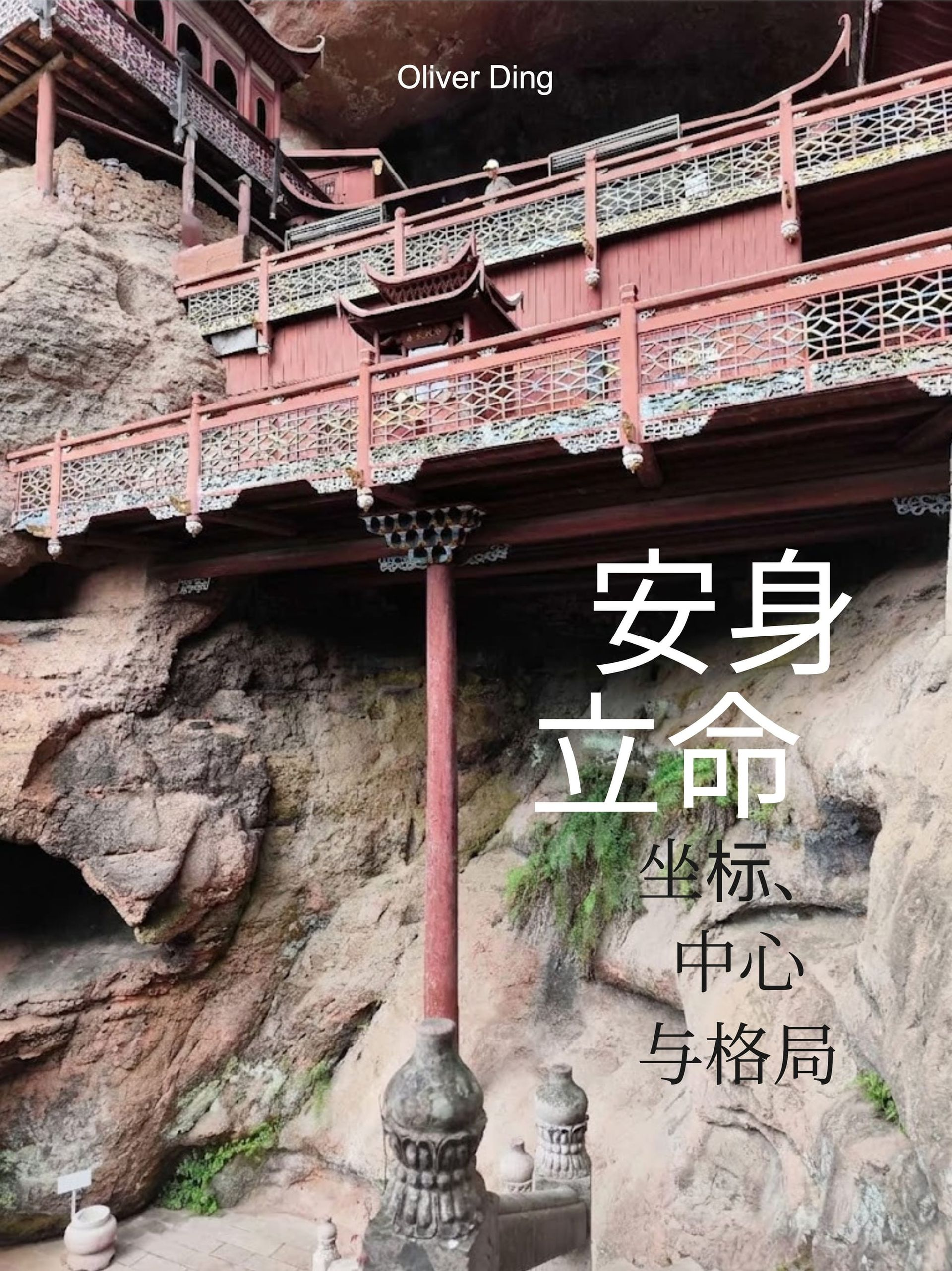
To help Chinese readers enter my theoretical system, I named this first module "安身立命" (Ānshēn Lìmìng)—settling oneself and establishing one's destiny. Instead of introducing the framework with unfamiliar terminology, I used Confucian classical allusions as creative entry points: "宇宙吾心" (the universe and my mind), "三省吾身" (examining myself thrice daily), "修齐治平" (cultivating the self, ordering the family, governing the state, and bringing peace to the world), and "月映万川" (the moon reflecting in ten thousand rivers). These familiar cultural anchors gradually open into the theoretical vocabulary of my own system.
In October, I added three more essays, bringing the total to nine. That marked an end of the project, with a thematic collection and a thematic map of Confucian allusions.
In the foreword, I described these allusions as creative heuristics, or more precisely, heuristics at the rhetorical level. They serve as a bridge that helps readers enter my narrative. My theoretical systems came first; the borrowing of Confucian vocabulary came afterward. I did not treat the allusions as theoretical resources.
The foreword also left a question open. When these slogans circulate among the general public, do they mean the same thing as they do in the classical texts? Even within the classics, scholars of different eras interpreted the same concept differently. And the way ordinary people received those interpretations back then is not the way we receive them today. I called this a puzzle, and I placed it outside the scope of the collection.
After the collection was finished, I kept thinking about it. Then I realized that I already had a tool for looking at it: the Concept Dynamics framework. This note does not answer how people actually use these allusions. That would require careful empirical research. What I want to do here is show how an allusion can be seen as a system.
2
I proposed the Concept Dynamics framework in 2020, while tracing the historical development of the concept of affordance across disciplines. The diagram is simple: a triangle placed inside an ellipse.
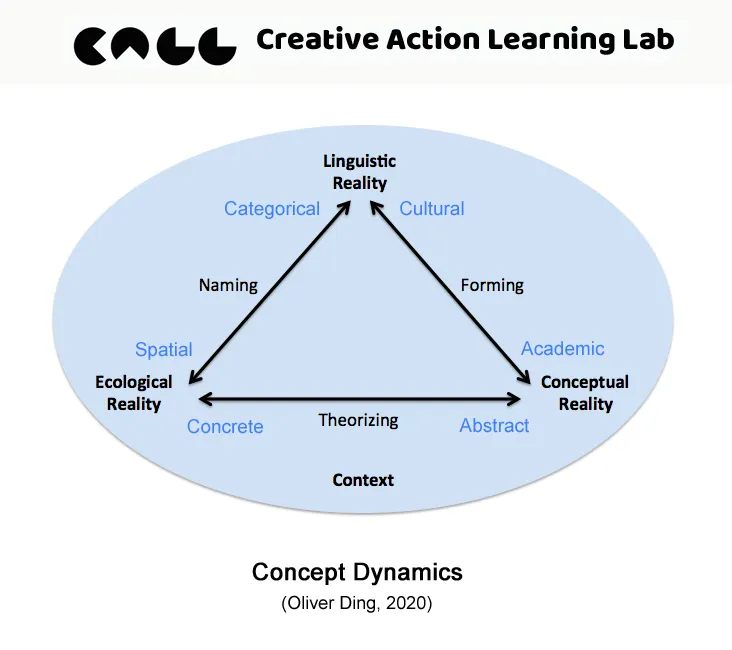
The three vertices of the triangle are the three basic aspects of a concept:
- Ecological Reality: the real experience of discovery in the real world from the researcher's perspective. It corresponds to personal knowledge.
- Conceptual Reality: the outcome of creative conceptualization. It corresponds to public knowledge.
- Linguistic Reality: the expressional form, with its verbal and rhetorical effects. It corresponds to ordinary language.
Between the three vertices are three edges, and each edge has its own meaning:
- Between Ecological Reality and Linguistic Reality is Naming. The two ends of this edge are marked Spatial and Categorical.
- Between Linguistic Reality and Conceptual Reality is Forming. The two ends are marked Cultural and Academic.
- Between Ecological Reality and Conceptual Reality is Theorizing. The two ends are marked Concrete and Abstract.
The ellipse that holds the whole triangle is Context, the dynamic background of a concept across the stages of its development.
So Concept Dynamics is not a list of four parallel viewpoints. It treats a concept as a system: three vertices, three edges, and a context around them. The "dynamics" refers to movement along the edges. An experience receives a name. The name becomes a cultural form or an academic concept. The concept then returns to concrete experience to be tested.
An ideal concept has no intrinsic contradictions along the three edges, and no extrinsic contradictions between the system and its context. Creating such a concept is hard. A more common situation is that an existing concept is detached from its original context, attached to a new one, and given a new meaning. This is re-conceptualization. It produces polysemy and ambiguity, and it gives a concept a complicated history.
Not every concept starts from Ecological Reality. Concepts can be created in many ways, and the framework is non-linear. For a reader, an allusion usually starts from Linguistic Reality: first a four-character phrase, then the concept in books, and only later, if ever, one's own experience.
3
Applied to Confucian allusions, the three vertices look like this. Linguistic Reality is the four-character phrase. It works as a chunk: it compresses a lot of information, so people can use the slogan in daily conversation without touching the original texts, and can unfold the texts when needed. Conceptual Reality is what scholars and classical readers found in the books, and it reflects the problem awareness of the tradition. Ecological Reality is the lived experience that people encounter in their own lives.
Each edge becomes a place to ask a question.
Naming. How does an experience get a name, and how does the name frame the experience in return? Take Nèi Shèng Wài Wáng (内圣外王), usually rendered as "Inner Sageliness-Outer Kingliness." The four characters split naturally into an inner half and an outer half. Once the phrase is fixed, people tend to ask how the inner is converted into the outer, and whether the outer is determined by the inner. Part of that question is produced by the language structure itself, since lived practice may not divide this way at all. Chunking also has a cost: it compresses the earlier layers. The four-character form was not used to summarize Confucianism until much later in history, so I trace an allusion from single characters, to two-character words, and then to the four-character phrase.
Forming. How does an expression move between cultural forms and academic concepts? A scholarly concept can be condensed into a slogan and travel widely. A phrase from everyday speech, or from another tradition, can be taken up by scholars and become a technical term. The puzzle from my foreword lives on this edge: is the meaning of the same expression the same in its cultural form and in its academic form? In the case of "Inner Sageliness-Outer Kingliness," my own observation is that everyday usage tends to read it as a two-stage practice, cultivate the inside first and then govern the outside, while the scholarly discussion treats it as a question about what connects the inner and the outer. But this is only my observation, not a survey result.
Theorizing. How does concrete experience become abstract concept, and how does an abstract concept return to concrete experience? I summarize the second direction as "I See It": have you seen it yourself? Many concepts look beautiful in Conceptual and Linguistic Reality but have never been tested in Ecological Reality. An allusion works the same way. If only the language remains, it is a pretty phrase. If it is still connected to real experience, it is alive.
Context. Allusions often have sources outside Confucianism. Ānshēn (settling oneself, 安身) and Lìmìng (establishing one's destiny, 立命) each appear in earlier texts, in different intellectual lines. They were combined into a four-character expression only in Chan Buddhist records, and later became a phrase that Confucian speakers use as their own. This is re-conceptualization: the expression was lifted out of one context, placed in another, and acquired new meaning. Within Confucianism, each era faced different circumstances, so the same allusion carried different connotations. Context can also create extrinsic contradictions. When modern Confucian thinkers tried to derive science and democracy from moral philosophy, they assigned a concept a task that the concept could not perform in its new context.
4
The foreword ended with a small observation: reading and writing are different experiences. Since then, I designed the House of Confucian Allusions, and I want to extend that contrast into reading versus writing plus design. I treat this experience as an example of Ecological Reality.
How can one interact with an intellectual tradition? Over the past year, I wrote a column, Appropriating Activity Theory, documenting how I interacted with Activity Theory between 2015 and 2025. This time, the tradition is Confucian thought. I have interacted with it in three ways.
Reading. For many years, I read papers and books on Confucian thought here and there. But I had never created anything related to Confucian thought within my own knowledge projects.
Writing. The nine essays in the collection use Confucian allusions as rhetorical tools, as creative heuristics, to introduce my theory of the World of Activity. To write them, I had to choose allusions within a specific narrative framework, and examine in detail their connections, similarities, and differences with my theory. That process was itself a way of learning Confucian thought.
Design. The House of Confucian Allusions is different. It uses the spatial structure of my meta-diagram, the same template I designed for a series of thematic maps of the World of Activity, to curate several widely circulated Confucian conceptual symbols.
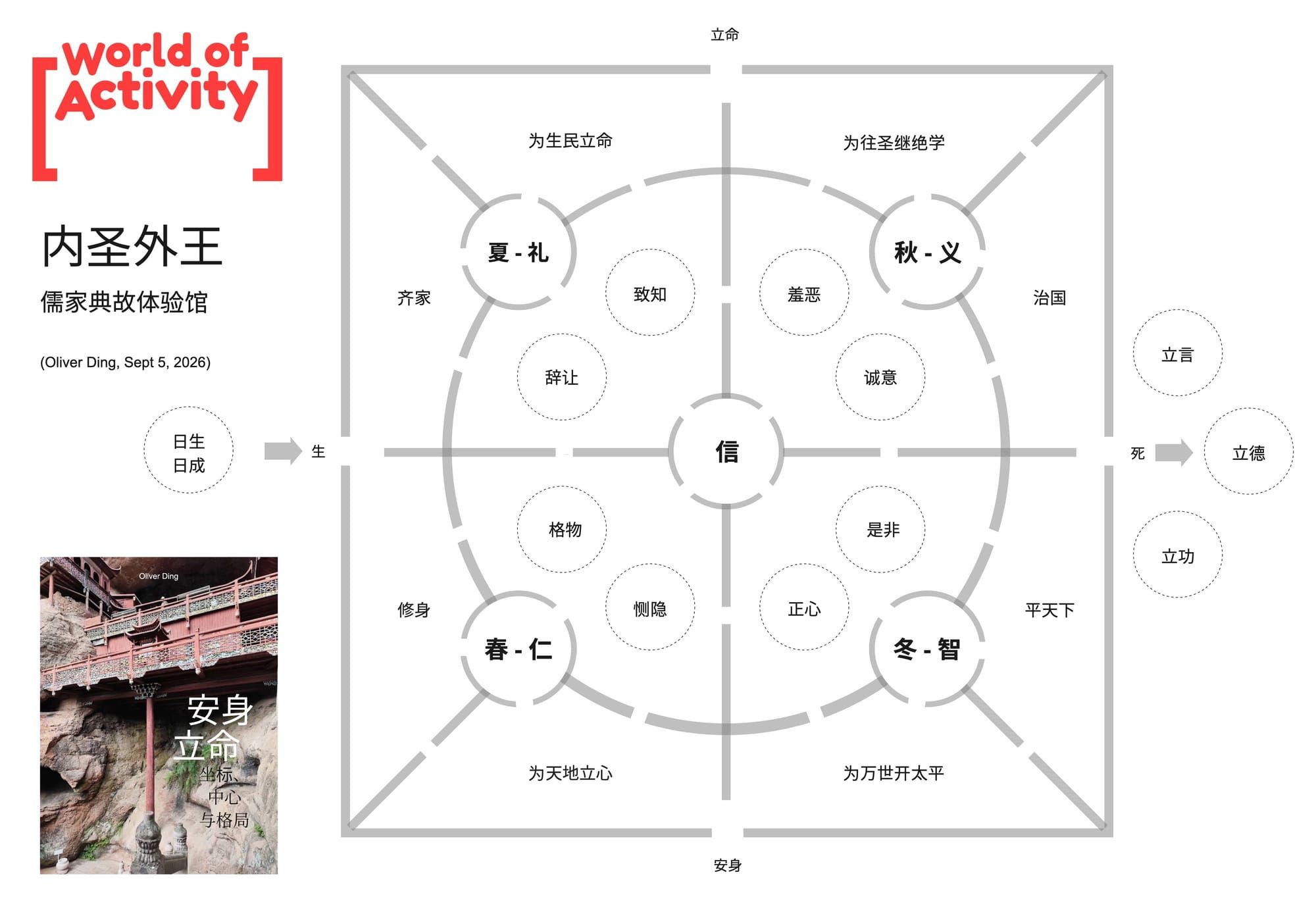
I did not select them by the traditional method of philosophical curation, which picks the core theoretical concepts of a tradition. Instead, I took a cultural-allusion approach: I guessed which phrases from which Confucian ideas the general public is likely to know, and placed those popular phrases into the structure. More important, the Hall demonstrates a new way of dealing with allusions: using a visual canvas, and interacting with the allusions through space. An essay is writing; a canvas is design.
These are different experiences, and the third one changed how I see the first two. This is why I regard the 安身立命 (Ānshēn Lìmìng) project as a watershed in my relationship with Confucian thought.
The map is also open to readers. They can replace any of the items, rearrange the positions, discuss their versions with others, and bring the concepts into concrete situations of practice. Then I am no longer the only person interacting with the allusions.
v1.0 - October 10, 2026 - 1,800 words