
Lake 42: The Great Confluence (Book, v1, 2026)
A Comprehensive Introduction
by Oliver Ding
February 18, 2026

On the first day of 2026, I walked around a lake near my home with my wife. As we reflected on the past year, I revisited my long journey of writing and curating more than 42 possible books — unpublished drafts — between 2019 and 2025. That evening, a new idea emerged: the lake could serve as an ecological metaphor for what had gradually taken shape through these 42+ possible books — a point of convergence rather than a destination.
After 42 days, on the first day of the horse year, Lake 42: The Great Confluence was released on Possible Press. It is the third in a trilogy applying the Creative Life Curation method to my own creative life
- Homecoming: A Thematic Trip and the World of Activity Approach (1974–2014)
- Wonder and Wander: Revealing The Evolving Knowledge Enterprise (2019–2025)
- Lake 42: The Great Confluence (June–December 2025)
This book, Lake 42: The Great Confluence, documents a six-month journey of theoretical development from June to December 2025.
The creative clue guiding this work is “The Great Confluence,” echoing my experience of unfolding what I came to recognize as a “Generative Confluence” journey.
Over the past several years, I have drawn on three theoretical traditions as resources to develop three theoretical approaches. While I maintained boundaries between these approaches, across time, I applied them to study how a person achieves a creative life, resulting in different perspectives and knowledge frameworks.
At some points, I developed a series of concepts, forming the core of a new approach, weaving ideas inspired by other approaches into a meaningful whole, especially for understanding Creative Life. On June 2, 2025, I curated them together by using the Self-Life-Mind schema. Suddenly, I saw a new, meaningful whole.

This new landscape represents a 3+1 structure, revealing a new pattern I didn’t notice in my creative journey. Inspired by geography, I named this pattern Generative Confluence.
Eight Movements of Generative Confluence
Unlike traditional confluence in geography, where streams merge and lose their individual identities, the term “Generative Confluence” is used in Creative Life Theory with a new meaning. It describes a pattern where ideas inspired by distinct theoretical approaches evolve from separate into interconnected, generating a new center for a brand-new possible theoretical enterprise. As the new one emerges, the original theoretical approaches still keep their developmental trajectories.
After launching the “Lake 42” thematic card on January 2, 2026, I reflected on the six-month journey and discovered eight movements that captured the complexity of my experience:
- #0 — Awareness from Flow: The initial recognition of patterns emerging from everyday experience
- #1 — Finding the Coordinate: Searching for a meta-framework to answer “Where am I?” and “Where should I be?”
- #2 — Anchoring the Center: Establishing a meta-framework to transform a potential focus into a creative center
- #3 — Scaling the Focus: Systematically developing the anchored center across multiple dimensions
- #4 — Sustaining the Streams: Maintaining momentum across parallel theoretical developments
- #5 — Catalyzing Curation: Integrating diverse frameworks through strategic curation
- #6 — Revealing the Landscape: Making visible the emerging theoretical terrain
- #7 — Setting the Enterprise: Creating new themes and opening new theoretical horizons
These movements are not steps but overlapping dynamics. The map traces patterns; it does not replace the terrain. What seems minor may carry structural weight.

This book documents a six-month journey of theoretical development from June to December 2025, culminating in Creative Life Theory v3.1. Chapters 1 through 9 follow the eight movements of Generative Confluence in close detail — the day-to-day decisions, the breakthrough moments, the parallel developments, and the strategic curation that brings coherence to complexity. Readers will find theory alive in the texture of lived experience.
The remaining chapters develop the theoretical implications in three ascending layers.
- The first layer stays within the six-month journey: Chapter 10 introduces the Living Coordinate Model, an intermediate framework that situates the Generative Confluence pattern within a broader knowledge hierarchy.
- The second layer extends outward in time: Chapter 11, Fractal Confluence, reveals that the same generative pattern had been operating across my entire 2019–2025 creative life — nested within each other at micro, meso, and macro scales.
- The third layer reaches furthest: the Epilogue introduces Cognitive Hydrology, connecting the theoretical pattern to its deepest source — the embodied experience of growing up within a river watershed, where water itself was the first teacher.
Lake 42 marked a milestone in a long journey of exploring the Creative Life Curation method. In Appendix 1, I drew on Ping-keung Lui’s Ontology — Realism — Hermeneutics schema to organize three layers of methodological development into a unified framework: Thematic Space Theory, Slow Cognition, and Creative Life Curation. For the first time, these threads — developed across different projects and years — came together as a coherent whole.
Lake 42 holds a special position within this framework. As the third part of a trilogy applying Creative Life Curation at different time scales — Homecoming (1974–2014), Wonder and Wander (2019–2025), and Lake 42 (June–December 2025) — it demonstrates Thematic Development Study as a living project, tracing “Generative Confluence” from its first stirrings through full articulation. It also continues the signature genre developed in Homecoming, weaving together Life Narrative, Theoretical Development, and Cultural Reflection into a single form. In this sense, Lake 42 is both a case study and a proof of concept: every operation of Slow Cognition appears in its pages, and every principle of Thematic Space Theory structures its development.
The Journey Begins: Alice’s Coordinate
The book opens with a conversation. On September 7, 2025, I released Homecoming as my first Kindle book. After sending it to several friends, I received an email from Alice on October 9, 2025. She mentioned her long-standing interest in conceptual frameworks and how our exchanges over the past decade had benefited her greatly.
What began as a simple response evolved into a sustained thematic conversation that dramatically shaped my creative journey through the fall of 2025. Alice was searching for her own life coordinate — a meta-framework to help her navigate questions of identity, purpose, and creative development. Our dialogue became a living laboratory for testing the theoretical concepts I was developing.
Through this conversation, I realized that “Finding the Coordinate” and “Anchoring the Center” were not merely personal challenges but universal movements in creative life development. The conversation demonstrated how theoretical frameworks could serve practical purposes: helping real people in real situations make sense of their lives and chart meaningful directions.
Both movements required searching for meta-frameworks, understood as conceptual systems, yet each served different purposes. In my 2025 journey, the World of Activity approach and the Flow-Focus-Center-Circle schema served as my life coordinate, while the Self-Life-Mind framework anchored my new creative center.
The Living Coordinate
While working on the Lake 42 project, my primary challenge was developing a general model of the “Generative Confluence” pattern and incorporating it into my existing knowledge system. On January 9, 2026, I addressed this by developing an intermediate framework called the Living Coordinate Model.
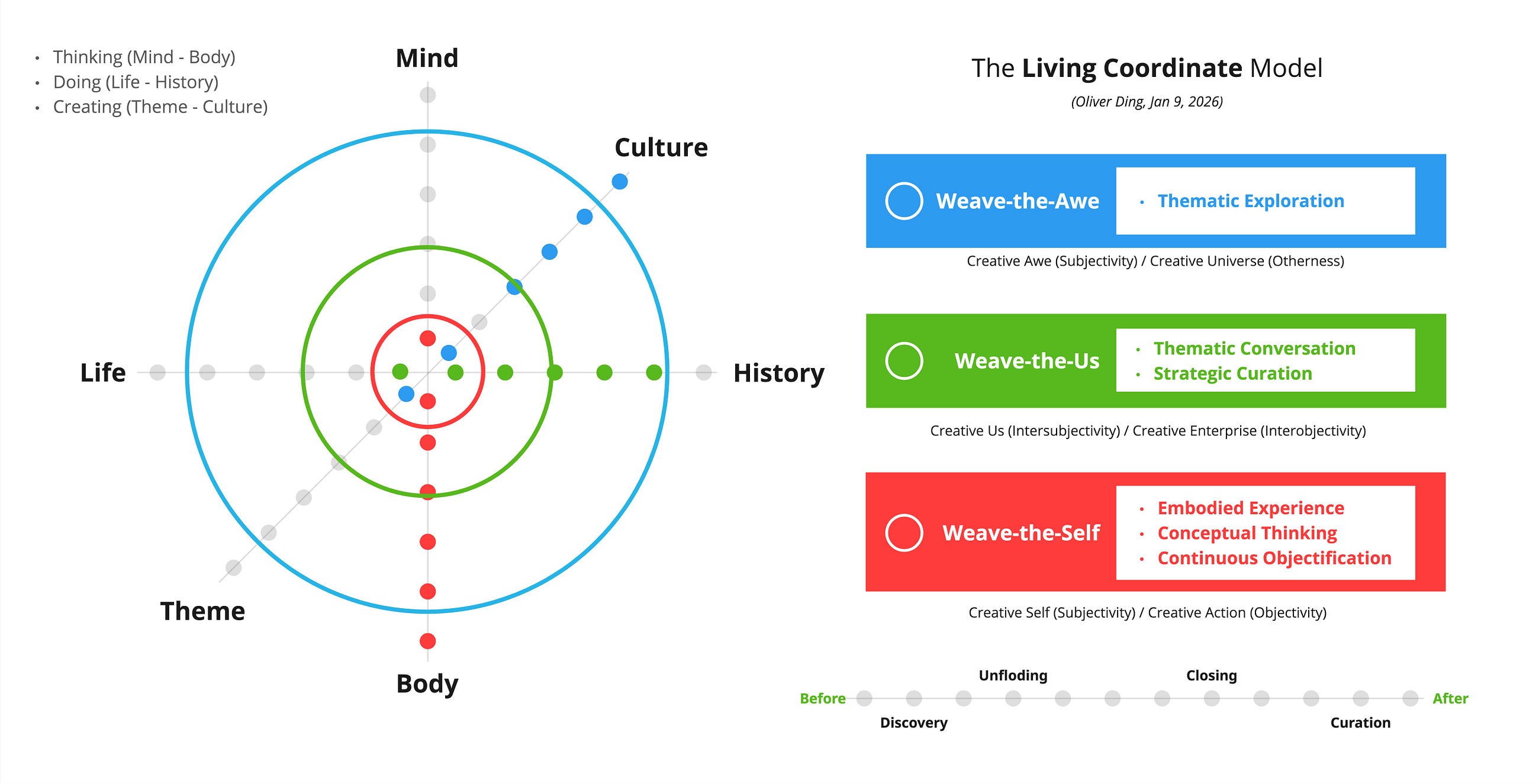
This model connects the Theorizing Creative Life Landscape diagram (a situational model) with the Life Coordinate Framework (a meta-framework), forming a clear hierarchy:
- Meta-framework: Life Coordinate Framework
- Framework: Living Coordinate Model
- Situational Model: Theorizing Creative Life Landscape
The Living Coordinate Model represents the significant outcome of the Lake 42 project, marking a new phase in Creative Life Theory’s development. But more importantly, it demonstrates a methodological principle: the need for intermediate frameworks that bridge abstract meta-frameworks and concrete situational models.
The new model was tested through two case studies. The LARGE Method applied the Living Coordinate Model to organize twelve of my own methods into a unified methodological framework — revealing four central focuses: Thematic Creation, Project Engagement, Spatial Cognition, and Supportive Development. Alice’s Method applied the same model to Alice’s life themes and creative projects, serving as a “methodological delivery” — providing the structural vessel while Alice supplies the living content. Together, these two cases demonstrate that the Living Coordinate Model works both as a tool for self-curation and as a framework for supporting others’ creative development.
Fractal Confluence: Patterns Across Scales
The Living Coordinate Model resolved one challenge — how to situate the 2025 Generative Confluence within my existing knowledge system. But in developing it, a new question surfaced: if this confluence could be modeled as a Living Coordinate, could earlier moments in my creative journey also fit the same pattern?
Looking back at the 2019–2025 journey, at least three earlier cases became visible. In 2019, Curativity Theory emerged from the confluence of Ecological Psychology (Gibson), Cognitive Linguistics (Lakoff), and Practice Philosophy (Schön). In 2020, the Project Engagement Approach emerged from Activity Theory (Blunden), Ecological Psychology (Barker), and the Corporate Identity System (Nakanishi). In 2022, Creative Life Theory v1.0 emerged from the Anticipatory Activity System Framework, the Project Engagement Approach, and Curativity Theory.
These were not isolated events. They were nested within each other — micro-confluences (days to weeks), meso-confluences (months to years), and the 2025 macro-confluence (six years) — all operating according to the same structural logic: meta-framework + creative resources → new creative center. This recursive structure across multiple scales is what I call Fractal Confluence. Chapter Eleven traces its full arc.
Cognitive Hydrology
Yet the deepest layer of this book reaches further still — not forward into theory, but backward into lived experience.
In Homecoming, I revisited my childhood and adolescence in Fujian Province. The Min River watershed, where I grew up, wasn’t just scenery — it was a lived meta-framework, though I had no language for it then. The river taught me about flow, confluence, cycles, scale, and direction. These weren’t abstract principles but embodied experiences that became the hidden meta-framework guiding my intellectual development.
My father worked at a municipal water plant, managing the treatment of water drawn from Chongyang Creek. He taught me that working with water systems requires both respect for natural flows and intelligent human intervention. Years later, when I developed the Ecological Practice Approach with concepts like “containers,” “flows,” and “strategic curation,” I was essentially translating what I had learned from the river into theoretical language.
To recognize the fundamental similarity while acknowledging crucial differences between geographic hydrology and creative flows, the concept of Cognitive Hydrology was introduced. In nature, confluence is typically a one-way transformation. In knowledge development, confluence can be generative — creating new knowledge systems without destroying old ones, opening new territories while preserving existing ones. The Epilogue explores this framework in full.
Designing a New Possible Book
The structure of the book is formally simple — no parts, no subdivisions — but its inner logic is carefully layered.
Chapter 1 introduces the journey. Chapters 2 through 9 follow the eight movements of Generative Confluence in close detail.
Chapters 10 and 11 lift the perspective, first to model the pattern (Living Coordinate), then expand the pattern to Fractal Confluence, revealing its fractal depth across six years. The Epilogue reaches furthest — tracing the pattern back to its deepest roots and introducing the Cognitive Hydrology framework to unite all discoveries.
Two appendices are attached for readers who want to explore deeply. Appendix 1 introduces a systematic framework connecting Thematic Space Theory, the Slow Cognition Framework, and the Creative Life Curation method. Appendix 2 returns to the original report of the June 2 discovery — the starting point of the Generative Confluence journey.
Each layer prepares the next. Chapter 12, the Tiny West-East Dialogue, may appear as a cultural aside, but it is in fact part of the deeper current: the cultural reflections that preceded June 2 were among the conditions that made the Generative Confluence possible.
Some numbers about v1.0 of the possible book:
- 1 introduction
- 12 chapters
- 1 epilogue
- 2 appendices
- 349 minutes of reading time
- 85,181 words (about 170 single-spaced pages)

Table of Contents
Introduction
- 8 min — 1778 words
Chapter One: Alice’s Coordinate
- A Thematic conversation on finding the coordinate
- 16 min — 3873 words
Chapter Two: Awareness from Flow
- Wonder! Wander! What a wild ride!
- 24 min — 5845words
Chapter Three: Finding the Coordinate
- The messy reality of homecoming
- 22 min — 5528 words
Chapter Four: Anchoring the Center
- Turning a focus into a foundation for growth
- 22 min — 5324 words
Chapter Five: Scaling the Focus
- Create, Curate, and Weave
- 26 min — 6205 words
Chapter Six: Sustaining the Streams
- The original creative streams continue to flow and develop
- 19 min — 4505 words
Chapter Seven: Catalyzing Curation
- Advanced Strategic Curation
- 21 min — 4933 words
Chapter Eight: Revealing the Landscape
- See things together
- 18 min — 4189 words
Chapter Nine: Setting the Enterprise
- The End as the Beginning
- 21 min — 5158 words
Chapter Ten: Living Coordinate
- Developing an intermediate framework
- 19 min — 4402 words
Chapter Eleven: Fractal Confluence
- What a Great Confluence
- 24 min — 5811 words
Chapter Twelve: Aristotle, Dragon, and Pearl
- A Creative Note on a Tiny West-East Dialogue
- 18 min — 4486 words
Epilogue: Cognitive Hydrology
- The Natural Mother’s Way of Cognitive Flow
- 12 min — 2651 words
Appendix 1 | Themes of Practice: The Living Way of Concept
- A methodological framework
- 33 min — 8351 words
Appendix 2 | The “Theorizing Creative Life” Project
- A Creative Life Discovery Project about Creative Life Theory (v3.0) and Beyond
- 44 min — 11660 words
Where to Buy
Lake 42 is currently released as a possible book on Possible Press.
The book is delivered as 16 individual PDF files. There is no single compiled PDF of the entire book.
Preview Chapters
- Chapter One: Alice's Coordinate
- Chapter Three: Finding the Coordinate
- Chapter Four: Anchoring the Center
- Chapter Nine: Setting the Enterprise
- Chapter Ten: Living Coordinate
- Chapter Twelve: Aristotle, Dragon, and Pearl
- Epilogue: Cognitive Hydrology
v1.0 - February 18, 2026 - 2,338 words