
Epilogue: A New Member of the Cognitive Hydrology Series
Epilogue to The Spatial Heuristic Sprint: A Case Study of a Two-Week Revisiting-and-Rebuilding Project
by Oliver Ding
November 9, 2026
The project that this collection studies began with a plan. I intended to advance Cognitive Hydrology to version 2.0, using the Curativity of Mind model as its object. Within two days the plan turned. The question became why Thematic Engagement had never been raised to a concept, and the work moved toward the Thematic Engagement Toolkit. In the end the project produced the Weave-the-Theme framework, the toolkit, and the book Developmental Theme. The plan for version 2.0 was set aside during the editing of that book, and it was not finished in those two weeks.
After the project and the book were complete, I began this collection. I applied the Creative Life Curation method to the two-week project itself, and I wrote ten case studies from it. When the collection was finished, I found that I had unintentionally written a new work of Cognitive Hydrology. It is the latest member of the series, and it is the first one whose time scale is two weeks.
That time scale is what the collection adds. The trilogy works at the scales of decades, years and months.
- Homecoming: A Thematic Trip and the World of Activity Approach covers forty years of a life
- Wonder and Wander: Revealing the Evolving Knowledge Enterprise covers six years of knowledge creation from 2019 to 2025
- Lake 42: The Great Confluence covers six months of generative confluence.
- Appropriating Activity Theory covers a decade.
This collection covers two weeks. It is the shortest scale in the series, and it shows the rhythm of a project that is compressed into a few days of intense work and can still be read in its own right. With it the series covers a range of time scales from two weeks to forty years.
The rest of this epilogue takes two directions. The first goes back to the beginning and tells the series from its origins: the three books that were named a trilogy, the book that followed them, and the questions that each one left open. The second returns to the present and looks at the knowledge system of Cognitive Hydrology as it stands now, in the new picture that October 2026 has drawn. It then asks how that picture relates to the coordinate–center transformation of spatial heuristics that the Introduction describes, since the spatial heuristic is now one of the aspects of Cognitive Hydrology, and the collection is one of the rounds through which that transformation advances.
Creative Life Curation and the First Three Books
2025 was a dense year of writing. In June, I finished Wonder and Wander: Revealing the Evolving Knowledge Enterprise — a work of modeling. Through eight case studies, it extracted the deep structures of my knowledge journey from 2019 to 2025. It was an analytical, framework-driven book.
In September, I published Homecoming: A Thematic Trip and the World of Activity Approach. This book used a completely different mode: narrative. Structured around a journey of return, it wove together personal memory (1974–2014), theoretical reflection, and cultural observation. Homecoming gave me a genre I would come to love — where life story, theoretical development, and cultural critique are braided together.

These two books showed me that my "Creative Life Curation" methodology could accommodate two very different voices: modeling for case studies, narrative for life writing. So what should the third book be?
The natural answer was: use the narrative mode of Homecoming to tell a specific, decade-long story of wrestling with a theoretical tradition. I had been wanting to write that story for years. I first encountered activity theory in 2015. By the end of 2022, I had produced a model-map of the first seven years. But from 2022 to 2025, the story kept growing — new projects, new concepts, new turns.
So in September 2025, I started a biweekly column called "Appropriating Activity Theory." I borrowed the title from that 2022 model-map, but the writing style was completely different. I switched fully to the Homecoming mode — narrative, reflective, personal. At the time, I imagined this would be the third book in a "creative life curation" trilogy:
- Wonder and Wander (modeling)
- Homecoming (narrative · life biography)
- Appropriating Activity Theory (narrative · theoretical appropriation)
But creation is never linear.
The Unexpected Birth of Lake 42
On January 1, 2026, a completely new idea landed: Lake 42: The Great Confluence.
It chronicled a six-month period (June–December 2025) when three theoretical streams converged — the Ecological Practice approach, the Life-as-Activity approach, and Creative Life Theory (early edition) — and produced something genuinely emergent. Its voice followed Homecoming, but it was more self-reflexive: it didn't just document a knowledge journey; it also theorized the act of documentation itself.
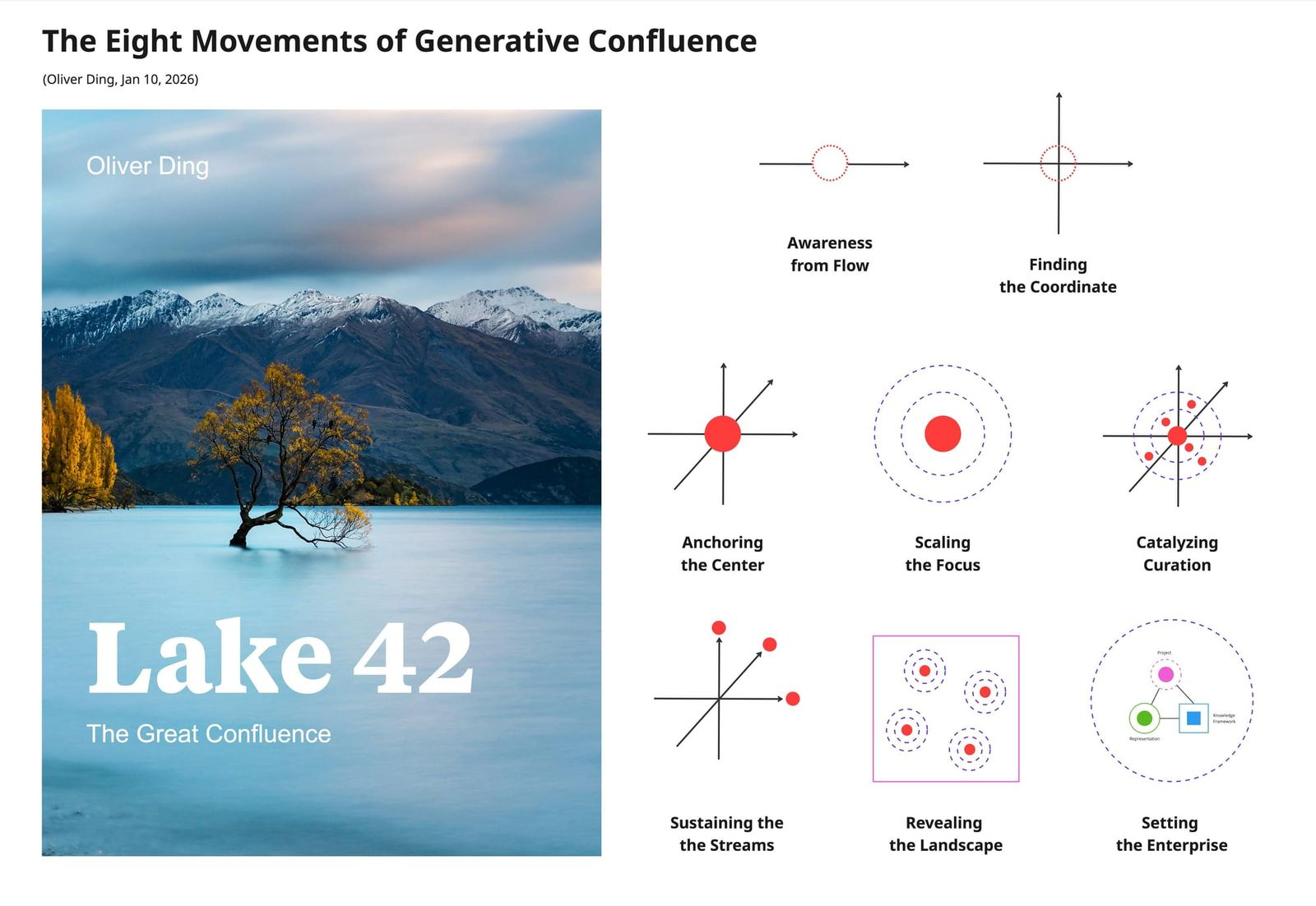
I finished the manuscript during the Lunar New Year. In the epilogue, I wrote a title: "Cognitive Hydrology." At that moment, it was just an image — thought flows like water, gathering and dividing in specific landscapes, forming recognizable channels. That image ran through Lake 42, so I put it in the epilogue.
The name carries a specific logic. Lake 42 introduces Generative Confluence — the pattern by which distinct theoretical streams converge to produce something genuinely new, documented across six months of creative work. Looking back further, Lake 42 also reveals Fractal Confluence — the same generative pattern operating at a larger scale across the years 2019 to 2025, the very period that Wonder and Wander had documented. And Homecoming connects back further still, to the embodied experience of growing up within the Min River watershed in Fujian, where water itself, long before any theory, was already teaching the same lesson.
"Cognitive Hydrology" Becomes the Name
After Lake 42 was released, I found myself talking with readers and friends. I needed a name that could hold the three books together — Wonder and Wander, Homecoming, and Lake 42. They all circled the same question: How does a person truly relate to knowledge? Each answered from a different angle: methodological grounding, practical bridge, theoretical crown.
I remembered that phrase from the epilogue. It was born for Lake 42, but it turned out to be the perfect umbrella. So in February 2026, I officially named the trilogy Cognitive Hydrology.
These three manuscripts were not planned as a trilogy. They grew organically out of the flow of a creative journey.
Looking back, they form a unified application of the Creative Life Curation method across three distinct time scales:
- Homecoming: A Thematic Trip and the World of Activity Approach (September 2025) — spanning my life from childhood to midlife (1974–2014)
- Wonder and Wander: Revealing the Evolving Knowledge Enterprise (June 2025) — focusing on my knowledge creation journey (2019–2025)
- Lake 42: The Great Confluence (February 2026) — documenting six months of high-density theoretical confluence (June–December 2025)
Three time scales: decades, years, months. Three narrative rhythms: biographical, knowledge journey, creative confluence. And yet running through all three is the same current.
A Decade of Engaging with a Century-Old Tradition
At that time, the Appropriating Activity Theory column was still ongoing (I had just published #11). I did not stop to ask where it belonged. The trilogy was complete, the column was still flowing, and the two coexisted without tension.
On May 30, 2026, I published the eighteenth and final column, and I wrote that the decade had been accounted for and the pattern named. On June 10, 2026, the column was released as a possible book, Appropriating Activity Theory, with a total of about 126,600 words. It has three parts. Curating tells how the column and the practice behind it came together. Storytelling is the column itself, issues #1 to #18. Modeling collects seven case studies written between 2022 and 2026, each returning to the same decade with a different eye. The book's preface already names it a member of the Cognitive Hydrology series, and it begins where the decade begins: in 2015, with a question about mindfulness and a reading of Bonnie Nardi's Activity Theory in HCI.
The decade the book covers passed through several projects: the Activity U project in 2020, the Anticipatory Activity System framework in 2021 and 2022, the Activity Analysis & Intervention program in 2023, the revision of Project Engagement in 2024, and in September 2025 the decision to use Life-as-Activity as the umbrella name. The book ends at the Life-as-Activity Approach, which closes the ten-year journey.
The book also names a practice that this collection later repeats. In issue #9, in January 2026, I wrote that the column now immersed itself in the present, returned to the past, and moved toward the future, and I named that practice Revisiting–Rebuilding. The first part of the book treats it as a recognizable activity, one that can be named, examined and developed. The two-week project in this collection is a later instance of that practice, carried out in fifteen days rather than across the nine months of the column.
From Trilogy to Series
The trilogy was already complete. If it were a closed set, this book would be outside it. But I could expand the trilogy into an open series, one that could hold more than three books. I decided to do that. A series can start with a trilogy, but it does not have to end there.
That decision changed how I edited the book. Once I saw the four books as a family, I re-examined the first three, and I found two absences in them. They were not flaws, only empty spaces, and this book could fill both. The first was a gap in the timeline. The trilogy covers childhood to 2014 in Homecoming, the source period of 2019 to 2025 in Wonder and Wander, and the second half of 2025 in Lake 42. One complete decade was missing: my 2015 to 2025 journey with activity theory. Wonder and Wander drew on that period, but as modeling, not narrative. The second was a gap in genre. Homecoming is a life-biography narrative of forty years, and Lake 42 is a narrative of six months of confluence. The series needed a third narrative work at the scale of a decade, with the same braiding of life story, theory and cultural reflection.
In the expanding series, the book has a clear place. It is the fourth book, after Wonder and Wander, Homecoming and Lake 42. It fills the temporal gap and the genre gap. Thematically, the trilogy asks how knowledge generates itself from one's creative life. Appropriating Activity Theory asks how one person meets, wrestles with, misuses, rebuilds and finds a voice within a century-old tradition of thought. Where the trilogy keeps narrative and modeling apart, this book places them side by side, so that the modeling and the narrative lead into each other.
This collection is the latest addition to that sequence. With it the series now has six books:
- the three of the trilogy
- Appropriating Activity Theory
- Developmental Theme, and this collection
Developmental Theme belongs to the series in its own right. Its subject is theme, which is the core of Cognitive Hydrology, and it echoes Wonder and Wander. That earlier book is about the Evolving Thematic Enterprise, the stage in which a theme has grown into an enterprise. Developmental Theme gives the whole process, from theme to enterprise. Its fifteen creative journeys were curated by the method of Creative Life Curation, although the book as a whole does not follow that method.
Taken together, the six books cover time scales from two weeks to forty years, and they show the enterprise as more than a set of memoirs or models.
Beyond the Books: The Knowledge System
The books are one form of the series, but they are not the whole of it. The books are the forms in which the series has so far taken shape, and the knowledge system is the wider structure in which those forms now stand. The Introduction describes a transformation of the spatial heuristic itself, from coordinate toward center. This section takes the knowledge system as the ground on which that transformation is taking place. The trilogy answered a single question at three levels: how does a person enter a genuine relationship with knowledge? Methodologically, it asked how ideas develop over long time scales. Practically, it showed how theory is tested by lived experience. Theoretically, it named the pattern by which distinct streams converge into something new.
The knowledge system that the series has built since then has moved into several working forms. The Creative Life Curation method is the primary method, and it has been applied to my own life across many projects. Thematic Development Study is the operation that came from that practice, a systematic study of how a theme develops across time. The six operations of Slow Cognition describe how an individual moves through a theme without hurry, and the pedagogy of version 1.0 organizes them into four stages and an integrating stage.
In October 2026 the system took on a new shape. The Weave-the-Theme framework gave theme a structure of sixteen weave-points.
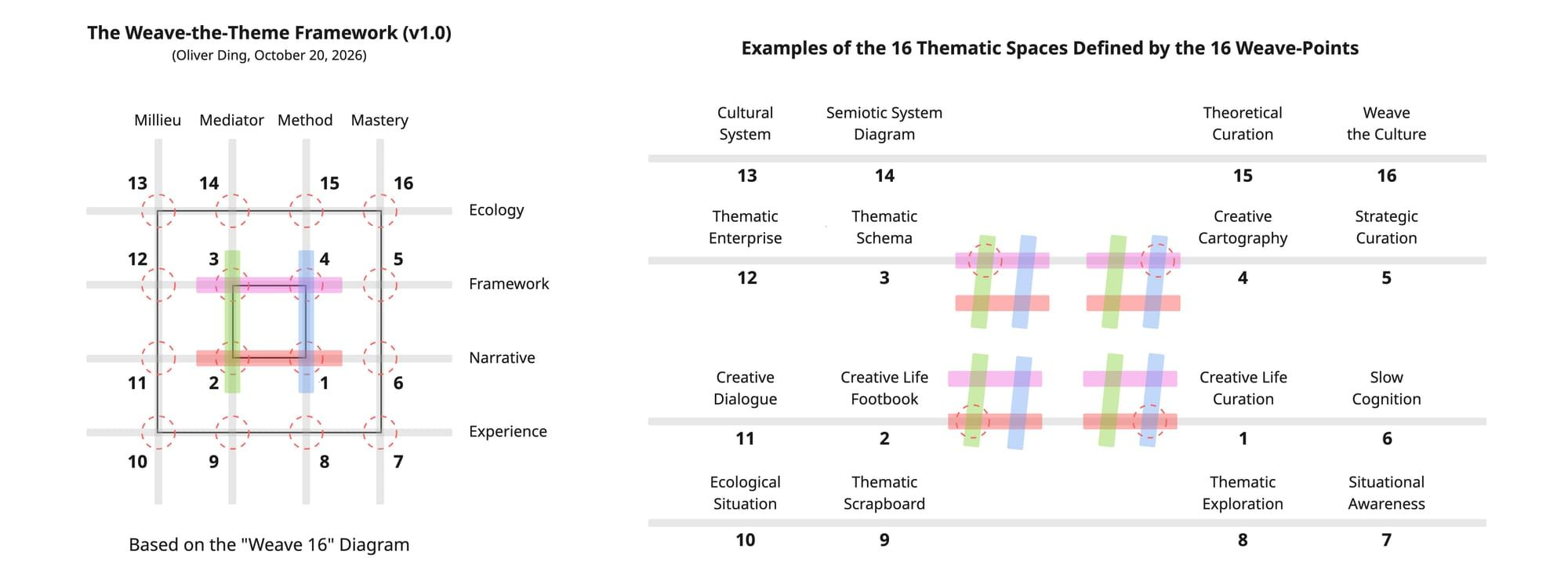
The Thematic Engagement Toolkit gave Thematic Engagement a formal concept with four layers. The Developmental Theme concept gave the theme a knowledge ecology, and Cognitive Hydrology was placed within it as one of its programs. The system is therefore not a single theory. It is a set of methods, frameworks and concepts that are tested against one another, and the books are only one place where that testing is recorded. This collection is another such place.
The system is still developing. Cognitive Hydrology 2.0 has been set aside, but its tasks remain open. The sixteen weave-points have not all been covered, the pedagogy needs more than one version, and the place of the enterprise in cognitive science has not yet been written. Each of these will be another round of the series, and each round will add a member to it.
Spatial Heuristics and Cognitive Hydrology
The relation between spatial heuristics and Cognitive Hydrology has changed in the course of this work. In the early stage, Cognitive Hydrology was one of three dimensions of the coordinate of spatial heuristics, alongside the theme lineage and Creative Diagramming. It gave the operation its question, its orientation toward the individual, and much of its material.
As the work developed, the relation turned. Spatial heuristics became one of the four aspects of Cognitive Hydrology on the HLS map of the social world. It sits in the Social Territory, where the Strategic Curation mechanism operates, and it is the aspect of the enterprise that is a method rather than a content. The other three aspects, Thematic Creation, Cognitive Representation and Significant Social Forms, name what a theme becomes in the enterprise. The spatial heuristic names how a creator moves through a theme.
This reversal does not cancel the earlier relation. It completes it. Cognitive Hydrology is one of the dimensions in which spatial heuristics was first recognized, and spatial heuristics is now one of the means by which Cognitive Hydrology is developed. The collection is a place where that mutual relation can be seen working. Thematic Space Theory and Creative Life Curation, which can each be considered on their own, entered the analysis through Cognitive Hydrology, and the spatial heuristic moved through them in turn.
The collection therefore belongs to the series in a double sense. It extends the time scales of the series to two weeks, and it shows the series' own concepts, the spatial heuristic among them, operating within the enterprise that the series has been building.
v1.0 - November 9, 2026 - 2,629 words