
Strategy as Curation (book, v1, 2024)
The Advanced Life Strategy Toolkit (v2, 2024)
by Oliver Ding
December 26, 2024

In the previous article The Advanced Life Strategy Toolkit (v2, Dec 2024), I reviewed the development of Advanced Life Strategy from 2022 to 2024. During this process, I realized that the “Curating” thematic room serves as the hub of the nine thematic rooms in the House of Creative Life Strategy, representing the core themes of Advanced Life Strategy.
So, I decided to title a new possible book Strategy as Curation: The Advanced Life Strategy Toolkit (v2, 2024). The book aims to collect articles that document and represent the development of Advanced Life Strategy.
Some numbers about the possible book:
- 6 parts
- 42 articles
- 720 minutes of reading time
- 192,920 words (about 385 single-spaced pages)
Preface
On December 23, 2024, I did a tiny knowledge curation project on Twitter by making a Twitter thread. The result is the diagram below, showing a knowledge map of Advanced Life Strategy (v2).
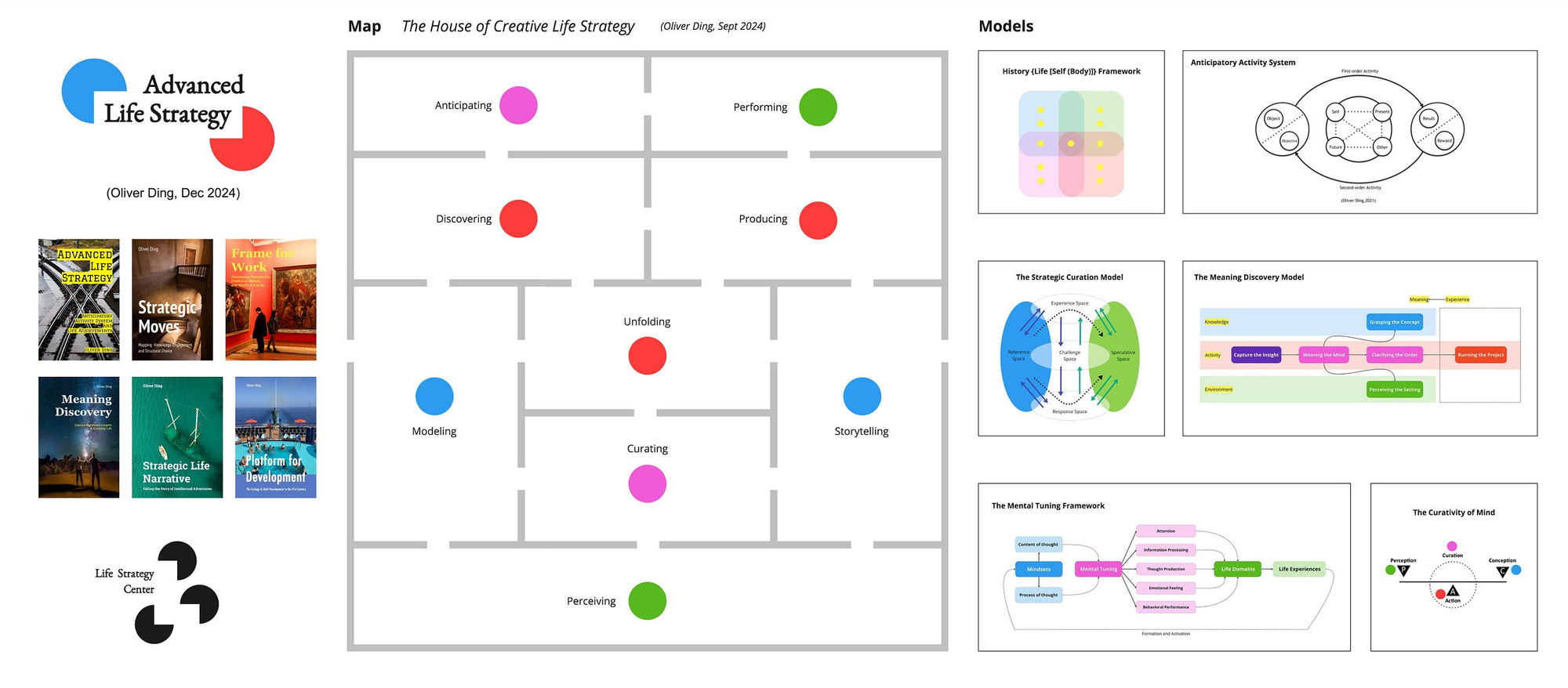
The “Advanced Life Strategy” theme was developed in 2022 while I worked on applying the Anticipatory Activity System (AAS) framework to adult development.
Featured article:
- The Advanced Life Strategy Toolkit (v2, December 2024)
Part 1: The “Strategy-as-Curation” Project
The “Strategy as Curation” theme was inspired by a note I wrote on January 25, 2022.

On January 18, 2022, I had a 91-minute talk with a friend who is a data scientist, programmer, and mathematical thinker. Recently, he shifted toward innovative mathematical thinking — a significant decision for him. He reached out to discuss the journey of independent research and the broader topic of epistemic development.
During our conversation, I briefly introduced my journey of knowledge curation in 2021. He asked several profound questions about the creative decisions underpinning my journey. However, we didn’t have enough time to talk about Life Strategy for Indie Creators.
In January 2022, I had been discussing project reviews, career reflections, and life discovery with several friends, often sharing insights and diagrams in my articles.
This period aligns with a phenomenon I call the “Social Clock.” At the end of a year, people tend to review their annual achievements and life experiences. At the beginning of a new year, they plan their work and life for the months ahead. The holiday season is also a prime time for deep conversations about review, reflection, strategy, and related topics.
The talk with my friend took place on Tuesday, January 18. Over the following days, I was busy launching new toolkits. On Friday, January 21, I edited a 57-page document titled Strategy-as-Curation and sent it to him. This document began with the Anticipatory Activity System framework and outlined my preliminary plan for expanding it into the Strategy-as-Curation project. However, the plan itself covered only three pages — the remainder included emails exchanged with other friends and diagrams I had created.
This marked the beginning of the Advanced Life Strategy project. Part 1 of the book compiles several articles that explore this story:
- January 25, 2022 — A “Strategy-as-Curation” Weekend — 19 min
- October 6, 2021 — Challenge as Opportunity — 10 min
- January 21, 2022 — The “Platform” Thematic Space — 16 min
- January 4, 2022 — The Sailor’s Mandala: A Life Discovery Framework — 5 min
- January 8, 2022 — Youth Development as Drama-fit — 6 min
Part 2: A Creative Journey
The “Advanced Life Strategy” theme was developed in 2022 while I worked on applying the Anticipatory Activity System (AAS) framework to adult development.


The Anticipatory Activity System (AAS) framework is inspired by Activity Theory, Anticipatory System theory, Relevance theory, and other theoretical resources. It models a specific structure: the “Self — Other — Present — Future” schema.
An Anticipatory Activity System is formed by two parts: First-order Activity and Second-order Activity. At its core is the Transactional Anticipatory System, which considers the “Self, Other, Present, Future” situation.

As a Specific Theory, the AAS framework can be applied across various domains. In 2022, I selected Adult Life Development to test its utility.
From 2022 to 2024, I developed several related concepts within the AAS framework while also exploring ideas about “Life,” such as Creative Life, Strategic Life, and related themes.

Ten key articles of the creative journey are curated in Part 2:
- September 15, 2021 — Strategy as Anticipatory Activity System — 16 min
- February 3, 2022 — The “Strategy” thematic space — 23 min
- August 26, 2022 — The Development of AAS (2021 — 2022) — 17 min
- December 19, 2022 — Advanced Life Strategy: Anticipatory Activity System and Life Achievements (Book) — 10 min?
- May 30, 2023 — Themes in the Field: Self, Agency, and Activity (Part I) — 20 min
- July 17, 2023 — TALE: A Possible Theme called “Life (Self)” — 14 min
- Sept 24, 2023 — The Microdynamics of Creative Identity — 13 min
- March 7, 2024 — The Indirect Activity of Life Strategy Center — 24 min
- October 17, 2024 — The Thematic Identity Curation Toolkit (v1, 2024) — 24 min
- October 17, 2024 — Strategic Life: The Strategic Life Development Framework (book, v1, 2024) — 10 min
Part 3: Ontological Foundation
While the v2 of Advanced Life Strategy keeps using the AAS framework as the Realism part (Life), it changes the Ontology part (Self) and expands the Hermeneutics part (Mind). The featured models of Advanced Life Strategy v2 are organized as follows:
- Ontology: The Life(Self) Model
- Realism: The Anticipatory Activity System (AAS) framework
- Hermeneutics: The Meaning Discovery Model, The Mental Tuning Framework, The Strategic Curation Framework, and the Curativity of Mind Model
In 2023, I developed a series of ideas about Life and Self. On July 2, 2023, I introduced the concept of Life(Self).


Based on the notion of Life (Self), I adopted Robert Rosen’s Anticipatory Systems Theory to develop the following schema:
- Life = Behavioral System
- Self = Mental System
- Life(Self) = Behavior System (Mental System)
On April 18, 2024, I expanded the Life(Self) model to an advanced version: the History{Life[Self(Body)]} Framework. See the diagram below.

This is the Ontological Foundation of the v2 of Advanced Life Strategy.
Part 3 of the book collects related articles.
- July 17, 2023 — A Possible Theme called “Life (Self)” — 14 min
- June 20, 2023 — A Possible Theme called “Context (Mind)” — 15 min
- August 30, 2023 — A Possible Theme called “Theme (Concept)” — 33 min
- January 12, 2022 — Project as Story — 15 min
- The Project — Event — Multiverse Schema — 16 min
- January 19, 2024 — The Meaning Discovery Model (v1, 2024) — 15 min
- December 19, 2023 — Mental Moves and Social Moves — 13 min
Part 4: Realism: Life as Activity
The primary model of the Realism part of the Advanced Life Strategy is the Anticipatory Activity System (AAS) framework, initially defined in 2022.
The foundation of the AAS framework can be found in Advanced Life Strategy: Anticipatory Activity System and Life Achievements (Book, 2022) and The Life Strategy Center.


From 2022 to 2024, several related models were developed, including the Persona Dynamics Framework and the Strategic Change model.

The Persona Dynamics Framework bridges the AAS framework with the Possible Selves theory.
In 2022, I wrote a book (draft) titled Advanced Life Strategy: Anticipatory Activity System and Life Achievements. However, the book didn’t address the “Self—Personas — Role” issue. The Persona Dynamics framework thus advanced the development of AAS framework and the Life Strategy Center.
Part 4 of the book collects related articles about the newest development of the AAS framework.
- Feb 16, 2023 — The Persona Dynamics Framework — 10 min
- April 28, 2023 — Possible Discipline — 9 min
- December 7, 2023 — The Strategic Change Model — 7 min
- January 29, 2024 — Discovery as Second-order Activity — 14 min
- January 18, 2024 — Thematic Triangles and Life Discovery + — 11 min


Part 5: Hermeneutics: The Curated Mind
The V2 of Advanced Life Strategy featured the following knowledge frameworks as the Hermeneutics part:
- The Meaning Discovery Model
- The Mental Tuning Framework
- The Strategic Curation Framework
- The Curativity of Mind Model
We can roughly call them “the Curated Mind” toolkit.
In my 2019 book draft, Curativity: The Ecological Approach to General Curation Practice, I introduced a new term, “Curativity,” which refers to “curating pieces into a meaningful whole,” defining a general social activity and a universal experience.
At an epistemological level, Curativity differs from mereology in philosophy and mathematical logic. While both address the relationship between parts and whole, Curativity is more concerned with action, experience, and value, whereas mereology focuses more on abstract reasoning about parts and whole.
Additionally, researchers often discuss mind-related topics using the keywords “perception, conception, and action.” From the perspective of Curativity Theory, I propose expanding the foundation of these mind-related topics from three to four keywords. See the diagram below.

As mentioned above, v2 of Advanced Life Strategy emphasizes the Strategic aspect of human life. The “Curated Mind” toolkit reflects the way of deliberately curating pieces of information into a meaningful whole, aimed at enhancing cognitive skills, creativity, and strategic intelligence.
Part 5 of the book collects related articles.
- The Curativity of Action — 7 min
- The Curativity of Mind (v1, 2024) — 3 min
- A Five-space Model for Strategic Curation — 14 min
- The Thematic Identity Curation Toolkit (v1, 2024) — 11 min
- Frame for Work: Knowledge Frameworks, Predictive Models, and World of Activity (book, v1, 2024) — 17 min
- The Strategic Life Narrative Practice #0 (Introduction) — 17 min
- The Mapping Strategic Moves Method (v1, 2024) — 19 min
- The Ecological Strategic Cognition Framework (v1, 2024) — 17 min
Part 6: Mindset for Life
The Mental Tuning Framework is a framework that offers an approach to connect Mindsets, Actions, and Life Experiences.
On September 9, 2023, I wrote Knowledge Engagement: The Concept of Mindset and Theoretical Integration, curating Carol S. Dweck’s version of Mindset theory and Peter Gollwitzer’s version of Mindset theory together. The outcome is the Mental Tuning framework.

The above diagram has three parts. The blue part refers to the Mindsets and Mental System. The green part refers to the Behavioral System. The pink part refers to the connection between the Mental System and the Behavioral System.
The difference between Dweck’s version of Mindset and Gollwitzer’s version of Mindset indicates a fundamental psychological view.
- Carol S. Dweck: Mindset = Belief = Content of Thoughts
- Peter Gollwitzer: Mindset = Cognitive procedures = Processes of Thoughts
The Mental Tuning Framework curates these two views of Mindset together. In other words, these two views are the two aspects of the Mindsets which mean the Predictive Model of the Mental System.
The middle part of the new framework is defined by a new term called “Mental Tuning” which is inspired by Gollwitzer’s term “Cognitive Tuning.”
In a general sense, “Mental Tuning” refers to active self-regulation strategic techniques that aim to improve particular psychological functions relating to life domains.
For instance, Gollwitzer’s version of Mindset uses the MCII (Mental Contrasting and Implementation Intentions) method as a strategic technique for “tuning” the Implementation Mindset.
This is a rough abstract general theoretical framework that can capture Dweck’s version of Mindset and Gollwitzer’s version of Mindset as its two concrete cases. You can find more details in Knowledge Engagement: The Concept of Mindset and Theoretical Integration.
Later, I detached a meta-diagram from the initial version of the Mental Tuning Framework. See the diagram below.

In The Concept of Mindset and Empirical Psychologists, I reviewed the Job Crafting framework (Wrzesniewski and Jane E. Dutton, 2001) and represented it with the Mental Tuning meta-diagram. The outcome was the “Job Crafting as Mental Tuning” diagram.
In The Concept of Mindset and Intervenors, I reviewed the practice of Psychotherapy and claimed that “all methods of psychotherapy are about doing the work of Mental Tuning”. In particular, I used Steven C. Hayes’ Acceptance and Commitment Therapy (ACT) as an example to discuss “Psychotherapy as Mental Tuning”.
In The Concept of Mindset and Actors. I reviewed Dan P. McAdams’ theory approach to personality and life development, especially his account of personal myth and narrative identity.
More details can be found in Four Mindsets of Knowledge Engagement and “AAI as Mental Tuning.”
Part 6 of the book collects articles about the Mental Tuning frameworks.
- The Concept of Mindset and Theoretical Integration — 48 min
- The Concept of Mindset and Empirical Psychologists — 27 min
- The Concept of Mindset and Intervenors — 28 min
- The Concept of Mindset and Actors — 39 min
- Four Mindsets of Knowledge Engagement and “AAI as Mental Tuning” — 17 min
- Lazarus’ Perspective and “Coping Activity as Mental Tuning” — 6 min
- Psychological Knowledge Engagement and Robert Kegan’s Knowledge Enterprise — 59 min
Epilogue
On December 26, 2204, I published The Advanced Life Strategy Toolkit (v2, Dec 2024) and Strategy as Curation (book, v1, 2024). Some friends appreciated them, and one friend even sent me a long email to discuss their further development.
On December 27, 2024, I reflected on this toolkit, particularly the History {Life[Self(Body)])} framework.
As mentioned in the previous article, the framework was inspired by Robert Rosen’s Anticipatory System Theory, especially his ideas on Natural Systems and Formal Systems.
I added the following concepts to the framework and made version 2.
- Symbolic Universe
- Social Territory
- Social Landscape
- Thematic Space
Symbolic Universe and Social Territory come from theoretical sociologist Ping-keung Lui’s Subjectivist Structuralism. I have followed Lui’s work for many years, and his Subjectivist Structuralism has greatly influenced my Creative Life Theory and guided my research on Knowledge Centers.
The other two terms — Social Landscape and Thematic Space — were developed during various projects I worked on between 2023 and 2024.
The result is a meta-framework for understanding the Social World that integrates actors’ subjective experiences, mindsets, and meanings.
It also offers a perspective that connects Sociology and Psychology as complementary disciplines within the same theoretical family.
This article shifts from the practice level to the theory level, exploring the theoretical value of the History {Life[Self(Body)]} framework.
December 31, 2024
Reference
- The Advanced Life Strategy Toolkit (v2, Dec 2024)
- Advanced Life Strategy: Anticipatory Activity System and Life Achievements (Book, 2022)
- Strategic Life: The Strategic Life Development Framework (book, v1, 2024)
- Frame for Work: Knowledge Frameworks, Predictive Models, and World of Activity (book, v1, 2024)
- Meaning Discovery (book, v1, 2024)
- The Mapping Strategic Moves Method (v1, 2024)
- Platform for Development (book, 2021)
v1.0 - December 26, 2024 / v1.1 - December 31, 2024 - 2,380 words