
[Creative Note] The Weave-the-Education (v1.0) Diagram
A new diagram
by Oliver Ding
November 15, 2026
This note is part of the Educational Project Engagement Series.
The day before yesterday, I saw a friend sharing her experience of participating in "Philosophical Counseling" on social media. Curious about it, I sent her a private message to ask for more details. Yesterday, she replied to my message. She is a teacher currently working with primary school children.
This exchange was a serendipitous coincidence. Yesterday morning, I had been working on a new creative idea: extending the Activity Analysis & Intervention (AAI) framework to a specific demographic—educational professionals. By this, I mean a broad spectrum: not just teachers in formal school systems, but also trainers in social sectors, facilitators of non-degree courses, and anyone engaged in educational practices.
To guide future development in this area, I developed a new creative theme: Educational Project Engagement. It represents my attempt to apply the Project Engagement Approach to the educational domain. Based on this theme, I designed a four-stage program to guide educators.
However, it was only when I read her reply at noon that a new insight struck me. As a primary school teacher, she is simultaneously a learner and an educator. Therefore, her "educational project engagement" inherently involves two types of projects: teaching and learning. This realization prompted me to conceptualize Teach and Learn as two distinct dimensions, initially forming a 2x2 weave diagram. Later, I expanded this into a 4x4 structure—the Weave-the-Education Diagram.
1. What is the Weave System?
Before presenting the diagram, let me briefly introduce the "Weave" system, as this is the first time I am applying it to the educational domain.
In October 2025, I introduced the "Weave" Basic Form as a meta-framework. It is a super-simple diagram that frames an activity as the synthesis of two diachronic (vertical) dimensions and two synchronic (horizontal) dimensions. Their intersections create four Weave-Points.
However, I soon discovered that the 2x2 structure was too cramped. By expanding the grid to a 4x4 structure, we unlock 16 Weave-Points. Crucially, each Weave-Point is not a fixed label. It acts as a portal to a Thematic Space—a living cognitive container. Inside each Thematic Space resides a multitude of Thematic Elements—frameworks, diagrams, case studies, notes, and lived experiences related to that coordinate.
2. Example: The Weave-the-Theme Framework (v1.0, 2026)
Recently, in October 2026, I developed the Weave-the-Theme Framework using this exact 4x4 Weave 16 system. This framework was designed to map out how a "theme" evolves through different stages of cognitive development. Its vertical axis represents the Experience—Narrative—Framework—Ecology schema, while its horizontal axis is the 4M schema (Milieu, Mediator, Method, Mastery). This structure creates 16 Weave-Points, each serving as a portal to a Thematic Space where specific cognitive materials—like case studies, theoretical models, and diagrams—are curated.
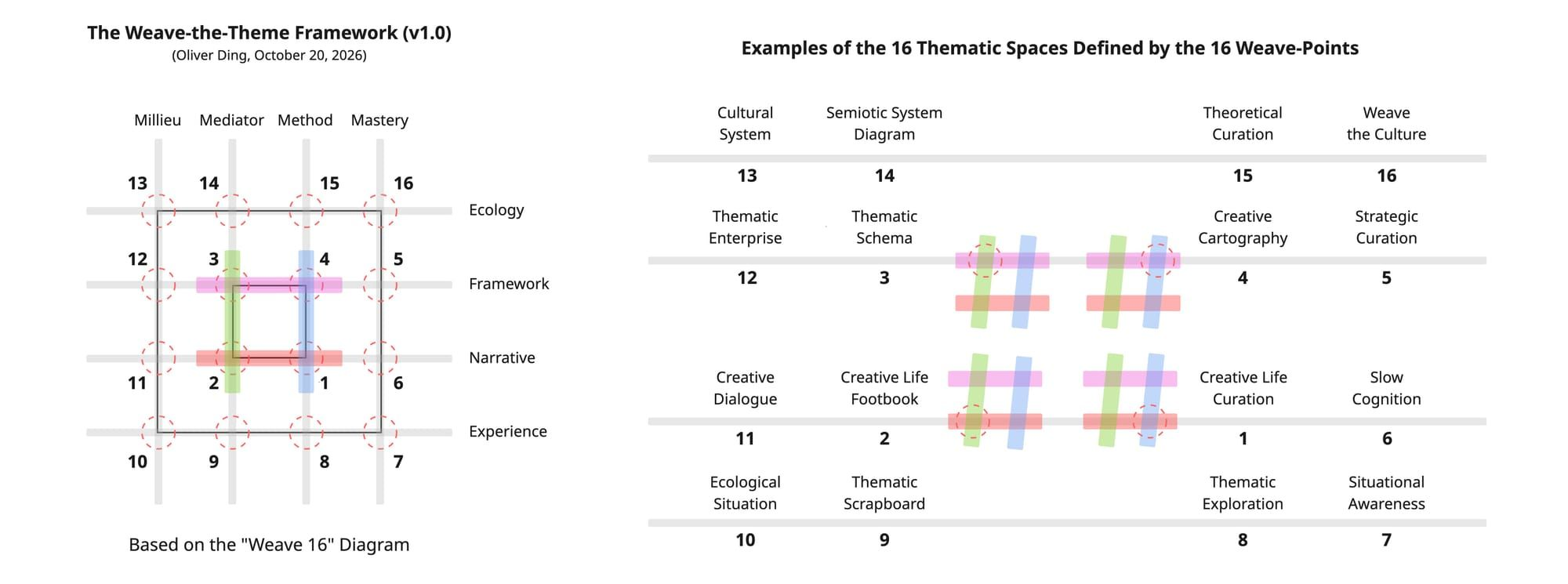
The power of this framework lies in its ability to organize a vast array of knowledge models simultaneously while retaining structural coherence. Each Weave-Point acts as a precise coordinate, telling me not only where a theme is in its lifecycle, but also how it is being engaged with in that moment. By placing my own creative works into these 16 spaces, it functions as an open map, allowing me to navigate and connect my theoretical explorations over time without breaking the underlying structure.
When I began designing the diagram for education, I naturally looked back at this framework. I realized that the vertical axis I used here—the 4M Schema (Milieu, Mediator, Method, Mastery)—is incredibly suitable for exploring education. Education is fundamentally about the Milieu (environment), using Mediators (tools), applying Methods (interventions), to achieve Mastery (the integration of capability and aspiration). Because this 4M schema fits so perfectly with the educational domain, I did not change a single thing on the vertical axis. It was precisely this striking coincidence that prompted me to develop the Weave-the-Education Diagram so quickly.
3. Developing the Horizontal Axis
The Horizontal Axis represents four states of the individual, expanding from the original Teach-Learn duality to include Create-Curate:
- Curate: Turning pieces into a meaningful whole. The individual organizes knowledge, outputs, and resources.
- Teach: Cultivating oneself and empowering others. Sharing knowledge and capabilities.
- Learn: Acquiring knowledge for application. Learning new things to improve capabilities for better creation.
- Create: Bringing forth the new. The individual takes action, produces outputs, and generates new things.
The Teach-Learn schema was inspired by my friend, as mentioned earlier—a primary school teacher who is simultaneously an educator and a learner. However, the Curate-Create schema was inspired by another weave diagram: the Weave-the-Theory Framework.
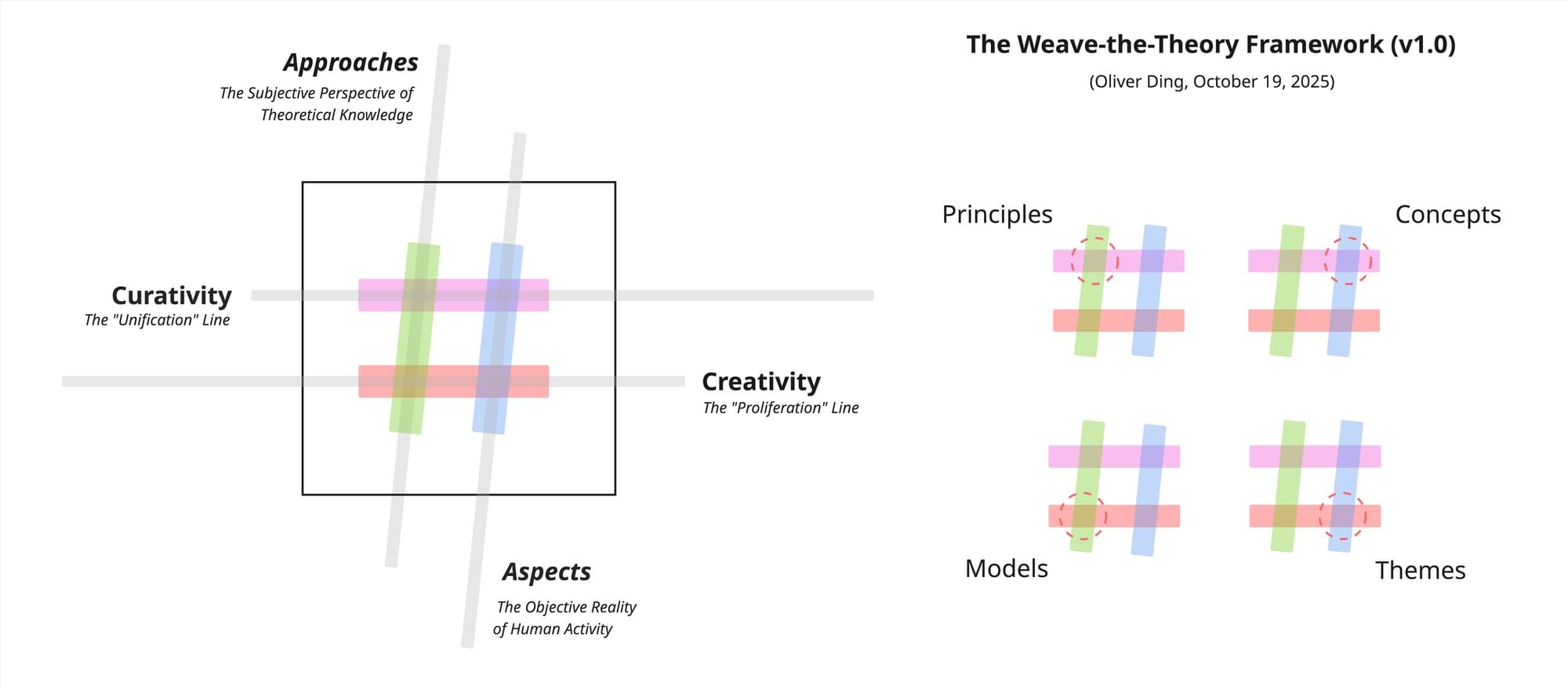
The Weave-the-Theory framework was developed to understand a special type of human activity: Theoretical Activity. Just as we map physical or educational activities, theoretical activity—the act of building theories, curating concepts, and integrating traditions—can also be mapped. The framework uses two diachronic lines (Creativity and Curativity) and two synchronic dimensions (Aspects and Approaches) to generate four Weave-Points: Themes, Models, Concepts, and Principles. Each point represents a critical moment in the transformation of abstract ideas into structured knowledge.
At the heart of this framework is the resolution of a fundamental tension. On one side is Creativity—the drive to proliferate, to generate new ideas, and to explore new territory. On the other side is Curativity—the drive to unify, to organize existing elements into a coherent whole, and to synthesize. An enterprise that only creates becomes incoherent; one that only curates stops growing. Weave is the third element that holds both in motion simultaneously. To weave is to create in a way that is already organized, and to curate in a way that is still generative. This tension between creating the new and curating the meaningful is the engine of all intellectual work.
Although the Weave-the-Theory framework was originally developed to understand theoretical activity, its underlying logic applies to any form of knowledge ecology. It provides a universal vocabulary for reflecting on how we manage our ideas and projects. I realized that this framework is exceptionally suitable for education. Education is fundamentally a knowledge ecology: educators must constantly Create new pedagogical approaches and materials, while simultaneously Curating existing knowledge, resources, and student experiences into coherent learning journeys. Therefore, incorporating the Curate-Create duality into the educational diagram felt like a natural and powerful extension.
4. The 16 Thematic Spaces and the Examples
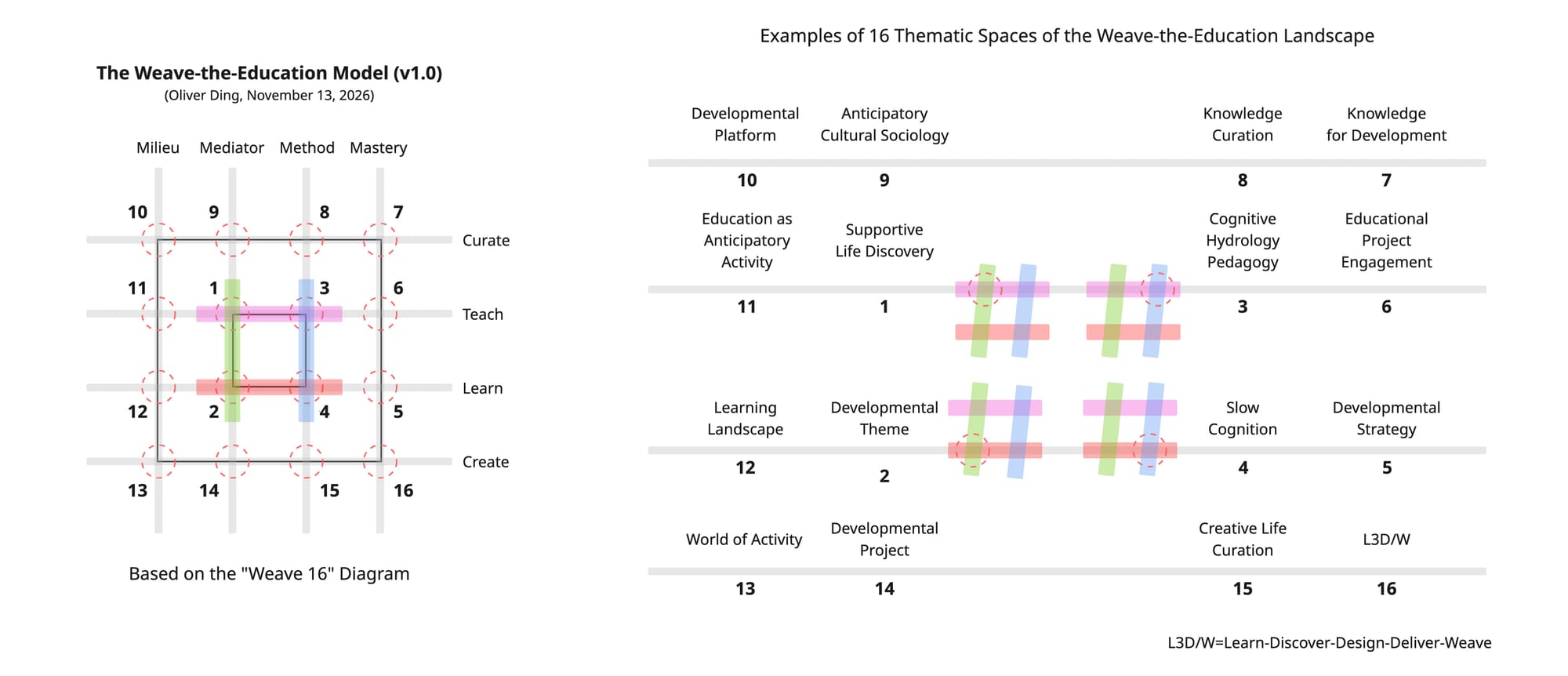
When the horizontal and vertical axes intersect, they form a 4x4 grid with 16 Weave-Points. Each point represents a structurally distinct position. Following the principles of Thematic Space Theory, each point opens onto a Thematic Space—a cognitive container where related creative ideas, knowledge materials, and experiential events can be stored and developed. I have numbered them from #1 to #16 to facilitate exploration.
Although this 4x4 structure was generated quite quickly, finding suitable cases for the 16 Weave-Points took a significant amount of time. Since this is the first time I am introducing this framework, I could not rely on external cases or published research, nor did I have the time to conduct a highly formal and rigorous reflection process right away.
Therefore, I relied on intuition. I quickly jotted down keywords next to the diagram—representing various creative outputs from my past years, including concepts, knowledge frameworks, and methodologies. As I wrote down one keyword, it triggered associations with others, and soon I had listed about 20 of them.
After listing these keywords, I matched them against the 4x4 structure and placed them one by one into the most suitable positions. Due to time constraints, some placements may not be perfectly precise. However, these are merely examples; they can be modified and refined in the future.
To make this abstract structure concrete, I provided 16 of these examples on the right side of the diagram. For each position, I wrote down a keyword representing one of my creative outputs. A fascinating pattern emerged: the names of these creative outputs all include one of four related terms: education, development, learn, or knowledge. (Examples include: Creative Life Curation, Slow Cognition, Thematic Exploration, Situational Awareness, etc.)
By weaving the axes and the 16 spaces into a model, these themes naturally found their homes.
5. An Unexpected Self-Discovery
I originally designed this model with the intention of developing a tool for educational professionals. However, as I populated the diagram with my own case studies, a profound realization emerged.
To illustrate this, let me take the "Method" row as an example, which is perhaps the most characteristic of my personal journey:
- Method × Learn (Slow Cognition): In the first half of 2022, I started the Slow Cognition project. My goal was to learn how to apply Howard Gruber's historical-cognition research method to study long-term intellectual development.
- Method × Create (Creative Life Curation): A major outcome of Slow Cognition was that I developed the Creative Life Curation method in 2022. From 2022 to 2026, I repeatedly used this method for case studies, generating a series of book drafts. In 2026, I finally curated these into what I call "Cognitive Hydrology."
- Method × Curate (Knowledge Curation): In 2019, I completed the Curativity book draft and its namesake theory. From 2020 to 2022, I applied it to the knowledge domain, producing a series of tools and works. Since then, Knowledge Curation has become my daily creative method.
- Method × Teach (Cognitive Hydrology Pedagogy): In early 2026, after completing the theoretical framework of Cognitive Hydrology, I quickly developed a pedagogy for it. This was the first time in years that I had developed a teaching methodology for one of my theoretical frameworks.
When I placed these four cases on the diagram, I was struck by an immediate realization: Wasn't this exactly a journey of my own "Educational Project Engagement"? These four projects formed a cohesive journey, and the theme of this journey was precisely Educational Project Engagement itself.
Furthermore, I realized that many of the other examples in the diagram were developed gradually over the years, scattered across different projects and knowledge frameworks. It was unexpected that they would converge here today. This prompted a deeper reflection: Doesn't this demonstrate that "Education" is, and has always been, one of the most important themes in my Life Themes?
The very fact that my creative works fit so naturally into these educational spaces means that "Educational Professional" is actually one of my own identities. I set out to build a tool for others, but in the process, I found a new coordinate for myself. This was a completely unexpected self-discovery.
This diagram has just been born. It is still in its early stages, and I will continue to develop it further. More details, specific applications, and theoretical expansions will be shared in future articles.
I am sharing this process to thank my friend for the serendipitous exchange that sparked this new creative insight.
v1.0 - November 15, 2026 - 1,844 words