
Activity Analysis Network #25: The Gejunction of Knowledge Engagement
Revisiting-and-Rebuilding the Knowledge Strategy Series
by Oliver Ding
September 30, 2026
Hi, and welcome to Activity Analysis Network, a newsletter hosted by the Activity Analysis Center.
Each issue is organized around the "Flow - Focus - Center - Circle" schema, the primary model of the World of Activity Toolkit (v1, 2025).
In this biweekly newsletter, I share summaries of new articles from the Activity Analysis Center, along with updates on related activities, including some of my own published work elsewhere.
This issue releases a new thematic collection: The Gejunction of Knowledge Engagement (Collection, v1, 2026), the outcome of the Revisiting-and-Ruilding the Knowledge Strategy Series (2025).
Flow
The historical development of the Activity Analysis Center and my experience of daily life
Here are some LinkedIn posts from the past two weeks — fragments of daily thinking, traces of ongoing conversations:
- 9/17/2026 - [GO with AI] The I-You-Free Experiment
- 9/18/2026 - [Revisiting-and-Rebuilding] The Knowledge Strategy Trilogy (2025)
- 9/19/2026 - [Meta-discussion] What Happens When Theory and Phenomena Share the Same Word?
- 9/21/2026 - [Meta-discussion] How do you engage with a theoretical paradigm?
- 9/26/2026 - [Meta-discussion] When Does a Theoretical Principle Emerge?
- 9/28/2026 - [Meta-discussion] What if you don't want to be bound by a theoretical tradition?
- 9/29/2026 - [Meta-discussion] How do you engage with a single theory or knowledge system?
Some new articles published on the Activity Analysis Center's site:
- 9/17/2026 - Marinate the Mind: The Living Coordinate of Knowledge Engagement
- 9/19/2026 - GO Square: Introducing the Knowledge Ecology Square
- 9/24/2026 - The Social Science Square: Mapping Objects and Things of Knowing
- 9/29/2026 - Thematic Space Theory: A Toolkit as a Specific Theory
- 9/29/2026 - The Weave-the-Strategy Toolkit (v1.0, 2026)
- 9/29/2026 - The Thematic Space of Knowledge Engagement
- 9/29/2026 - The Knowledge Strategy Series
- 9/30/2026 - Revisiting-and-Rebuilding Knowledge Strategy Through the Gejunction Lens
- 9/30/2026 - The Gejunction of Knowledge Engagement (Collection, v1, 2026)
- 9/30/2026 - [Dramatic Life Pattern] Enterprise Relay
But underneath these public posts and articles, there is another flow, traced in my private notes:
- The "September Sprint" Journey
One theme that kept appearing in my private notes this month was what I started calling the September Sprint. There is an older influence behind it: October is the anniversary month of the founding of several of my long-running creative projects, so September has often become a natural month of acceleration — a time to bring things together, finish loose ends, and prepare for another cycle.
There is also a newer influence. For the past three years, I have traveled back to China in July. The trip itself is usually only one part of the story; its effects tend to unfold much later. New observations, conversations, memories, and unfinished thoughts continue to work in the background, and by September they often begin to resurface and connect with my ongoing work. The September Sprint, then, is partly a front-loaded effect from October and a delayed effect from July — two different temporal forces converging in the same month.
Focus
The Thematic Foci of the Activity Analysis Center
Two things have been occupying my attention.
[Revisiting-and-Rebuilding] The Knowledge Strategy series. In the past two weeks, I continued to work on the RR project. The outcome is a new thematic collection: The Gejunction of Knowledge Engagement (Collection, v1, 2026)

This collection is a record of a Revisiting-and-Rebuilding.
The Knowledge Strategy trilogy was completed in June 2025. What I now call the Knowledge Strategy series extends that timeline: later manuscripts carry it through the second half of 2025 and up to SDP. Earlier this year, I had deliberately stepped away from Knowledge Engagement and redirected my creative attention toward Cultural Innovation — a journey that unfolded through ACS (Anticipatory Cultural Sociology), SDP (Strategic Developmental Psychology), and GO Theory. In the first half of 2026, I produced several new book drafts and a series of knowledge frameworks. Among them, the Gejunction framework led me back.
The return began with a specific question. Castle and Forest (2025) left largely untouched what happens when two knowledge creators meet. The answer I gave then was thin. With new tools, I revisited that part and wrote The Relationfield of Knowledge Engagement. It introduces a formula — RelationField = Subject–Subject (Subject–Object) — and uses it to finish what Castle and Forest left undone. After finishing that article, I realized Gejunction could be used to reflect on the entire trilogy from last year. The RR series widened from there.
This collection gathers the results. Part 1 introduces the background. Part 2 presents the RR articles themselves, each taking one aspect of the Gejunction lens. Part 3 reorganizes the four aspects into operational tools. The Epilogue returns to the question of method.
The Mapping Knowledge Ecology Series. The Knowledge Ecology Square inspired me to design two new sub-squares for mapping Niklas Luhmann's knowledge ecology. This project is not finished yet.
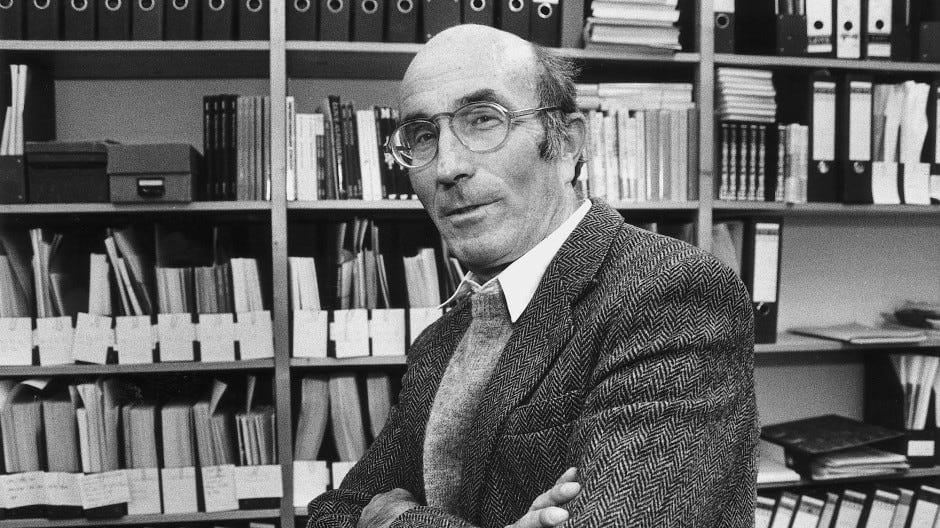
Niklas Luhmann is one of the best-known social theorists of the twentieth century, and one of the last to attempt something increasingly rare: a single, self-contained grand theory of society, built by one person over one lifetime, answerable to no school.
I have read his work for years, in fragments — an essay here, a chapter there, whatever happened to cross my path while I was reading for something else. I never sat down and studied his thought as a whole. The "Mapping Luhmann's Knowledge Ecology" project is the first time I have.
His body of work is large enough, well-documented enough, and independent enough of my own research program to serve as an outside check on the whole knowledge-ecology method — if the method could make sense of someone this prolific and this far from home, that would say something about the method, not just about Luhmann.
Center
The Core of the Activity Analysis Center
For the past several issues, I have been documenting a shift within the Activity Analysis Center — from theoretical development to practical application. AAI 2026 is the first product of that shift. The past two weeks have been focused on two things: a possible case study of World of Activity and a Revisiting-and-Rebuilding of the "AAI as Mental Tuning" Framework (2023).
Enterprise Relay: The Ten-Year Story of Xiejiang
On September 20, a close friend of mine, Yang Zhiping, published a long essay recounting his ten-year journey with Xiejiang, an Chinese-language AI-assisted writing software. I have known Yang for many years, but what caught my attention in this essay was not simply the history of a piece of software. It was the way an enterprise could persist, change form, and move through different stages of activity over a decade.
The story began in 2011, when Yang first conceived the idea of building a writing tool designed specifically for serious writers. The first version of Xiejiang was launched in 2016, followed by a second version in 2017. Development then stopped for two years because of changes in funding and the development team. In 2020, Yang rebuilt the development team and restarted the project, eventually releasing a substantially redesigned third version. What is striking here is that the enterprise did not simply proceed continuously. It was interrupted, abandoned for a period, and then taken up again by the same person from a different point in his life.
The project itself also kept changing. Xiejiang was initially imagined as a writing tool, but gradually became a more elaborate writing environment organized around cards, projects, corpora, intelligent analysis, and writing workflows. Yang described it at one point as a writing project management system rather than simply another document editor. In 2026, the enterprise entered yet another phase, with the introduction of Xiejiang's large language model (LLM) capabilities. The underlying aspiration remained recognizable, while the concrete project through which that aspiration was pursued had changed substantially.
Seen through the lens of Enterprise Relay, this is a particularly interesting case of self-relay. The relay does not primarily occur between different people. It takes place across different moments of one person's life, with each new project taking up something left by an earlier project. The 2011 idea, the 2016 and 2017 versions, the two-year interruption, the 2020 reconstruction, and the 2026 AI phase can be understood as successive project engagements through which the same broader enterprise continues to evolve. The enterprise is therefore neither identical with any single version of the software nor reducible to a fixed original plan.
This also makes Xiejiang a possible case study for the World of Activity. The enterprise provides the longer temporal continuity; projects provide the concrete sites of activity; and the changing relationship between the person, the project, and its evolving objectives makes visible how an activity can persist through transformation rather than through simple continuity. What looks like “ten years of developing a software product” can instead be viewed as a Dramatic Life Pattern of enterprise relay: an enterprise repeatedly becoming something new through successive projects, while remaining connected to what came before.
Revisiting-and-Rebuilding the “AAI as Mental Tuning" Framework (2023)
In November 2023, while working on the Mindset project, I developed the Mental Tuning meta-framework and a series of applications including the "AAI as Mental Tuning" framework.
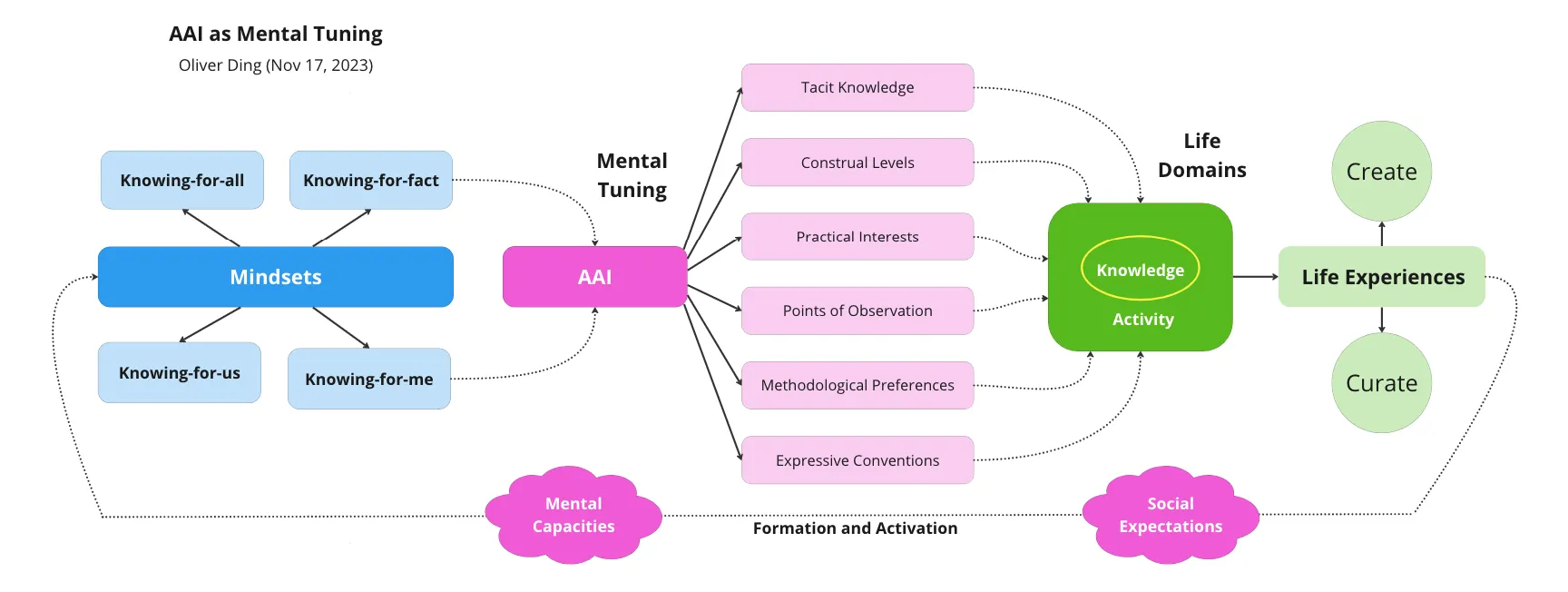
On September 18, 2026, I revisited it and considered how to rebuild it for the AAI 2026 program.
Circle
The Context of the Activity Analysis Center
Since September 2025, the Activity Analysis Center has been operating as a meta-center, using GO Theory as my theoretical platform to host several theoretical enterprises. These enterprises constitute the Center's Circle—the broader context within which the Center operates.
On this platform, five theoretical enterprises operate, each occupying a distinct position within the World of Life:
- Life as Activity (including the Project Engagement Approach) — at the center, attending to activity itself
- Anticipatory Cultural Sociology (ACS) — at the Collectives boundary, attending to cultural development
- Strategic Developmental Psychology (SDP) — at the Individuals boundary, attending to individual life development
- Cognitive Hydrology — at the Spirituality boundary, attending to the flow of ideas and meaning
- Platform Ecology — at the Science boundary, attending to ecological and structural conditions of platform development
These five enterprises are equal. Each occupies a different position within the World of Life, which means each brings a genuinely different theoretical perspective. And because they share the same spatial foundation—the same map, the same boundaries, the same operating concepts—they naturally support one another, forming a network of enterprises rather than a hierarchy.
In the past two weeks, a major achievement of the GO Theory platform was the Gejunction toolkit, released as part of The Gejunction of Knowledge Engagement.
Gejunction arrived as a unit of synthesis within GO Theory, connecting four knowledge systems. Recent developments have placed it within a larger GO Theory framework — Coordinate-Center-Gejunction — which links the individual and the social world.
Although Gejunction had already been established as closely tied to four knowledge systems, the recent RR work advanced two operational tools in particular. The first concerns Weave-points: recent work based on GO Square has developed several sub-squares, yielding a method of creative situation mapping that can be used to map weave-points closer to the individual.
The second is the creation of the Weave-the-Strategy Toolkit, which applies the principles of Thematic Space Theory to the drawing and diagramming of thematic maps, thereby improving the understanding of mental moves and strategic moves. Together with earlier progress on the other two aspects, these developments mean that all four aspects of Gejunction now have operational tools that connect to strategic analysis and intervention:
- RelationFields → the RelationField Framework, the Subject–Subject (Subject–Object) schema, and related analytical models
- Thematic Spaces → the Weave-the-Strategy Toolkit (v1.0, 2026)
- Living Coordinates → the Living Coordinate model, and the FFCC model (Flow–Focus–Center–Circle), with Center at its core
- Weave-points → the Weave Knowledge System and the GO Square series of maps
With these four toolkits, each aspect of Gejunction is no longer only a conceptual perspective. It has its own operational tools, and these tools can be used independently or in combination.
World
Me, You, and We
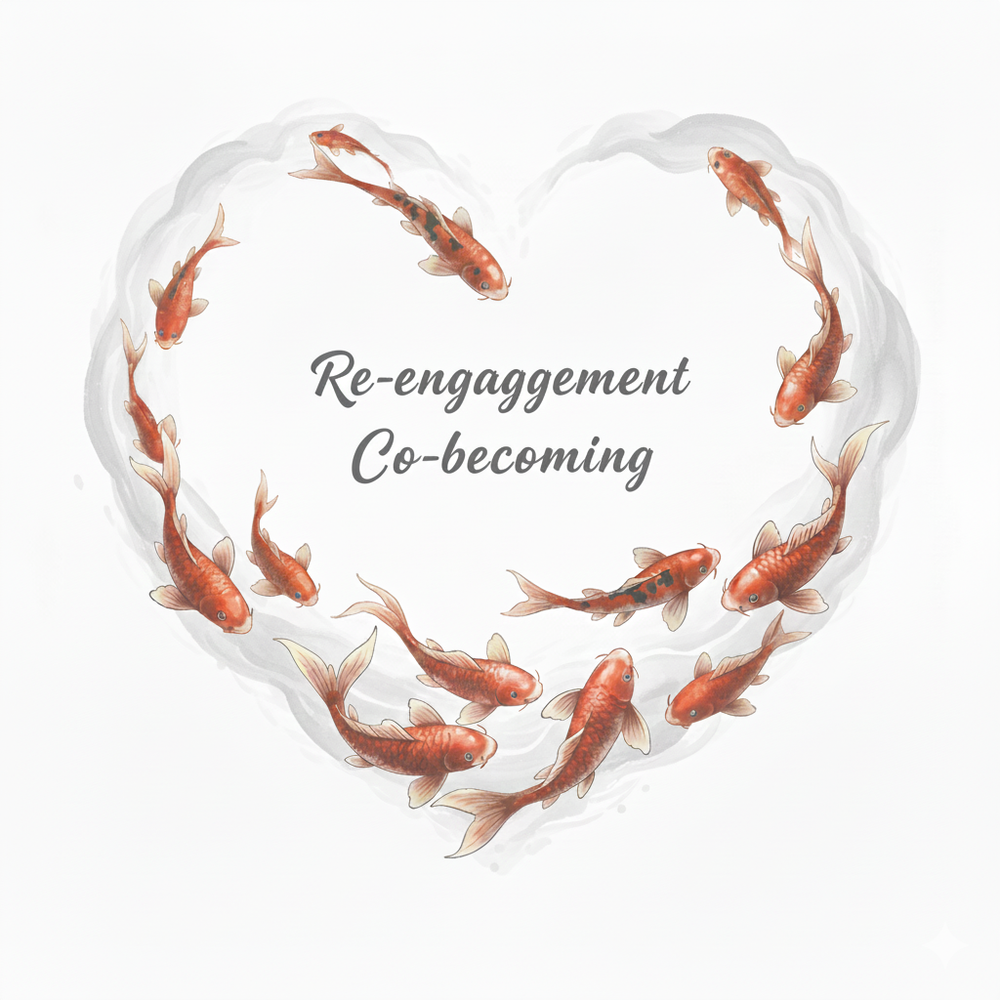
September is a month of anniversaries and sequels.
One year ago, “World of Activity” was a subtitle. This year, it is the main title. The question is still the same: how does a creative self find its place in the social world? The answer is still unfolding.
If you are working with the World of Activity approach in your own practice — as an analyst, a theorist, or simply someone trying to understand your own unfolding — I would like to hear from you.
Re-engagement and Co-becoming. I placed them there in January. The year answered.
Oliver Ding
Founder of the Activity Analysis Center
September 30, 2026
p.s. I am based in Houston, Texas, US. Where are you?
v1.0 - September 30, 2026 - 2,192 words